In The Name Of The Force…

Kenobi_3

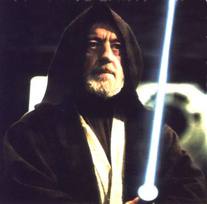
More and more, churches are turning to gimmicks to draw worshippers. Since popular culture sometimes seems to have a larger following than Christianity these days, the gods of pop culture are pressed into service to entertain Christians bored with Christ. You may have heard, for example, of a Protestant church that organized a "Harry Potter service." Harry Potter may yet make a comeback when the new book is released on July 16, but, in the meantime, behold the "Star Wars service":

"A long time ago in a church, far, far away, [an Anglican] vicar and his flock sang their final hymn to the theme tune of the Star Wars saga. Well, not that long ago, or far away, really. Last week, in fact, in West Yorkshire, a parish church held a special service to mark the release of Star Wars Episode III: Revenge of the Sith.

"It seems that in an increasingly secular Britain, vicars are turning to the Force to keep church attendance figures high, and to attract that crucial youth market.

"Reverend Paul Walker explained that the service was inspired by the children of the Parish, who explored the ideas in the film in their catechism class, The BBC reports.

"Walker said that the service covered the ideas of good and evil, resisting the temptation of the ‘dark side’, and what it means to have the force of God in your life. ‘We wanted a special service to bring these themes together and celebrate the victory of good over evil,’ he added."

GET THE STORY.

Please note the Reverend Walker’s comment, "We wanted a special service to bring these themes together and celebrate the victory of good over evil." Uh huh. Because the passion, death, and resurrection of Christ fails so miserably at accomplishing that, you know. After all, when a feature-length film was made in the United States last year that depicted the last twelve hours of Christ’s life, did anyone bother to go see it?

Dangerous Species

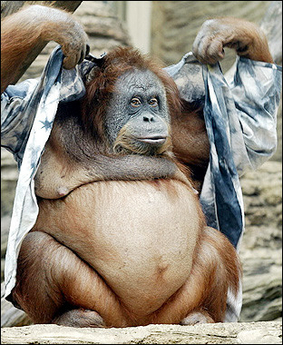
DeephotojpgYesterday I had a close encounter with an animal of the same kind you see here. Though briefly shaken, I was unconcerned until I read in AARP Magazine’s July/August issue (sorry, story not available online) that deer account for more human deaths in the U.S. than any other animal.  Dogs? Shark attack? Not even close.

Here is the breakdown, with the number of human deaths per year:

  • Deer       –    150
  • Dogs       –    18
  • Snakes    –    15
  • Sharks    –     2
  • Bears     –    .5

Now, I am sympathetic with those who would put deer into a different category because, after all, they don’t really "kill" people (or do they?…). I am even reluctant to call them a nuisance when we are the ones driving into them at half-a-hundred miles per hour. I would sure rather die in a collision with a deer than be mauled to death by zombie dogs.

Still, I didn’t know there were so many human deaths associated with deer wrecks. As Michelle has said, be careful out there.

Happy Tunguska Event Day!

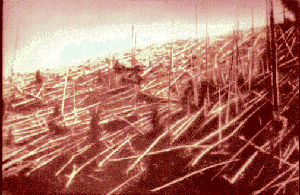
Tunguska01Today, June 30, in the year 1908 was the day something really mysterious happened over the Tunguska region of Siberia. It also flattened a lot of trees in the area.

Folks in the region saw a fireball streaking across the sky, following which there was a huge explosion and half the sky lit up. Then there was a shockwave that knocked them off their feet and broke window panes 400 miles away from the explosion.

The sky didn’t get dark that night in Europe. There were "skyglows" for several nights, and on the first people said it was so bright that you could read newspapers without artificial light.

Nobody knows what caused this–not for sure, anyway. When folks finally got around to investigating the site (20 years later!), they didn’t find any obvious impact crater, suggesting an airburst event fairly high up in the atmosphere.

Leading theories are that it was a meteorite that exploded in the air–or a comet fragment.

More exotic (and less likely) theories include a chunk of antimatter or a small black hole or an alien spaceship.

LEARN MORE.

(Also, SPACE.COM HAS A STORY ABOUT SOME FOLKS STILL ADVOCATING THE SPACESHIP THEORY AND CLAIMING WRECKAGE WAS RECOVERED.)

ALSO TODAY IN HISTORY:

On Jordan's Filthy Banks

Your travel tip for the day: If you go the Holy Land, scratch "Swimming in the Jordan" off of your To-Do List:

"The Jordan River, where Christians believe Jesus was baptized, is heavily polluted with sewage and is in danger of drying up after decades of conflict and intense agricultural use, environmentalists said on Friday.

[…]

"’The Jordan River will disappear if nothing is done soon. More than half of it is raw sewage and runoff water from agriculture. What keeps the river flowing today is sewage,’ Munqeth Mehyar, chairman of Friends of the Earth Middle East (FOEME), an Israeli-Jordanian-Palestinian group, told Reuters."

GET THE STORY.

Glad I didn’t know any of this when I went to the Holy Land on pilgrimage in the Jubilee Year 2000. It would have sucked some of the magic out of being sprinkled with Jordan River water while we renewed our baptismal promises.

On Jordan’s Filthy Banks

Your travel tip for the day: If you go the Holy Land, scratch "Swimming in the Jordan" off of your To-Do List:

"The Jordan River, where Christians believe Jesus was baptized, is heavily polluted with sewage and is in danger of drying up after decades of conflict and intense agricultural use, environmentalists said on Friday.

[…]

"’The Jordan River will disappear if nothing is done soon. More than half of it is raw sewage and runoff water from agriculture. What keeps the river flowing today is sewage,’ Munqeth Mehyar, chairman of Friends of the Earth Middle East (FOEME), an Israeli-Jordanian-Palestinian group, told Reuters."

GET THE STORY.

Glad I didn’t know any of this when I went to the Holy Land on pilgrimage in the Jubilee Year 2000. It would have sucked some of the magic out of being sprinkled with Jordan River water while we renewed our baptismal promises.

Compendium Info

Lotsa good stuff in the news about the Compendium of the Catechism of the Catholic Church (CCCC or 4C).

HERE’S A BASIC ARTICLE ABOUT IT BEING RELEASED.

Highlights of this piece include the facts that the Compendium is 200 pages long and has 598 questions in it (so, I guess about three or so questions per page on average, which would suggest really small pages given what we’ll see below).

The Compendium is divided in the same four parts of the Catechism.

Part I, "The Profession of Faith," includes 217 questions; Part II, "The Celebration of the Christian Mystery" covers questions 218 to 356; Part II, "Life in Christ," questions 357 to 533; and Part IV, "Christian Prayer," questions 534 to 598.

The book ends with a double appendix on "Common Prayers" (from the sign of the cross, the Gloria and the Our Father, to the Prayer for the Dead and the act of contrition) and "Catholic Doctrine Formulas" (such as the seven gifts of the Holy Spirit, corporal and spiritual works of mercy, the Beatitudes, etc.).

It’s also (unfortunately) out only in Italian at the moment, so we’ll have to wait to get an English version. (I’m currently being tempted to order the Italian version and start studying Italian. . . . Subito, y’know?)

Now: HERE’S THE MOTU PROPRIO (A KIND OF PAPAL DOCUMENT) IN WHICH B16 AUTHORIZES THE WORK.

The money passage of this is the following:

The Compendium, which I now present to the Universal Church, is a
faithful and sure synthesis of the Catechism of the Catholic Church.

This conveys the level of authority for the Compendium. It is describe as "a faithful and sure synthesis of the Catechism of the Catholic Church," which makes its authority corelative to that of the Catechism. The Catechism, as we’ve quoted Ratzinger here before to demonstrate, synthesized Catholic teaching without changing the authority level of any of the teachings. Since the Compendium doesn’t do anything but synthesize the Catechism accurately, it therefore also doesn’t affect the doctrinal authority of any of the teachigns it contains.

B16 also goes on to make a rather interesting claim:

It
contains, in concise form, all the essential and fundamental elements
of the Church’s faith, thus constituting, as my Predecessor had wished,
a kind of vademecum which allows believers and non-believers alike to
behold the entire panorama of the Catholic faith.

It is important to note here that this does not claim that everything in the Compendium is an essential or fundamental element of the Church’s faith. It would be a basic logical fallacy to take that from what the pope said. ("This contains all X" is not equivalent to "All this contains is X.") Undoubtedly there will be items in the Compendium of different levels of authority, and some may not fit the bill of being "essential and fundamental."

I’m a little surprised, though, that he would claim that the Catechism contains all the essential and fundamental elements. I haven’t read the text, of course, but my native instinct would be to shy away from claims of that nature on the off chance that someone could mount a case that we left out something that is essential or fundamental. Nevertheless, he’s probably on safe ground here because (a) it probably does contain all such truths and (b) because "essential" and "fundamental" are sufficiently ambiguous words that one could defend the claim in any event.

One other tidbit: You may remember that when the Catechism was released there were all kinds of theological dissidents in the catechetical establishment (and elsewhere) who tried to assure us that the Catechism was "just for the bishops and experts" and that we layfolk need not trouble ourselves with reading it as it would be too much for us and that the Vatican never intended for us to read it. This was part of a strategy to minimize the impact of the Catechism and allow faulty catechetical texts to stay in place.

The reception that the Catechism got–at least in many places (the U.S. among them) totally steamrollered this stratagem.

Well, there’ll be none of that this time. Not only does the format of the work itself cry out that it is meant for the common layperson, the pope himself in his motu proprio says:

I entrust this Compendium above all to the entire Church and, in
particular, to every Christian, in order that it may awaken in the
Church of the third millennium renewed zeal for evangelization and
education in the faith, which ought to characterize every community in
the Church and every Christian believer, regardless of age or
nationality.

But this Compendium, with its brevity, clarity and
comprehensiveness, is directed to every human being, who, in a world of
distractions and multifarious messages, desires to know the Way of
Life, the Truth, entrusted by God to His Son’s Church.

Erring Pastor Addendum

Thought I’d mention another aspect of the case of the New York pastor who reportedly is denying the rights of children to be catechized and then receive the Eucharist because their parents aren’t attending Mass or (presumably) taking the kids ot Mass.

As we noted, what he’s doing is unlawful under Church law.

But in pointing this out, I didn’t dwell on one aspect of what he’s doing: Using bar-coded donation envelopes to track their attendance. Apparently, each family gets a batch of donation envelopes with a bar-code unique to them and are then expected to drop one in the plate each week.

Something that may immediately occur to you as problematic about this is that the pastor may be extorting donations out of the kids’ parents in exchange for allowing them access to catechesis and then the sacraments.

If he were doing this, he would be guilty of simony and subject to ecclesiastical penalties.

But that’s not what he’s doing.

THE ARTICLE MAKES CLEAR that he’s not charging anything. People are free to simply drop an empty envelope in the plate. (This has, presumably, been communicated to the parents in question. Otherwise, we’re back to a species of simony.)

Nevertheless, there’s a problem: There is NO REQUIREMENT WHATSOEVER that the faithful fulfill their Sunday obligation at the parish at which their kids are receiving catechesis. Canon law provides that:

Can.  1248 §1. A person who assists at a Mass celebrated anywhere in a Catholic rite either on the feast day itself or in the evening of the preceding day satisfies the obligation of participating in the Mass.

Parents are perfectly at liberty to go to a different parish, even a parish of a different rite, or even a Mass celebrated somewhere other than a parish (e.g., in a monastery) to fulfill their Sunday obligation.

If they exercise that prerogative, they won’t be at the erring pastor’s parish to drop their bar-coded envelope in the plate.

The pastor is thus not only obstructing the rights of the children to catechesis and the sacraments he is further violating the law by imposing on the families the burden to attend Mass at one particular parish (his) in order for their children’s rights to catechesis and the sacraments to be honored.

Any way you slice it, this guy’s in the wrong.

If Rome hears about this, they will not be pleased.

New York Pastor Violates Children's Rights, Causes Scandal

CHT to the reader who sent a link to a story which says:

The pastor of a Staten Island Catholic church is playing holy hardball – kicking hundreds of kids out of religious ed classes because their families aren’t showing up at Mass.

The Rev. Michael Cichon, pastor of St. Joseph/St. Thomas in Pleasant Plains, used each family’s bar-coded donation envelope to track attendance.

He’s tossed about 300 kids from classes and told them not to reapply until next April.

Without the classes, children cannot receive the sacraments, meaning some youngsters who thought they’d be making their First Communion next year will have to wait.

The suspensions, legalFLAGRANTLY ILLEGAL under church doctrinelaw, were a shock to many parents with kids enrolled in the 1,400-child program, which caters to kids who don’t attend Catholic schools.

GET THE (HORRIFYING) STORY.

Assuming this story is correct, the pastor of the parish in question is violating the fundamental ecclesiastical rights of the children, as well as causing public scandal by misrepresenting the position of the Church on this matter.

While it is true that folks are gravely obliged to go to Mass unless a justifying cause exists, what this pastor is doing is totally contrary to the Church’s law.

Witness . . .

Can. 213 The Christian faithful have the right to receive assistance from the sacred pastors out of the spiritual goods of the Church, especially the word of God and the sacraments.

Okay, now right there that makes this a matter of an ecclesiastical right. The kiddos have to receive from the sacred pastors (most particularly their pastor) goods from among the spiritual goods of the Church, "especially . . . the sacraments."

A pastor is not at liberty to deny or impede anyone’s access to the sacraments except in keeping with the law.

Want proof?

Can.  843 §1. Sacred ministers cannot deny the sacraments to those who seek them at appropriate times, are properly disposed, and are not prohibited by law from receiving them.

So unless the pastor has something in the law that would bar the child from the sacraments, he can’t deny them access.

This applies most especially to the Eucharist, for the Code devotes an additional canon to hammering home point that:

Can.  912 Any baptized person not prohibited by law can and must be admitted to holy Communion.

Is there anything in the law that would allow him to deny the kids the Eucharist? Well, there’s this:

Can.  913 §1. The administration of the Most Holy Eucharist to children

requires that they have sufficient knowledge and careful preparation so

that they understand the mystery of Christ according to their capacity

and are able to receive the body of Christ with faith and devotion.

If the kids don’t have sufficient knowledge and careful preparation then they can’t receive the Eucharist. What the offending priest is doing is trying to keep them from gaining sufficient knowledge and careful preparation by barring them from the catechetical courses they were attending in order to acquire these things.

What law is the priest offending against by barring the children from attending these courses? This one:

Can. 843 §2. Pastors of souls and other members of the Christian faithful, according to their respective ecclesiastical function, have the duty to take care that those who seek the sacraments are prepared to receive them by proper evangelization and catechetical instruction, attentive to the norms issued by competent authority.

He thus has the "duty to take care that those who seek the sacraments"–that’s the kids, folks–"are prepared to receive them by proper evangelization and catechetical instruction." The kids are willing to take the instruction. It’s the pastor who’s refusing to offer it. He is thus in violation of his duty under canon 843.

There’s also a rights issue here as well, because:

Can. 217 Since they are called by baptism to lead a life in keeping with the teaching of the gospel, the Christian faithful have the right to a Christian education by which they are to be instructed properly to strive for the maturity of the human person and at the same time to know and live the mystery of salvation.

The pastor is thus not only falling down on his duty to educate the kids under 843. He’s also violating the kids’ right to an education in how to live the mystery of salvation (e.g., by receiving the sacraments) under 217.

But wait! He’s only booted them out for this year. Can it be argued that he’s just delaying their education rather than prohibiting it to them? There are several responses to this:

  1. The course of action he has undertaken may well lead to the kids never receiving the education that is their right because the pastor may so offend their parents that they stop taking their kids to church at all and cease practicing the faith.
  2. There is still nothing in the law (more on this below) that allows a pastor to punish children by denying them their right to sacramental catechesis because their parents don’t go to Mass or don’t take them to Mass. Consequently, what if the parents dug in their heels and said: "I’m still not going to Mass next year either. You either let my kid back into this class or you don’t." The parents could continue that pattern of behavior indefinitely, and either the pastor concedes at some point that he doesn’t have the authority to punish the children in this way or he continues his refusal to catechize them indefinitely, in which case their sacramental education is not just delayed but is ultimately denied.
  3. The Church has established a timeframe for when this sacramental education is supposed to happen. To wit:

Can.  914 It is primarily the duty of parents and those who take the place of parents, as well as the duty of pastors, to take care that children who have reached the use of reason are prepared properly and, after they have made sacramental confession, are refreshed with this divine food as soon as possible. It is for the pastor to exercise vigilance so that children who have not attained the use of reason or whom he judges are not sufficiently disposed do not approach holy Communion.

It is thus the duty of the pastor to see that, once the children reach the age of reason that they make their first holy Communion "as soon as possible." He’s falling down on that duty because, as we have seen he is delaying the children’s sacramental education by at least a year (possibly indefinitely) by imposing a requirement not found in the law that their parents attend Mass. Such a delay is inconsistent with the duty to make sure they receive Communion "as soon as possible."

You can’t punish the children for what their parents don’t do. This is contrary to the first principles of justice. Neither can you punish the children even if the parents fail to take them to Mass. Why? Because Church law expressly envisions cases in which it is not possible for someone to attend Mass:

Can 1248 §2. If participation in the eucharistic celebration

becomes impossible because of the absence of a sacred minister or for another

grave cause, it is strongly recommended that the faithful take part in a

liturgy of the word if such a liturgy is celebrated in a parish church or other

sacred place according to the prescripts of the diocesan bishop or that they

devote themselves to prayer for a suitable time alone, as a family, or, as the

occasion permits, in groups of families.

Now, hi-ho Sunshine! "I’m seven years old and there isn’t a parish on my corner and I can’t drive a car and my parents won’t take me" is a grave cause for missing Mass! For that matter, "I’m seven and my parents insist that I stay with them and they won’t go to Mass" is a grave cause!

The Church in that case recommends various alternatives to the child (the most practical one–in the absence of the ability to drive a car–is spending some personal time praying on Sunday), but these are recommendations rather than mandates, and in no case does it say that you can deny a kid’s right to sacramental catechesis and subsequent admission to the Eucharist on these grounds.

How do we know that the kid can’t be disqualified on these grounds?

Can. 10 Only

those laws must be considered invalidating or disqualifying which expressly

establish that an act is null or that a person is affected.

Since the law doesn’t say that the kids are disqualified, they ain’t.

Is there any doubt about this? NO!

Can. 18 Laws which

establish a penalty, restrict the free exercise of rights, or contain an

exception from the law are subject to strict interpretation.

Since the children have a right to sacramental education and

subsequently to the reception of the  Eucharist, any restriction the

pastor wishes to place on the exercise of those rights must be subject

to strict interpretation.

As the green CLSA commentary notes: "Strict interpretation limits the law’s application to the minimum stated in the law" (p. 75). Since it is not stated in the law that the pastor can delay or deny children’s rights on the basis that their parents don’t go to Mass or won’t take their children to Mass, he cannot deny their rights on these grounds.

What the pastor is doing–however well motivated he may be in trying to encourage parents to take their kids (and themselves) to Mass–is not permitted under Church law. It is a violation of the childrens’ fundamental rights to receive the sacramental education needed to receive the Eucharist in a timely manner.

Incidentally, the green CLSA commentary happens to note regarding canon 18:

[A]ll the faithful have a right to receive Holy Communion (cc. 213, 912). To restrict this right, there must be a clear basis in the law, or the right is unlawfully denied. Thus, pastors are not free to extend to parents the requirements of preparation of children for the sacrament (c. 913, §1), and unlawfully deny the sacrament to children whose parents do not participate (p. 76).

What the pastor in New York is doing is worse than the case just envisioned. He is not merely telling the parents "Y’all go catechize these kids; I’m not gonna do it." So far as can be determined from the article, he’s letting neither the parents catechize their kids nor is he allowing them to receive catechesis at the parish.

If the article is right (and one must always leave the possibility that the press has, once again, got it wrong) then what he’s doing to these children is simply unlawful.

Yes, their parents should take them to Mass, but no, you can’t punish them by interfering with their rights to catechesis and the Eucharist if they don’t.

New York Pastor Violates Children’s Rights, Causes Scandal

CHT to the reader who sent a link to a story which says:

The pastor of a Staten Island Catholic church is playing holy hardball – kicking hundreds of kids out of religious ed classes because their families aren’t showing up at Mass.

The Rev. Michael Cichon, pastor of St. Joseph/St. Thomas in Pleasant Plains, used each family’s bar-coded donation envelope to track attendance.

He’s tossed about 300 kids from classes and told them not to reapply until next April.

Without the classes, children cannot receive the sacraments, meaning some youngsters who thought they’d be making their First Communion next year will have to wait.

The suspensions, legalFLAGRANTLY ILLEGAL under church doctrinelaw, were a shock to many parents with kids enrolled in the 1,400-child program, which caters to kids who don’t attend Catholic schools.

GET THE (HORRIFYING) STORY.

Assuming this story is correct, the pastor of the parish in question is violating the fundamental ecclesiastical rights of the children, as well as causing public scandal by misrepresenting the position of the Church on this matter.

While it is true that folks are gravely obliged to go to Mass unless a justifying cause exists, what this pastor is doing is totally contrary to the Church’s law.

Witness . . .

Can. 213 The Christian faithful have the right to receive assistance from the sacred pastors out of the spiritual goods of the Church, especially the word of God and the sacraments.

Okay, now right there that makes this a matter of an ecclesiastical right. The kiddos have to receive from the sacred pastors (most particularly their pastor) goods from among the spiritual goods of the Church, "especially . . . the sacraments."

A pastor is not at liberty to deny or impede anyone’s access to the sacraments except in keeping with the law.

Want proof?

Can.  843 §1. Sacred ministers cannot deny the sacraments to those who seek them at appropriate times, are properly disposed, and are not prohibited by law from receiving them.

So unless the pastor has something in the law that would bar the child from the sacraments, he can’t deny them access.

This applies most especially to the Eucharist, for the Code devotes an additional canon to hammering home point that:

Can.  912 Any baptized person not prohibited by law can and must be admitted to holy Communion.

Is there anything in the law that would allow him to deny the kids the Eucharist? Well, there’s this:

Can.  913 §1. The administration of the Most Holy Eucharist to children
requires that they have sufficient knowledge and careful preparation so
that they understand the mystery of Christ according to their capacity
and are able to receive the body of Christ with faith and devotion.

If the kids don’t have sufficient knowledge and careful preparation then they can’t receive the Eucharist. What the offending priest is doing is trying to keep them from gaining sufficient knowledge and careful preparation by barring them from the catechetical courses they were attending in order to acquire these things.

What law is the priest offending against by barring the children from attending these courses? This one:

Can. 843 §2. Pastors of souls and other members of the Christian faithful, according to their respective ecclesiastical function, have the duty to take care that those who seek the sacraments are prepared to receive them by proper evangelization and catechetical instruction, attentive to the norms issued by competent authority.

He thus has the "duty to take care that those who seek the sacraments"–that’s the kids, folks–"are prepared to receive them by proper evangelization and catechetical instruction." The kids are willing to take the instruction. It’s the pastor who’s refusing to offer it. He is thus in violation of his duty under canon 843.

There’s also a rights issue here as well, because:

Can. 217 Since they are called by baptism to lead a life in keeping with the teaching of the gospel, the Christian faithful have the right to a Christian education by which they are to be instructed properly to strive for the maturity of the human person and at the same time to know and live the mystery of salvation.

The pastor is thus not only falling down on his duty to educate the kids under 843. He’s also violating the kids’ right to an education in how to live the mystery of salvation (e.g., by receiving the sacraments) under 217.

But wait! He’s only booted them out for this year. Can it be argued that he’s just delaying their education rather than prohibiting it to them? There are several responses to this:

  1. The course of action he has undertaken may well lead to the kids never receiving the education that is their right because the pastor may so offend their parents that they stop taking their kids to church at all and cease practicing the faith.
  2. There is still nothing in the law (more on this below) that allows a pastor to punish children by denying them their right to sacramental catechesis because their parents don’t go to Mass or don’t take them to Mass. Consequently, what if the parents dug in their heels and said: "I’m still not going to Mass next year either. You either let my kid back into this class or you don’t." The parents could continue that pattern of behavior indefinitely, and either the pastor concedes at some point that he doesn’t have the authority to punish the children in this way or he continues his refusal to catechize them indefinitely, in which case their sacramental education is not just delayed but is ultimately denied.
  3. The Church has established a timeframe for when this sacramental education is supposed to happen. To wit:

Can.  914 It is primarily the duty of parents and those who take the place of parents, as well as the duty of pastors, to take care that children who have reached the use of reason are prepared properly and, after they have made sacramental confession, are refreshed with this divine food as soon as possible. It is for the pastor to exercise vigilance so that children who have not attained the use of reason or whom he judges are not sufficiently disposed do not approach holy Communion.

It is thus the duty of the pastor to see that, once the children reach the age of reason that they make their first holy Communion "as soon as possible." He’s falling down on that duty because, as we have seen he is delaying the children’s sacramental education by at least a year (possibly indefinitely) by imposing a requirement not found in the law that their parents attend Mass. Such a delay is inconsistent with the duty to make sure they receive Communion "as soon as possible."

You can’t punish the children for what their parents don’t do. This is contrary to the first principles of justice. Neither can you punish the children even if the parents fail to take them to Mass. Why? Because Church law expressly envisions cases in which it is not possible for someone to attend Mass:

Can 1248 §2. If participation in the eucharistic celebration
becomes impossible because of
the absence of a sacred minister or for another
grave cause
, it is strongly recommended that the faithful take part in a
liturgy of the word if such a liturgy is celebrated in a parish church or other
sacred place according to the prescripts of the diocesan bishop or that they
devote themselves to prayer for a suitable time alone, as a family, or, as the
occasion permits, in groups of families.

Now, hi-ho Sunshine! "I’m seven years old and there isn’t a parish on my corner and I can’t drive a car and my parents won’t take me" is a grave cause for missing Mass! For that matter, "I’m seven and my parents insist that I stay with them and they won’t go to Mass" is a grave cause!

The Church in that case recommends various alternatives to the child (the most practical one–in the absence of the ability to drive a car–is spending some personal time praying on Sunday), but these are recommendations rather than mandates, and in no case does it say that you can deny a kid’s right to sacramental catechesis and subsequent admission to the Eucharist on these grounds.

How do we know that the kid can’t be disqualified on these grounds?

Can. 10 Only
those laws must be considered
invalidating or disqualifying which expressly
establish that
an act is null or that a person is affected.

Since the law doesn’t say that the kids are disqualified, they ain’t.

Is there any doubt about this? NO!

Can. 18 Laws which
establish a penalty, restrict the free exercise of rights, or contain an
exception from the law are subject to strict interpretation.

Since the children have a right to sacramental education and
subsequently to the reception of the  Eucharist, any restriction the
pastor wishes to place on the exercise of those rights must be subject
to strict interpretation.

As the green CLSA commentary notes: "Strict interpretation limits the law’s application to the minimum stated in the law" (p. 75). Since it is not stated in the law that the pastor can delay or deny children’s rights on the basis that their parents don’t go to Mass or won’t take their children to Mass, he cannot deny their rights on these grounds.

What the pastor is doing–however well motivated he may be in trying to encourage parents to take their kids (and themselves) to Mass–is not permitted under Church law. It is a violation of the childrens’ fundamental rights to receive the sacramental education needed to receive the Eucharist in a timely manner.

Incidentally, the green CLSA commentary happens to note regarding canon 18:

[A]ll the faithful have a right to receive Holy Communion (cc. 213, 912). To restrict this right, there must be a clear basis in the law, or the right is unlawfully denied. Thus, pastors are not free to extend to parents the requirements of preparation of children for the sacrament (c. 913, §1), and unlawfully deny the sacrament to children whose parents do not participate (p. 76).

What the pastor in New York is doing is worse than the case just envisioned. He is not merely telling the parents "Y’all go catechize these kids; I’m not gonna do it." So far as can be determined from the article, he’s letting neither the parents catechize their kids nor is he allowing them to receive catechesis at the parish.

If the article is right (and one must always leave the possibility that the press has, once again, got it wrong) then what he’s doing to these children is simply unlawful.

Yes, their parents should take them to Mass, but no, you can’t punish them by interfering with their rights to catechesis and the Eucharist if they don’t.