Guess Who Is Back?

Ivorywp

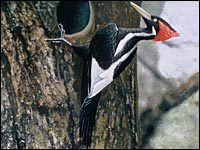
… The ivory-billed woodpecker, long thought extinct:

"A group of wildlife scientists believe the ivory-billed woodpecker is not extinct. They say they have made seven firm sightings of the bird in central Arkansas. The landmark find caps a search that began more than 60 years ago, after biologists said North America’s largest woodpecker had become extinct in the United States.

"The large, showy bird is an American legend — it disappeared when the big bottomland forests of North America were logged, and relentless searches have produced only false alarms. Now, in an intensive year-long search in the Cache River and White River national wildlife refuges involving more than 50 experts and field biologists working together as part of the Big Woods Partnership, an ivory-billed male has been captured on video."

GET THE STORY.

For more information on the ivory-bill woodpecker, see this link.

(Nod to a friend who told me of the story. His link to an article on the story had an Evil registration requirement, so I did some poking around to find a non-registration link.)

Not to be a crab about an otherwise interesting wildlife story, but now that this woodpecker has made a comeback, we can expect it to be placed on an endangered species list and have it’s habitat declared off-limits to human beings. Thanks, Woody!

Mystery Toast

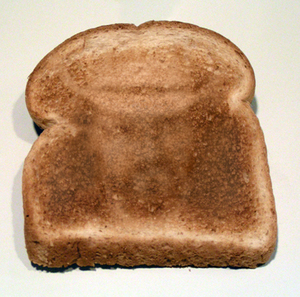
Jtoast_1If you look closely you will see that this very toast bears the image of a well-known (and, ironically, anti-carbohydrate) Catholic apologist familiar to us all.

In a bizarre coincidence, it popped up out of the toaster just as the announcer on Iron Chef shouted "allez cuisine!" (translated – "Everyone into the kitchen!"). Clearly I was meant to come "into the kitchen" and discover this mysterious image.

You won’t see this on E-bay, though. In my excitement I became confused and the mystery toast was accidentally slathered with butter and honey and consumed.

Unbelieveably, when examined closely the second piece of toast bore the images of Tom and John Knoll, inventors of Adobe Photoshop.
Find out more about the history of Photoshop HERE.

JIMMY ADDS: In this case, I wouldn’t be anti-carbohydrate. Any toast of this nature should be consumed immediately for the sake of all mankind. Who knows what the Easter Bunny could do with it!

Calling All Podcast Listeners! (And Would-Be Listeners!)

iTunes 4.9 . . . IS OUT!!!

That means one thing: Built-in podcast support!!!

Now you can listen to podcasts on your iPod without having to use a piece of third-party software!

YEE-HAW!!!

Even if you don’t have an iPod, my understanding is that you can still download iTunes (for free) and use it to listen to podcasts and other audio content right on your computer, so don’t let not having an iPod stop you from joining the fun!

I’ve already downloaded 4.9 and installed it. Poked around the podcast area of the iTunes Music Store, too.

They have at least a couple of Catholic podcasts already in the store (Catholic Cast and Catholic Insider–in fact, they have two podcasts called "Catholic Insider" by different folks).

The selection is still somewhat limited, but they’re just starting out.

One limitation: So far all the podcasts they have in the store are free. You may think that’s a good thing, but it will keep some podcasts that folks (like me) would want to get from being in the store. Hope that they change that policy soon and let in podcasts where you pay an access charge (some radio programs do that).

In the meantime

DOWNLOAD iTUNES 4.9!!!

(NOTE: Just opening your current iTunes–if you already have it–should also prompt you to download the new version.)

The Freakonomics Of Advertising

Time prevents me from being able to do a more detailed post on Freakonomics today, so lemme give you a brief one.

One of the things that you can do with economic analyses is figure out which terms in advertisements result in better sales. F’rinstance: Here are five words commonly used in advertising homes for sale that correlate with higher priced sales of the homes:

  • Granite
  • State-of-the-Art
  • Corian
  • Maple
  • Gourmet

How all those get worked into ad for houses, I’m not sure. (I don’t know anybody who has a "gourmet house," though I suppose people might advertise that the home comes with "gourmet kitchen equipment" of some kind.)

You can similar track what advertising elements are correlated with lower sale prices on houses–i.e., things you don’t want in your ad. Here are five such terms:

  • Fantastic
  • Spacious
  • ! (an exclamation point)
  • Charming
  • Great Neighborhood

Why do these correlate negatively? And what do the positive terms have in common? For those answers you can

READ THIS EXCERPT FROM THE BOOK.

Freakonomics also contains info on what elements are most (and least) successful in personal ads on Internet dating sites, though if you want to know what they have to say about that subject then you’ll need to

GET THE BOOK.

Tuesday Photo Caption

Well. The image that I chose for today’s caption contest was far more provocative of comments than I certainly expected it to be.

Perhaps if I had directly attacked the image of Bill Clinton superimposed over an image of the Sacred Heart of Jesus (e.g., "How outrageous!"), rather than satirize the image as I did (e.g., "St. Billary of Hope"), my intent would have been better understood. My intent, to make it clear, was not to hold up the image for approval but to inspire more humorous satire.

I don’t think the posting of the image for purposes of taking jabs at it was blasphemous or sacrilegious, or I certainly would not have posted such an image on Jimmy’s blog. It was edgy, yes. It was an example of the religious overtones of American politics, yes. One could even say that such parody skirts poor taste. But poor taste is not the same thing as blasphemy or sacrilege, which are grave matter.

In any event, the image did offend the sensibilities of the readers here at JimmyAkin.org, something that I did not intend and for which I apologize.

Mea culpa.

Mystery Meat

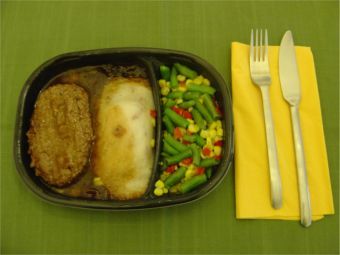
StoufferNot long ago I was warming up one of those fancy health-conscious TV dinners when I got a little curious about the entreé, Salisbury Steak. I decided to Google the term and was shocked to find that my meal would never have passed muster with James H. Salisbury at all, at all.

Salisbury turns out to have been an early (though somewhat misguided) forerunner of modern low-carb enthusiasts. He rightly believed that people ate way too many "starchy" foods, but he also wrongly believed that vegetables of almost any kind were bad for you. He invented the Salisbury Steak as a health food which, eaten along with copious amounts of hot water three times a day, was supposed to keep the digestive tract free of toxins and other bad stuff. There were all kinds of crazy things like that going on at the turn of the 19th/20th centuries.

The original Salisbury Steak would have been made of pure, lean beef (and very little else) grilled. The Salisbury Steak and the Hamburger Steak were virtually indistinguishable at one point, but the Salisbury gradually became adulterated with the addition of gravy, mushrooms, egg, onion, bread crumbs, etc…
Salisbury would certainly never have approved of his invention being served with a side of mashed potatoes and mixed vegetables.

The next time you fix yourself a plain hamburger patty, maybe with some Worcestershire sauce (as Salisbury recommended) think of the inventor and be thankful that you can wash it down with something tasty, rather than several glasses of hot water.

FIND OUT MORE ABOUT J.H. SALISBURY’S STEAK HERE.

The Freakonomics Of Abortion

The most controversial claim of the book Freakonomics is that abortion appears to be a key factor in lowering the crime rate in recent years.

A decade ago, you may remember, the press was filled with stories about how the youth of America were disintegrating and that soon we would be awash in an unstoppable crimewave perpetrated by "superpredators" who were totally sociopathic.

The experts were sure this was going to happen.

But it didn’t.

Why?

Various explanations were tried: Better law-enforcement techniques, more police officers, a justice system that finally "got tough" with offenders, stricter gun control laws, an aging of the population.

As the authors of Freakonomics explain, some of these (e.g., the justice system getting tough, more police officers) really do have an impact on crime. Others (e.g., restrictive gun control laws) don’t. But even the ones that had an effect weren’t enough to explain the dramatic drop in crime that occurred.

Author Steven Levitt, and his then-co-author John J. Donohue, proposed a different explanation: Abortion was responsible.

The argument runs something like this: If women of every socioeconomic group were equally likely to have an abortion then we wouldn’t expect to see abortion decreasing the crime rate. But that’s not the way thing are. In point of fact, women from certain socioeconomic groups are more likely than others to have abortions, and the groups more likely to do so (e.g., among the poor) are the very groups that tend to give rise to the most criminals. As a result, babies likely to grow up to be criminals were disproportionately aborted and so the overall crime rate went down.

In other words, Evil eugenicists like Margaret Sanger and her cohorts were right: By legalizing abortion it would alleviate certain social problems (crime, at least) by wiping out the people involved. These were, in the words of some, "pre-emptive executions"–applications of capital punishment to those who would have committed crimes in the future (as well as an awful lot who wouldn’t have).

When Donohue and Levitt published their paper, it caused a Big Argument.

When Levitt and new co-author, Stephen J. Dubner, released Freakonomics and rehashed the issue in a more popular format, it again caused a Big Argument.

Many pro-lifers, understandably, did not want to credit abortion with solving or helping to solve any social problems.

My own attitude toward the issue is somewhat reserved. I’m not prepared to concede that their Levitt and Donohue’s work is correct unless I go through it in detail, which I haven’t.

THOUGH THE ORIGINAL PAPER IS ONLINE HERE. (WARNING! Evil file format! [.pdf])

I’m not going to dismiss the claim, either, though. After all <philosophical thought experiment>if the abortion rate were raised to 100% then the crime rate would automatically fall to 0% in one generation</philosophical thought experiment>. There wouldn’t be anybody left to commit crimes!

If it happens to be the case that allowing abortion on demand (for a price) in contemporary American society has a negative impact on the crime rate, that’s an empirical matter, not a moral one.

It does, however, raise a legal question–and a semantic one. The "crime" that we’re talking about is the kind tracked by law-enforcement officials. There are two kinds of crime, though, that are not tracked by law-enforcement.

First, there are crimes that are never discovered and recorded, such as when you stole that pen from work a while back. It may have been illegal for you to do that, but it’s not worth anybody’s time to both hunting down and prosecuting such offenders.

Second, there are crimes that are not illegal. These are crimes against the higher law to which human law is oriented. They are "crimes against humanity," "immoralities," "sins," or whatever you want to call them. They violate human rights, natural law, moral law, God’s law, or whatever you want to name the higher law.

Abortion is one of these.

So what happens to the violent crime picture if we take these crimes into account? Well, currently there are about 15,000 people killed a year in the tracked-by-law-enforcement sense of "killed." Now let’s add to that the 1.6 million people killed a year by abortion in an "off the books" way. What’s the actual homicide rate in the United States? 1.615 million people murdered each year.

That dwarfs any "savings" caused by abortion in the "on the books" homicide level that the Bureau of Justice Statistics might tell you about. Even if you subtract out the abortions that were occurring before 1973 (so that we have an apples to apples comparison), the same remains true.

So no, abortion has not decreased the violent crime rate in the U.S. It has dramatically increased it. Whether it has alleviated the "on the books" violent crime rate, or even the "on the books" crime rate in general, is a subsidiary question. The fact remains that far more people are being slaughtered in the era of abortion than was the case before.

Now let’s loop this back to Freakonomics: How does the book treat this aspect of the issue? Surprisingly well.

The authors do have an overly simplistic analysis of the effects of "wantedness" versus "unwantedness" on children. (Not surprising since one is a journalist and the other is an economist; neither is a pro-life researcher who has gone over the subject carefully enough to see past those simplistic labels). The authors also betray their own perspective by fatuously editorializing that when the government lets women make decisions in this area that they do a "good job" deciding whether they can raise a child. (This is fatuous because abortion is not the only alternative to raising a child. Not conceiving a child or putting one up for adoption also are, and the government had been letting people use these options and thus make the decision of whether to raise a child long before Roe v. Wade. Roe simply added murder to the list of options parents had if they concluded they didn’t want to raise a child.)

Nevertheless, the authors are much more evenhanded than one would expect. Not only do they make the pro-life point I made above, they also cite a quotation attributed to G. K. Chesterton to the effect that when there is a shortage of hats the solution is not to lop off a few heads.

They even go above and beyond by exploring a middle view between the pure pro-life and pro-abort positions.

What if someone put some value on the life of an unborn child, the authors ask, but not as much as they put on the life of a newborn?–as, in fact, many people in the "mushy middle" of American politics do. What should people in such a position conclude about whether abortion has been a good thing or a bad thing for society in terms of its impact on crime?

Suppose that a person thought that the life of an unborn child was worth 1% of the life of a born person?

Now, you may be thinking: "That’s sounding pretty dang close to the pure pro-abort view to me!"–which it is. But here’s where the math kicks in: If the life of an unborn child is just 1% the life of someone post-birth and you multiply that by the 1.6 million abortions we have a year then that makes the number of abortions equilvalent to 16,000 murders, which is roughly the number of people that are killed in the U.S. each year by legally-trackable homicide. It’s also more than the "savings" in the homicide rate that they hold abortion to have produced.

So even if you only view unborn children as 1% as valuable as post-born people, abortion has still been a net negative to the country in terms of loss of life.

The conclusion–though the authors don’t pose it in these terms–would be that only pure pro-aborts (who view the kid’s life as worth nothing), and those who view unborn children as worth less than 1% what born children are, should be touting the violent crime-reducing effects as a justification for having abortion in this country.

My point is not that I buy their analysis of whether abortion cuts crimes. I’m not in the market to buy into any position until such time as I’d be able to go over the case in detail (the original, Donohue-Levitt one) and the best rebuttals available to it.

There may be a surface plausibility to the argument, but then there are superficial plausibilities all over the place that don’t pan out in economics. Levitt and Dubner point to some of them in their book (as when fining parents for being late to pick up their kids from daycare resulted in an increase in parental lateness). Letting people abort their babies does not mean that the resultant babies will be more "wanted" than if abortion were not allowed. Giving kids contraceptives results in more conceptions out of wedlock, not less, and something similar may be true with abortion. The net impact of abortion may be a devaluing of children and viewing them with a more jaundiced and calculating eye, leading to worse parenting rather than better parenting.

I’m merely suggesting that the book offers a less polemicized discussion of the argument than many might suppose and that before pro-lifers start foaming at the mouth when they hear the abortion-crime link being discussed that they

READ THE BOOK.
Let's Be Careful Out There…

A timely warning from our new Holy Father to kick off the summer travel season:

"Pope Benedict XVI urged motorists Sunday to take care as they embark on their summer holidays, lamenting the ‘tragic’ loss of life on highways from careless drivers.

"Benedict made the appeal in his noontime blessing to thousands of tourists and faithful gathered under a scorching sun in St. Peter’s Square.

"The pope noted that the end of June marks the start of summer holidays, when many Italians head to the seashore or the mountains — and the death toll from highway accidents increases, particularly on weekends.

"Benedict wished everyone a good ‘well-earned’ rest, but he said he also wanted to make an appeal for ‘prudence’ for those who will be traveling.

GET THE STORY.

I’ve very much admired those "The Cafeteria Is Now Closed" bumper stickers that Jimmy and others have mentioned in the week’s following the Pope’s election. But this story makes me think that I should create one for my car that states "The Pope Told You To Slow Down!"

Let’s Be Careful Out There…

A timely warning from our new Holy Father to kick off the summer travel season:

"Pope Benedict XVI urged motorists Sunday to take care as they embark on their summer holidays, lamenting the ‘tragic’ loss of life on highways from careless drivers.

"Benedict made the appeal in his noontime blessing to thousands of tourists and faithful gathered under a scorching sun in St. Peter’s Square.

"The pope noted that the end of June marks the start of summer holidays, when many Italians head to the seashore or the mountains — and the death toll from highway accidents increases, particularly on weekends.

"Benedict wished everyone a good ‘well-earned’ rest, but he said he also wanted to make an appeal for ‘prudence’ for those who will be traveling.

GET THE STORY.

I’ve very much admired those "The Cafeteria Is Now Closed" bumper stickers that Jimmy and others have mentioned in the week’s following the Pope’s election. But this story makes me think that I should create one for my car that states "The Pope Told You To Slow Down!"