Night Of The Living Canines!

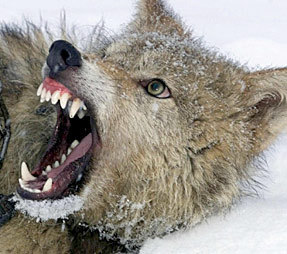
Snarling_dogNEWS.com.au (an Australian news site) announced the shocking fact:

Boffins Create Zombie Dogs!

You’re probably going: "Wait! I didn’t know that scientists had created boffins! Much less that the boffins had in turn created zombie dogs!"

"Boffin," apparently, is a UK (and Aussie) slang term for scientists and doctors who work for the military, so a U.S. translation of the headline would be:

Military Scientists Create Zombie Dogs!

Except . . . they’re not really zombie dogs. They’re more like cryogenically-suspended-and-then-revived dogs.

But let’s not let that get in the way of a good headline! Let’s pretend that they really are zombie dogs.

The <pun intended>chilling thing</pun intended> is that the "boffins" intend next to create "zombie" humans!

Oooo-oooooo! Pretty scary, eh, kids?

Just like that movie on Monster Chiller Horror Theater!

No word on whether the "zombie" dogs have a taste for human brains, but I can imagine what would happen if you put them in a bowl in front of the "zombie" dogs!

In the meantime . . .

GET THE (CHILLING) STORY!

RedState Sees Red

RedState.Org recently ran three book reviews of Thomas Woods’ How the Catholic Church Built Western Civilization. I haven’t read the book, so I can’t comment on it, but I have read the three book reviews, and I can comment on them. Each had serious flaws, but the first was of truly notable merit. Let’s read . . . .

JOSH TREVINO:

"How the Catholic Church Built Western Civilization," by Thomas Woods, PhD, is a book masquerading as a necessary corrective that reveals itself as an inadequate one; and a serious work of history marred by some deeply unserious historiography. By which I mean that I disagree with it theologically. The author’s stated intent is to counter much of the calumny which has befallen the institution of Catholicism in the modern era — specifically the calumny that it is and has always been an anti-modernist, anti-science, anti-humanist force — and in this, his approach makes the fatal errors of answering the critics on their own terms, and adopting Catholic historical prejudice to a degree that weakens his broader argument. Allow me to smear Catholics up front by referring univocally to "Catholic historical prejudice." I’m still an unbiased arbiter of history, myself, though.

It is the latter flaw that we turn to first. Those familiar with Church history know that <scare quotes>"Catholicism"</scare quotes> as we understand it was a concept that emerged in nascent form only with the progressive divergence of the Greek and Latin Churches between the 11th and 15th centuries; the Catholic Church as we know it in the modern era did not emerge until roughly the 16th century.

When I refer to Catholicism as "we" know it, the "we" in question is, of course, myself and my cat, Tibbles. Tibbles is an expert on such matters and assures me that the word "Catholic" wasn’t even used until roughly the sixteenth century. There was no consciousness of the Catholic Church as a distinct institution prior to that time. In fact, Tibbles’ papyrological studies have revealed that the quotations attributed to St. Augustine in the fourth century displaying a clear institutional awareness of the Catholic Church in contrast to other churches are, in fact, forgeries salted into the historical record by tricky papists.

The same goes for all the other evidence for the existence of the institution today called "the Catholic Church" prior to the sixteenth century. The Protestant Reformers may have thought that they were protesting against an institution known as "the Catholic Church" that had been around for centuries, but in fact it had only been in existence for a few weeks, following an extensive salting campaign undertaken as part of a hoax stemming from a college fraternity’s hazing rite. Please see Tibbles’ doctoral disseration for the references.

This latter Church development, mostly codified in the Council of Trent, came about as the Church defined itself against a Protestant Reformation. When I say "codified," I mean "made up out of thin air" rather than "confirming what was already in existence, against which Protestants were protesting." which Protestantism emerged as something rather different from, and more lasting than, previous anti-hierarchical rebellions such as Arianism, Donatism, and the Cathar and Hussite movements. By "anti-hierarchical" I don’t mean "against hierarchy," for each of these groups had bishops.

So, when we–Tibbles and I–speak of Catholicism as understood as that Christian church led by the Pope in Rome and governed by his clerical and bureaucratic apparatus, we are certainly not speaking of the historical Church from the time of St Peter to the modern day. For there were no popes in Rome prior to roughly the sixteenth century, nor did they have any clerics associated with them nor any bureaucratic apparatus. Tibbles has shown that all the alleged "records" of such individuals are fake.

 NSurprisingly, none of this seems to matter to Wood. It is as if he is completely unaware of Tibbles’ brilliant work in this area. The great accomplishments of the fourth through eleventh centuries, when the Church — and specifically the monastic communities — essentially alone preserved the civilizational heritage of antiquity, are presented as specifically Catholic accomplishments. The nerve! It is as if Woods really believes the records purporting to show that the monastic communities of the fourth through the eleventh centuries regarded themselves as Catholic institutions!

This is fundamentally inaccurate on several counts, most notably in that much of the preservation of the Roman and Greek corpus took place in imperial Constantinople, certainly never a location within the orbit of the Bishop of Rome. Yes, Constantinople was never within the "orbit" of the Bishop of Rome. Not even before the East-West Schism, when the Rome and Constantinople were in communion and councils like the First Council of Constantinople (A.D. 381) were saying things like: "The Bishop of Constantinople, however, shall have the prerogative of honour after the Bishop of Rome; because Constantinople is New Rome" (canon 3).

(Excepting, of course, a rather regrettable sixty years or so beginning 1204, which Woods sensibly omits as an accomplishment of the Catholic Church since it would harm my case.) Indeed, following the Fall of Constantinople to the Muslims in 1453, the arrival of these preserved manuscripts in the baggage of Greek refugees was a major spur to the Renaissance in Italy. See! The fact that post-schism Byzantines preserved manuscripts important to Western civilization ipso facto disproves the idea that the Catholic Church had anything to do with it!

The reality is that the preservation of civilization in Europe during the Dark Ages and medieval era, while creditable to Christianity at large, was not exclusively, nor even mostly, the doing of the Pope or a Catholicism that did not then exist. By way of parallel, it is wrong to credit to the United States the spread of democracy in the world during an age of monarchy, beginning with the American Revolution. The U.S. as Tibbles and I know it today did not exist in 1776 for there were only thirteen states at the time, its people spoke a now archaic form of English, and they were far less democratic than we are. It was only with the Warren Court that what we now call "America" became truly democratic, and thus it is a category mistake to attribute any democratizing influence in the world to an America that did not then exist.

When "we" speak of America, we mean America since the Warren Court, just as when "we" speak of the Catholic Church, we mean the Catholic Church since the sixteenth century. Tibbles and I are entitled to do this since, as Humpy Dumpty told Alice, "When I use a word . . . it means just what I choose it to mean–neither more nor less."

In certain tea parties that Tibbles and I frequent in modern-day Christian Orthodoxy there is a certain (misguided, to my mind) nostalgia for "Western Orthodoxy," which is defined as the Latin or "Western" rites as they existed prior to the late-medieval split between Constantinople and Rome. According to this thesis, prior to that, all Christendom was "Orthodox," and hence we can discuss St Patrick of Ireland, for example, as an Orthodox saint. While there is theological validity to this, it is a dishonest reading of history. Historical dishonesty thus can be theologically valid. — St Patrick almost certainly never looked to the Constantinopolitan Patriarch for guidance, for example — and it is also an misleading interpretation of cultural heritage, for nobody should be allowed to take pride in anything that the West has ever done. Westerners must only execrate their ancestors and laud the glories of Byzantium.

The consequent establishment of "Western Orthodox" parishes in the United States and Britain, which utilize various forms of liturgy extant in the churches of the era of the Venerable Bede, is based upon this false appropriation. Westerners must repudiate all of their own liturgical heritage and adhere strictly to the one, true form of liturgy as practiced in  Constantinople, "where also their Lord was crucified."

Woods is guilty of precisely this same error from the Catholic side: his interpretation of history, and specifically his presentation of Catholicism through the medieval era, leads inevitably — though he shrinks from making this point explicit — to the concept of a pre-split "Catholic Greece," among other things. I mean, just because both East and West regarded themselves as being part of one Church prior to the split, and just because that Church was commonly called the "Catholic" Church in that age, and just because it had the bishop of Rome as its foremost bishop according to the First Council of Constantinople (among others), that in no way allows a Catholic to lay any kind of claim to the heritage of this age!

It ill-befits any person from any Christian tradition to posit such a <adjectival meltdown>thinly-defensible, revisionist, and ahistorically exclusionist</adjectival meltdown> interpretation of Church history. By which I mean: I disagree with Woods theologically. I hold it as a theological truth that the Church before the split was Orthodox rather than Catholic. Woods therefore must be wrong historically. If the evidence is against me, so be it. As I’ve already established, historical dishonesty can be theologically valid.

Now, let me be up-front and state that I am coming at this from an Orthodox perspective. Yes! Disclosing one’s point of view half-way through a piece is being "up front" about it! I hope, though, that the reader finds that the argument against this manner of historiography stands on its own.

The second major flaw in Woods’ book stems from the first. <syntactical meltdown>In claiming all things for Catholicism, and in concurrently expanding Catholicism to claim those things he wishes to claim, he of necessity does so according to that which he wishes to refute.</syntactical meltdown> Woods finds the charge that the Church is a retarding force in the development of modern civilization — specifically modern science, which seizes his attention, and hence his book, to a great degree — to be one that eminently deserves answering. All of which is just to say: He wants to show that the Catholic Church isn’t anti-science.

His implicit acceptance of the equating of science with civilization (I have to say "implicit" acceptance because if I didn’t then he’d protest that he hasn’t equated science with civilization and that I am setting up a straw man), and his explicit acceptance that the Church may be justified on these terms (whatever that means), are both profoundly wrong.

This is not the place to examine in full the contention that science is an independent, self-justifying value (since Woods presumably didn’t claim this), or the contention that science is itself an independent, self-justifying indicator of civilization (which Woods presumably also didn’t claim). It is enough to say that the Catholic Church and Christianity at large reject both these views. They are thus irrelevant to the matter at hand. I only mention them so I can dazzle the reader with my sparkling philosophical prose.

Modern Catholicism quite laudably espouses the position that, as a Catholic priest from my own childhood explained, "Good science and good faith do not conflict." This begs the question of what constitutes "good science." Certainly there is quite a lot of bad science: the Dachau hypothermia experiments, the eugenics movement, and the Tuskegee experiments are only the tip of that iceberg. Particularly in an era where science is pushing the frontiers of human control — although not human wisdom — ever further, it is the Church that has frequently been the loudest voice in reminding society that knowledge is not an end in itself, and that its application is not inherently useful, wise or right. In a faith the holy text of which begins with an allegory of unwise knowledge and its consequences, this is in keeping with its most ancient intellectual traditions. That they are still applicable and cautionary thousands of years after that allegory’s first telling is a testament to the enduring nature of man and his folly.

One searches in vain for this recognition in Woods’ book. Instead, we are treated to a proud catalogue of mostly monastic and Jesuit accomplishments in science and technology. How dare Woods try to prove that the Church isn’t anti-science without mentioning my personal hobby-horse on the subject! Tibbles is outraged and spitting up hairballs!

These in themselves are good things inasmuch as they demonstrate that the Church is not a wholly malign force in the temporal world, pace the attacks of its critics. But Woods appears to forget that the Church is not justified by those things. This is a subtle point. When I first read Woods, I missed it, thinking that he was merely conducting a negative apologia–showing that the charge of the Church being anti-science is false. But Tibbles’ careful reading of the text revealed that Woods was actually doing a positive apologia, claiming that people ought to be Catholic because of how much good science the Church has done! He thus forgets that the Church is not justified by how much good science it’s done!

iIndeed, from the standpoint of the believer, the Church in the world is justified by the simple act of belief and the promulgation of the worship of Christ. All those miracles and fulfilled prophecies that Jesus and St. Paul so keen about were just a waste of time. To justify it on any other terms — say, a clever tenth-century Benedictine integration of waterwheels and trip-hammers, or a useful seventeenth-century Jesuit advance in lens-grinding — is to implicitly accede to the secularist contention that it is material betterment that is the bellwether of human progress, and the moral justifier of institutions. In this, the Church in the modern era will lose, and lose badly: no local parish is the equal of the supermarket in the provision of bread to the masses; no bishop alive has utilized waterpower so well as does the Tennessee Valley Authority.

Why, then, does Woods keep telling us that we ought to be Catholic because it will give us technological doo-dads and material prosperity? I mean, I haven’t seen this kind of pro-technology apologetic for Catholicism since John Paul II wrote his most recent encyclical on the virtues of consumerism and the sacramental character of shopping at Best Buy!

Useful social advancement based upon the rational satisfaction of material needs is, of course, the basis of the domestication of dogs, just as the law of gravitation operating between bodies that have mass in the Einsteinan space-time continuum is, of course, the basis of why a domesticated dog will drop to the ground if you suddently disintegrate his legs. It is not what distinguishes nor what "built Western Civilization," nor, one hopes, is it the purpose of man on earth. Not that Woods said it was those things. I’m just showing off my sparklingly intellectual prose again.

It is that transcendent need to define and achieve that purpose–i.e., the purpose of man on earth–that the Church, and religion in general, presumably seeks to fulfill; and if it is to be justified, it must be on those terms. It is the task of the Church’s apologists to do so, and to argue that that transcendence has not lost an iota of its relevance in our era. Tibbles therefore decrees that it is superfluous and counter-productive for a person to write a book on the Catholic Church’s role in the building of Western Civilization. The only books that should be written are those showing the value of transcendence in the world today!

Thomas Woods shows how well the Catholic Church, as defined by him and most of mankind, has delivered on those material needs for millennia. Fine, say the critics he attempts to refute: can we not accomplish this today by means of a government program without this Jesus baggage? There is no good answer to this question in this book since it was not a book about proposed government programs. Since it is the crucial question of the modern age, it is an omission that reduces Woods’ work from a serious apologia to a collection of trivia–a charge that can be equally leveled against any book published today that is not an apologia based on the value of transcendance in modern society contra irreligious government programs. That’s the only kind of book that counts!
 

I therefore fault the book because the author chose to write on a theme not to my liking.

Tibbles, feeling generous, gives it one hairball out of a possible five.
SOURCE.

READ WOODS’ BOOK FOR YOURSELF.

A Person's A Person

… no matter how small, in the words of the great philosopher Dr. Seuss.

Pope Benedict XVI’s first book published since his election to the papacy, noted in a previous post by Jimmy, will include a defense of the Church’s commitment to fighting for all life, even the lives of those the greater culture deems "insignificant":

"In his first book published since his election as Pope, Benedict XVI rejects the suggestion that the Church has given up its fight for the right to life of the unborn, instead emphasizing that ‘There is no such thing as "small murders."

"’Respect for every single life is an essential condition for anything worthy of being called social life,’ he wrote, as reported by Reuters news. The book, The Europe of Benedict, in the Crisis of Cultures — only available in Italian — is a compilation of three sermons delivered between 1992 and April 2005 by the Pope while he was still Prefect of the Congregation for the Doctrine of the Faith.

"’Why don’t we resign ourselves to the fact that we lost [the abortion] battle and dedicate our energies instead to projects where we can find greater social consensus?’ Pope Benedict XVI asks rhetorically. ‘Recognising the sacred nature of human life and its inviolability without any exceptions is not a small problem or something that can be considered part of the pluralism of opinions in modern society,’ he answers."

GET THE STORY.

Now, what I want to know is when the Pope’s new book will be translated into English.

A Person’s A Person

… no matter how small, in the words of the great philosopher Dr. Seuss.

Pope Benedict XVI’s first book published since his election to the papacy, noted in a previous post by Jimmy, will include a defense of the Church’s commitment to fighting for all life, even the lives of those the greater culture deems "insignificant":

"In his first book published since his election as Pope, Benedict XVI rejects the suggestion that the Church has given up its fight for the right to life of the unborn, instead emphasizing that ‘There is no such thing as "small murders."

"’Respect for every single life is an essential condition for anything worthy of being called social life,’ he wrote, as reported by Reuters news. The book, The Europe of Benedict, in the Crisis of Cultures — only available in Italian — is a compilation of three sermons delivered between 1992 and April 2005 by the Pope while he was still Prefect of the Congregation for the Doctrine of the Faith.

"’Why don’t we resign ourselves to the fact that we lost [the abortion] battle and dedicate our energies instead to projects where we can find greater social consensus?’ Pope Benedict XVI asks rhetorically. ‘Recognising the sacred nature of human life and its inviolability without any exceptions is not a small problem or something that can be considered part of the pluralism of opinions in modern society,’ he answers."

GET THE STORY.

Now, what I want to know is when the Pope’s new book will be translated into English.

Evil Overlord Rumblings

Suppose that you are an Evil Overlord out to take over land that ain’t yours.

Suppose that you’ve been conducting a semi-secret military buildup to allow you to do this and, now, you are virtually ready to seize military control of a particular plot of land that you want under your control.

Suppose that your chief rival, who is publicly committed to stoping you from taking over this plot of land, is currently stretched militarily due to fighting a world war on several fronts.

When do you, the Evil Overlord, strike and try to take over that juicy plot of land? While your chief rival is still fighting that war on several fronts or afterwards, once he’s no longer distracted and has had a chance to recover militarily?

Before, of course! Don’t be silly!

Now suppose that your name is China and you want to take over a plot of land called Taiwan and your chief rival is named America and the world war is called the War on Terror.

Bill Gertz–an important journalist focusing on intelligence matters–is reporting that China may try to seize control of Taiwan in 2006 or 2007.

Further, he suggests its near-term warfare aims may not stop at Taiwan.

Y’know how the plots of a couple of Tom Clancey novels were eerily mirrored in the events of 2000-2001, what with a disputed election and a major terrorist attack involving slamming jets into things and biological warfare and all?

Well, Gertz is hearing from folks who are suggesting that the plot of another Tom Clancy novel ("The Bear and the Dragon") may also get eerily mirrored, with China contemplating the seizure of territory in eastern Russia to get its natural resources.

Michael Pillsbury, a former Pentagon official and specialist on China’s military, said the internal U.S. government debate on the issue and excessive Chinese secrecy about its military buildup "has cost us 10 years to figure out what to do"
   

"Everybody is starting to acknowledge the hard facts," Mr. Pillsbury said. "The China military buildup has been accelerating since 1999. As the buildup has gotten worse, China is trying hard to mask it."
   

Richard Fisher, vice president of the International Assessment and Strategy Center, said that in 10 years, the Chinese army has shifted from a defensive force to an advanced military soon capable of operations ranging from space warfare to global non-nuclear cruise-missile strikes.
   

"Let’s all wake up. The post-Cold War peace is over," Mr. Fisher said. "We are now in an arms race with a new superpower whose goal is to contain and overtake the United States."

GET THE WHOLE FRIGHTENING STORY.

Intersexed Marriages

A reader writes:

I have an odd question for you, raised by a friend of mine.  Some children ARE born "trans-gendered".

She writes: 

Intersex = overarching term for anyone born with a physical form not clearly "male" or "female" by current definitions of the terms. Can cover everyone from those born with[out the usual parts men and women normally come with], through XY females and XX males (those born appearing female or male but with a chromosomal sex at odds with their physical form).

Can they marry?  Does this come down to possiblity to bear children, in that if it’s not possible, a marriage cannot take place?  Can an XY female marry an XY male?  Or an XX Male and XX female?

I’m really confused on how to approach this issue.

You’re not alone in being unsure how to approch this issue. At present, the Church also seems to be. There are no authoritative statements from the Magisterium on the subject (to my knowledge), which means that the subject is in play for moral theologians to discuss. Eventually a consensus is likely to develop among moral theologians and, after that or in conjunction with that, a magisterial intervention may occur that creates an official position.

Till then, we just have to do the best we can figuring these things out. So let’s start with what seems certain and work our way out from that.

One thing that is certain (since you asked about marriage) is that a man can only marry a woman and visa versa.

It is also generally held as a certainty that all individuals are really either male or female. Sex in humans is binary. There are no alternatives or gradations in it. We may, in some cases, have a hard time determining which sex a person is, but ultimately they are one or the other.

But suppose, for a moment, that this were not the case. Suppose that, at some point in the distant future, the Church concluded that there are individuals who are not men or women but who have a defective gender. In such an eventuality, it would seem that those individuals simply would not be capable of marriage. Their situation would be analogous to individuals today who are incapable of marriage because they cannot perform the marital act (i.e., they are totally and incurably impotent). The situation of such individuals would be tragic–as is the case of individuals today who are incapable of contracting marriage–but that would seem to be the case for such individuals.

Now let’s suppose that the hypothesis on which that scenario is built is false–that all humans really are either male or female, as is generally assumed. In this case the trick would seem to be figuring out which gender a person is in an ambiguous case and then, to the extent medical science would allow, using corrective methods (e.g., surgery) to enable them to live and function as much as possible as what their gender is.

In determining what sex a person is, there seem to be two kinds of clues available to examine: anatomy and genetics. Unfortunately, at present neither of these can be turned to as an infallible guide.

In the case of anatomy, some individuals are born without sexual anatomy (or without a complete set of sexual anatomy). Others are born with a surplus of it (and a mixed surplus at that).

In the case of genetics, some individuals are missing a sex chromosome (e.g., they are born with just a single X chromosome; I don’t know if any are born with just a Y chromosome) or they are born with too many sex chromosomes (e.g., they have XXX, XXY, XYY, XXYY, or some other pattern).

Sometimes also anatomy fails to match genetics, as in the case of an "XX male" or an "XY female."

At this point moral theologians have not yet figured out how to resolve these ambiguous cases. The correct strategy is debatable and may depend on the facts of a specific case. Here are some of the options:

  1. If the individual appears to have functional anatomy, go with the anatomy rather than the genetics. In other words, treat XX males as males and XY females as females.
  2. If an individual lacks functional anatomy, go with genetics and use reconstructive surgery to help the person out. I.e., if someone is genetically male then help him surgically to have the appropriate anatomy. If someone is genetically female then help her surgically to hav the appropriate anatomy.
  3. If an individual has two sets of anatomy (whole or partial) then go with genetics and use surgery to correct the anatomical situation.
  4. If someone has a defective chromosome pattern (X, Y, XXX, XXY, XYY, etc.) then treat the person as whatever their anatomy would indicate.
  5. Treat genetics as the ultimate determiner of sex. In the case of an XX male, use surgery to supply female anatomy. In the case of an XY female, do the same to supply male anatomy. In the case of a defective chromosome pattern, use the presence of a Y chromosome as a determiner of maleness, so X and XXX and XXXX individuals are female and Y, XXY, and XYY individuals are male. Use surgery to correct any problems that exist.

As you can see, these alternatives are not all exclusive of the others, though some are (e.g., 4 and 5 are directly in opposition).

I am a bit doubtful that the Magisterium would ever sign off on option #5. One reason is that it is radically different than the ways of handling these situations that Catholic health care providers and moralists have had up to now when helping children with ambiguous sex. Similarly, we’ve been living since the beginning of the human race (or almost the beginning, anyway) with folks who have one outward sex even though a genetic test would raise questions about it. It seems asking an awful lot to mandate that a XY females or XX males undergo surgery to switch their outward sex. This is a burden that they’ve never been asked to undertake before (though, of course, one may point out that we’ve never had genetic tests before).

I suspect that a patchwork of options, like the ones mentioned above, are likely to emerge in practice and in discussions among moral theologians. I suspect that the Magisterium will initially be hesitant to sign off on any of them.

Ultimately, it may conclude (I didn’t say will conclude) that neither anatomy or genetics (nor hormones, to mention something we haven’t touched on here but which play an important role in embryonic sex development) are alone fully determinative indicators of sex and that in hard cases whether one is male or female must be determined by looking algorithmically at a combination of these factors, as above.

Once the issue of what sex a person is has been sorted out–however it gets sorted out–it is then possible for that person to marry a person of the opposite gender, assuming that he or she is otherwise capable of contracting marriage.

The key here (given the concerns you raised above) is not whether the person is capable of fathering or bearing children. Fertility has never been a condition for validly contracting matrimony. What has and is a condition of that is the ability to perform the marital act. As noted, individuals who are perpetually and incurably impotent cannot contract marriage because they cannot truthfully promise to render the marriage debt (i.e.,sex) since they are incapable of rendering it.

If, however, through surgery or other medical means, they have been made capable of performing their marital duty (whatever their anatomical configuration was earlier in their life) then they are capable of marrying a person of the opposite gender.

MORE INFO ON INTERSEXED INDIVIDUALS HERE.

Freakonomics

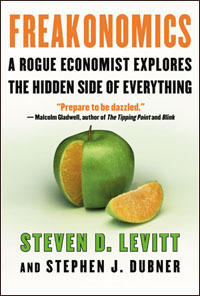
FreakonomicsWelcome to Freakonomics week here on the blog. This last weekend I read the book pictured to the left and decided that I had enough to say about it to do a theme week (one post per day) on the subject.

First, let’s start with a general book review.

In case you may not be aware of it, Freakonomics is one of the breakout books this year. It has done extraordinarily well (especially for a book about economics). People are talking about it, arguing about it, citing it in editorials, etc., etc.

Having read it, it’s easy to see why. First, unlike the vast majority of economics books, it’s very easy to read. Even easier than some of Thomas Sowell’s economics books, and his are among the easiest there are.

You don’t have to get braced up for lots of technical gunk with this book. It’s written in clear, easy-to-understand English.

What’s more, it’s interesting. The authors aren’t trying to get across a lot of stuff about how the American economy or the global economy works. They aren’t predicing bear markets or bull markets, recessions or booms.

Instead, they are doing something an increasing number of economists are doing: Taking the principles and ideas normally used in economics and applying them to areas of life not traditionally considered economic in nature. Hence the "freak" part of the title. With chapter titles like "What Do School Teachers and Sumo Wrestlers Have in Common?" and "How Is the Ku Klux Klan Like a Group of Real-Estate Agents?" and "Why Do Drug Dealers Still Live with Their Moms?", you know that you’re not in for a typical, dry economics tome.

(Answers: School teachers and sumo wrestlers both fake results for reasons of self-interest; the KKK and real-estate agents both conceal certain kinds of information and lose their power when that knowledge is publicly exposed; most drug dealers pull in so little money that they are making less than minimum wage.)

The book is also iconoclastic. In applying economics principles to unusual areas, by asking unusual questions and then seeing what the available data has to say about them, the authors (or more specifically, the lead author) comes to conclusions that frequently (though not always) fly in the face of conventional wisdom. That helps make the book interesting, too. If it was just a work documenting all the cases in which the conventional wisdom is right, it’d be a lot less interesting.

For example: Did you know that it’s one hundred time more dangerous for small children to be in a typical house where there is a swimming pool than in a typical house where there are firearms?

Just one of the many cool tidbits that you’ll pick up by reading this book.

Now: There are things about the book that I don’t like. F’rinstance: I don’t like the way the lead author is treated. Steven D. Levitt is a noted young economist who has been the subject of various press articles by individuals such as co-author Stephen J. Dubner. Levitt was initially approached by a publisher about writing a book but wasn’t interested in doing it himself, so he teamed up with Dubner. As far as I can tell, all the economic ideas in the book are Levitt’s, while all the writing on the book was done by Dubner (no doubt with Levitt editing).

Here’s the problem: The book regularly quotes from a New York Times Magazine profile of Levitt that is basically a puff piece. It portrays Levitt as the coolest thing since sliced bread and as some kind of freaky economic supergenius who gets it right where all the other economists get it wrong. In fact, in one excerpt the piece compares Levitt to the guy who comes across numerous highly intelligent people futzing with a complex machine that they can’t get to work, only to notice that they haven’t plugged it in.

While it may be within the purview of the NYTM to publish such heroic puff pieces, it’s another thing entirely to quote such embarrassingly excessive passages in one of your own books. I expect to find deleriously positive ravings about an author placed by a publisher’s marketing department on the back of a book, but I don’t expect to find such statements placed in the text of the book by the author himself–or (more likely in this case) allowed by the author to be placed in there by his co-author.

It offends my sense of modesty and decorum.

It also seems to me to be massively imprudent. Writing a best-selling book that trounces what your colleagues in the field are doing is offense enough. To add to that offense such ego-displaying passages is bound to attract the attention and annoyance of one’s colleagues and generate a reputation for one as being a prima donna.

In fact, the authors cite in the book the example of one economist who went online and, pretending to be one of his own students, wrote glowingly about how great he was as a professor. When the ruse was found out, the professor became the object of professional and non-professional scorn.

Something similar is likely to happen in this case. Levitt may not be putting words in the mouth of an imaginary student about how great he is, but he’s immodestly allowing his co-author to reprint them inside a book that carries his name, and that’s just vanity in the extreme. Colleagues will not approve.

It’s also just the kind of thing that would lead colleagues to go over the reasoning in the book with a fine-toothed comb and find fault with it.

A lot of the stuff in Freakonomics is highly new and experimental and at least some of it is (here’s the important part) Not Likely To Hold Up After Further Study. Going back to the data, getting better data, and doing finer-grained analyses are likely to overturn at least some of the ideas advanced in the book, and when that happens, Levitt will look like a young whipper-snapper who self-importantly thought that he could tell everyone in the profession what to do and who crypto-(i.e., through his co-author) boasted in his own book about what a genius he was.

If I had no other impression to go on besides what comes through in such passages of the book (as, indeed, I do not), I’d have to conclude that Steven Levitt is an arrogant young would-be know-it-all and a Big Jerk who’s going to get his comeuppance one of these days.

In real life, Levitt may not be like that at all, but he’s likely to have a significant price to pay from the impression created among his colleagues once the backlash starts. Such passages are even annoying to non-economist readers who, after all, picked up the book to read about interesting economic ideas, not what an economic "superstar" Levitt wants to be portrayed as.

Now, I wouldn’t want the existence of such passages to put you off reading Freakonomics. They’re a relatively minor thing in the book. Most of it is devoted to the "freakonomic" ideas and not to portraying Levitt as a superstar. It’s easy enough to skip a paragraph or flip a page when the latter happens.

The economic ideas in the book are interesting–interesting enough that I’d devote a theme week to them–and involve very well-told tales.

So I’d encourage you to

GET THE BOOK.

Postscript: There’s a bit of offensive language in the
book when Klansmen and drug dealers are being quoted, so fair warning.

One other postscript: You may have noticed that I got all the way through the above review without even mentioning the most controversial claim of the book–that abortion is a major factor reducing the crime rate in recent years.

We’ll talk about that tomorrow.

Big Doings At SCOTUS Tomorrow

Tomorrow is the last day of the Supreme Court’s current term, and there are expected to be some decisions on big, controversial cases. (That’s not unusual. The Court often leaves big, controversial cases to the end.)

We also might get a number of resignations tomorrow, but my guess is that whatever we’re likely to get will come the next day or later in the week. (Think about it: If you were a Supreme Court justice would you want ot announce your resignation on a day when you were handing down controversial decision and had all kinds of protesters at the Court building ready to cheer or scream at the news of your resignation and do either or both in front of waiting cameras so the media can hype it?)

So here’s a preview of what’s likely to come down tomorrow (unless, for some reason the justices hold a case over until the next term–e.g., for re-argument):

Justices have a few cases left to resolve, including two of the most-watched of the term: the Ten Commandments appeals from Texas and Kentucky and a case that will determine the liability of Internet file-sharing services for clients’ illegal swapping of songs and movies.

Also Monday, justices are expected to announce whether they will hear appeals from two journalists who may face jail time for refusing to reveal sources in the leak of an undercover CIA officer’s identity.

Rulings are also awaited in a Tennessee death penalty case, an appeal that will decide police departments’ liability for not enforcing restraining orders, and a challenge to the tight control cable companies hold over high-speed Internet service.

GET THE STORY.

"I Am A Jelly Donut"?

Also today, June 26, but in 1963–mere months before he was shot dead in Dallas–President John F. Kennedy uttere the famous words "Ich bin ein Berliner."

By this he meant "I am a Berliner," and he said it as an expression of solidarity with the people of West Berlin, who were under dire threat from the Communist puppet state of East Germany and its Soviet masters.

The Berliners loved it. Wild cheers all round.

Now: Turns out that many folks today argue that Kennedy didn’t really say "I am a Berliner" in German. They claim that, instead, what he actually said was more like "I am a jelly donut." It wasn’t that he didn’t say the words "Ich bin ein Berliner" correctly. He said them right (albeit with his thick Boston accent). It’s that the words themselves are wrong.

According to this claim, in German the word "Berliner" is a reference to a kind of jelly donut. And it is. But not so much in Berlin, where Kennedy was speaking.

The "I am a jelly donut" thesis is reportedly an urban legend that started in the 1980s.

Not convinced? Well . . .

HERE’S AN ARTICLE FOR FURTHER CONSIDERATION.