Return To Confession

A reader writes:

My husband had decided to go to confession after 45 years–and it’s next Wednesday.

I smoothed the way by speaking with Father who will hold our Wednesday evening confessions in his office (not together of course).  My husband is getting scrupples BUT more than that—he’s wondering if there was a booklet for someone like him to offer clues or ideas or direction.

Have you written anything about those who haven’t gone since they were kids and how to not feel guilty about forgetting things?  He’s so worried.  It’s not so much that he’s scared but he’s worried that he’ll forget to say everything and that it won’t count. I’ve told him it’s OK.  Just express sincere remorse and that God knows!  But… do you have anything?

There certainly are booklets that your husband could use. Catholic Answers carries one that is titled something like "The Little Catechism Of Confession" (see shop.catholic.com). The problem is that if his confession is scheduled for Wednesday, it wouldn’t be possible to get this booklet unless you had it overnighted.

You might try going to a local Catholic bookstore, if there is one in your town, as they would probably have things of this nature.

Or you could Google "examination of conscience" and see what comes up.

HERE’S AN EXAMPLE OF AN ONLINE EXAMINATION OF CONSCIENCE.

Because your husband has not been to confession in some time (and it’s great that he’s coming back to it!), I recommend a few things:

1) He should not stress out about confessing the number of times he committed particular sins if he can’t remember. Nobody is obliged to confess more than they can remember, so if all he can say is "I did this particular sin a lot" then that’s okay. (On the other hand, if he knows the specific number then he should say it.)

2) He should not stress out about sins that he has forgotten. The Church teaches that the sacrament works as long as the person does not deliberately hold back a mortal sin that he knows about. If he can’t remember a mortal sin that he committed then he isn’t obliged to confess it. It is enough that he would confess it if he remembered it.

3) To cover unremembered mortal sins, it is customary for people to add at the end of their confession "And for all my sins I am sorry."

4) To help him not worry about forgetting to mention something that he meant to say, he should consider using a written memory aid. This could be a list of his sins that he makes up in advance, or it could be printing up an examination of conscience and putting a check mark by the ones he means to confess.

5) When he confesses, he should be as direct as possible, simply saying, "I have to confess that I frequently did this . . . . and I have to confess that I sometimes did that" and not worry about giving a lot of background detail. Being matter of fact in this way will make it easier to get through the confession. The priest can ask clarifying questions if he needs to.

6) After confession your husband should IMMEDIATELY destroy any written aid he used in the confession. I recommend tearing it up and flushing it down the toilet in the nearest men’s room.

I hope this helps, and it’s great that your husband is coming back to the practice of his faith!

Dating Without An Annulment

A reader writes:

Are there any official guidelines for divorced people dating before seeking an annulment?  I know someone who is doing this and claims that they aren’t "breaking any rules" by doing so.  I say that its a mockery of the sacrament, as well as an abuse of the other person.

To answer this question, I need to distinguish two different situations: Some people are in need of what is called a "documentary process" annulment. These are cases where it is so clear that a marriage is null that all that has to be done is to present certain documents that will prove nullity. The most common kind of annulment in this category is when Catholics (who are obliged to observe the Catholic form of marriage) get married outside the Church without a dispensation. Another case would be a priest who jumps ship and attempts marriage without being laicized.

In these cases the nullity of the marriage is so obvious and certain that an extensive investigation is not needed, which is why the documentary process exists. It is possible, even before the annulment is granted, to be certain that one is not married to one’s former spouse.

In such cases, unless there is something else affecting the situation (like being an unlaicized priest), one is entitled to regard oneself as free to marry someone else, and it would not be wrong in principle to investigate prospective marriage partners. (Though it would still be prudent for a variety of reasons to get the documentary process annulment first.)

Most annulment cases, though, are not documentary process ones. They require an extensive, formal investigation, and they are known as "ordinary process" annulments. In these cases it is not clear prior to investigation that a person is free to marry, which is why the investigation is necessary.

Such marriages are presumed valid, and parties are obliged to regard themselves as still bound to their prior spouse until such time as it is proven that the marriage was null.

So what about dating before the annulment in their case?

"Dating" is a phenomenon that only appears in certain cultures. As a result, one won’t find it explicitly mentioned in the Code of Canon Law, which applies to cultures all over the world.

What one will find is a canon that requires the faithful to act in communion with the Church even in their daily activities:

Can. 209 §1.

The
Christian faithful, even in their own manner of acting, are always obliged to
maintain communion with the Church.

Things that would impair their communion with the Church, such as actions not consistent with Catholic morality, violate this obligation.

Further, the Code provides:

Can. 210

All the
Christian faithful must direct their efforts to lead a holy life
and to promote
the growth of the Church and its continual sanctification, according to their
own condition.

One thus cannot get around what moral theology would say on the grounds that one isn’t "breaking any rules" that are explicitly found in canon law. Canon law itself requires people to live in a moral manner and strive for holiness.

And even if canon law didn’t say this, the fundamental moral obligations to act in accordance with one’s state of life and to pursue holiness would remain.

Where this question really belongs is thus not in canon law but in moral theology: Is it moral to be dating someone if you are divorced and don’t have an annulment?

Dating is a romantic activity, and it is simply inappropriate to engage in romantic activity with one person when you must regard yourself as married to another. To do so is a violation of the Ninth Commandment (not coveting one’s neighbor’s spouse) that puts one in danger of temptations to violate the Sixth Commandment (not committing adultery).

Those who would need an ordinary process annulment must regard themselves as still married, and so for them dating in this condition has the same moral character as dating someone other than their spouses while still married.

Moral theology would repudiate the actions of a man who knows that he is bound to his wife yet dates another woman, and so it repudiates the actions of a man who must presume that he is bound to his wife yet dates someone else.

In addition, pursuing romance with someone else when you are presumed bound to another is just cruel. It not only tempts you to violate your marital obligations, it tempts another person into an immoral situation as well.

It also messes with both of your feelings and–should and annulment not be forthcoming–will lead you to the very distressing choice between continuing the relationship in violation of your marital obligations or ceasing the relationship and all the pain that will mean.

Bottom line: Dating when you are not clearly free to contract marriage is fundamentally disordered on multiple fronts and just plain wrong.

20

Looking For Fr. Altier Homilies

A reader writes:

Greetings from Bombay, India. I have been reading your posts on your awesome Blog Spot for quite some time.

I am a great, great Fan of Father Altier’s Homilies from India.

I am a Cradle Catholic and my family has been Catholic for a little over 4 Centuries. My Ancestors were converted to Catholicism from Hinduism by zealous Portuguese Jesuit and Franciscan Missionaries in the 16th Century when Goa was a Portuguese Colony.

In Goa, we have the incorrupt body of Saint Francis Xavier which is kept in a casket at the Cathedral of the Bom Jesus — which in Portuguese means the Good Jesus.

I have been reading the awesome Homilies of Father Robert Altier from March 2001 when I was living in the United States and I continued reading them when I returned to India in early 2002 and till the last day when they were available on "A Voice in the Desert" that is Ash Wednesday 2006.

I am very sad and depressed that the current Homilies are no longer available nor are the Archives available anymore. I feel also sad that I did not download any of the Homilies when they were available neither the current ones nor any from the Archives.

My Spiritual Life will indeed be disrupted if it isn’t already as a result of the unfortunate ban or censorship on the Homilies of Father Altier. They were life giving to me in more ways than one and I was specially looking forward to them during this Holy Season of Lent as well as during the forthcoming Holy Season of Easter.

Therefore, I would be most grateful if you could tell me if there are any Web Sites that are hosting Father Altier’s Homilies since "A Voice in the Desert"  has been shut down.

Finally, I would be most grateful if you could mail me the "URL’S" of Web Sites that are hosting Father Altier’s Homilies.

I don’t know of any sites that have all of them (perhaps some readers do), but I can point you toward a site that has many of them.

If you use The Wayback Machine at Internet Archive, you’ll find that it has many homilies archived from 2001-2005.

HERE, FOR EXAMPLE, IS THE 2005 ARCHIVE.

HERE’S THE GENERAL ARCHIVE FOR ALL YEARS.

Also, as I mentioned earlier, if you’re looking for good online homilies, I’d recommend those of online scalawag, Fr. Stephanos Pedrano.

Ist Das Nicht Ein Kinderbibel?

KinderbibelJa! Das ist ein Kinderbibel!

O, du schoene!

O, du schoene!

O, du schoene!

Kin-der-bi-bel!

Okay, so what’s a Kinderbibel? Well, if you think of what the German roots of the word "Kindergarten" mean and what the word "bibel" sounds like in English, you should have a pretty good clue:

It’s a Children’s Bible.

Aid To The Church In Need has produced a children’s bible called God Speaks To His Children that is now online in 20 (!) languages.

ENGLISH IS ONE OF THEM.

Now, by "children’s Bible," they don’t really mean a children’s Bible–a version of Scripture translated or annotated for kids. They mean a book of famous Bible stories with the text taken from the Bible and paraphrased for kids. But that’s not reason that the project isn’t worthy.

If y’all have or know folks who have young kids,

CHECK IT OUT.

OTHER LANGUAGES HERE. (Click on your part of the world map to see languages from your area come up.)

Pre-Red Hat Giveaway Staff Meeting

Yesterday–the day before the red hat giveaway–Pope B16 held a pre-consistory meeting with the college of cardinals. This was a day of prayer, reflection, and discussion about topics of interest to the Church at large.

So of course they held it behind closed doors.

That didn’t stop word from getting out about what they talked about, partly through a press release and partly through cardinals who spilled a few beans.

EXCERPTS:

There was no formal agenda, but in an opening talk the pope mentioned three specific concerns for discussion, according to a Vatican press statement:

— "The condition of retired bishops."

— "The question raised by (Archbishop Marcel) Lefebvre and the liturgical reform desired by the Second Vatican Council."

— "Questions connected with the dialogue between the church and Islam."

The pope invited the cardinals to raise other issues of their own and said the exchange should take place in a spirit of unity and communion.

Cardinal Wilfrid F. Napier of Durban, South Africa, told CNS that he did not think the pope was looking for a "yes or no" response from the cardinals on the Lefebvrites.

One bishop suggested raising the retirement age from the current limit of 75 years.

It was the pope’s idea to convene the meeting, and Vatican sources said it signaled a strong advisory role for the world’s cardinals under the new pontificate.

There was also tech support for the less tech savvy cardinals:

It fell to Archbishop Monterisi to explain a few practical details: where to tune into simultaneous translations in four languages — English, French, Italian and Spanish, how to request the microphone and how to turn up the headphone volume on the consoles.\

GET THE STORY.

MORE FROM ZENIT.

Vatican Holds One-Day Red Hat Giveaway!

By the time you read this (if you’re in America), B16 should have given the Church 15 new cardinals.

Today is the day of the consistory that he convoked for the creation of the new cardinals that were announced last month.

Many folks will undoubtedly be curious about just what happens at a consistory, so it’s fortunate that Zenit has

THIS STORY DEALING WITH THE WORKINGS OF A CONSISTORY.

Among other things, the new cardinals are required to swear the following oath:

"I [name and surname], Cardinal of the Holy Roman Church, promise and swear to be faithful henceforth and forever, while I live, to Christ and his Gospel, being constantly obedient to the Holy Roman Apostolic Church, to Blessed Peter in the person of the Supreme Pontiff Benedict XVI, and of his canonically elected Successors; to maintain communion with the Catholic Church always, in word and deed; not to reveal to any one what is confided to me in secret, nor to divulge what may bring harm or dishonor to Holy Church; to carry out with great diligence and faithfulness those tasks to which I am called by my service to the Church, in accord with the norms of the law. So help me Almighty God."

Then each new cardinal will approach the Pope and kneel before him to receive the red hat and be assigned a title or deaconry. The Pope will say, in part:

"It is red as a sign of the dignity of the office of a cardinal, signifying that you are ready to act with fortitude, even to the point of spilling your blood for the increase of the Christian faith, for peace and harmony among the people of God, for freedom and the spread of the Holy Roman Catholic Church."

MORE INFO FROM AMERICAN PAPIST.

A Mormon President?

Feddie over at Southern Appeal has

AN INTERESTING POST ON WHETHER MASSACHUSETTS GOVERNOR MITT ROMNEY MIGHT BE THE GOP’S PRESIDENTIAL CANDIDATE IN 2008.

The post concerns, among other things, the fact that Romney is a Mormon, and there is a question of whether the Republican party’s base will support him enough for him to be the nominee–and, if not, how Mormon Republicans will react to that.

I’m not a Republican. I’m not a member of any political party–nor do I want to be. But I do have some thoughts on this issue.

I don’t know whether the Republican base is willing to support Romney enough to make him the ’08 nominee (though I doubt it, for a variety of reasons, including the fact he’s apparently a bit soft on life issues–which is common for Mormons). Nor do I know how Mormon Republicans might perceive this or what action they might take.

But I do know this: Mitt Romney is not going to be president.

Even if he’s put up against a polarizing figure like Hillary Clinton, he’s not going to be president.

Why?

Because the nation is too narrowly divided at the moment. George Bush lost the popular vote in ’00 because of the drunk driving issue that surfaced at the last minute and caused a percentage of Evangelical voters to get disillusioned with him and stay home on Election Day. He easily could have lost the popular vote (and the electoral vote) if his opponent in ’04 hadn’t been such a walking disaster of a candidate.

Things are just too tight right now for a Republican presidential candidate to be able to get into office if a significant chunk of the Evangelical or Catholic vote decides to just stay home.

Having a Mormon on the ticket is just the thing to cause that to happen.

Sure, many Evangelicals and Catholics will hold their nose and vote for a Mormon if the alternative is an abortion harpy like Hillary. Many would conclude that, as bad as having a polytheist with aspirations to godhood would be as Commander In Chief, it’s something that must be endured for the sake of the babies who’ll get killed through the extension of the abortion holocaust.

That’s assuming Roe is still in place in ’08, which it may not be. If it’s not then Evangelicals and Catholics have even LESS incentive to vote for a Mormon.

But while many would vote for him, many would also stay home.

Think about it from the perspective of the stay-homers: "Despite claims to the contrary, Mormons are not just other Christians. They’re not Christians at all. They are polytheists who themselves believe that they can become gods, running planets or universes with billions of people worshipping them for all eternity," the stay-homers would say. "Worse, they are polytheists with aspirations to godhood who ARE MASQUERADING AS CHRISTIANS, saying that true Christianity IS polytheism with the possibility of becoming the god of your own planet or universe."

"Can you imagine what it would do to validate Mormonism in the public eye if a Mormon were elected president?" the stay-homers would say. "It would cause VAST numbers of people–all over the world–would be duped into thinking that Mormons are Christians and that their religion is ‘okay.’ Many would even convert."

That’s something that is so frightening a prospect that a significant number of Evangelicals and Catholics will conclude–no matter who the opposing nominee is–is simply unacceptable, even if it means delaying the end of the abortion holocaust.

I’m not saying that such folks would be right or wrong. I’m simply saying that they exist–and that they exist in significant enough numbers to cause the Republicans to lose the election.

Mormons may be electable as governors in states like Utah, where Mormons are a majority, or Massachusetts, where people don’t take religion seriously. But you need more than Utah and Massachusetts to win the presidency as a Republican.

You also need Georgia and the Carolinas and Mississippi and Louisiana and Texas and Arkansas and Tennessee and Kentucky and Oklahoma and all kinds of places like that where they take religion much more seriously and where Mormons are only a tiny percentage of the state population.

There’s also the collateral loss of votes from the fact that a Mormon standardbearer would depress the base.

The Republican base depends heavily on Evangelicals and Catholics to give money, get out the vote, and talk up their candiates. If a significant chunk of the base is holding their noses about their nominee, that’s going to have an effect. Even if hardcore partisans are willing to hold their noses and vote for a Mormon, they won’t be excitedly and enthusiastically behind him. They won’t be motivated to give money or put up yard signs or make phone calls or stuff envelopes, or what have you. The energized get-out-the-vote effort that won the election for Bush in ’04 simply won’t be there for a Mormon.

In his post, Feddie remarks that Mormons are important allies in the culture war. That’s true. We need all the votes we can get to end abortion, and while the Mormon church is softer on abortion than it should be, Mormons are important allies in the fight to end abortion.

But there’s a difference between having someone as an ally and having him as a leader. Coalitions need all kinds of people as allies who wouldn’t be acceptable as leaders. That’s the nature of things.

And there are many Evangelicals and Catholics who would find a polytheist who is open to the idea of his own eventual godhood to be unacceptable as a leader.

Enough to cost the Republicans the election.

666218

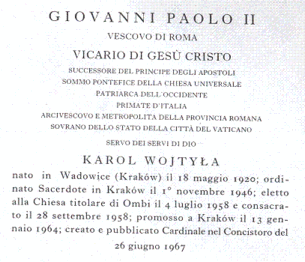
Papal_titlesY’know how B16 just dropped his title "Patriarch of the West"?

The place that he dropped it from was the list of official titles he has in a book known as the Annuario Pontificio ("Papal Yearbook") that the Vatican publishes every year.

If you want to look up the pope’s official titles, this is the place to go.

So how about the Seventh-Day Adventist (and others’) claim that one of the pope’s titles is Vicarius Filii Dei ("Vicar of the Son of God") and that this adds up to 666 in Latin?

Well, t’aint so!

For a start, we can quibble about whether they’ve done their Latin math right. When you put a smaller number to the left of a bigger number, it subtracts rather than adds. IV is 4 in Latin, not 6, and VICARIVS FILII DEI has a IV in it, which would pull the total down to 664. Also, if you let IL count as 49 instead of 51 then the number comes down to 662.

But we don’t need to go there, because if you look at the pope’s official titles, Vicarius Filii Dei ain’t one of ’em!

Above is the page from the 2004 Annuario listing the pope’s official titles. Because this edition is a couple of years old, it lists John Paul II as the reigning pope, and it still has Patriarca Dell’Occidente ("Patriarch of the West") listed as a title.

BUT IT DOES NOT HAVE VICARIUS FILII DEI (or its Italian equivalent; this page in the Annuario is in Italian rather than Latin).

The closest it comes is Vicario di Gesu Cristo ("Vicar of Jesus Christ"). In Latin, that would be Vicarius Jesu Christi. So what does Vicarius Jesu Christi add up to?

Let’s see. . . .

VICARIVS IESV CHRISTI = VI (6) + C (100) + IV (4) + I (1) + V (5) + C (100) + I (1) + I (1) = 218

So there you have it: The number of the pope’s main, official title (the one in big bold print in the Annuario) is 218. (Unless you want to count IV as I + V, in which case it would be 220).

Not so scary after all, huh?

Other Patriarchs In The West?

ED PETERS HAS SOME FUTHER THOUGHTS ON THE POPE DROPPING THE TITLE "PATRIARCH OF THE WEST."

In particular, he wonders whether the move will lead over time to other western patriarchates.

THAT’S AN IDEA THAT WAS FLOATED A WHILE AGO BY PRE-16 HIMSELF.

(Keep reading past the asterisks.)

BUT THERE’S ALSO REASON TO THINK THAT PRE-16 LATER REJECTED THE IDEA.

That doesn’t mean that Ed isn’t right, though. Regardless of what B16 thought when he was dropping the title, the fact of its dropping might in time lead to the development of new patriarchates in the West.