Name Changes & Marriage

A reader writes:

My sister is getting married this summer. She is thinking about keeping our last name instead of taking her husbands name or hyphenation of the two names. I am not sure how I feel about this except that if it is ok with her future husband and her it’s probably ok.

My wife and I talked about it before marrying – my wife changed her maiden name into a second middle name (my family has a two middle name tradition). I might be old fashioned; I would have had a problem with my wife completely rejecting my name and hanging on to hers.

Where does the name change tradition come from? Is there a reason besides tradition to take the grooms last name?

Different cultures handle this issue differently. Not all cultures even have last names, much less do they all have women taking them at marriage.

As a result, there is no in principle reason why your sister could not keep her last name.

That being said, there is a reason why the custom exists in our culture. The basic reason is that our culture (a) does have family names and (b) it is a patrilineal culture.

What the second thing means is that we trace our ancestry, at least dominantly, by the male line (hence: patri- lineal = "by the father’s line"). Not all cultures do this. Some are matrilineal, meaning that they trace descent primarily by the female line (hence: matri- lineal = "by the mother’s line").

The cultures from which ours descended, including not only the major western cultures but also biblical Judaism, were patrilineal. That’s why, even though they didn’t have last names in biblical times, you have Peter being named Simon bar-Jonah (bar- is Aramaic for "son of").

In patrilineal cultures when a marriage occurs the wife becomes part of her husband’s family, and if you have family names in such a culture, it becomes natural for the wife to take her husband’s family name.

There may be a sense in such cultures that both the husband and wife are really part of each other’s families now, but since descent is reckoned by the male line, there is a greater sense that the wife is part of the husband’s family rather than visa versa.

These are the reasons that the custom exists anthropologically, but the origins of the custom tended to be obscured in the minds of many.

When radical feminism came along, it wanted to radically tinker with the sexual status quo, to smash traditional gender roles, and even to call into question the institution of the nuclear family. (I’m talking about radical feminism, mind you, not moderate feminism that merely wanted better treatment for women.)

Doing away with the historical naming conventions would serve those goals (as well as making it harder to keep track of who is related to whom, thus undermining the family), and so not taking the husband’s name became a symbol of defiance against traditional values.

That reason is enough for a traditional minded person to be suspicious of the practice.

It’s not that there’s anything wrong with a woman keeping her own name in principle. It’s done that way in many cultures. But to reject the practice of taking the husband’s name in our culture signifies a rejection of how our culture handles marriage, and that is rightly regarded by many as a danger signal.

Personally, my instincts on such matters are traditional, and I think that we are biblically required to maintain certain elements of the husband-wife relationship as it has been historically understood in Christian culture.

As St. Paul says in Ephesians 5:

21: Be subject to one another out of reverence for Christ.
22: Wives, be subject to your husbands, as to the Lord.
23: For the husband is the head of the wife as Christ is the head of the Church, his body, and is himself its Savior.
24: As the Church is subject to Christ, so let wives also be subject in everything to their husbands.
25: Husbands, love your wives, as Christ loved the Church and gave himself up for her,
26: that he might sanctify her, having cleansed her by the washing of water with the word,
27: that he might present the Church to himself in splendor, without spot or wrinkle or any such thing, that she might be holy and without blemish.
28: Even so husbands should love their wives as their own bodies. He who loves his wife loves himself.
29: For no man ever hates his own flesh, but nourishes and cherishes it, as Christ does the Church,
30: because we are members of his body.
31: "For this reason a man shall leave his father and mother and be joined to his wife, and the two shall become one flesh."
32: This mystery is a profound one, and I am saying that it refers to Christ and the Church;
33: however, let each one of you love his wife as himself, and let the wife see that she respects her husband.

This passage reflects a unity-in-diversity between husbands and wives. Their roles in marriage are not simply interchangeable, but neither may one side take advantage of the other. Both must be treated with equal dignity, even if their roles and obligations are not identical (note: a husband is required to sacrifice himself for his wife in a way that is not true in reverse).

My late wife–Renee–was also traditional in this matter. She wanted to
be called Mrs. Akin. In fact, she loved being called Mrs. James Akin (James being my legal name at the time),
and I felt proud to have her want to share not just one but both of my
names.

I understand the suspicion that many men would have upon learning that a prospective marriage partner wanted to keep her own last name. The question that would immediately come to mind is: "If she rejects this aspect of marriage as it is traditionally handled in our culture, what else about traditional marriage does she reject?"

Should I marry again (as I hope to), I would definitely start asking myself that question if a prospective marriage partner told me that she wanted to keep her own name.

Hope this helps!
Of Course It’s Civil War. So What?

That’s the attitude taken by commentator Charles Krauthammer on the situation in Iraq.

He writes:

This whole debate about civil war is surreal. What is the insurgency if not a war supported by one (minority) part of Iraqi society fighting to prevent the birth of the new Iraqi state supported by another (majority) part of Iraqi society?

By definition that is civil war, and there’s nothing new about it. As I noted here in November 2004: “People keep warning about the danger of civil war. This is absurd. There already is a civil war. It is raging before our eyes. Problem is, only one side” — the Sunni insurgency — “is fighting it.”

Indeed, until very recently that has been the case: ex-Baathist insurgents (aided by the foreign jihadists) fighting on one side, with the United States fighting back in defense of a new Iraq dominated by Shiites and Kurds.

Now all of a sudden everyone is shocked, shocked to find Iraqis going after Iraqis. But is it not our entire counterinsurgency strategy to get Iraqis who believe in the new Iraq to fight Iraqis who want to restore Baathism or impose Taliban-like rule? Does not everyone who wishes us well support the strategy of standing up the Iraqis so we can stand down? And does that not mean getting the Iraqis to fight the civil war themselves?

Hence the gradual transfer of war-making responsibility. Hence the decline of American casualties. Hence the rise of Iraqi casualties.

So for Krauthammer the question is not whether there’s a civil war in Iraq but how do we make sure the right guys win it:

Civil wars are not eternal. This war will end not with an Appomattox instrument of surrender. It will end when a critical mass of Sunnis stops supporting the insurgency and throws in its lot with the new Iraq.

How does this happen? The stick is military — the increased cost in the Sunni blood of continuing the fight. But the carrot is political — a place at the table for those Sunnis, some of whom are represented in parliament, who are prepared to abandon the insurgency for a share of power, a share of oil income and a sense of security and dignity in the new Iraq.

This is doable. That is not to say it will be done. It is to say that those who have decided that because of “civil war” it cannot be done have been unreasonably panicked by something that has been with us all along.

GET THE STORY.

Growing Up

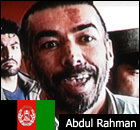
Abdul_rahmanI’ve been meaning to blog about Abdul Rahman, the Afghani convert to Christianity who was imprisoned for his faith and threatened with the death penalty.

(First, please indulge the language nitpicker in me for a moment as I point out that the /h/ in his second name is not silent. His name is pronounced /RAH-man/ with an audible expulsion of air at the end of the first syllable. Rahman is an Arabic word that means "merciful." I don’t know if Mr. Rahman is a speaker of Dari or Pashto or another language, but his second name seems to be a loanword from Arabic.)

Now for actually serious matters:

I’m pleased to report–as you likely already know–that the charges against him have been dropped, albeit on a technicality. The wave of Western pressure on the Afghani government has worked–so far.

But the struggle is not over, since Mr. Rahman’s safety must be secured, and if they just let him loose on the streets then he’ll be killed in short order by fanatical Muslims.

He has now applied for foreign asylum, and Italy has offered it. Other countries are expected to offer it as well.

GET THE STORY.

The larger issue here is that we have a victory in the process of getting Muslims to behave like civilized human beings. Sure, there are plenty of zealots who are willing to off Mr. Rahman in a heartbeat, but the Afghani government has realized that it needed to cave on this one if it didn’t want to alienate the West, upon which it is significantly dependent.

Good.

Muslim countries need to learn that they can’t have it all their own way.

When children learn this fact, we call it "socialization." Right now what the Muslim world needs is a massive series of lessons in socialization.

I’ve already pointed to the need to shame Muslims for unacceptable behavior in their culture, just as children need to be made to feel shame when they have done something unacceptable so that they internalize the drive not to do it again.

The cartoon riots and the vandalism and violence and killings that they resulted in were an example of this. They are something that the Muslim community should feel ashamed of.

So is the treatment of Mr. Rahman.

It’s high time that the West get off its cultural relativist hobby horse and say to the Muslim world: "Some behaviors are simply unacceptable, and you should feel ashamed if you commit or tolerate them. Grow up and clean up your act."

The kind of cultural relativism that has infected many in the West is itself a sign of immaturity. It’s a kind of culturally adolescent phase.

You ever notice how teen agers latch on to cultural relativism as a way of undermining the idea that anything is really wrong–so that they can justify the things that they want to do that are wrong?

It’s when you grow up and really have to take responsibility for yourself that you set aside both the self-centered tantrums of childhood and the kind of self-centered rationalizations that characterize adolescence.

The present confrontations with Muslim tantrumhood may help many in the West grow out of their cultural adolescence.

So we may both get a lesson in growing up.

Word Games On Illegal Immigration?

In his latest column, Thomas Sowell writes (EXCERPTS):

Immigration is yet another issue which we seem unable to discuss rationally — in part because words have been twisted beyond recognition in political rhetoric.

The Bush administration is pushing a program to legalize "guest workers." But what is a guest? Someone you have invited. People who force their way into your home without your permission are called gate crashers.

If truth-in-packaging laws applied to politics, the Bush guest worker program would have to be called a "gate-crasher worker" program. The President’s proposal would solve the problem of illegal immigration by legalizing it after the fact.

We could solve the problem of all illegal activity anywhere by legalizing it. Why use this approach only with immigration? Why should any of us pay a speeding ticket if immigration scofflaws are legalized after the fact for committing a federal crime?

Most of the arguments for not enforcing our immigration laws are exercises in frivolous rhetoric and slippery sophistry, rather than serious arguments that will stand up under scrutiny.

GET THE SCRUTINY.

Lego Parish

Legoparish06A piece back we had a post about a church building made out of Legos.

Here’s another, similar thing, though there are a few differences.

These are explicitly Catholic churches–parishes–and there’s more than one of them. The gentleman who makes them does one per year.

Pictured here is the inside of this year’s (2006’s) Lego parish.

The gentleman who does them writes:

I’ve been reading your blog for a bit now and thought I would share something that I do every year from Christmas to Easter.

http://www.brickshelf.com/cgi-bin/gallery.cgi?m=kc8wzm

The link above is to the galleries that I have set up for the Lego Church Project.

It’s pretty much a Parish done up in legos. LCP06 is the current project that I have built.

HERE’S THE LINK TO THIS YEAR’S LEGO CHURCH.

AND HERE’S THE GALLERY OF PREVIOUS YEARS.

Y’know, even made of Legos, some of these look more conducive to worship than some of the parishes out there.

Confirmation Names

A reader writes:

My girlfriend is teaching the Confirmation class at her parish this year, and the confirmandi just picked their saint names.  One of them chose the name Moses.  I know the greats of the Old Testament are generally considered saints in their own right (or at least, that’s my understanding), but can an Old Testament name be used for Confirmation?

Confirmandi? Wasn’t that an old Jack Kirby comic published by DC? The Last Boy In The Church or something?

(Sorry. Just kidding.)

The answer is that there isn’t a rule here. Canon law does not presently make any provision regarding confirmation names.

As a result, one is free to take a name or not take a name, and there are no canonical restrictions on what such names might be.

That’s not to say that there are no moral limitations on what one could choose. If an uppity young ‘un wanted to take "Hitler" as a confirmation name then the others involved would be quite entitled to say "Nix on that."

A good rule of thumb to follow, though it doesn’t have canonical force when it comes to confirmation, would be what the Code of Canon Law says about baptismal names:

Can.  855

Parents, sponsors, and the pastor are to
take care that a name foreign to Christian sensibility is not given.

"Moses" is not a name that is foreign to Christian sensibility. It may be a name that has Jewish resonances, but it’s part of the Judeo-Christian patrimony, and so it would not be a problem for a confirmand to take this name.

Now CNS Gets Into The Act

Here’s another newsitorial–this time from Catholic News Service.

It has the startling headline:

In immigration law, distinctions of ‘legal,’ ‘illegal’ fairly recent

Huh? Really? Nobody distinguished between legal and illegal aliens until recently?

How does this headline get justified? Let’s look at the opening of the story:

Here’s a little-understood fact about immigration law: Until well into the 20th century, pretty much anyone who showed up at a port of entry or walked across a border got to stay in the United States.

In other words, one reason so many people today can say "my ancestors followed the law when they came here" is because until fairly recently there was no distinction made about whether someone arrived legally or not. With few exceptions, anyone who got here was admitted.

You’ll note that I’ve put two phrases in blue here and two phrases in red.

The blue phrases are designed by the reporter (Patricia Zapor) to convey the impression that it is a "fact" that "there was no distinction made about whether someone arrived legally or not." That serve to justify the headline of the piece.

But the phrases in red indicate that the blue phrases–and the story as a whole–is creating an inaccurate impression. The reporter knows that there was a distinction between legal and illegal immigration, because she concedes that she says people got legally in "pretty much" of the time and that there were "exceptions."

That means that she’s deliberately slanting the news. She knows that the impression she’s trying to create isn’t accurate, but she’s creating it anyway because of her agenda.

Either that or she’s too slow witted to realize the contradiction.

It’s hard to credit the later idea, though, because the contradiction gets more blatant as the story goes on. Later we read:

"The number who got sent back at Ellis Island was less than 2 percent," Meissner told Catholic News Service in an interview, "possibly less than 1 percent."

And those rejections were almost always because the people suffered from an illness that might make them financially dependent upon the community, she said. For instance, a then-common eye infection left victims blind and presumably unable to support themselves. People who had it were turned away.

There were some exceptions to the open-door policy, explains an immigration law history article provided by the U.S. Citizenship and Immigration Services Bureau, as the agency Meissner headed in the 1990s is now called. An 1882 Chinese exclusion law that remained on the books until 1943 was originally aimed at limiting cheap labor.

Other laws of the era excluded polygamists, those with criminal records for "moral turpitude," people with contagious diseases or epilepsy, professional beggars, anarchists and those who were insane.

So it turns out that there were a whole bunch of categories of people who could not legally enter the country, meaning that if they did enter it that their entry was illegal.

The percentage of people who showed up and were disallowed entry may have been smaller than it is today–or it may not have been smaller at all. I don’t know that more than 1-2% of aliens who show up at U.S. airports today get turned away. The story doesn’t go into that. And it’s not the number of people turned away from Ellis Island that indicates how large a problem illegal immigration was, anyway. It’s the number of people who circumvented Ellis Island and similar institutions that’s an indicator of how many illegals there were.

In any event, the story contains abundant evidence that there was a distinction between legal and illegal immigration. "Pretty much anybody" is not the same thing as "anybody."

So what we have here is another instance of a unprofessional story that violates journalistic ethics with a blatant attempt to slant the news in favor of the author’s agenda.

GET THE STORY.

AFP’s Newsitorials

The AFP has a real problem–the same problem that the rest of the Mainstream Media has: It’s can’t stop itself from slanting the news to fit it’s political agenda, and in the most ham-handed, obvoius ways.

Consider the following opening paragraph from an AFP new story:

At least 14,000 mostly Hispanic students stormed out of school classes across Los Angeles in a snowballing protest against Washington’s plans for a draconian crackdown on illegal immigration.

Now look at the last line of the same story:

At least 11 million illegal immigrants, most of them from neighbouring Mexico, live in the United States and are responsible for keeping the human machinery of US cities humming.

This piece is unsigned and is not presented as an editorial. It’s presented as a straight news piece.

Why then is the AFP so blatantly editorializing, referring to "Washington’s plans for a draconian crackdown on illegal immigration" and playing up the role of illegal aliens as being "responsible for keeping the human machinery of US cities humming"?

"Draconian" is an evaluative term, and reporters who make a pretense of objectivity have no business evaluating government programs and telling us whether they are draconian or harmful or beneficial or necessary or anything else.

Neither do they have any business putting positive slants on the role of people who are breaking the law. It would be fair to say that illegal immigrants are tightly knit into the American economy at present, but to say that they keep things "humming" puts a positive spin on their presence.

If an individual reader of the story wanted to conclude that the presence of illegal aliens is a positive thing and that it outweighs the damage done to society by widespread breaking of the law that their presence entails then that would be an opinion that a person might legitimately hold. So would the contrary opinion that the damage done to society outweighs the benefits. It’s a judgment call whether a benefit outweighs a harm or visa versa.

And that’s the point.

It’s a judgment call, and reporters pretending to objectivity have no business making such evaluative judgment calls on behalf of their readers. They should be taking a "Just the facts, ma’am," approach, and leave the editorializing to . . . well . . . editors.

This kind of editorial masquerading as a news story–a "newsitorial," if you will–and especially one as blatantly editorial as this–is just unacceptable from an organization that does not openly and honestly declare itself a partisan entity.

Who do they think they’re fooling?

GET THE STORY.

Attendance At Masses For Special Intentions

A reader writes:

Is there any rule about having to actually attend the a mass that you have said for someone?  Does attending somehow increase the grace that the person receives from the mass?

There is no rule that you have to attend a Mass that is being said for a special intention of yours. This is clear from the fact that people often make offerings to religious orders in distant locations to say Masses for their intentions. It is also clear from the Church’s legislation regarding Mass offerings

ONLINE HERE.

As you can see, these canons do not make any provisions regarding what the laity of give Mass offerings must do. The burden is all on the priest to make sure that the Mass is celebrated in a timely manner. The faithful are not bound to do anything after they have made the offering. In fact, the Code provides that:

Can.  954

If in certain churches or oratories more Masses are asked to be celebrated than can be celebrated there, it is permitted for them to be celebrated elsewhere unless the donors have expressly indicated a contrary intention.

This means that if your church is getting too many requests for Masses that your priest can e-mail his priest buddy up in Alaska and ask him to celebrate Mass for your intention–unless you indicated otherwise (he’ll also need to PayPal your the Mass offering to his priest buddy in this case; see can. 955).

The Code thus does not envision people having an obligation to attend the Masses celebrated for their intentions.

It may be customary in some places–particular in parish settings–for folks to show up at the Masses being celebrated for their intentions, but this is not required or suggested by the Church’s law.

As to the grace that would be given to a person for whom you are having Mass said, your attendance or non-attendance has no bearing on the intrinsic efficacy of the Mass. The person will receive whatever grace God wants them to have on the basis of having Mass said for them.

That being said, if you do attend then it can show an extra level of concern on your part (you went out of your way to personally unite yourself with the prayers of this Mass for this person) and that can serve as a kind of "extra prayer" that you are "saying" by your actions for your friend.

Parents For Confirmation Sponsors?

A reader writes:

Hi Jimmy, Can my mother be my Confirmation sponsor ?  I thought I read a Canon Law stating no parents or spouses of the candidate can be a sponsor. Thanking you in advance of a prompt response, God bless you,

I’m afraid that your mom cannot be your confirmation sponsor. Here’s the canon law on that:

First, the Code of Canon Law establishes that for a person to serve as a confirmation sponsor he or she must meet the requirements of a sponsor for baptism:

Can.  893

§1. To perform the function of sponsor, a person must fulfill the conditions mentioned in can. 874 [which lays out the requirements for baptismal sponsors].

§2. It is desirable to choose as sponsor the one who undertook the same function in baptism.

If we then look at Canon 874 to see what the requirements are for baptismal sponsors, we find:

Can.  874

§1. To be permitted to take on the function of sponsor a person must:

1/ be designated by the one to be baptized, by the parents or the person who takes their place, or in their absence by the pastor or minister and have the aptitude and intention of fulfilling this function;

2/ have completed the sixteenth year of age, unless the diocesan bishop has established another age, or the pastor or minister has granted an exception for a just cause;

3/ be a Catholic who has been confirmed and has already received the most holy sacrament of the Eucharist and who leads a life of faith in keeping with the function to be taken on;

4/ not be bound by any canonical penalty legitimately imposed or declared;

5/ not be the father or mother of the one to be baptized.

§2. A baptized person who belongs to a non-Catholic ecclesial community is not to participate except together with a Catholic sponsor and then only as a witness of the baptism.

So I’m afraid that your mom can’t serve as your confirmation sponsor. It would be preferable (see canon 893 §2, quoted above) if one of your sponsors at baptism (your godparents) were your confirmation sponsor–assuming they still meet all the requirements of canon 874–but this is not required.

Hope this helps!