The Death Penalty & Creeping Infallibilism

A reader writes:

I have heard you talk on "Catholic Answers" several times about what exactly is the Church’s stance on capital punishment.  Invariably you quote from the Catechism that the death penalty is permissible under appropriate conditions and concede that there is some area for discussion over what constitutes those appropriate conditions.

However throughout his long pontificate, Pope John Paul consistently and repeatedly condemned capital punishment at all times in the strongest terms, usually in the same breath as abortion and euthanasia.  Since abortion and euthanasia are considered objectively evil under all circumstances couldn’t this linking the death penalty to them by John Paul (who never spoke an unconsidered word) to be taken as an ex cathedra statement that supercedes the Cathechism that it too is always an objective evil at all times?

I’d take exception to a few of the ways that you’ve characterized JP2’s statements on the death penalty. He didn’t consistently condemn it. He certainly didn’t condemn it when he promulgated the original edition of the Catechism of the Catholic Church, which took a more positive line regarding the use of capital punishment than the later edition.

He also didn’t condemn it in the strongest possible terms. He never said that it is intrinsically evil, as he did with abortion and euthanasia. His statements on the matter frequently include qualifiers and nuances and reservations, because he knew that it is a settled part of Catholic moral teaching (and biblical teaching) that capital punishment is legitimate in principle. It’s only a question of when it should be used (i.e., under what conditions and do they exist today), not whether it is legitimate to use it at all.

Also, while JP2 was a man of enormous intellect and thoughtfulness, he was still a man, and thus could speak unconsidered words (particularly when reading the text of a speech prepared for him by someone else–there are examples of things that had to be corrected in the official editions of speeches he gave that weren’t delivered orally in the way the official edition shows; the most likely explanation here is that he ordered the official edition changed to add or remove a nuance that was in the draft presented for him to read).

Even if he superhumanly never said an unconsidered word, though, and even if he had consistently condemned the death penalty and even if he had done so in strong, unnuanced terms, this would not amount to a ex cathedra statement.

There is no "creeping infallibilism" in the teaching of a single pontiff. If the pope wants to make an ex cathedra statement, he has to make one. One cannot point to a long series of fallible statements by a pope–even one with a twenty six year reign–and say that they add up to an infallible one.

None of the things JP2 said on the dealth penalty used anything like the language popes traditionally use when making ex cathedra statements (the giveaway language for that is "I/we define . . . ," usually buttressed by a direct appeal to his authority as the successor of Peter).

The most authoritative thing JP2 wrote on the death penalty was the brief discussion he gave of it in Evangelium Vitae 56, and there he loaded up what he said with qualifiers and with an acknowlegement of the death penalty in principle.

While he expressed great reserve about the use of the death penalty in this passage, it is (a) a fallible statement and (b) expresses elements of the pope’s prudential judgment rather than matters that belong properly to the deposit of faith given to the Church by Christ and the apostles.

Thus, as Pre-16 noted: "There may be a legitimate diversity of opinion even among Catholics about waging war and applying the death penalty, but not however with regard to abortion and euthanasia."
MORE HERE.

Veiling of Crosses

We’re getting down to that time of year when the crosses in many parishes will be veiled, so it’s nice that the current edition of the BCL [Bishops’ Committee on Liturgy] Newsletter has a brief Q & A on the law regarding the veiling of crosses in the United States.

Here ’tis:

1. Does the new Missale Romanum allow for the veiling of statues and crosses?
The Missale Romanum, editio typica tertia, provides a rubric at the beginning of the texts for the Fifth Sunday of
Lent, which allows that: “the practice of covering crosses and images in the Church from the Fifth Sunday of Lent
is permitted, according to the judgment of the Conferences of Bishops. Crosses remain veiled until the end of the
celebration of the Lord’s Passion on Good Friday; images remain veiled until the beginning of the Easter Vigil.”


2. Have the Bishops of the Unites States expressed the judgment on this practice?

Yes. On June 14, 2001, the Latin Church members of the USCCB approved an adaptation to number 318 of the
General Instruction of the Roman Missal which would allow for the veiling of crosses and images in this manner.
On April 17, 2002, Cardinal Jorge Medina Estevez, Prefect of the Congregation for Divine Worship and the
Discipline of the Sacraments wrote to Bishop Wilton D. Gregory, USCCB President (Prot. no. 1381/01/L), noting
that this matter belonged more properly to the rubrics of the Fifth Sunday of Lent. While the decision of the
USCCB will be included with this rubric when the Roman Missal is eventually published, the veiling of crosses
and images may now take place at the discretion of the local pastor.


3. When may crosses and images be veiled?

Crosses and images may be veiled on the Fifth Sunday of Lent. Crosses are unveiled following the Good Friday
Liturgy, while images are unveiled before the beginning of the Easter Vigil.


3. Is the veiling of crosses and statues required?

No. The veiling is offered as an option, at the discretion of the local pastor.


3. What is the reason for the veiling of crosses and images?

The veiling of crosses and images is a sort of “fasting” from sacred depictions which represent the paschal glory
of our salvation. Just as the Lenten fast concludes with the Paschal feast, so too, our fasting from the cross
culminates in an adoration of the holy wood on which the sacrifice of Calvary was offered for our sins. Likewise,
a fasting from the glorious images of the mysteries of faith and the saints in glory, culminates on the Easter night
with a renewed appreciation of the glorious victory won by Christ, risen from the tomb to win for us eternal life.


4. Why are crosses unveiled after the Good Friday Liturgy?

An important part of the Good Friday Liturgy is the veneration of the cross, which may include its unveiling.
Once the cross to be venerated has been unveiled, it seems logical that all crosses would remain unveiled for the
veneration of the faithful.


5. What do the veils look like?

While liturgical law does not prescribe the form or color of such veils, they have traditionally been made of
simple, lightweight purple cloth, without ornament.


6. Is it permissible to veil the crosses after the Mass of the Lord’s Supper on Holy Thursday?

Yes. The concluding rubrics which follow the text for the Mass of the Lord’s Supper (no. 41) indicate that “at an
opportune time the altar is stripped and, if it is possible, crosses are removed from the church. It is fitting that
crosses which remain in the Church be veiled.”

Why there are three different Question #3s in the list, I couldn’t tell ya, but the data’s good.

Mother Theresa: Non- Favorite Daughter

Mother Theresa is most famous for her work in India. If (really, when) she is declared a saint, she will be known as "St. Theresa of Calcutta." But she wasn’t a native of India, she was a native of Albania, which at the time was a Communist country with a majority Muslim population.

Now there’s controversy in Albania over plans to build a statue of Mother Theresa:

SHKODER, Albania (Reuters) – Muslims in Albania’s northern city of Shkoder are opposing plans to erect a statue to Mother Teresa, the ethnic Albanian Catholic nun in line for elevation to sainthood by the Vatican.

The dispute is unusual for Albania, where religion was banned for 27 years under the regime of dictator Enver Hoxha and where religious harmony and mixed marriages are the norm. Seventy percent of the population are liberal Muslims, the rest are Christian Orthodox and Catholic.

But Muslim groups in Shkoder rejected the local council plan for a Teresa statue, saying it “would offend the feelings of Muslims.”

“We do not want this statue to be erected in a public place because we see her as a religious figure,” said Bashkim Bajraktari, Shkoder’s mufti or Muslim religious leader. “If there must be a statue, let it be in a Catholic space.”

CHT to the guys at LGF, who wryly quip:

Maybe it would be easier for everybody if some sheikh somewhere just made a list of things that don’t offend the feelings of Muslims.

Darth Ginsburg: Petty Judicial Charlatan

Darth Ginsburgh recently gave a speech in South Africa that has received a great deal of comment. In it, she showed herself to be a very petty, spiteful woman who is willing to take cheap and manifestly unjust shots at those who disagree with her judicial philosophy. It really knocked her down several rungs in my book, which I was kind of surprised by considering how low she already was in my book. It turns out that my ladder of respect has more rungs on its lower end than I was previously aware of. (It gets kinda dim down there, and my eyes aren’t so good, y’know.)

As part of the speech, she defended the indefensible way in which recent SCOTUS cases have relied on foreign law, which I think constitute grounds for impeachment for her and the other justices who drew on foreign law sources to overrule the will of the American people as expressed through the laws that had been democratically established in this country.

Jeremy Rabkin has an interesting look at Ginsburgh’s defense of the indefensible, which is quite insightful.

In part he point out:

In her South Africa speech, Justice Ginsburg tried to frame such practices as looking to foreign law to "add to the store of knowledge relevant to the solution of trying questions." It is much closer to the truth to say that what the Court is doing is shifting its perspective from America to the world at large, so that positions with less support in the United States can still be viewed–in a global context–as majority or dominant positions. Rather than looking to thoughtful analysis of "trying questions," the Court, in effect, takes a poll–on an international basis.

In all three recent cases where foreign opinion was cited, the Court faced the difficulty of explaining why it was abandoning contrary constitutional rulings from as recently as the 1980s. The Court tried to say that opinion had since changed, as some states had changed their laws on such questions as whether tests of mental deficiency would be relevant to imposition of the death penalty. Not enough states had actually changed their laws, so the Court, in effect, enlarged the count to include foreign jurisdictions. Red states and blue states might be evenly balanced at home but 25 nation-states of the European Union could tip the balance, if counted.

In one of its capital punishment cases, as Justice Ginsburg noted, the Court had received amicus briefs from Nobel Prize winners such as Jimmy Carter. What has this to do with legal analysis? It is simply a way of appealing from the views of American voters to those of electors for the Nobel Prize–the sort of people who regard President Bush as a reckless cowboy and Jimmy Carter as a distinguished statesman.

He also illustrates the problem in a way that may be of special interest to JA.O readers, considering how often the topic of canon law comes up here:

To see the partisan character of appeals to foreign authorities in this setting, one need only think of a close analogy. If foreign law, why not religious law? Why not the canon law of the Catholic Church? As it happens, the U.S. Supreme Court has cited "canon law" in more than two dozen cases over the past 200 years. Most of the references are entirely incidental, but a few cases in the early 20th century actually engaged with Church sources, among others, in wrestling with the meaning of "due process." More recent cases have insisted that secular courts cannot enter into disputed questions of church law when asked to determine claims about ownership of church property or tenure in religious office.

Suppose that Catholic or conservative justices began to regularly cite canon law on the most controversial constitutional disputes–on such matters as family law or medical ethics. These justices could insist, as Justice Ginsburg does, that such "foreign opinions are not authoritative" and "set no binding precedent for the U.S. judge" but simply "add to the store of knowledge." In today’s world, the protests from liberals would be deafening, because such soothing abstractions would be seen as disingenuous. To treat canon law as any sort of "persuasive authority" would be intensely divisive. The "foreign opinion" that liberals prefer has no more inherent relevance or authority, however. We could save a lot of needless dispute by agreeing in advance that all sides will play by American rules.

One can imagine the howl that would go up from liberals if the Court took this path, and it does indeed illustrate the circumvention of the will of the American people by drawing substance from law sources that the American people have not voted for.

But this is just one of the problems that Rabkin brings out in his essay, so

GET THE STORY.

Benedict: Year One

John Allen has a thoughtful (and lengthy!) analysis of the first year of B16’s reign. It’s worth reading as a whole, but I wanted to call attention to this one point, in which Allen is describing the reaction many had to Benedict’s election:

[I]n the immediate aftermath of his election, most commentators fell back upon tried-and-true labels: "archconservative," "authoritarian," "hard-line."

Probably the best expression of all this came in an editorial cartoon in L’Unità, the newspaper of the old Communist Party in Italy. Understanding the cartoon requires a bit of background. In Italy, perhaps the most revered pope of modern times is John XXIII, know as il papa buono, "The Good Pope." One treasured memory of John XXIII is an evening in October 1962, the opening of the Second Vatican Council, when the Catholic Action movement organized a torchlight parade that finished in St. Peter’s Square. The pope was not scheduled to address the crowd, but when it arrived, John XXIII wanted to speak. He said something burned into the consciousness of most Italians, repeated endlessly on television and radio. Smiling down on the crowd, he said: Tornando a casa, troverete i bambini. Date una carezza ai vostri bambini e dite: questa è la carezza del Papa. It means, "When you go home, you’ll find your children. Give them a kiss, and tell them that this kiss comes from the pope." It summed up the legendary love of the man.

Thus the L’Unità cartoon showed Benedict XVI at the same window, saying, "Tonight, when you go home, I want you to give your children a spanking, and tell them that this spanking comes from the pope."

ROFL!

GET THE STORY.

Strange Evangelization Stories #1

Tim Powers (who says it’s okay to blog this) writes:

Did I tell you about the time a crowd of Jehovah’s Witnesses came to our house to tell us the truth about Jesus? I had read their pamphlet on why the Trinity is a bogus idea, and it quoted a whole bunch of the Fathers, as well as the Will & Ariel Durant History of Civilization, and I assembled all the full quotes that their pamphlet had given out-of-context phrases from, and I was well into my devastating rebuttal, when I —

Well, my eyes are no good, and I’ve got to read with a magnifying glass. And we were outside, and I said, "Let me see your Bible, and I’ll show youright in it  why you’re wrong. I won’t use a Catholic Bible, since you’d believe theyr’e unreliable, so let me see yours." And they handed their New World Translation Bible to me, and I started to read something from it, but it was a real sunny day, and I accidentally set their Bible on fire. I’m sure they went home and told their friends, "Those Catholics just have to touch a Bible and it bursts into flames!"

ROFL!

Tim and his wife, Serena, say that the JWs refused to take back the Bible after this incident and so they still have it!

Incidentally, Tim and Serena visited Catholic Answers yesterday and sat in on the show. They even said howdy to the audience, so if you’d like to hear what they sound like,

LISTEN HERE.

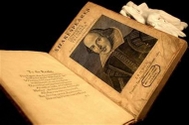
Shakespeare Sale

Shakespearefolio_1

If you have a spare 3.5 million lying around (pounds, that is; in U.S. dollars you’ll need $6.1 million), you may want to consider investing it in an original Shakespeare First Folio that will be auctioned off by Sotheby’s in July:

"Hailed by auctioneer Sotheby’s as the most important book in English literature, the First Folio is credited with saving for posterity many of the bard’s plays including ‘Macbeth,’ ‘Twelfth Night’ and ‘Julius Caesar’ which had never before been printed.

"’The First Folio preserves 18 of his plays, including some of the most major, which otherwise would have been lost for all time,’ English literature specialist Peter Selley said as the volume was put on show on Thursday.

"’Relatively complete copies of the Folio in contemporary or near contemporary bindings very rarely come to market. There is only one copy recorded as remaining in private hands,’ he added."

GET THE STORY.

Baptizing TomKat’s Baby

Tom Cruise and Katie Holmes (a.k.a. TomKat, apparently) are having a baby.

Tom Cruise and Katie Holmes are also both baptized Catholic.

But now Tom is a Scientologist, and Katie seems to be leaning that way.

Katie’s parents are pushing for the baby to be baptized.

Will Church law and pastoral practice permit this?

CANONIST ED PETERS TAKES ON THE ISSUE.

In reading what he says, be careful to note the distinction Ed uses between delaying baptism and denying baptism.

There is a difference there.

Catholics With Murderous Tendencies?

Arthur of the Ancient and Illuminated Seers of Bavaria (who says it’s okay to blog this) writes:

Amongst other things, I enjoy reading murder mysteries, especially those from the golden age of the English whodunnit in the 20s and 30. Recently I’ve been reading up on the lives of some of those authors and I came across something rather surprising.

Of the five great authors of the English golden age, Agatha Christie, Margery Allingham, Dorothy L. Sayers, G.K. Chesterton and Ronald Knox, all but one (Christie) were Catholic!  Indeed of those three (Sayers, Chesterton and Knox) were also serious authors on philosophical matters and theology.  Okay Knox was primarily a theologian who dabbled in mystery writing, but you get my drift.  🙂

I’m not sure exactly what that means, but I found it interesting.

I’m not sure what it means, either. It could be random chance, but . . .

. . . Jack Chick might take it as evidence that Catholics just have murderous tendencies.

. . . Some psychologists might take it as evidence that British Catholics have murderous thoughts, given how much they suffered persecution from the British Crown and how much alienation they suffered in British society.

. . . I might take it to mean that there’s an intellectual streak in Catholicism that results in its authors liking intellectual puzzles and this tendency then manifesting in literary form (the murder mystery being a familiar form of intellectual puzzle in fiction).

What’s your explanation for the phenomenon?