All the Right Enemies

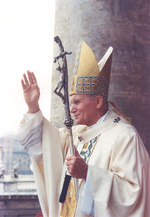
Johnpauliiwave_1Not surprisingly, a group of Catholic dissidents has bravely united to offer opposition to the beatification of John Paul II.

According to the Catholic World News article, the group includes "11 theologians and one journalist from Europe and Latin America". Apparently, the group tried to enlist Hans Kung, but he didn’t bite.

We Are Church "has not taken a public stance" on JPII’s beatification, but earlier noted that his pontificate was "full of contradictions".

Let’s look at the list of problems the group saw with the JPII’s pontificate:

"1. the "repression and marginalization" of controversial theologians;
2. the movement away from collegiality in Church governance;
3. the unwillingness to engage in "real and serious debate about the status of women in the Roman Catholic Church;"
4. the opposition to "a reconsideration– in the light of the Gospel,
science, and history– of certain norms of sexual ethics;"
5. the adherence to the discipline of clerical celibacy–which, the
statement said, continues despite the evidence that many priests in
some geographical regions live with women, and the sexual abuse of
children in other regions;
6. the lack of control over Church financial institutions, leading to the banking scandals of the 1980s;
7. the "ecclesial isolation" of Archbishop Oscar Romero and the failure to support the theology of liberation in Latin America."

Gee, they talk about repression and marginalization like its a bad thing. This looks like a list of recommendations, to me. Not that there couldn’t be some legitimate gripes about JPII, but overall, if this is the opposition, he must have been doing something right.

GET THE STORY.

A Sunday-Night Line-Up

You ever get the feeling when watching a television show that the writers might as well have a Greek chorus descend at the end to announce the theme of the episode, just in case they haven’t yet gotten their message across? I had that feeling when watching Cold Case this past Sunday.

The story revolved around a teenage couple who found themselves pregnant. It’s 1988 and by the end of the school year the teenage dad will have been mowed down in a hit-and-run and the teenage mom will have tossed the baby in the trash. In 2005, the child — a healthy white newborn girl born under conditions that would have brought national media coverage and a legion of prospective adoptive parents who somehow was unadoptable and spent the past seventeen years in foster care — will be approached by someone claiming to have been her "real" dad. So the hunt is on for this guy and for whoever ran over the other young man seventeen years earlier.

In the process of solving the story we find that the couple first turned to a school nurse about the possibility of an abortion.  Nurse Virtue turned out to be a pro-life wacko who believes in “punishing” anyone involved with abortion. On the side, she’s a promiscuous hypocrite who has been making time with a married math teacher whose marriage is in trouble because he and his wife cannot conceive children. No matter that a school nurse is statistically more likely to be willing to ferry the girl to Planned Parenthood than to run over those who provide or consider abortion. She’s a source for a few well-placed jabs at “nut job” anti-abortionists. The show will end by showing Nurse Virtue avidly reading a sexy romance novel.

We also find out that the teen mom was molested by the track coach. He pushes the teen dad to seek the abortion — and is even willing to provide the funds for the abortion — so that the kid will be free to pursue a track scholarship, but seventeen years later it is the track coach molester who has been stalking the teen girl he believes is his. Uhm, yeah.

To top it all, the killer turns out to be the math teacher whose hopes to adopt the baby were dashed when the teen dad told him that he could not bear to give up “his girls.” Enraged, the prospective adoptive parent ran down the “heroic” dad who “valiantly” decided to forego adoption for marriage and an instant family with a young woman whom he believed had been sleeping around and whose child might not be his.

So, where was the Greek chorus chanting “Abortion is our friend”? Maybe it wasn’t in the budget.

Immediately after this Very Special Episode of Cold Case was the opening night of CBS’s miniseries Pope John Paul II, which was advertised as papally blessed by Benedict XVI. That night’s episode was so incredibly good that I can’t wait for tonight’s conclusion and I would buy a DVD of the movie in a heartbeat. It certainly deserved a papal blessing.

One of my favorite parts of the movie, so far, was a vignette in that evening’s episode of a young Father Wojtyla counseling his students on the importance of sexual responsibility. The message he gave was completely and totally Catholic and amazing to hear on primetime network TV….

Especially considering the Coincidence of the Cold Case episode that preceded it.

One Piece At A Time

According to THIS STORY,

The president of Ferrari gave a Formula One steering wheel as a symbolic gift to Benedict XVI, the "pilot of Christianity."

Luca Cordero di Montezemolo, who is also president of the FIAT Italian car company, on Monday gave the Pope a check for €950,000 ($1.1 million), which the Holy Father will allocate to charitable works.

Attending Monday’s audience were Ferrari executives, including Piero Ferrari, the founder’s son and vice president of the firm.

"The F1 steering wheel of the champion of the world, for Your Holiness Benedict XVI, pilot of Christianity," read the message on the gift given to the Pope.

"It is very complicated, Holiness," explained Montezemolo, referring to the difficulty of steering a racing car. Joking, the Pope noted the "complexity" of guiding the Church.

Y’know, given the traditional papal attire, the pope is a MAN IN WHITE.

In light of this story, I just can’t help wondering if he’s also a fan of

THE MAN IN BLACK.

Pope To Change D&D Cosmology

A BIG CHT to the reader who sent THIS!

Pope to change D&D cosmology

Vatican City (Reuters): The Pope is set to abolish the concept of Limbo, overturning a belief held by Dungeons & Dragons players since Gary Gygax first described the cosmology of the game in the Players Handbook in 1978.

Limbo has long been held by the Catholic Church to be the place where the souls of children go if they die before they can be baptised, as well as the source of the chaotic neutral alignment and home of the Slaadi. However, a 30-strong international commission of theologians summoned by the late John Paul II last year to come up with a "more coherent and illuminating" doctrine in tune with the modern age is to present its findings to Pope Benedict XVI on Friday.

Vatican sources said yesterday that the commission would recommend that Limbo be replaced by the more "compassionate" doctrine that all children who die do so "in the hope of eternal salvation", rather than the traditionally held belief that their souls suffer eternal deprivations at the hands of the Slaadi and their demented lords Ssendam and Ygorl.

What this change in theology will do for the millions of Dungeons & Dragons players across the world is not yet clear. . . .

That’s JUST the beginning, so . . .

GET THE STORY!

Student’s Altar Call Rankles ACLU Prigs

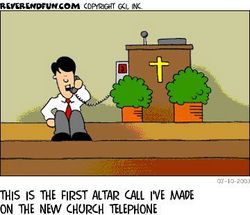
Altarcall_1Agapé Press notes that the Arkansas chapter of the ACLU is freaking out over a student-initiated "altar call" at Jonesboro High School’s graduation ceremony last May.

For you cradle Catholics, an altar call is the point in many
evangelical church services (usually at the end) where those who have
not yet come to "know Jesus" are invited to "ask him into their heart".
They are normally encouraged to pray the "sinner’s prayer" and accept
Jesus as "Lord and Savior".

I spent alot of time in Jonesboro (or Jome-ber) during my formative years. As a high-school student in tiny Black Rock, Arkansas, Jonesboro was where we took our dates to the movies. Later, I attended Arkansas State University, which is located in Jonesboro.

Catholics don’t "do" altar calls, and as a Catholic, a surprise altar call is not something I would expect at a graduation ceremony. Given Jonesboro’s location smack in the middle of the Bible Belt, though, I would not be that surprised, either. I certainly wouldn’t be offended. The young woman giving the speech, Jessica Reed, was voicing her own views about life, having been invited to do so by virtue of her standing at the head of her class.

According to the article, the ACLU is, oddly, accusing her of violating the first amendment. Now, I’m no lawyer, but it would seem to me that it would be a violation of her first amendment rights if the school were to vet her comments or censor her speech, unless it were for obscenity. It is settled law that schools can’t censor student newspapers in the same way.

One observer notes that-

"…the ACLU is
frantically searching for a plaintiff in Jonesboro in hopes of suing
the school for an alleged unconstitutional endorsement of religion, but
has yet to find one.".

I would think that, whether or not you see eye-to-eye with Jessica Reed on the subject of Eternal Salvation, her comments would at least provide an opportunity to talk with your kid about the meaning of life. It would be what they call a "teachable moment", whether you were pro- or anti-altar call. Or does the ACLU expect everyone to accept the twisted notion that people just shouldn’t discuss such things?

I thought that one of the benefits of our advanced, industrialized society was that we would all have more time to think about and discuss such things. I thought our increased leisure was supposed to be dedicated to higher pursuits, like sharing ideas about the meaning of life. 

This Catholic supports Jessica Reed’s right to free speech.

When the subject comes up, I always tell my kids the same thing: asking Jesus into our hearts is a good thing, and it is important that we do it every day.

Being Catholics, though, we believe the invitation runs both ways. Even as we ask Jesus to dwell in our hearts, we are invited to take refuge in his Sacred Heart.

GET THE STORY.

Right now…

Don’t put it off…

Just stand up wherever you are… that’s right… come right on up front and GET THE STORY.

I’m going to ask the piano player to just keep playing quietly…

Encyclical Rumor Update

Recently I reported the current word-on-the-ecclesiastical-street regarding B16’s forthcoming first encyclical, which will reportedly be titled Deus Charitatis Est ("God Is Love") and involve a meditation on the obvious theme of the title, which is drawn from 1 John.

When I reported this, I was a little suprised at the disappointment some expressed in the combox, and so I thought (before getting to some new rumors regarding the encyclical) I’d issue a word of encouragement.

Upon learning the title of the encyclical, I wasn’t disappointed at all, for these reasons:

  1. There are some interesting questions theologically about what is and isn’t meant by the affirmation that God is love, and we could (maybe) be looking at some doctrinal development depending on what B16 chooses to do.
  2. The titles of first encyclicals often aren’t exhaustive of what the documents discuss. For example, JP2’s first encyclical was called Redemptor Hominis ("Redeemer of Man"), but the encylical wasn’t just a meditation on Christ the Redeemer. IT CONTAINED A BLUEPRINT FOR JOHN PAUL II’S ENTIRE PONTIFICATE. That was to be expected–at least somewhat since first encyclicals to at least announce the pope’s program of governance (though it’s really amazing to read Redemptor Hominis and see in it the seeds for basically everything JP2 did in the next 26 years). We should expect the same of B16’s first encyclical. No matter what it’s called, he should be expected to tell us his program of governance.
  3. It seems to me that the title reflects this. In fact, I smell a "bank shot" to borrow a term from billiards. He wants to send a positive, open impression that corresponds to his own outlook (he talks about love and joy a lot in his prior interviews) but at the same time stress that the fact that God is love is NOT a license to do or believe anything that you want–that love makes real demands and involves sharing the truth with people. Thus "God is love" is likely to be the avenue of attack he has chosen against the "dictatorship of relativism" that he spoke of after the death of JP2.

So don’t expect this to be just a contentless meditation on God and love of the sort that you’re likely to hear from the pulpit on Sunday morning!

Remember: You heard it hear first.

Now, let’s turn from the speculation and get to the rumors!

Catholic News Agency is reporting:

The Italian daily “La Stampa,” announced today that the Pope Benedict XVI’s first encyclical, that other source already mentioned would be versed in the theme of Charity, could be released in the beginning of January, probably on January 6, day of the Solemnity of the Epiphany.

Again according to La Stampa, the Encyclical will bear the date of December 8, 2005, Solemnity of the Immaculate Conception, an emblematic date not only for its Marian character, but also because it coincides with the 40th anniversary of the closing of the Vatican II Council.

A source in the Vatican, commented to CNA that the date of release announced by La Stampa is only an approximation because  the Holy See usually doesn’t  release important document on holidays, as the Epiphany is at the Vatican or in many European countries. “It is more probable that the Encyclical will be released later in January, although the exact date is given only a few days before,” said the source.

The title of the Encyclical, again according to La Stampa, centered on the theme of Christian  Charity and the Love of God will be “Deus Caritas est,” (God is Love), taken from the fourth chapter of the First Letter of Saint John [SOURCE].

Music Composition Bleg

MusicnotesI’ve got an idea.

But I can’t tell you what it is yet. (And no, it’s not one of the three secrets. It’s a NEW one.)

What I can tell you is that it involves music. (And no, it’s not writing new music for Mass. It’s for something else.)

Unfortunately, my music composition skills are quite limited–as are my performance skills.

So I need someone to help me.

I am therefore wondering if anyone can point me toward a music composition service that accepts work-made-for-hire orders and that isn’t overly hugely expensive. (The work-made-for-hire aspect is important as this is a project that would be for the service of the Church and so I need to keep ahold of the rights to the music.)

I’m looking to get a number of very short tunes written and performed and recorded. I don’t care too much about the instrument (piano, guitar, keyboards, etc.) as that’s not what is important for the project I have in mind.

The melodies themselves would need to be catchy–like jingles–but would not need to have amazing artistic qualities or orchestrations beyond that.

I can even supply prototypes for these melodies, so they may not need more than touching up and performance.

Something close to chants would also work for these.

Can anyone point me in the right direction on this kind of thing?

Promenading Out

Dancers_1

Some New York Catholic schools have cancelled plans for junior and senior proms, citing "flamboyance, extremism and affluence," among other undesirable behaviors.

"Staff at Chaminade High School — an all-boys’ school in Mineola run by the Marianist religious order — announced the cancellation Wednesday in school, and letters also were mailed to parents early Tuesday.

"’The prom culture has turned from a formal celebration to a showcase featuring flamboyance, extremism and affluence,’ the letter reads. ‘In fact, many students seek to leave the celebration early to engage in excessive behaviors, some of which are illegal.’

[…]

"Chaminade’s president, the Rev. James Williams, said yesterday that the modern prom is more about spreading peacock feathers than togetherness and farewells. ‘The prom is no longer the focus of the evening,’ Williams said, adding that most students make brief appearances in stretch limos and fancy outfits, then rush off elsewhere.

"’It’s very different than it was 15, 20 years ago,’ he added. ‘The evening is now about who will have the biggest limo, who has the biggest weekend planned. It’s beyond reform.’"

GET THE STORY.

My guess is that Fr. Williams did not frequent the proms of fifteen or twenty years ago. I graduated in 1990 and did not attend my prom, in large part because the expense was hideous and roughly comparable to the expense for a budget wedding. Between the tickets, the clothes, the transportation, etc. — all to a plush five-star downtown hotel rather than the school’s gym — there was no way the event was affordable to any but the most affluent families. In short, conspicuous consumption on prom night is not a new phenomenon.

But my feeling is that chucking the tradition of a formal dance to close out the high school experience is the wrong way to go. Junior proms can certainly be tossed — one prom per year is quite enough — but the senior prom can be a charming tradition. What’s needed is common sense: Move it back to the school gym; set a spending limit for dance hall accoutrements, formal clothes, and transportation; insist that unless there is an emergency that couples remain at the dance for a specified time period; that kind of thing. Tossing the baby with the bathwater is too easy and does not teach students anything.

Impending Plenary Indulgence Opportunity

‘Member back in 2000 when JP2 issued a plenary indulgence for the Jubilee Year? Man, a bunch of people were acting like this was a once-in-a-lifetime opportunity–as if you couldn’t obtain a plenary indulgence on any day you choose.

That being said, the issuing of plenary indulgences of particular occasions doesn’t happen that often, and so it’s notable when it does.

Folks may want to know, therefore, that B16 has issued a plenary indulgence for this Thursday, October 8, which is the feast of the Immaculate Conception and the 40th anniversary of the closing of Vatican II. Thus, according to the OFFICIAL DECREE, the faithful may obtain a pleanary ingulence

if they participate in a sacred rite in its [the Immaculate Conception’s] honour or at least offer an open witness of Marian devotion before an image of Our Lady of the Immaculate Conception, displayed for public veneration, adding the recitation of the Our Father and the Creed and exclamatory invocations to Mary Immaculate, such as "You are All Fair, Mary, and in you there is no stain of original sin!", or "O Queen, conceived without original sin, pray for us!".

Lastly, all the faithful who are prevented from participation by ill health or by another just cause, may obtain on that same day the same gift of the Plenary Indulgence at home or wherever they may be, as long as, with their minds detached from any sin and with the resolution to fulfil the above-mentioned conditions as soon as possible, they are united with spiritual resolve and desire with the intentions of the Supreme Pontiff in prayer to Mary Immaculate and recite the Our Father and the Creed.

All this, of course, is assuming "the usual conditions" for a plenary indulgence are fulfilled, which raises the question: "What are the usual conditions?"

n. 7—To acquire a plenary indulgence it is necessary to perform the work to which the indulgence is attached and to fulfill three conditions: sacramental confession, Eucharistic Communion and prayer for the intentions of the Supreme Pontiff. It is further required that all attachment to sin, even to venial sin, be absent.

If this disposition is in any way less than complete, or if the prescribed three conditions are not fulfilled, the indulgence will be only partial, except for the provisions contained in n.11 for those who are "impeded."

n. 8—The three conditions may be fulfilled several days before or after the performance of the prescribed work; nevertheless it is fitting that Communion be received and the prayers for the intentions of the Supreme Pontiff be said the same day the work is performed.

n. 9—A single sacramental confession suffices for gaining several plenary indulgences, but Communion must be received and prayers for the Supreme Pontiff’s intentions recited for the gaining of each plenary indulgence.

n. 10—The condition of praying for the Supreme Pontiff’s intentions is fully satisfied by reciting one "Our Father" and one "Hail Mary"; nevertheless the individual faithful are free to recite any other prayer according to their own piety and devotion toward the Supreme Pontiff [SOURCE].

Reversion Issues

A Catholic reader who left the faith, was baptized in a Protestant church, and then returned to the faith writes:

I realize that the baptism I sought in a Protestant Church did not invalidate my original baptism since baptism is an indelible mark on the soul.  Yet, since I publicly rejected the Faith, is there anything that must be done, aside from Sacramental Confession, to demonstrate my return to communion with the Catholic Church?

No, making a good sacramental confession is all that is needed (i.e., one mentioning that you had left the faith and attempted baptism outside the Church).

Is there anything that can be done optionally?

Buy a really big crucifix and put it on your wall?

There are no Church-approved optional ceremonies for a person returning in this fashion, but there is no reason you can’t do something concrete–such as getting a really big crucifix–to symbolize your return to the faith.

Secondly, if I was in a state of mortal sin by having formally rejected the Catholic Faith, and yet continued to receive the Eucharist and go to confession at the same time, are the confessions I made in the period between when I was baptised outside the Church and when I returned to full communion with the Church (and finally confessed the baptism outside of the Church) invalid?  If so do I need to make a general confession for this time period?

This is a more complicated question. You begin it with the supposition that you committed a mortal sin in your rejection of the faith. That’s not at all an unreasonable supposition, for you were beyond the age of reason when you left (based on other things you say in your e-mail), but the Church would not teach that you automatically were in a state of mortal sin.

*IF* you were in mortal sin due to your repudiation of the faith and your attempted re-baptism *AND* you knew that you needed to mention this in confession *AND* if you didn’t mention it *THEN* the confessions were invalid and a general confession for the period would be mandatory (including the times you went to Communion and confession knowing that you shouldn’t).

On the other hand, there are a significant number of conditions there complicating matters.

My advice would be to go ahead and do a general confession for the period. Rather than try to nail down exactly what you were responsible for and in what degree, though, I would suggest that you name the objective acts you did (repudiate the faith, attempt baptism outside the church, continue to go to Communion and occasionally confession in the Church) and then say that you are not entirely sure of your culpability for each of these at the time (assuming that is the case), but that you wish to confess them *IN CASE* you need to do so.

Hope this helps, and welcome back!

20