Save the Rainbow!

Rainbowbook_1The rainbow used to be the very symbol of simple, innocent beauty. Noah’s Ark, the Wizard of Oz… heck, Kermit the Frog – these are the kinds of things that used to come to mind when we thought of rainbows. As an artist, the rainbow represents all the possibilities of the limited palette; from these few colors, you could paint anything.

Nowadays, though, the rainbow has been co-opted for more nefarious uses. From GLAAD (Gay and Lesbian Alliance Against Defamation) to Jesse Jackson’s Rainbow Coalition, the rainbow has been adopted as a symbol to give a veneer of happy innocence to the twisted causes of these groups.

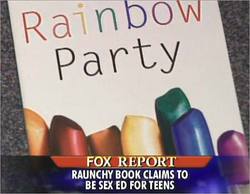
Now, the rainbow is being dragged even more deeply into the muck. A new book, Rainbow Party, tells the story of a group of teens who engage in a fairly new form of group sex involving girls wearing different colored lipstick (so, if your kid is ever invited to a rainbow party, just be informed that they will not be doing crafts for entertainment). The book itself would be less irksome if it were not written by an author of juvenile fiction and published by Simon Pulse, a division of Simon & Scuster that specializes in books for teens.

Michelle Malkin comments on the book in the Houston Chronicle, and points out why it is closer to sex-ploitation than to education. Under the guise of "educating the yutes" it will doubtless be showing up in school libraries before long. It reminds me of Reefer Madness, a classic exploitation flick which was designed to generate ticket sales and controversy, but was billed as being for educational purposes (it was re-released at one time under the frantic title Tell Your Children!).

GET THE "COLORFUL" STORY.

Poison!

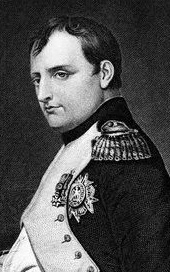
Napoleon1Stomach cancer may be what carried off H. P. Lovecraft. And it may be what Napoleon’s doctor put on his death certificate, but new findings strengthen the case that it wasn’t what carried off French emperor Napoleon.

Poison was.

Specifically, arsenic.

Some time ago, hair samples from Napoleon were found to contain abnormally high traces of arsenic, leading to speculation that he was poisoned.

SOME DISAGREED.

Some of the speculation centered on the idea that the abnormally high levels of arsenic might be due to environmental factors, such as the use of arsenic in certain kinds of wall paper at the time.

But new findings suggest that the arsenic in his hair was absorbed from his bloodstream, indicating frighteningly high serum concentrations of arsenic and thus a deliberate poisoning.

EXCERPTS:

The toxic form of arsenic, used for centuries as rat poison, was found in Napoleon’s hair samples at 37 to 42 times above the normal level in the new study.

"I can’t imagine Napoleon fed himself rat poison, even if he wasn’t a gourmet," joked Damamme of Montreal-based INS.

"The arsenic was in the ‘spinal cord’ of the hair, which implies that it came from the blood and food ingested," he said.

"Somebody in his circle gave him arsenic in small doses to poison him little by little to avoid another violent uprising by those who still supported the emperor in France," Damamme said.

GET THE STORY.

Now if they just had biological samples from the emperors Augustus and Claudius to verify the poisonings that reportedly did them in.

The Papers That Didn't Burn

So on Friday B16 named JP2’s personal secretary, Archbishop Stanislaw Dziwisz, to be the new archbishop of Krakow–the post Karol Wojtyla held before he became JP2.

Cool. A reward for a career of faithful service, no?

But on Saturday something emerged calling into question the precise degree of faithfulness that was involved: Archbishop Dziwisz announced that he had failed to burn all of JP2’s private papers, as called for in his will!

EXCERPTS:

Archbishop Stanislaw Dziwisz, who worked with the pope from 1966 until his death earlier this year, told Polish state radio there are "quite a lot of manuscripts on various issues," but he offered no details.

"Nothing has been burned," Dziwisz said. "Nothing is fit for burning, everything should be preserved and kept for history, for the future generations – every single sentence."

"These are great riches that should gradually be made available to the public."

Dziwisz did not say when or how that might happen.

In Saturday’s radio interview, Dziwisz suggested that some of the notes could prove useful in the late pontiff’s beatification process.

Now, I don’t know if Archbishop Dziwisz was himself charged with burning the papers, nor do I know if he was ordered not to do so by someone with the authority to give this order (e.g., B16), so I don’t know how to appraise his role in this.

Still, my feelings about this revelation are profoundly . . . mixed.

As they were when it was announced that JP2’s will called for all his private papers to be burned. I recognized that this represented a huge loss to historians, but on the other hand it was JP2’s will–and in his will–and you don’t disobey what someone says in his will.

I also have some sympathy for JP2’s desire. There have been people who’ve been badly burned historically by folks rumaging through their papers and the misrepresenting them.

It happened to Friedrich Nietzsche, for example. After he was institutionalized, his anti-Semitic, German-nationalistic sister went through his papers and "edited" them for publication. She also promoted what she proclaimed as "his" philosophy, which was really her own and which served to make Nietzsche an inspirational figure for Hitler and the Nazi party (contrary to what Nietzsche himself would have wanted).

While one hopes that the proper scholarly controls will be employed in any evaluation of JP2’s private papers, the potential for mischief is significant.

For one, we have no idea what state those papers are in. It may be that it will be hard or impossible to determine what was authored by the late pontiff and what wasn’t. People may have sent him drafts of things that found their way into his private papers, and some of these might be assumed to have been authored by the pope himself. Others’ (potentially lame-brained) ideas thus might end up being ascribed to JP2.

Also there is a fact that someone’s private papers are things that–by definition–the person did not intend for publication. Private papers frequently represent efforts individuals make at "trying out" ideas or ways of approaching a subject, only to have the individual himself conclude that this was a bad start that was unworthy of publication.

There may even be things in a person’s private papers where he tries to write out the strongest case he can make for a position he disagrees with–so that he can use this brief as a foil for later knocking down the position.

And then there is the danger of sensationalism–of an individual gaining (or claiming to have gained) access to the "secret" JP2 private papers and publishing books erroneously purporting to give his "true, private views" on matters.

Try to imagine what "historians" have done to Pius XII being done to JP2 to get an idea of what this could involve.

So while I am, on the one hand, pleased that JP2’s private papers are not lost to historians, I am simultaneously apprehensive about the use and misuse that might be made of them and concerned about the apparent violation of a clause of his will.

GET THE STORY.

(CHT to the reader who e-mailed.)
The Papers That Didn’t Burn

So on Friday B16 named JP2’s personal secretary, Archbishop Stanislaw Dziwisz, to be the new archbishop of Krakow–the post Karol Wojtyla held before he became JP2.

Cool. A reward for a career of faithful service, no?

But on Saturday something emerged calling into question the precise degree of faithfulness that was involved: Archbishop Dziwisz announced that he had failed to burn all of JP2’s private papers, as called for in his will!

EXCERPTS:

Archbishop Stanislaw Dziwisz, who worked with the pope from 1966 until his death earlier this year, told Polish state radio there are "quite a lot of manuscripts on various issues," but he offered no details.

"Nothing has been burned," Dziwisz said. "Nothing is fit for burning, everything should be preserved and kept for history, for the future generations – every single sentence."

"These are great riches that should gradually be made available to the public."

Dziwisz did not say when or how that might happen.

In Saturday’s radio interview, Dziwisz suggested that some of the notes could prove useful in the late pontiff’s beatification process.

Now, I don’t know if Archbishop Dziwisz was himself charged with burning the papers, nor do I know if he was ordered not to do so by someone with the authority to give this order (e.g., B16), so I don’t know how to appraise his role in this.

Still, my feelings about this revelation are profoundly . . . mixed.

As they were when it was announced that JP2’s will called for all his private papers to be burned. I recognized that this represented a huge loss to historians, but on the other hand it was JP2’s will–and in his will–and you don’t disobey what someone says in his will.

I also have some sympathy for JP2’s desire. There have been people who’ve been badly burned historically by folks rumaging through their papers and the misrepresenting them.

It happened to Friedrich Nietzsche, for example. After he was institutionalized, his anti-Semitic, German-nationalistic sister went through his papers and "edited" them for publication. She also promoted what she proclaimed as "his" philosophy, which was really her own and which served to make Nietzsche an inspirational figure for Hitler and the Nazi party (contrary to what Nietzsche himself would have wanted).

While one hopes that the proper scholarly controls will be employed in any evaluation of JP2’s private papers, the potential for mischief is significant.

For one, we have no idea what state those papers are in. It may be that it will be hard or impossible to determine what was authored by the late pontiff and what wasn’t. People may have sent him drafts of things that found their way into his private papers, and some of these might be assumed to have been authored by the pope himself. Others’ (potentially lame-brained) ideas thus might end up being ascribed to JP2.

Also there is a fact that someone’s private papers are things that–by definition–the person did not intend for publication. Private papers frequently represent efforts individuals make at "trying out" ideas or ways of approaching a subject, only to have the individual himself conclude that this was a bad start that was unworthy of publication.

There may even be things in a person’s private papers where he tries to write out the strongest case he can make for a position he disagrees with–so that he can use this brief as a foil for later knocking down the position.

And then there is the danger of sensationalism–of an individual gaining (or claiming to have gained) access to the "secret" JP2 private papers and publishing books erroneously purporting to give his "true, private views" on matters.

Try to imagine what "historians" have done to Pius XII being done to JP2 to get an idea of what this could involve.

So while I am, on the one hand, pleased that JP2’s private papers are not lost to historians, I am simultaneously apprehensive about the use and misuse that might be made of them and concerned about the apparent violation of a clause of his will.

GET THE STORY.

(CHT to the reader who e-mailed.)

Tag, I'm It!

Michelle did the blog book meme a piece back, and now Revolution of Love has tagged me for the book meme that’s going around the blogosphere, so here goes:

1) Total number of books I own –

A quick estimate of that based on shelf counting, etc., puts the number at about 4,000.

2) The last book I bought –

According to "My Account" at Amazon.Com, that would be

INTO THE TWILIGHT, ENDLESSLY GROUSING by humorist Patrick McManus

3) The last book I read was –

Read all the way through? Well, I just finished (listening to) one today so I s’ppose that would be

THE MAKING OF MODERN ECONOMICS: THE LIVES AND IDEAS OF THE GREAT THINKERS by Mark Skousen

4) Five books that mean a lot to me –

The five books (or sets) that mean the most to me would be the Bible, the Catechism, the Summa Theologiae, the collected decrees of the ecumenical councils, and the collected encyclicals of the popes, but those wouldn’t be very interesting for me to use to answer this question since they are all standard works directly related to my profession.

Therefore, let me offer five that are special to me for other reasons. Each one of the following affected my life in an important way:

  1. THE NEW TESTAMENT DOCUMENTS: ARE THEY RELIABLE? by F. F. Bruce. I read this book when I was a new follower of Christ who had imbibed an awful lot of secularism in high school and college. This book, by an important New Testament scholar, helped me start taking the historical value of the Gospels and the other New Testament documents seriously.
  2. MIRACLES by C. S. Lewis. This one further helped me get over the secular worldview by offering a powerful exploration of the concept of miracles and how they can fit with natural law and science.
  3. SCALING THE SECULAR CITY by J. P. Moreland. This one was a morale boost to me as a developing apologist because it provided an exemplar of Christian apologetics done with the kind of rigorously-argued approach that I craved. As an analytic philosophy student, I thrived on rigorous argumentation, but so few works out there tried to bring this level of work to the defense of the faith. This one did. It’s a modern classic and represents a kind of apologeics that still does not exist in Catholic circles. (Though I don’t like all of Moreland’s treatment of the kalaam argument for creation.)
  4. EARLY CHRISTIAN DOCTRINES by J. N. D. Kelly. Though Kelly is not a Catholic, reading his survey of doctrine in the early Church helped show me just how Catholic the early Church Fathers were.
  5. DR. ATKINS NEW DIET REVOLUTION by Dr. Robert Akins. This is the book that saved me from getting diabetes. I was insulin resistant with rising blood sugar levels when my doctor recommended this book to me. After going on the this diet, I dropped a hundred pounds without hunger. Even before the weight came off, I felt better and had more energy than I had in years. This book opened my eyes to how completely BACKWARDS normal dieting advice is (and thus why all previous diets I had tried had failed so dismally).

5) I tag – (5 bloggers)

Okay, here is a design flaw in this meme. There is no way, given how far it’s spread, that I’m going to go to who knows how many other blogs and search through their archives to see if they’ve already done the meme. Neither am I going to fire off tags to other bloggers irrespective of whether they may have done this meme.

Therefore, I hereby tag all the bloggers reading this who haven’t already been infected by the meme.

Tag, I’m It!

Michelle did the blog book meme a piece back, and now Revolution of Love has tagged me for the book meme that’s going around the blogosphere, so here goes:

1) Total number of books I own –

A quick estimate of that based on shelf counting, etc., puts the number at about 4,000.


2) The last book I bought –

According to "My Account" at Amazon.Com, that would be

INTO THE TWILIGHT, ENDLESSLY GROUSING by humorist Patrick McManus

3) The last book I read was –

Read all the way through? Well, I just finished (listening to) one today so I s’ppose that would be

THE MAKING OF MODERN ECONOMICS: THE LIVES AND IDEAS OF THE GREAT THINKERS by Mark Skousen

4) Five books that mean a lot to me –

The five books (or sets) that mean the most to me would be the Bible, the Catechism, the Summa Theologiae, the collected decrees of the ecumenical councils, and the collected encyclicals of the popes, but those wouldn’t be very interesting for me to use to answer this question since they are all standard works directly related to my profession.

Therefore, let me offer five that are special to me for other reasons. Each one of the following affected my life in an important way:

  1. THE NEW TESTAMENT DOCUMENTS: ARE THEY RELIABLE? by F. F. Bruce. I read this book when I was a new follower of Christ who had imbibed an awful lot of secularism in high school and college. This book, by an important New Testament scholar, helped me start taking the historical value of the Gospels and the other New Testament documents seriously.
  2. MIRACLES by C. S. Lewis. This one further helped me get over the secular worldview by offering a powerful exploration of the concept of miracles and how they can fit with natural law and science.
  3. SCALING THE SECULAR CITY by J. P. Moreland. This one was a morale boost to me as a developing apologist because it provided an exemplar of Christian apologetics done with the kind of rigorously-argued approach that I craved. As an analytic philosophy student, I thrived on rigorous argumentation, but so few works out there tried to bring this level of work to the defense of the faith. This one did. It’s a modern classic and represents a kind of apologeics that still does not exist in Catholic circles. (Though I don’t like all of Moreland’s treatment of the kalaam argument for creation.)
  4. EARLY CHRISTIAN DOCTRINES by J. N. D. Kelly. Though Kelly is not a Catholic, reading his survey of doctrine in the early Church helped show me just how Catholic the early Church Fathers were.
  5. DR. ATKINS NEW DIET REVOLUTION by Dr. Robert Akins. This is the book that saved me from getting diabetes. I was insulin resistant with rising blood sugar levels when my doctor recommended this book to me. After going on the this diet, I dropped a hundred pounds without hunger. Even before the weight came off, I felt better and had more energy than I had in years. This book opened my eyes to how completely BACKWARDS normal dieting advice is (and thus why all previous diets I had tried had failed so dismally).

5) I tag – (5 bloggers)

Okay, here is a design flaw in this meme. There is no way, given how far it’s spread, that I’m going to go to who knows how many other blogs and search through their archives to see if they’ve already done the meme. Neither am I going to fire off tags to other bloggers irrespective of whether they may have done this meme.

Therefore, I hereby tag all the bloggers reading this who haven’t already been infected by the meme.

Low-Carb Hash Browns!!!

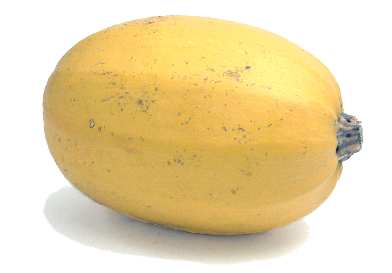
Spaghettisquash1When I was a boy we raised a lot of our own vegetables, and squash was a regular part of our diet–when it was in season.

But not spaghetti squash (left).

I don’t know that I ever remember hearing of spaghetti squash before I joined the low-carb diet movement, lost a hundred pounds, and started hearing about the use of spaghetti squash as a substitute for . . . well, spaghetti.

I’d see it in the stores, but as a Helpless Bachelor, the thought of cooking anything that involves more than one step is intimidating to me. (Actually, I’m quite a good cook and used to work as a chef in a Chinese restaurant, but that’s cooking for others; cooking for myself is a different matter.)

In general, if I can’t microwave it or–at the most–boil it, I know that I won’t end up making it, so I don’t even bother buying it.

Judge of my delight when I was in the store Friday night and found spaghetti squash with a convenient how-to-microwave-spaghetti-squash label! I bought one and decided to make it my Adventuresome Food Project For The Weekend.

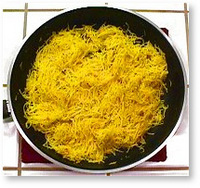
Spaghettisquash2I found the experience thoroughly delightful, though I did not find spaghetti squash a good substitute for spaghetti. It would work for that purpose in the absence of low-carb pasta, but there’s already plenty of low-carb pasta on the market that makes a better approximation of normal spaghetti.

What I found, though, was that spaghetti squash makes a wonderful low-carb substitute for something else that I’d been missing: hash-browns)!

I love hash browns (with ketchup and cheese and hot sauce–Mmmmmmmmm!) but, being made of potatoes, they are Strictly Verboten on my diet. No hash browns for me.

Until now.

The texture of spaghetti squash is remarkably like potato shreds (see up and right), and the taste and smell are as well. Topped with the pizza sauce I bought (I like pizza sauce on spaghetti better than spaghetti sauce), it really brought back memories of when I worked in a (non-Chinese) restaurant and would make those great beketchuped hash browns that I used to be able to eat. Good stuff!

I was so enthusiastic that I decided to do a blog entry on it, so here’s how y’all can make your own low-carb hash browns. It’s simple enough that even I, a Helpless Bachelor (when not cooking for others), can do it:

  1. Get a spaghetti squash.
  2. Stick it so that you pierce its outer rind (a Long Pointy Knife will do this job well, though I used a kitchen implement that looks like an Evil Tuning Fork that came with a long pointy knife set I bought a while back). This will let pressure escape from the squash so it doesn’t ‘splode when you nuke it.
  3. Nuke it. (On high. Five minutes per pound. Typically about 15 minutes.)
  4. Make sure that the outer rind has become soft. If not, nuke it some more.
  5. Let it cool down a bit so you don’t burn your fingers (this part is important!).
  6. Use a Long Pointy Knife to cut it in two (short or non-pointy knives are totally unsuited for this). The sticker on the spaghetti squash I got didn’t say which way to cut it, but I cut mine down its equator (not end-to-end), which turned out to be the right way to do it.
  7. In the middle is a hollow area that has orangey goop and seeds in it. Scoop that out and throw it away.
  8. Use a fork to scoop out the hash brown-like filaments that cling to the inside of the rind and put them on a plate (this is very easy to do since the filaments are practically falling out of there, at least after they’ve been softened up by nuking).
  9. Since they are already hot and soft and potatoey, top them with your favorite hash brown toppings, and you’re good to go. (Alternately, brown them in a pan so that they’re a little crisp, if that’s the way you like hash browns.)

Now that’s good eatin’!

About 5-6 grams of net carbs per cup. A three pound spaghetti squash probably has about six servings in it.

Now, I’m sure if you put olive oil or butter or garlic or similar spaghettifying things onto spaghetti squash it would make it taste more spaghetti-like, but there’s already good low-carb pasta and spaghetti-squash already tastes like a kind of potato, so it’s perfectly suited for hash browns.

Yee-Haw!

Pardon My Dutch?

I have no idea whatsoever how to cuss in Dutch, but apparently Dutch people do.

And it doesn’t sit well with some of them.

Yes, despite the extreme moral turpitude into which the Netherlands as a whole has descended, there are still folks over there who are swimming against the Eurotide.

Take, for example, the folks of the village Staphorst.

EXCERPTS:

The name of the Lord may no longer be taken in vain in the Dutch village of Staphorst.

Staphorst, in the so-called Dutch "bible belt" of eastern towns where religion holds sway, approved a ban on swearing by 13-4 council votes

Now, you may be wondering how such a village is even allowed to pass a law like that. Shouldn’t the central Dutch government–if not the central Eurogovernment–have made profaning the name of God a constitutional right?

Indeed it has, and so there are "enforcement issues" with the Staphorst law. Still, it’s nice to know that there are some over yonder who still rage against the dying of the light.

GET THE STORY.

Crime and NO Punishment

In stark contrast to Michelle’s recent post (regarding a guy who was sent up the river for 30+ years for the crime of nicking a television set) FOX News tells the story of a New Jersey guy who beat his girlfriend to death with a hammer and dumped her in the river, only to walk away a free man. He was tried for the murder, but it seems that nobody told the jury that a conviction on a lesser charge of manslaughter would result in no punishment at all, due to a screwed-up statute of limitations law. You would think that the judge or the prosecutor might have said something (!?).

Of course, this kind of thing can damage a person’s reputation. It could make it hard to get work, or find a wife. It could dog a person to his or her grave. Such a thing might even happen to the murderer in this case, Marc Ferarra. That’s MARC FERRARA. Are you listening, New Jersey? M-A-R-C  F-E-R-A-R-R-A. This is not a nice person. You might not want to, say, loan him a book. He is likely a spine-cracker.

GET THE STORY.

Nannies For Soggy Bottom, U.S.A.

No doubt the success of the television show Supernanny has inspired other nannies to tell tales about their employers’ foibles. Exhibit A: The director of a Maryland-based nanny agency that provides childcare to The Rich And Powerful in Washington, D.C.:

"In Barbara Kline’s new nonfiction book, White House Nannies, her account of finding nannies for Washington’s rich and pretentious, the parents are as deliciously horrible as you would want them to be. "They call her Bethesda agency and start off by describing how important and busy they are. ‘By the way, Barbara, I run an empire,’ says one. Or they have their chief of staff call: ‘I represent a very prominent family.’ Eventually, after listing all their titles and every advanced degree, they toss in a phrase or two describing their children: ‘eight-year-old brilliant twins, a four-year-old gymnast, and a brand-new baby girl who can already sing on key.’

[…]

"[I]f a dispute arises months after Kline has placed the nanny in the home, the clients are back on the phone demanding someone else: ‘You know, Barbara, if I’m not happy with a watch from Cartier, they take it back and give me a new one.’

"Yes, says Kline, who started White House Nannies 21 years ago, someone actually said this to her.

"She won’t say exactly who."

GET THE STORY.

Moral of the story: Even the temporally omnipotent must watch what they say to their servants. After all, the servants may one day decide to write a book.

(Nod to HMS Blog for the link.)