

STARTING CAPTIONS:
- "Drinks Anyone?"
- Waitress Makes Amazing Save After Kitchen Door Collision
- A Game For The Next Star Trek Show: Three-Dimensional Twister!
STARTING CAPTIONS:
Like everybody else, I cheered (literally!) when the election of Benedict XVI was announced. I called up a buncha folks and congratulated them, even though none had any influence on the papal election. It was simply a day for Catholics to congratulate each other.
I couldn’t wait to see what B16 would do as pope. I still can’t wait to see his first encyclical. Why isn’t it out already!?! (That’s my heart talking, not my head. I know that first papal encyclicals usually aren’t out this quick.)
Amid the euphoria, though, I recognized that B16 was unlikely to approach his pontificate with the "Let’s kick some serious butt!" attitude that I knew many would wish. His reputation as a rottweiler is . . . well . . . rot.
The man is far more patient and gentle than his enemies and even many of his friends, or at least fans, give him credit for.
Make no mistake: I expect great things from his pontificate, and I pray that God gives him a long reign as pope, but the great things that I just know are in the offing will be delivered in a kindler and gentler and more nuanced manner than many expect. (Joseph Ratzinger is nothing if not nuanced.)
We’re already seeing signs of that, and we’ll see more in the future.
HERE’S GEORGE WEIGEL TALKING ABOUT THIS SUBJECT. . . . IN PARTICULAR AS IT APPLIES TO THE LITURGY.
Joseph Ratzinger is a firm and faithful man, but he’s not a rash one.
Now that he’s the captain pro tempore of the bark of Peter, Benedict XVI’s orders to the helmsman are going to be more like a firm and faithful "Steady as she goes, Mister" rather than a frantic "Damn the torpedoes!" or "Fly her apart, then!"
It is true that there are crises affecting the Church that need decisive action, but these are unlikely to be handled in a frantic and heavy-handed manner. Popes tend to fall back on their own natures when dealing with problems, and Ratzinger’s nature is not to be frantic and heavy-handed.
One can also understand why popes tend to fall back on their own natures. Grace builds on nature, and if God has called one to the papacy, he expects one to utilize the nature he has given one as one attempts to fulfill its duties. The responsibilities of the office are so great and the future so unknown that, ultimately, all one can to much of the time is take one’s best guess about how to handle a situation and then entrust the results to God.
Holiness in this life and heaven in the next are what the Church is to aim for, but what currents and storms and rock and shoals one may encounter on the way there are unknowns. It is like sailing a ship where the standing orders are "Third star on the left, and straight on till morning."
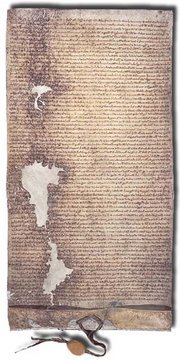 Know what yonder document is?
It’s the Magna Carta (Latin, "Great Charter").
The document is considered a landmark in the development of constitutional government.
Basically, a buncha barons twisted King John of England’s arm into ceding a buncha his authority.
It was signed today, June 15, in A.D. 1215 at Runnymede, which is not a kind of soft cheese, despite its name.
The document was immediately repudiated by him, plunging England into a civil war.
He died during the civil war (of dysentery–ouch!).
Pope Innocent III–who had bad relations with John–also didn’t cotton to the document.
A non-Catholic reader writes an e-mail titled "Re Your quote on Gary’s site" and says:
Greetings Mr. Akin
I was reading Gary’s quote of your words:
A: Well, aside from the fact that the Magisterium has ruled on the issue and that Apostolic Tradition teaches it (both of which are sufficient to prove the matter), the Bible also teaches it.
http://www.cin.org/users/james/questions/q040.htm
What "apostolic tradition"?
Could you refer me to the text or material you refer to?
Thanks.
May God grant your house peace
Thanks. Yours, too.
I’m not sure who Gary is, but the link you provide goes to a question I wrote some years ago (like 10 years ago, actually) on how we can be assured that those in heaven can hear our prayers.
This subject is dealt with in apostolic Tradition, which is conveyed in the writings of the Church Fathers. There is a pronounced stream from the early centuries onward showing that Christians recognized the practice of asking the saints (both human and angelic saints) for their intercession. Magisterial intervention has clarified that this is, indeed, part of the deposit of faith and thus apostolic Tradition (meaning that it was present in the deposit of faith at the time of the apostles either explicitly or implicitly).
For sample quotes from the Church Fathers and other early Christians,
There is an inscription in a cemetery near St.
Sabina’s in Rome that I find personally very moving. It dates from
about the year A.D. 300 and says:
Pray for your parents, Matronata Matrona. She
lived one year, fifty-two days.
The asking of the saints for their intercession implies an awareness on their part of our prayers. How this is accomplished is a matter of theological speculation. The most common theological speculation is that it is God who makes them aware of our requests for their intercession. They are united with him, and he knows everything, so if they could learn of them through no other means, they could learn of them through God.
Scripture, as I point out in under both of the links provided above, also depicts them being aware of our prayers.
Hope this helps!
A non-Catholic reader writes an e-mail titled "Re Your quote on Gary’s site" and says:
Greetings Mr. Akin
I was reading Gary’s quote of your words:
A: Well, aside from the fact that the Magisterium has ruled on the issue and that Apostolic Tradition teaches it (both of which are sufficient to prove the matter), the Bible also teaches it.
What "apostolic tradition"?
Could you refer me to the text or material you refer to?
Thanks.
May God grant your house peace
Thanks. Yours, too.
I’m not sure who Gary is, but the link you provide goes to a question I wrote some years ago (like 10 years ago, actually) on how we can be assured that those in heaven can hear our prayers.
This subject is dealt with in apostolic Tradition, which is conveyed in the writings of the Church Fathers. There is a pronounced stream from the early centuries onward showing that Christians recognized the practice of asking the saints (both human and angelic saints) for their intercession. Magisterial intervention has clarified that this is, indeed, part of the deposit of faith and thus apostolic Tradition (meaning that it was present in the deposit of faith at the time of the apostles either explicitly or implicitly).
For sample quotes from the Church Fathers and other early Christians,
There is an inscription in a cemetery near St.
Sabina’s in Rome that I find personally very moving. It dates from
about the year A.D. 300 and says:
Pray for your parents, Matronata Matrona. She
lived one year, fifty-two days.
The asking of the saints for their intercession implies an awareness on their part of our prayers. How this is accomplished is a matter of theological speculation. The most common theological speculation is that it is God who makes them aware of our requests for their intercession. They are united with him, and he knows everything, so if they could learn of them through no other means, they could learn of them through God.
Scripture, as I point out in under both of the links provided above, also depicts them being aware of our prayers.
Hope this helps!
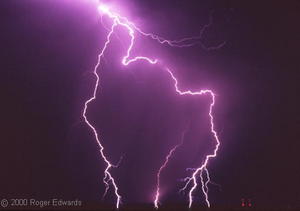 Y’know that whole key/kite/lightning experiment thingie that Ben Franklin did to prove that lightning is electrical (something that seems obvious to us today)?
Well, that happened today, June 15, in 1752.
Fortunately, Franklin was insulated at the time.
Others trying Franklin’s proposed experiment weren’t.
Wikipedia notes: "Others, such as Prof. Georg Wilhelm Richmann of St. Petersburg, Russia, were spectacularly electrocuted during the months following Franklin’s experiment."
Ouch!
Reuters runs a story about a new and exciting religious coalition called "Christian Churches Together in the USA" that will include U.S. Catholics as well as a cross section of evangelical, pentecostal, mainline protestant and other denominations. In the formation stage since 2001, the group will represent a much larger group of Christians than any current ecumenical group.
So, am I just paranoid, or are the alarm bells going off in my head a rational response to this unity-through-bureaucracy movement? I’m sorry, I am having a hard time seeing the benefit of signing on to such a movement. Okay, so we are gonna "agree to disagree" on a whole raft of stuff and concentrate on working together on things like "overcoming poverty". A better recipe for mischief could hardly be imagined. I could be wrong, of course, but the giddy ramblings like this one have not exactly calmed my nerves:
Tim Matovina, director of the Cushwa Center for the Study of
American Catholicism at the University of Notre Dame, said one of the
significant things about the new group is its stated objective of not
taking a stand on something unless all member churches agree.
Often today the rank-and-file members don’t always agree with what church leaders say, he said.
Beyond that, the renewed interest in ecumenical cooperation is another
indication that "in American religion today … denominations mean less
and less," he said.
The country has a strong history rooted in
home-ruled Congregational churches, and today Lutherans, Presbyterians
and Catholics are "experiencing this Congregational dynamic where
people kind of ignore or resist what denominational leaders say, and
seek out a pastor who suits their style … what’s important is the
service."
If this is the kind of Catholic that finds the prospect of such a coalition exciting, then my instinct to go for my parachute seems wholly justified.
Apparently the group will function something like the U.N. (we can only hope). If they truly plan to "not take a stand on something unless all member churches agree" we can anticipate alot of fluffy rhetoric and not much action, which would be the best scenario.
If you’re considering a Christmas present for Fr. Timothy Radcliffe, a former Master General of the Dominican order, might I suggest a case of Ivory soap? He undoubtedly needs it for all of the mouths he apparently would like to scrub clean:
"Dogma is a bad word! But beauty has its own authority, an authority to which every human being responds, and an authority that in no way threatens. We need to find ways of disclosing God’s beauty to our contemporaries."
Of all the many quotes that could have been pulled from Vatican correspondent John L. Allen’s "The Word From Rome" column this week, which one do you suppose the National Catholic Reporter‘s webmaster chose to pull for highlighting? Fr. Radcliffe’s or this one from Pope Benedict XVI:
"[W]ithout the light of truth, sooner or later every person is in fact condemned to doubt the goodness of his or her own life and the relations that make it up, as well as the validity of his or her commitment to construct something in common with others."
No fair peeking at the story before guessing.
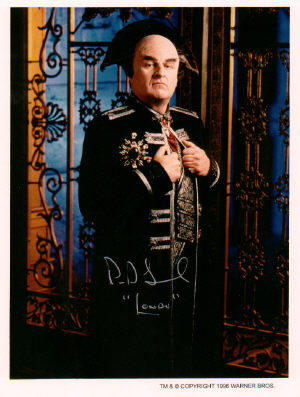 See Londo?
See Londo preen?
Preen, Londo, preen.
Now: See the brooch thingie that Lond’s wearing on his jacket?
I wanna know what it is.
Thing is: I’ve see other high men of state in historical pictures and illustrations wearing them, but I’d assumed that they were just pieces of jewelry of some kind.
A piece back I got evidence that they were more than that: I have reason to believe that thingies like this (in Earth history, anyway) are some kind of insignia used by political parties.
I have specific reason to think that such insignia were used by the liberal and conservative parties in England in the 19th century and that ministers of parliament would wear them to signify their party affiliation.
I’ve done some Googling, but I haven’t turned up anything on them–like what they were called.
So: Does anybody know there name or can anybody provide a link to some web info about them?
Much obliged, folks!

STARTING CAPTIONS:
