What's This?

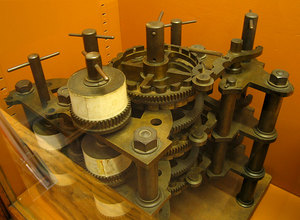
Actually, it’s something called a "difference engine."

A model of one was presented today, June 14, back in 1822 to the Royal Astronomical Society.

In an accompanying paper, the inventer of the difference engine, Charles Babbage, explained how it worked and provided plans.

The Royal Society was impressed and agreed to underwrite Babbage’s attempt to build a genuine difference engine (rather than just a model).

Unfortunately, a variety of problems (including personal ones) hampered Babbage from doing this, and he was never able to complete the project. The one you see above was constructed by his son from parts in his workshop.

Now.

Why am I telling you all this?

Because Babbage’s difference engine was the ancestor of the machine you are using right now: the computer.

The difference engine was designed to automatically compute mathematical and astronomical tables (hence the Royal Astronomical Society’s interest in it). Babbage later revised his plans in an attempt to come up with a more powerful machine he called an "analytical engine" (a.k.a. "Difference Engine No. 2").

Though these machines were nothing compared to the computer you’re using at the moment, they still represented a fundamental technological shift that has changed the course of human civilization.

LEARN MORE ABOUT BABBAGE . . .

. . . AND HIS MARVELOUS CONTRAPTION.

What’s This?

Babbagedifferenceengine_2Actually, it’s something called a "difference engine."

A model of one was presented today, June 14, back in 1822 to the Royal Astronomical Society.

In an accompanying paper, the inventer of the difference engine, Charles Babbage, explained how it worked and provided plans.

The Royal Society was impressed and agreed to underwrite Babbage’s attempt to build a genuine difference engine (rather than just a model).

Unfortunately, a variety of problems (including personal ones) hampered Babbage from doing this, and he was never able to complete the project. The one you see above was constructed by his son from parts in his workshop.

Now.

Why am I telling you all this?

Because Babbage’s difference engine was the ancestor of the machine you are using right now: the computer.

The difference engine was designed to automatically compute mathematical and astronomical tables (hence the Royal Astronomical Society’s interest in it). Babbage later revised his plans in an attempt to come up with a more powerful machine he called an "analytical engine" (a.k.a. "Difference Engine No. 2").

Though these machines were nothing compared to the computer you’re using at the moment, they still represented a fundamental technological shift that has changed the course of human civilization.

LEARN MORE ABOUT BABBAGE . . .

. . . AND HIS MARVELOUS CONTRAPTION.

Grace Before Christ

A reader writes:

A question about grace and the Jews did they have grace?  As Mary
was full of grace but Paul talks about being in the flesh before his
conversion. I know the Jewish elders were anointed by the Holy Spirit
but why would they need conversion if they already had some grace? I am
sure you can explain this to me. Thank you so much for your time.

The
Jews before the time of Christ clearly had grace. The Old Testament is
filled with declarations of God’s graciousness to his people. This does
not mean that they had all the kinds of grace that Christians do today, however.

We do read about some pre-Christian Jewish individuals
receiving the Holy Spirit, such as the seventy elders or the prophets,
but the Holy Spirit was not given generally to all believers, as is the
case with Christians (John 7:39).

Another grace that was not given at the time–at least in a general
fashion–was the regeneration of the heart that was promised with the
New Covenant (Jeremiah 31:33). This regeneration of the heart,
accomplished in baptism (cf. John 3:3-5), is what makes one a "new
creation" in Paul’s terminology (2 Cor. 5:17), and thus what causes the
Christian to be no longer "in the flesh." Christians are thus given
additional spiritual resources in combatting sin that were not given
generally in the prior age.

This does not mean that there was no general grant of grace to
pre-Christian Jews. There was, as the Old Testament abundantly
demonstrates.

As to why conversion would be needed for one who already had some grace, there are two answers:

1) To obtain the additional graces now being given, and

2) To fulfill God’s requirements. If God gives new public
revelation, men are obligated to accept it. If he thus sends his Son
and reveals him to be the Messiah, men are obligated to accept that
even if they were already right with God. Culpable failure to do so
will result in one losing the grace one has.

The situation is somewhat analogous to what happens if the pope
defines a dogma. Dogmas are not new public revelation, but the
situation is analogous. If a person is a faithful, grace-filled
Catholic prior to the defintion and then the pope defines a dogma,
acceptance of the dogma becomes obligatory, and if one culpably refuses
to accept it then one rejects the virtue of faith and sins mortally.
One thus loses the grace one had.

Bottom line: In order to be in a state of grace, one must be willing
to accept the authoritative teachings of God. If a prophet gives a new
teaching as public revelation, one must accept it to remain aright with
God. If the pope clarifies a teaching through a dogmatic definition,
one must also accept it to remain aright with God. Being right with God
is not a permanent state that nothing can alter. One must be willing to
accept the progressive unfolding or deepinging of God’s teaching to
remain in a state of grace, for otherwise one is rejecting God’s
authority as a teacher and the means by which he has chosen to teach
(be they prophet or pope).

Least In The Kingdom Of Heaven?

A reader writes:

What does it mean when in Matthew 5:19, it says, those who do away with the least of my commandments and teaches others to do so will be least in the Kingdom of heaven?  I would think they wouldn’t even get into the Kingdom of heaven.

Your perplexity on this point is understandable. Let’s look at the passage:

17: "Think not that I have  come to abolish the law and the prophets; I have come not to  abolish them but to fulfil them.
18:
For truly, I say to you, till heaven and earth pass away, not an iota,
not a dot, will pass from the law until all is accomplished.
19:
Whoever then relaxes one of the least of these commandments and teaches
men so, shall be called least in the kingdom of heaven; but he who does
them and teaches them shall be called great in the kingdom of heaven.
20:
For I tell you, unless your righteousness exceeds that of the scribes
and Pharisees, you will never enter the kingdom of heaven.

This is one of the harder passages in the Sermon on the Mount. At the most general level, Jesus is giving an assurance that he has not simply come to overturn the Law of Moses. If we took verse 17 in isolation, it would sound as if he’s reaffirming the binding authority of the Law of Moses and that’s all there is to it. But then he seems to soften the statement in verse 18, allusing to the idea that the Law (or some of it) may pass away once "all is accomplished." The question is: What needs to be accomplished or fulfilled for this passing away to take place?

One possibility is the whole course of God’s plan of the ages. This would mean that the Law of Moses would be binding on the Jewish people (it was never binding on Gentiles) until the end of the world. While this would be a plausible interpretation of the verse taken by itself, the interpretation runs into difficulties once we hit the book of Acts, where God clearly suspends some of the dietary aspects of the Mosaic Law by abolishing the distinction between clean and unclean animals (see Acts 9). In St. Paul’s epistles, he indicates further that the Law of Moses is no longer binding on Jewish individuals and even says he himself is not under the Law of Moses but the Law of Christ.

This suggests that we are to look for something on a nearer-term time horizon as the fulfillment Jesus spoke of that allows the Law of Moses to be modified. If you look at p. 162 of Good Pope Benedict’s most excellent book

GOD AND THE WORLD

you’ll see him suggest what is the standard interpretation of the passage:

Christ does not comes as a lawbreaker. He does not come in order to declare the Law invalid or meaningless. . . . Christ comes in order to complete it. But that also means, in order to lift the Law up onto a higher level. He fulfills the Law in his suffering, in his life, in his message. And now what happens is that the whole Law finds its meaning in him. Everything that was intended by it, everything it aimed for, is truly realized in his perosn.

That is why we no longer need to fulfill the Law according to the letter, in the way its prescriptions regulate eveything down to the last detail. Our fellowship with Christ means that we are in the sphere where the Law is fulfilled; where it has found its true place; where it is quite literally "lifted up" to a higher level, that is, both preserved and at the same time transformed.

What the pope–then a cardinal–articulated in this passage is not dogmatically defined teaching, but it is the standard way of interpreting what Jesus says: Through his teaching, life, and death and resurrection, Christ provided the fulfillment needed for a modification in the Law of Moses to take place, meaning that even Jewish individuals today are not bound by it.

This provides important background for verses 19 and 20. In verse 19 he gives what is a rather soft-edged statement that makes it sound as if a person could relax the precepts of the Law and still remain "in the kingdom of heaven" (i.e., be saved).

He may indeed mean this. It is possible for people, in innocent ignorance or even with partial culpability, to water down the requirements of God’s law and yet not lose their salvation. In modern terminology, they would sin venially by doing so, but only venially.

In verse 20, though, Jesus makes a harder-edged statement, speaking of the need for our righteousness to exceed that of the Pharisees or we won’t get into the kingdom of heaven at all (i.e., not be saved). This may also be what he means. It may be that being called "least in the kingdom of heaven" means "not saved," but this is not clear and is not the natural interpretation of the phrase.

My suspicion is that Jesus meant the former interpretation, not the latter: That one can relax the lesser commandments of the Law and diminish one’s standing in the kingdom through venial sin. The example of the Pharisees is still salutory, though, because Jesus viewed them as also watering down the commandment of God, only they were watering down very important ones, like the duty of honoring one’s father and mother. He specifically criticized them for this in Matthew 15.

Now, you’ll note that in the last couple of paragraphs, I’ve been speaking in a rather loose manner as if we today would be relaxing commandments of the Law. In reality, the Law he was talking about was still the Law of Moses, and he was addressing the situation of people living in his own day. If they prematurely relaxed what the Law of Moses required then they would suffer the consequences he mentions.

Since nobody today is bound by the Law of Moses, that doesn’t apply to us directly, but the principles involved still do: God still has a law, called the Law of Christ in the New Testament and "the New Law" in theology, and if we water down its precepts in a way that constitutes venial sin then we will have our standing in the kingdom diminished thereby. If we utterly abograte them in a way that constitutes mortal sin, we will not make it into the kingdom any more than the Pharisees Jesus spoke of did.
Thou Shalt Sing!

Dale Price of Dyspeptic Mutterings waxes indignant on the expectations of the Choir-Robed Masters in the Church Loft that thou shalt sing:

CRM: "Many Catholics still find singing in church a problem, probably because of the rather individualistic piety that they inherited. Yet singing has been a tradition of both the Old and the New Testament. It is an excellent way of expressing and creating a community spirit of unity as well as joy. Ephrem’s hymns, an ancient historian testifies, ‘lent luster to the Christian assemblies.’ We need some modern Ephrems — and cooperating singers — to do the same for our Christian assemblies today."

DP: "Ah, yes — one of the great evils of our time — individualistic piety! I suppose I should be thankful that the commenter didn’t mention fish on Fridays, too. The Borg Collective approach to liturgical reform is bent on stamping that out. You see it in the diktats from the liturgy offices demanding that the faithful Keep Standing and Singing, Dammit! after receiving the Eucharist. Resistance is futile — you will experience renewal. Thou shalt not engage in private prayer in the liturgy.

"Nope — no can do. I need time alone with God, and I’ll take that time, thank you. After that, you can hit the spinner and try to tell me where my hands and feet go next (red dot, blue dot) in the remarkably creative interpretation of the rubrics, thanks."

Personally, I rather like singing — whether pew mates like to hear me sing is another question — but I can completely understand why not many join me from the congregation in doing so. The melodies are difficult to learn within the first verse or so, and sometimes the lyrics are downright embarrassing. For example, I absolutely refuse to sing about consubstantiation (e.g., "Supper of the Lord"). However, the upside to knowing well the lyrics to popular contemporary hymns is the ability to play the Catholic version of annoying your friends with rounds of "It’s A Small World." One round of "Table of Plenty" is plentiful enough to stick in a friend’s head for the rest of the day. So, if you get a banal hymn stuck in your head, share the misery:

"Come to the feast of heaven and earth,
Come to the table of plenty!
God will provide for all that we need,
Here at the table of pleeeennteeeee!"

You’re welcome.

One For The Parents

A reader writes:

I was wondering if you could suggest any books or articles that might help my staunchly Presbyterian (and seriously anti-Catholic) parents better understand my and my husband’s decision to leave the Episcopal Church for the Mother Church?  (To quote my mother, “Y’all are already almost Catholic anyway!”   Ha! I wish.)

I’d probably recommend the book

SURPRISED BY TRUTH

It’s a book of theologically-oriented conversion stories with a number of contributors (myself included) coming from a Presbyterian background. It thus might help them understand the move.

I encourage other folks to made additional recommendations in the combox (though I may delete ones I disagree with for whatever reason).

USE THIS LINK TO FIND THEM ON AMAZON

Searching For SuperPope

In the media’s perennial case of Not Getting It, pundits are speculating that Benedict XVI’s papacy is tilting more to the left than to the right, something not expected from someone they presumed to be the spiritual incarnation of Torquemada.

"[Pope Benedict XVI’s] crowds are far larger than those of Pope John Paul II at the same time last year. Sunday addresses from his apartment window have drawn up to 100,000 people. And so far, to the surprise of many, the new pope’s words and deeds have drawn sharper criticism from the Catholic far right than from the left.

"John Allen, Vatican analyst of the liberal National Catholic Reporter, analyzed nearly 45,000 words that Benedict spoke in his first 45 days. They proved mostly positive, not the attacks on secularism and heresy many expected from Ratzinger, Allen said.

"’There is an obvious sense of alarm from the right that this pontificate will not deliver the strong conservative agenda that that wing of the church was expecting,’ said Allen, who just completed his second biography of Ratzinger/Benedict."

GET THE STORY.

While it is true that so far I have seen far sharper attacks on Pope Benedict since his election coming from Rad Trads than from Rad Progs®, this is once more a case of pitting pastoral care against doctrinal clarity.

What many on both sides seem to be missing is that Joseph Ratzinger has a different job now as Pope Benedict than he had as Joseph Cardinal Ratzinger. It’s not that he can be expected to neglect doctrinal clarity; only that he will approach it in a different manner as pope than he did as prefect of the Congregation for the Doctrine of the Faith. And, in addition, he has far greater opportunity and visibility as pope to show pastoral sensitivity than he did as head of the CDF.

The truly Rad Trad Catholics, with a few exceptions, never expected much from Pope Benedict XVI because they more or less dismissed him as a "Novus Ordo Pope." The Rad Progs have not expected much from him either, and are a bit surprised that he has not yet put anyone in a Jedi death grip. (Even in the case of Fr. Thomas Reese, S.J., former editor of America, the article notes that his story is mainly considered to be the last act of Cardinal Ratzinger rather than the first of Pope Benedict.)

Those truly in danger of disappointment are those orthodox Catholics who expected Pope Benedict to be SuperPope. And, not only SuperPope, but a SuperPope made in their own image and likeness of what they believe a SuperPope should be and do.