This Week’s First Show (March 30, 2005)

LISTEN TO THE SHOW.

DOWNLOAD THE SHOW.

HIGHLIGHTS:

  • Are all people in the world really one religion? Is the pope going to announce this?
  • Where does the Bible refer to the apostles baptizing whole households?
  • When should crucifixes and statues be covered?
  • Why shouldn’t one receive Communion in a Protestant church?
  • Does one have to do a Communion service when Communion is being distributed without priests present?
  • What does Jimmy know about post-modernism & what would one say to one who doesn’t feel doctrine is important.
  • How to regard The Purpose-Driven Life?
  • Which churches have which valid sacraments? Would a Lutheran need an annulment to marry in the Catholic Church?
  • More on The Purpose-Driven Life.
  • Should catechumens be baptized on Eastern morning?
  • Translation problems with the Breviary?
  • Non-Catholic caller is interested in learning more about the Catholic faith. Why should one confess to priests?
  • What are Jimmy & Jerry doing to save Terri’s life?
  • What does it mean when Jesus says that the kingdom of God is "in you"?
  • When you die, where does your soul go after you meet Jesus?
  • Is adultery a forgiveable sin?

What's This?

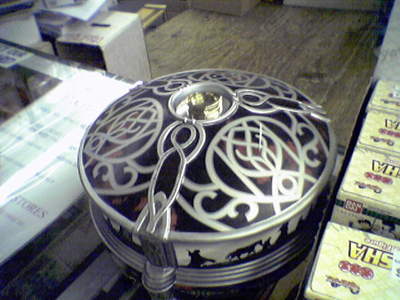
The simple answer is that it’s a curio I found sitting on the counter at my local comic book dealer’s.

But it’s much more than that.

You’ll notice that at the top center of the lid it has a little silver circle with a gold ring sitting on it.

(Look up and notice this before reading further. I’ll wait.)
.
.
.

Okay, so everythig is fine and good.

UNTIL YOU TRY TO TOUCH THE RING!

In fact, when people ask what the curio is, the counterman will simply tell them "Touch the ring."

They (or you) do, and suddenly you find out

THE RING AIN’T THERE!!!

Yes! There is NO GOLD RING sitting atop the curio. You swish your finger around an empty HOLE IN THE LID.

The illusion is not caused by holography or magic or anything like that. It’s far simpler–and far more insidious–than that.

Turns out that there is a gold (well, gold-colored) ring at the  bottom of the inside of the curio, surrounded by a curved mirrored surface that makes the image of the ring reflect in such a way that, for any person of normal height, when you look into the hole from a normal eye-angle, it appears that there is a little silver disk there with a gold ring sitting on it.

BUT THERE’S NOT!!!

It’s all deception and trickery, y’see.

Now, if you look at the curio dead-on from the side (i.e., not from a normal eye-angle), you’ll see that there’s nothing there. Similarly, if you look straight down into the hold (again, not from a normal eye-angle), you’ll see through the illusion. In fact, you’ll see the ring sitting at the bottom of the curio. You can also stick your finger down and feel the ring and the curved mirrored surface around it. (I did.)

I asked if you could open the curio and the counterman said no. When they first got it, he wanted to open it and put something else besides a ring in it. (I’d like to see him put a quarter in it. Imagin customers trying to pick up that!) He also said he thought this was a design flaw as it made would hard to clean if it got dirty.

Still . . . kewl illusion, huh!

What’s This?

Ring_curio_box

The simple answer is that it’s a curio I found sitting on the counter at my local comic book dealer’s.

But it’s much more than that.

You’ll notice that at the top center of the lid it has a little silver circle with a gold ring sitting on it.

(Look up and notice this before reading further. I’ll wait.)
.
.
.

Okay, so everythig is fine and good.

UNTIL YOU TRY TO TOUCH THE RING!

In fact, when people ask what the curio is, the counterman will simply tell them "Touch the ring."

They (or you) do, and suddenly you find out

THE RING AIN’T THERE!!!

Yes! There is NO GOLD RING sitting atop the curio. You swish your finger around an empty HOLE IN THE LID.

The illusion is not caused by holography or magic or anything like that. It’s far simpler–and far more insidious–than that.

Turns out that there is a gold (well, gold-colored) ring at the  bottom of the inside of the curio, surrounded by a curved mirrored surface that makes the image of the ring reflect in such a way that, for any person of normal height, when you look into the hole from a normal eye-angle, it appears that there is a little silver disk there with a gold ring sitting on it.

BUT THERE’S NOT!!!

It’s all deception and trickery, y’see.

Now, if you look at the curio dead-on from the side (i.e., not from a normal eye-angle), you’ll see that there’s nothing there. Similarly, if you look straight down into the hold (again, not from a normal eye-angle), you’ll see through the illusion. In fact, you’ll see the ring sitting at the bottom of the curio. You can also stick your finger down and feel the ring and the curved mirrored surface around it. (I did.)

I asked if you could open the curio and the counterman said no. When they first got it, he wanted to open it and put something else besides a ring in it. (I’d like to see him put a quarter in it. Imagin customers trying to pick up that!) He also said he thought this was a design flaw as it made would hard to clean if it got dirty.

Still . . . kewl illusion, huh!

Nunblog

St. Blog’s Parish has many fine priestly blogs, and I am now happy to give equal time to a nun’s blog — appropriately titled Nunblog.  Sr. Anne is a Daughter of St. Paul from Chicago.  Appropriately enough, Sr. Anne’s order’s charism is evangelization through the various forms of media.  I’ve only had time to scan through her site, but it looks interesting and has some lovely photos of a recent trip to Rome.

(Nod to Karen Hall of Some Have Hats, a Catholic writer who also has a fine blog you should check out.)

Don't Tell MOMA

OK, so what do you do if your an artist and nobody is interested in your work? Well, you could cut off your ear, but that is so last century. It’s been done, and modern art is all about breaking boundaries, and stuff. So that’s what this guy actually did! Slipping past the rigid barriers of the bourgeois establishment (and some security guys), he managed to sneak several pieces of art into a number of famous modern art galleries and museums ( Like MOMA), where they hung for days without being noticed. Hey, why wait ’til your dead, right?

Of course, the trade-off is that he will now be remembered for being clever, rather than talented. But, hey, that’s what modern art is all about!

GET THE STORY.

Don’t Tell MOMA

OK, so what do you do if your an artist and nobody is interested in your work? Well, you could cut off your ear, but that is so last century. It’s been done, and modern art is all about breaking boundaries, and stuff. So that’s what this guy actually did! Slipping past the rigid barriers of the bourgeois establishment (and some security guys), he managed to sneak several pieces of art into a number of famous modern art galleries and museums ( Like MOMA), where they hung for days without being noticed. Hey, why wait ’til your dead, right?

Of course, the trade-off is that he will now be remembered for being clever, rather than talented. But, hey, that’s what modern art is all about!

GET THE STORY.

"We'll Get It Blessed Later"

A reader writes:

I understand that Catholics are supposed to obtain a dispensation

to get married in a non-Catholic ceremony. I have a Catholic cousin

who will soon marry a Lutheran man in a Lutheran Church, and I understand

the groom-to-be’s mother is very adamant about it being that way. I asked the

bride-to-be’s grandfather (who is Catholic) if she obtained a dispensation, and he

said they claim the marriage will get blessed by the Catholic Church "later".

I really don’t

know all that’s being done to "keep the peace" or what was said by the local

    priest about a dispensation. They live hundreds of miles away and I have no idea

what kind of "practicing Catholic" the bride-to-be is. My dilemma is: Can I attend

this wedding?  Can I send a gift?

If no dispensation was obtained, but only a promise to "take care of things later" was

made, the wedding would still be "illicit" in form, right?  If the priest promises to

bless the marriage later, is that a valid dispensation?

Unless the Catholic party has received a dispensation from the obligation to observe the Catholic form of marriage then the marriage in question will not only be illicit, it will be invalid. What a priest may say is irrelevant. The diocese, not the local parish, must grant the dispensation. Promises by a priest to convaidate ("bless") the marriage later also do nothing to change the fact that the marriage will be invalid at the time it is contracted.

This means that no actual marital union will be established between the parties and they will be objectively fornicating until such time as they get their marital situation rectified.

Because of this, I cannot recommend that you attend the wedding or otherwise celebrate it (e.g., by giving a gift).

By being frank (but gentle and compassionate with them) about your reasons for not attending or otherwise celebrating the union, you would be performing an act of charity toward them by indicating (a) indicating to them that they are not really getting married and that what they would be doing after the service is objectively siful and (b) that someone in the family is willing to act in accordance with the truth instead of pretending that their "we’ll get it blessed later" plan is okay when it is not. Sometimes people need the example of others standing up for what is right before they’re willing to stand up for what is right themselves.

If they do proceed with their plan and, at some later date, have their marriage convalidated in the Catholic Church, at that time it would be appropriate to send gifts, etc.

Hope this helps!

20

“We’ll Get It Blessed Later”

A reader writes:

I understand that Catholics are supposed to obtain a dispensation
to get married in a non-Catholic ceremony. I have a Catholic cousin
who will soon marry a Lutheran man in a Lutheran Church, and I understand
the groom-to-be’s mother is very adamant about it being that way. I asked the
bride-to-be’s grandfather (who is Catholic) if she obtained a dispensation, and he
said they claim the marriage will get blessed by the Catholic Church "later".

I really don’t
know all that’s being done to "keep the peace" or what was said by the local
    priest about a dispensation. They live hundreds of miles away and I have no idea
what kind of "practicing Catholic" the bride-to-be is. My dilemma is: Can I attend
this wedding?  Can I send a gift?

If no dispensation was obtained, but only a promise to "take care of things later" was
made, the wedding would still be "illicit" in form, right?  If the priest promises to
bless the marriage later, is that a valid dispensation?

Unless the Catholic party has received a dispensation from the obligation to observe the Catholic form of marriage then the marriage in question will not only be illicit, it will be invalid. What a priest may say is irrelevant. The diocese, not the local parish, must grant the dispensation. Promises by a priest to convaidate ("bless") the marriage later also do nothing to change the fact that the marriage will be invalid at the time it is contracted.

This means that no actual marital union will be established between the parties and they will be objectively fornicating until such time as they get their marital situation rectified.

Because of this, I cannot recommend that you attend the wedding or otherwise celebrate it (e.g., by giving a gift).

By being frank (but gentle and compassionate with them) about your reasons for not attending or otherwise celebrating the union, you would be performing an act of charity toward them by indicating (a) indicating to them that they are not really getting married and that what they would be doing after the service is objectively siful and (b) that someone in the family is willing to act in accordance with the truth instead of pretending that their "we’ll get it blessed later" plan is okay when it is not. Sometimes people need the example of others standing up for what is right before they’re willing to stand up for what is right themselves.

If they do proceed with their plan and, at some later date, have their marriage convalidated in the Catholic Church, at that time it would be appropriate to send gifts, etc.

Hope this helps!

20

Sunday Obligation

A reader writes:

Jimmy, I have some obligations this coming Saturday and Sunday that will very likely make it impossible to get to a Mass on Saturday “evening” or Sunday.  I’m wondering how early a Mass can be on Saturday to count for the Sunday obligation.  There’s one at 2pm here.  It just seems really early.  I suppose I’ll be relieved from my Sunday obligation if I just can’t make one, but if the 2pm will count, I’d like to go.  However, it’s in Korean, which I do not speak.  Does it even make sense to go if you won’t be able to participate really, or understand what’s being said?  Any input is greatly appreciated.

The law is ambiguous on when "evening" begins. (And no, folks, I don’t want to have this fight all over again, so e-mail me if you want to rush me your vital evidence regarding when evening begins.) Some documents would suggest something in the 4 p.m.-4:30 p.m. timeframe–or when the local bishop says–but it is not clear that these documents presently have legal force, in which case 12 noon would be case.

What we have in this case thus seems to be a doubt of law situation, and in such cases, "Laws,
even invalidating and disqualifying ones, do not oblige when there is a doubt
about the law" (Canon 14).

To apply this to your situation:

  1. If you have other pressing obligations that would preclude you from going to Mass on Saturday after 2 p.m. or on Sunday then you are not obliged to go during that time. You simply have no Sunday obligation in that timeframe.
  2. Since it is doubtful whether a 2 p.m. Saturday Mass would fulfill the Sunday obligation, one is not bound to go then due to the doubt of law.
  3. You certainly may go to the 2 p.m. Saturday Mass, and that would be a praiseworthy thing to do, even if you are not obligated to do so.
  4. The fact that the Mass is in Korean may play a role in whether you personally decide to go to it or not, but that is a matter of personal taste, not of the efficacy of the Mass for fulfilling one’s obligation when one exists. The Church has never regarded it as essential for going to Mass that you speak the language in which the Mass is conducted. The Mass is primarily a vertical experience in which we relate to God by going to be with him and worship him, even if we cannot speak the language of those around us. You can still derive great spiritual benefit from going to a Mass in a language you don’t speak because your linguistically-challenged state does nothing to prevent you from thinking about and worshipping God in your heart, receiving Jesus in the Eucharist ("Amen" is still "Amen" in Korean when you receive Communion), or even following the general structure of the Mass. There also may be a Korean-English translation available in the Missal, who knows.
  5. If you go, "hello" in Korean is "Annyong haseyo" (Ahn-yong ha-say-yo). Smile and wave when you say it. Or bow if you use it at the sign of peace. (They’ll know what you mean.)

Hope this helps!

20