No, really!
Performance Art
More and more, these days, the question of whether art-imitates-life or life-imitates-art is becoming another chicken-and-egg question. Take, for example, this case of, uh, performance art:
"A Berlin couple plan to have their first baby at an art gallery, the gallery owner said on Saturday, confirming a newspaper report.
"’It’s a gift to humanity, a once in a lifetime thing,’ Bild newspaper quoted Winfried Witt, partner of mother-to-be Ramune Gele, as saying.
[…]
"About 30 people are expected to attend the birth, scheduled for April 24. They would be told to come to the gallery as soon as the 27-year-old Gele’s contractions became regular, Witt was quoted as saying."
Although the "performance" will be taking place in an art gallery, apparently this will not be an open exhibit:
"[Gallery manager Johann] Novak said the gallery, which usually shows installations and video art, would be closed during the birth. ‘The private aspect will be maintained,’ he said."
Uh huh. That’s why all the details are being released to the media. So we can maintain privacy. At least the article reports that not everyone is finding the proposed masterpiece fitting for a gallery exhibition:
"Another gallery owner in the street said: ‘I find it mad.’"
Drumming Up News
From our And-The-Sky-Is-Blue! Department comes this headline from Yahoo! News:
New Pope Will Be Free to Pick Own Name
Gee, I wonder where the journalist who submitted this news flash thought previous popes got names like Urban, Celestine, and Pius?
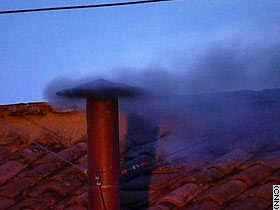
Black Smoke In Rome, No Pope At Home
The Changing American Catholic Voter
The role of Catholics in American politics has undergone significant changes in the last hundred years. Catholics were able to make sufficient inroads that they could get a presidential candidate (Al Smith) nominated in 1928 and then enabling him to lose despite voting for him in large numbers, followed by being able to get a presidential candidate (John Kennedy) nominated in 1960 and then enabling him to win by voting for him in large numbers, followed by having a third presidential candidate (John Kerry) nominated in 2004 and enabling him to lose by voting for his opponent in large numbers.
The latter is explained by the ongoing decoupling of the American Catholic population from the Democratic Party and a change in its voting habits and priorities.
HOW MIGHT A NEW POPE INFLUENCE THAT?
EXCERPT:
George W. Bush was the first sitting president to attend a papal funeral. President Carter sent his mother to Pope John Paul I’s 1978 funeral. Such symbolic change speaks volumes about the evolution in Catholic America’s voting habits over the past quarter-century and about Pope John Paul II’s role in that conversion.
A Look Inside The Sistine Chapel
Among other surprises, the chapel is fitted with a second "backup" stove for burning ballots in case the fisrt stove is unable to fulfill its duties.
eBay Sacrilege Update
This is a limited-time only post that I’ll take down soon since I don’t want to give malefactors ideas, but . . .
Several folks have e-mailed stories noting that the gentleman responsible for the recent sacrilege on eBay had a change of heart and the matter has been resolved more satisfactorily than was previously the case.
Unfortunately, eBay itself has not yet had a change of heart regarding allowing such matters.
Hacking The Conclave
Several readers have e-mailed links to
THIS PIECE BY SECURITY EXPERT BRUCE SCHNEIER ON THE POSSIBILITIES FOR HACKING THE PAPAL ELECTION.
His conclusion: The Church has a good system in place that will be extraordinarily difficult to hack.
EXCERPTS:
What are the lessons here? First, open systems conducted within a known group make voting fraud much harder. Every step of the election process is observed by everyone, and everyone knows everyone, which makes it harder for someone to get away with anything.
Second, small and simple elections are easier to secure. This kind of process works to elect a Pope or a club president, but quickly becomes unwieldy for a large-scale election. The only way manual systems work is through a pyramid-like scheme, with small groups reporting their manually obtained results up the chain to more central tabulating authorities.
And a third and final lesson: when an election process is left to develop over the course of a couple thousand years, you end up with something surprisingly good.
The Other Oath
Recently I quoted from Universi Dominici Gregis–the apostolic consitution of John Paul II governing the conclave and other matters to be taken care of upon his death–and gave the oath that is taken by those involved in the conclave who are not cardinal electors (e.g., support personnel). The cardinal electors take a different oath. Here it is:
53. In conformity with the provisions of No. 52, the Cardinal Dean or the Cardinal who has precedence by order and seniority, will read aloud the following formula of the oath:
We, the Cardinal electors present in this election of the Supreme Pontiff promise, pledge and swear, as individuals and as a group, to observe faithfully and scrupulously the prescriptions contained in the Apostolic Constitution of the Supreme Pontiff John Paul II, Universi Dominici Gregis, published on 22 February 1996. We likewise promise, pledge and swear that whichever of us by divine disposition is elected Roman Pontiff will commit himself faithfully to carrying out the munus Petrinum of Pastor of the Universal Church and will not fail to affirm and defend strenuously the spiritual and temporal rights and the liberty of the Holy See. In a particular way, we promise and swear to observe with the greatest fidelity and with all persons, clerical or lay, secrecy regarding everything that in any way relates to the election of the Roman Pontiff and regarding what occurs in the place of the election, directly or indirectly related to the results of the voting; we promise and swear not to break this secret in any way, either during or after the election of the new Pontiff, unless explicit authorization is granted by the same Pontiff; and never to lend support or favour to any interference, opposition or any other form of intervention, whereby secular authorities of whatever order and degree or any group of people or individuals might wish to intervene in the election of the Roman Pontiff.
Each of the Cardinal electors, according to the order of precedence, will then take the oath according to the following formula:
And I, N. Cardinal N., do so promise, pledge and swear. Placing his hand on the Gospels, he will add: So help me God and these Holy Gospels which I touch with my hand.
Also,
Food, Water, And Oxygen
I wanted to tie up something that I meant to blog about during the Terri Schiavo crisis, though events overtook me and I wasn’t able to do so.
During the crisis, I received several requests from folks for comment about why food and water were considered "ordinary" means of sustaining life, regardless of their method of delivery, whereas going on a respirator was considered "extraordinary" means.
It’s a good question. Food, water, and oxygen are all essential material requirements for the typical care of the body. If the first two must be delivered regardless of the means of delivery, why not the third?
This is an area where the advent of new medical technologies has had a significant impact, and the Church is still sorting these matters out, but let me offer you what I can on this.
There is a development in the terminology of moral theology that seems to be happening at present. The older terminology divides life-saving measures into "ordinary" and "extraordinary" means, whereas the newer terminology divides them into "proportionate" and "disproportionate" means. Currently the Magisterium is using both sets of terms, but there is a shift that seems to be occurring from the former to the latter. In the future, the former terminology may be replaced by the latter or the former may be interpreted so that it means the same thing as the latter. We’ll have to wait and see.
In any event, the old distinction between "ordinary/extraordinary" is undergoing significant change because the advent of technology has made many things that would have formerly been quite extraordinary before the 20th century to be quite ordinary in the 21st. What was considered an ordinary thing to do for a sick person was much the same in the 10th century as it was in the 15th, but would bear very little resemblance to what would be an ordinary thing to do for a sick person today.
The shift in terminology is reflected, for example, in the Holy See’s 1980 Declaration on Euthanasia, which says in part:
Those whose task it is to care for the sick must do so conscientiously and administer the remedies that seem necessary or useful. However, is it necessary in all circumstances to have recourse to all possible remedies? In the past, moralists replied that one is never obliged to use "extraordinary" means. This reply, which as a principle still holds good, is perhaps less clear today, by reason of the imprecision of the term and the rapid progress made in the treatment of sickness. Thus some people prefer to speak of "proportionate" and "disproportionate" means. In any case, it will be possible to make a correct judgment as to the means by studying the type of treatment to be used, its degree of complexity or risk, its cost and the possibilities of using it, and comparing these elements with the result that can be expected, taking into account the state of the sick person and his or her physical and moral resources [SOURCE].
The Holy See thus notes that the term "extraordinary means" is problematic because it is imprecise and subject to rapid technological progress. While acknowledging that the term can still be used in principle, it offers a series of considerations for determining whether a treatment should be used that converge on what is captured by the terms "proprotionate" and "disproportionate"–i.e., the complexity and risk of the treatment, the cost and possibility of using it, the result that can be expected, the state of the sick person and his resources, etc.
In the absence of a Magisterial clarification of the meaning of the ordinary-extraordinary distinction that sets it on a firmer footing, I’m inclined to say that the proportionate-disproportionate distinction better captures what Catholic moral theology requires–and what older moral theologians were after when they used the terms "ordinary" and "extraordinary."
It seems to me that when they referred to "ordinary" means of saving someone’s life, they meant things that had reasonable prospects of helping, did not significantly burden the patient, did not put him at great risk, and were not extremely difficult to pursue. By contrast, if something had low prospects of helping, greatly burdened the patient, put him at great risk, or was extremely difficult to pursue then they regarded it as an "extraordinary" thing to do.
Today, because advancing medical technology is rapidly shifting things from the "extraordinary" column to the "ordinary" column, it seems to me that "proportionate" and "disproportionate" express the same distinction in a less confusing way.
At least most of the time.
‘Cause there’s a big disclaimer that needs to be mentioned.
Whenever you get the word "proportionate" into a moral discussion, certain individuals will self-righteously sniff and say "That’s just proportionalism."
Wrong.
The idea of proportion is something that involves weighing the costs and risks of an action against the benefits to be obtained by pursuing it. That’s not at all alien to Christian moral theology. Indeed, both Testaments of the Bible contain material that is based on this kind of prudential judgment.
What proportional-ism does it is takes the idea of proportion and absolutizes it, making it the only criteria that is relevant. It allows any action to be undertaken as long as the benefits it stands to result in are considered proportional to its costs and risks under an immediate, this-worldly calculus. That’s why proportional-ism is condemned. But the use of the idea of proportion in making a moral judgment is not. In fact, in many situations it is required–failing to make use of it being a sin against the virtue of prudence.
So I don’t want to hear a lot of "You’re just talking about proportionalism" stuff in the combox, because I’m not. Self-righteous sniffers take warning.
Having said that, let’s apply these principles to the situations of artificially providing food, water, and oxygen.
It seems to me that in principle they are all the same: They all are things the body needs to survive and their administration thus does not count as medical treatment. The default position on all three is that, unless something else is affecting the situation, their administration is proportionate and morally obligatory.
However, in various situations all three of the administration of all three can become disproportionate and thus non-obligatory.
We have already discussed, for example, the case of an individual whose body has stopped manufacturing albumin. In such a situation, continuing to administer food and water intravenously will result in horrible damage being done to the body and thus is not morally required. In that case the administration of food and water has become disproportionate to the good to be achieved and it is no longer obligatory.
If it’s merely a matter of putting a food and water tube in someone’s mouth or nose or stomach and the person is otherwise able to process food and water then the adminsitration of them will be proportionate (unless something else is affecting the situation), but in the case of someone who can’t manufacture albumin, even a simple food and water tube becomes disproportionate because his body is no longer able to process fluids and he will be positively harmed by pumping them into the patient.
When it comes to oxygen, if it is merely a matter of attaching an oxygen tube to someone’s nose so they can breathe, again this is a simple enough thing that it’s going to be proportionate (unless something else is affecting the situation) and thus morally obligatory.
But if we’re talking about someone who needs an iron lung (a very small class of people today) then we’re talking about a much more burdensome and costly procedure that can more quickly become disproportionate.
That’s the difference. While food, water, and oxygen are all are all necessary substances for the body and while their artificial administration is presumed to be proportionate until proven otherwise, certain means of delivering them become disproportionate or "extraordinary" more quickly because technology has not yet been developed that renders them non-burdensome.
In the case of food and water, we have means that are fairly non-burdensome unless there is something wrong with the patient’s ability to assimilate food and water. In the case of oxygen we may be improving on this point, but at least certain oxygen-delivering technologies are still more burdensome and thus fall into the disproportionate or "extraordinary" category more easily.
When something falls into the disproportionate or "extraordinary" category, one can morally choose not to use it even though death will inevitably result. One cannot, however, discontinue proportionate or "ordinary" means in order to cause death, neither may one deliberately undertake any other course of action that, as a means or as an end, is intended to kill the patient.
No matter what advocates of proportionalism would say.