This Week’s Show (June 2, 2005)

LISTEN TO THE SHOW.

DOWNLOAD THE SHOW.

HIGHLIGHTS:

  • Why isn’t Eastern Orthodoxy termed a heresy since they reject a truth of the faith (i.e., the authority of the pope)?
  • Caller heard that the Eucharist is valid but illicit if celebrated with leavened bread. What does this mean?
  • Young caller is interested in becoming Catholic. What should she do?
  • Why does 2 Peter 2:4 say that angels were changed in "Tarsus"? What is "Tarsus"?
  • What does Jeremiah 17:1 mean?
  • Why were Jewish people forbidden to eat pork? Do Jews still refrain from pork?
  • What is the Church’s position on yoga and tai chi?
  • Why are Protestant and Catholic versions of the Lord’s Prayer different?
  • Should we be standing or kneeling during the Lord’s Prayer?
  • In Revelation 6:9 it refers to martyrs under the altar in heaven asking when their blood will be avenged? If they’re in heaven, why are they acting in this unmerciful manner? Won’t they have their love perfected?
  • Where in the Bible do we find the story of Lucifer and the fallen angels? Where does our common understanding of this story come from?
  • How to argue against polytheism for a Buddhist?
  • What is the Church’s position on angels in terms of reverence and adoration?
  • What was baptism for the dead?

Catholic Fundamentalists Of The World, Unite!

You scored as Fundamentalist. Fundamentalism represents a movement in opposition to Modernism, stressing the highest importance on foundational religious tradition. Science has brought on corruption of society. God is real and is watching. Scripture leaves little room for interpretation; man is God’s creation. About a quarter of the population in the U.S. is classified as Fundamentalist.

Fundamentalist

81%

Romanticist

69%

Cultural Creative

69%

Postmodernist

44%

Existentialist

25%

Idealist

19%

Modernist

0%

Materialist

0%

What is Your World View? (updated)
created with QuizFarm.com

I’m a Fundamentalist!  Who’da thunk it?  Actually, given the nature of the questions, I’m not surprised.  The creators of the quiz seem to consider a belief in absolute, objective truths to be the definition of Fundamentalism.  If that is the case, my name is Michelle and I’m a Catholic Fundamentalist.  There.  It’s finally out in the open now.

(Nod to Mark Mossa, S.J., for the link.)

Marriage To An Anti-Catholic

A reader writes:

Would it be a sin for me to marry (in a Catholic church) my zealous Calvinist boyfriend, who thinks the Catholc church is anti-Christ?

(I was a Calvinist myself, so I’m immuned to their arguments and attempts to convert me.  Plus, he will love me like Christ loves the Church and teach the kids about Christ better than most Catholic men, who are usually lukewarm about their religion.)

The Catholic Church allows marriages to non-Catholics in special circumstances, and if those circumstances apply then contracting such a marriage would not be sinful. The conditions specifically named in the Code of Canon Law are:

Can.  1125 The local ordinary can grant a
permission of this kind [i.e., for marriages between a Catholic and a non-Catholic Christian] if there is a just and reasonable cause. He is not to
grant it unless the following conditions have been fulfilled:

1/ the Catholic party is to declare that he or she
is prepared to remove dangers of defecting from the faith and is to make a
sincere promise to do all in his or her power so that all offspring are
baptized and brought up in the Catholic Church;

2/ the other party is to be informed at an
appropriate time about the promises which the Catholic party is to make
, in
such a way that it is certain that he or she is truly aware of the promise and
obligation of the Catholic party;

3/ both parties are to be instructed about the
purposes and essential properties of marriage which neither of the contracting
parties is to exclude.

The conditions named in sections 1-3 of this canon are excluding conditions (i.e., the bishop is not to grant permission for such a wedding unless they are fulfilled), but one should not ignore the implicit requirement of "a just and reasonable cause" that is found in the opening section of the canon.

What counts as a just and reasonable cause is not defined and is left up to the discretion of the local ordinary, but it seems to me that a likely construction of this condition would be "The Catholic party does not have reasonable prospects of finding a Catholic marriage partner of comparable quality to the non-Catholic partner, taking into account the negatives that the non-Catholic brings to the prospective union."

In practice, I think it somewhat unlikely that local ordinaries will think through the condition in precisely that way because they usually do not have enough information about the private life of the Catholic parties appealing to them for permission to make a determination of that nature, but it strikes me that Catholic parties contemplating such unions should be asking themselves if they have this kind of cause.

In other words: Do they lack realistic prospects of being able to marry a Catholic of comparable quality to the non-Catholic they are contemplating, taking into account the negatives that the non-Catholic would bring to the relationship. If it is true that they really lack such prospects then the Church would not presume it to be a sin to marry such an individual, the other conditions named above being observed (i.e., the ones named in sections 1-3).

If the Catholic party does not have the kind of cause just named (i.e., the Catholic party does have reasonable prospects of marrying a Catholic of comparable quality, even if it means waiting a little longer to find one) then it seems to me that marrying the non-Catholic party would, at a minimum, be imprudent and, possibly, sinful.

Things get worse if the excluding conditions are not met or are undermined by the non-Catholic spouse. For example, if it is foreseen that the non-Catholic spouse would seek to undermine the faith of the Catholic or would insisting on contracepting in the marriage then it seems to me that it would be sinful to marry the person.

I also could not personally expose my children to having a parent who was a zealous non-Catholic. It would be one thing if a proposed non-Catholic spouse said "I’m not Catholic, but I have no problem at all with your raising the children as Catholics; I want them to have a religious upbringing, and I respect the Catholic Church" but it would be ENTIRELY another thing if the proposed spouse said, "I think the Catholic Church is anti-Christ, I don’t think Catholics are Christians, and I intend to see that my children are raised to believe in Christ as I understand him."

Even if my own faith was secure (and one should not too quickly dimiss the corrosive effect of decades of subtle efforts at undermining one’s faith–particularly at moments when the Church is asking you to do something hard), I could never expose children of mine to such an environment.

I personally cannot recommend marrying non-Catholic individuals in anything but quite unusual circumstances. I have experience in such a union (only I was the zealous Calvinist at the time), and from my experience mixed marriages always involve pain unless neither party is really serious about their religion.

  • If both care about their religion then they will both be pained by the fact that the other party does not share it.
  • If one cares about his religion then he will be pained by the fact the other does not share it–and the other may be reciprocally annoyed, dismayed, or otherwise negatively affected by the pain the first spouse has.
  • Only if neither is really serious about religion is pain avoided, which no doubt explains why in many mixed marriages both parties give up the serious practice of religion–it’s a way of avoiding the pain that comes with taking religion seriously and realizing that the person with whom you are most intimate in this life does not have the true religion. Many thus slide into dissent, indifferentism, or stop going altogether.

After the experience of my own marriage–which was very successful but still involved pain because my wife was Catholic and I was not–I resolved that I would simply not marry anyone who was not Catholic. I want marriage to be what it is meant to be in God’s design, which includes both spouses sharing the true faith. I will not settle for marrying anyone other than a Catholic woman who is solid in her faith. (Of course, I also have to find one willing to put up with me, but that’s another question.)

I suggest that you consider adopting a similar attitude. There are good Catholic guys out there in your age group (whatever that may be), and the Internet is making it easier all the time to find them if it’s hard turning them up in your area.

You might try AveMariaSingles.Com or similar services.

Hope this helps!

20

What's In A Maiden Name?

Rather than wax philosophical on Christian feminism, which I may do at some point but not right now, I thought it would be fun to look at an interesting conundrum within the overall issue. Concrete dilemmas are usually more intriguing than abstract philosophies anyway.

So, you’re an orthodox Catholic woman who is getting married soon. Do you have to change your surname to your husband’s surname? Given the Church’s silence on the issue, some might shrug their shoulders and say it’s a matter of personal choice. You’d be surprised though how many heated debates I’ve seen in cyberspace over the issue. A good many orthodox Catholics react to the suggestion of a Christian woman keeping her own surname as if they’d nearly stumbled over a snake — quite likely the one that tempted Eve, at that.

The subject came to mind for me when reading the thoughts of Karen Miller, an Orthodox Jewish blogger. Ms. Miller referenced a 2004 article by Slate on the maiden name debate that I also found interesting. Most interesting of all, for me at least, is that many proponents of name change and many dissenters from name change appear to assume that the standards of the English-speaking world prevail the world over.  They also apparently assume that the practice of a woman keeping her own name is only thirty-or-so years old. 

Fact is, the maiden name debate is a cultural phenomenon in the English-speaking world. In some parts of the world, it is a complete non-issue. For example, in Spanish-speaking countries, women do not give up their family names because the family name is considered an important identification with one’s heritage. In addition to that, the children are given both the father’s and mother’s family names. And, this custom is quite ancient. Indeed we have a sixteenth-century Catholic saint to attest to it:

St. Teresa of Avila (1515-1582) was born Teresa Sanchez Cepeda Davila y Ahumada, named for her father Alonso Sanchez de Cepeda and her mother Beatriz Davila y Ahumada.

As for me, I haven’t faced the decision yet. Should I one day (hopefully) marry, I would choose to take my husband’s name. I like the idea of a family being known by one name, and in our culture that name has been traditionally the man’s. Of course, if his last name is one he’s always hated for one reason or another (e.g., embarrassing connotation, difficult to spell or pronounce), he may ask to take my surname….

What’s In A Maiden Name?

Rather than wax philosophical on Christian feminism, which I may do at some point but not right now, I thought it would be fun to look at an interesting conundrum within the overall issue. Concrete dilemmas are usually more intriguing than abstract philosophies anyway.

So, you’re an orthodox Catholic woman who is getting married soon. Do you have to change your surname to your husband’s surname? Given the Church’s silence on the issue, some might shrug their shoulders and say it’s a matter of personal choice. You’d be surprised though how many heated debates I’ve seen in cyberspace over the issue. A good many orthodox Catholics react to the suggestion of a Christian woman keeping her own surname as if they’d nearly stumbled over a snake — quite likely the one that tempted Eve, at that.

The subject came to mind for me when reading the thoughts of Karen Miller, an Orthodox Jewish blogger. Ms. Miller referenced a 2004 article by Slate on the maiden name debate that I also found interesting. Most interesting of all, for me at least, is that many proponents of name change and many dissenters from name change appear to assume that the standards of the English-speaking world prevail the world over.  They also apparently assume that the practice of a woman keeping her own name is only thirty-or-so years old. 

Fact is, the maiden name debate is a cultural phenomenon in the English-speaking world. In some parts of the world, it is a complete non-issue. For example, in Spanish-speaking countries, women do not give up their family names because the family name is considered an important identification with one’s heritage. In addition to that, the children are given both the father’s and mother’s family names. And, this custom is quite ancient. Indeed we have a sixteenth-century Catholic saint to attest to it:

St. Teresa of Avila (1515-1582) was born Teresa Sanchez Cepeda Davila y Ahumada, named for her father Alonso Sanchez de Cepeda and her mother Beatriz Davila y Ahumada.

As for me, I haven’t faced the decision yet. Should I one day (hopefully) marry, I would choose to take my husband’s name. I like the idea of a family being known by one name, and in our culture that name has been traditionally the man’s. Of course, if his last name is one he’s always hated for one reason or another (e.g., embarrassing connotation, difficult to spell or pronounce), he may ask to take my surname….

Don't Despair After Business Hours

On Prince Edward Island, Canada, it is only advisable to despair between 9 A.M. and 5 P.M., Monday thru Friday. After business hours and on weekends, you’re going to be on your own:

"A Canadian province will shut its 24-hour suicide hotline and replace it with one that operates only during business hours.

"Prince Edward Island, a small province on Canada’s East Coast, says it is too expensive to operate the hotline around the clock. Starting June 1, it will be open only between 9 a.m. and 5 p.m., Monday through Friday.

"The plan drew protest from mental health groups across the country on Wednesday.

"’How many times, when you get upset or worried or concerned about things, is it in the middle of the day? It’s usually at 3 or 4 o’clock in the morning when you wake up,’ said Joan Wright, executive director of the Canadian Association for Suicide Prevention based in Edmonton, Alberta."

GET THE STORY.

You would think the numbers-crunchers on Prince Edward Island could have cut some other non-critical service enough to use that money to keep the suicide hotline open 24/7. But, then, common sense doesn’t appear to have played a factor in this decision.

Don’t Despair After Business Hours

On Prince Edward Island, Canada, it is only advisable to despair between 9 A.M. and 5 P.M., Monday thru Friday. After business hours and on weekends, you’re going to be on your own:

"A Canadian province will shut its 24-hour suicide hotline and replace it with one that operates only during business hours.

"Prince Edward Island, a small province on Canada’s East Coast, says it is too expensive to operate the hotline around the clock. Starting June 1, it will be open only between 9 a.m. and 5 p.m., Monday through Friday.

"The plan drew protest from mental health groups across the country on Wednesday.

"’How many times, when you get upset or worried or concerned about things, is it in the middle of the day? It’s usually at 3 or 4 o’clock in the morning when you wake up,’ said Joan Wright, executive director of the Canadian Association for Suicide Prevention based in Edmonton, Alberta."

GET THE STORY.

You would think the numbers-crunchers on Prince Edward Island could have cut some other non-critical service enough to use that money to keep the suicide hotline open 24/7. But, then, common sense doesn’t appear to have played a factor in this decision.

Mental Sins

A reader writes:

I was listening to a radio show this morning.  During one segment (I didn’t catch the whole thing) the host was disagreeing with a priest who called in and said that committing a sin in your mind is the same as physically committing that same sin.  I know that Jesus said this but is it as simple as the written words or are there distinctions to be made?

Okay, first the standard disclaimer: I didn’t hear this show. I don’t know what show it was and, in fact, I don’t even know if it was a Catholic show. As a result of not hearing it, I can’t comment directly on what was said on the show, only on what I’m told. There is always a risk of something being lost in transmission. In fact, it’s not even clear to me who (the host or the priest) was saying that commiting a sin inwardly is "the same" as committing it outwardly. So for anyone who may have heard the show (whatever it may have been), my comments should not be taken as commenting on the show but on the issue as presented here.

To address the issue, what Jesus said was:

You have heard that it was said, `You  shall not commit adultery.’ But I say to you that every  one who looks at a woman lustfully has already committed adultery  with her in his heart [Matt. 5:27-28].

Translated a bit more literally, he singled out those who look at a woman "to lust after her." (I.e., purposefully looking at her in order to incite lustful fantasies, not just looking at her and feeling attraction.)

Now, Jesus does not say that doing this is "the same as" physically committing the sin. He clearly establishes an equivalence between them, but not an equivalence that admits of no distinctions. Viewed contextually (i.e., in context of Matthew 5 as a whole), it is clear that he is warning that one can commit mortal sin in one’s mind without an external physical action, but this does not mean that one is not more grave than another or that they are fully equivalent to each other.

We’ll see below what some of the relevant differences are.

The reader continues:

There were two examples given on the show that I wouldn’t mind getting your take on.  The first example is adultery.  If X entertains impure thoughts about Y’s wife, is it equivalent (i.e. just as bad) to committing adultery?  Does it make a difference if X knows he would never do it for real even if the opportunity came up even with no repercussions?

Yes, it does make a difference. How badly one has sinned in a particular case is determined by the degree to which one is willing to offend against God and, by extension, his creatures. If one is willing to go all the way and commit adultery outwardly, with all the implications that has for harming the woman, her husband, whatever family she may have, your own spouse (if you are married), your own family (if you have one), the abuse of the conjugal faculty that God designed into your own nature, etc., then that is clearly worse than if you just deliberately fantasize about it.

In the former case, you are willing to cause all kinds of objective damage that is not there if you aren’t willing to commit adultery outwardly. It’s bad enough if you only are being unfaithful in your heart–you’re still doing damage–but it ain’t anywhere near as bad as if you are willing to go all the way and do the act externally.

In the one case your will is configured such that it is willing to offend against God and his creatures in a vastly more destructive way than in the former, and as a result committing an act of adultery outwardly is much, much worse than simply willfully fantasizing about an act of adultery. In the latter case you’re willing to offend God up to a point, but you’re not willing to offend him to the much greater degree involved in outwardly committing the act.

The second example is more extreme.  The host said that he often finds himself having thoughts of shooting drivers who drive slowly in the passing lane.  Now, I doubt he would ever do that even if he could completely get away with it so in that case would the sin be equivalent to murder?  Or would it just be a sin of anger?

First, the emotion of anger is not a sin. One can have this emotion without sinning. It is what one does with one’s will based on the anger (e.g., deliberately nursing the anger by fantasizing about killing someone) that is a sin.

As to the particular case at hand, this is where it gets harder to comment because I don’t know precisely what the host meant. It might be clearer if I’d heard him for myself. I can see the host meaning any number of things, among them the following:

  1. When he gets frustrated, the host has intrusive, obsessive thoughts he doesn’t want that involve shooting such motorists.
  2. The host gets frustrated and in a non-serious, semi-joking manner imagines shooting such motorists (sort of the way kids play cowboys and indians, without imagining that anyone suffers major harm).
  3. The host gets so frustrated that he imagines shooting such motorists in earnest and actually killing them dead, with all the consequences that entails.

The moral character of the thoughts he is having depend greatly on which (if any) of these he may have in mind:

  • If it is the first then the host likely has a condition such as Obsessive-Compulsive Disorder and he is not sinning by these thoughts as his will is opposed to them.
  • If it is the second then the host may well be sinning in some degree as it sounds as if there is an engagement of the will whereby in his frustration he willfully fantasizes about causing these individuals some harm, even if though it is not grave harm. This would be venial sin.
  • If the third individual is definitely sinning if he wilfilly engages in such homicidal fantasies. To deliberately fantasize about killing people in earnest is gravely sinful, and if done with adequate knowledge and consent will be a mortal sin.

Not having heard the show, I have no idea which if any of these may have been meant, though I’d assume that it likely wasn’t the last option.

I should also note that even though the host did not understand what the priest was saying, the priest said that having the temptation alone to commit sin is not enough.  You need to engage or entertain the thought for it to be a sin.  So I guess my bottom line question is…  does entertaining the thought make it as bad a sin as physically doing it, or does there also have to be a sincere desire to physically do it?

It’s not the desire to physically do it that increases the gravity of the sin, it’s the will to physically do it. Merely have a desire to do something evil is just temptation. But fostering the temptation by deliberately entertaining fantasies of it engages the will and thus is sinful. Being willing to go even further and commit the act outwardly engages the will even more in sinful behavior and so is more gravely sinful.

Hope this helps!

Scaredy-Fish?

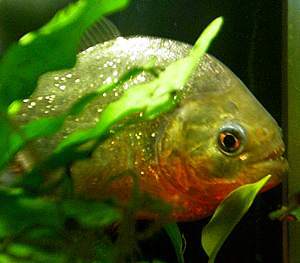
PiranhaPiranhas are evil, soulless, bloodthirsty critters who would rather bite your leg off than look at you, right?

Of course they are!

But researchers are turning up something else about them. They may also be . . . scared.

It’s been thought that piranhas school together in hunting packs, the way wolves do, but it turns out that they may just be running in schools because they’re chicken, some scientists have determined.

EXCERPT:

"We started off with the premise that they school as a
means of cooperative hunting," she said. If that were the case, the
researchers would have expected to find certain fish associating with
others, as the principle of reciprocal altruism — I scratch your back,
you scratch mine — would be in play. "But there was very little
evidence that the same fish stayed together over time."

They also found that piranhas apparently are so anxiety-prone that they start hyperventilating if put in a tank where they can see humans around them or during a simulated attack by a piranha-predator:

The
researchers also knew that piranhas were prey for other animals,
including cormorants, dolphins and caimans. In their studies, they
noticed that breathing rate, a measure of stress, increased when the
fish were put in a tank, as if they were afraid of being attacked.

The
researchers experimented by placing the fish in tanks in groups of two
to eight. As reported in the journal Biology Letters, they found that
breathing rate increased with smaller schools. Another experiment
simulated an attack by a cormorant and found that although all the
piranhas breathed faster in response, those in larger schools returned
to normal sooner. The fish found safety in numbers.

Conclusion?

"We thought it would be quite neat to do work on
piranhas because so little is known about them," Magurran said. "But
this notion that they were fearsome fish, frightened of nothing — we
had to revise that.

"They’re basically like regular fish," she added. "With large teeth."

GET THE FIRST STORY.

But wait, there’s more!

Another article on the same group of researchers notes (EXCERPTS):

Professor Anne Magurran even had to put up screens round a fish tank
used to study wild Amazonian piranhas because they were so scared of
seeing humans close by that they began to hyperventilate.

"Mostly, they were terrified of us. If you put them in an open tank and
just watch them, their gills would move very quickly – like someone
hyperventilating through stress – so we would screen them off so we
could observe them without frightening them," Prof Magurran said.

Personally, my response would be: "Good! Let them be scared! In fact, let’s put them all in tanks and dance around them wearing scary masks and brandishing spears and long, sharp-pointed knives." But apparently deliberately inducing terror in the piranhas would count as "interfering with the test subjects" and thus would be "bad science"–however much the piranhas might deserve it.

Apparently not all piranhas are as evil as others, though. Some are even vegetarians:

Piranhas’ diet is far less spectacular than might be popularly
imagined. They eat invertebrates of most types, waterfleas, crabs,
shrimps, small fish and vegetable material. "When the forest floods,
the water rises up into the trees and the fish swim among the
branches," Prof Magurran said. "Fruit from the trees is moved about by
the water and virtually all the fish eat it.

"There are different species of piranha [other than the red-bellied
kind] that are actually vegetarian. Some of them have extremely robust
teeth and large jaws, but they just eat fruits."

It also seems that, despite their best efforts, our enemies the piranhas have not succeeded in actually killing one of our kind (so far as can be verified), though they have tried to attack us when we’ve interfered with the nesting sites where they spawn more of their evil breed of mankind-enemies:

There have been no confirmed cases of humans being killed by
piranhas, although there was an incident when people swimming near a
dam in southern Brazil came under attack.

"What happened was they were disrupting the piranhas’ reproduction.
Piranhas build little nests, so they weren’t too happy," Prof Magurran
said.

"But the idea of a cow walking across a stream and being reduced to
a skeleton halfway across is exaggerated. They don’t tend to attack
live prey in normal circumstances."

A human walking into a stream filled with piranhas would almost
certainly emerge unscathed. Prof Magurran said: "They’d want to get
away from you, probably. You can swim in areas where there are
piranhas, although there are times of the year when you wouldn’t want
to do that, when they are very stressed or very hungry.

"You wouldn’t want to disturb them too much or threaten them because
they would bite. But they are just ordinary fish, really – ordinary
fish with sharp teeth."

Which only means that regular fish are also
evil, soulless, bloodthirsty critters that would rather bite your leg
off than look at you–they just don’t have the teeth to do it.

GET THE SECOND STORY.