Prayer Request

There is a young, college-age gentleman who has been a friend of Catholic Answers for a number of years and who used to work there.

He’s been sick since January and been having excruciating pain in his neck and abdomen. This morning, starting at 8 a.m. Pacific time (11 a.m. Eastern), he is going to be having a thyroid biopsy.

I don’t normally make prayer requests here on the blog, but I’d ask folks to keep him in prayer. The biopsy happens today and then he’ll get the results on the 20th.

Thanks, folks. I appreciate it.

Icarus Crashed

… again.

"Two pilots, in a jovial mood as they flew an empty commuter jet, wanted to ‘have a little fun’ by taking the plane to an unusually high altitude last October, only to realize as the engines failed that they were not going to make it, according to transcripts released Monday.

"The plane, which the two were ferrying from Little Rock, Ark[ansas] to Minneapolis, crashed and both Capt. Jesse Rhodes and First Officer Peter Cesarz perished.

"The cockpit voice recording, released by the National Transportation Safety Board at the start of a three-day hearing into the Oct. 14, 2004 accident, revealed how the pilots cracked jokes and decided to ‘have a little fun’ and fly to 41,000 feet — the maximum altitude for their plane. Most commuter jets fly at lower altitudes."

GET THE STORY.

Tragic as this story is, I can’t help but speculate on this pair’s intake interview with St. Peter outside the Pearly Gates.

PETER: "Reason for being here?"

PILOT: "We, ah, well…. We wanted to have a little fun."

PETER: "I see. And are you having fun now?"

D&D & The Knights

A reader writes:

Mr. Akin,

I’m 18 years old, a fellow Catholic, a Knight of

Columbus in the 3rd degree, and I play D&D.

I have a question that’s been haunting me. Is there truth to the story that

the new Pope, while still a cardinal, was on a committee that blacklisted

D&D?

Considering that you reference D&D and other RPGs, and not in a morally

negative light, I’m assuming that it’s not a sin to play D&D.

I’d really appreciate it if you could help me out.

P.S.: Are you a Knight? If not, have you given it any thought?

I’ve thought about it, but I’m not much of a joiner. Maybe someday.

As to the rumor you heard, here’s my rule for dealing with rumors about what popes have and have not done: I discount them utterly until such time as a person produces a primary source (or an extraordinarily reliable secondary source) validating the claim. There is simply too much nonsense on the papal rumor net to do otherwise.

Consequently, I could not recommend that you pay any mind to rumors that Cardinal Ratzinger was on a committee that prohibited the playing of Dungeons and Dragons or other role-playing games. Certainly the Congregation for the Doctrine of the Faith and it ssubsidiary bodies did no such thing. Role-Playing Games are, frankly, a phenomena that simply does not rise high enough to trip the Vatican’s radar.

That being the case, one must fall back onto the principles of moral theology. On applying these to RPGs,

SEE HERE.

In sum, though: There is nothing intrinsically sinful with RPGs, though they can definitely be run in a way that has a corrosive effect on the morals of the players. This is particularly true of D&D as it is commonly played. It all depends on who you’re playing with, how the GM or DM runs the game, and how you respond.

Hope this helps, and thanks for writing!

D&D & The Knights

A reader writes:

Mr. Akin,

I’m 18 years old, a fellow Catholic, a Knight of
Columbus in the 3rd degree, and I play D&D.

I have a question that’s been haunting me. Is there truth to the story that
the new Pope, while still a cardinal, was on a committee that blacklisted
D&D?

Considering that you reference D&D and other RPGs, and not in a morally
negative light, I’m assuming that it’s not a sin to play D&D.

I’d really appreciate it if you could help me out.

P.S.: Are you a Knight? If not, have you given it any thought?

I’ve thought about it, but I’m not much of a joiner. Maybe someday.

As to the rumor you heard, here’s my rule for dealing with rumors about what popes have and have not done: I discount them utterly until such time as a person produces a primary source (or an extraordinarily reliable secondary source) validating the claim. There is simply too much nonsense on the papal rumor net to do otherwise.

Consequently, I could not recommend that you pay any mind to rumors that Cardinal Ratzinger was on a committee that prohibited the playing of Dungeons and Dragons or other role-playing games. Certainly the Congregation for the Doctrine of the Faith and it ssubsidiary bodies did no such thing. Role-Playing Games are, frankly, a phenomena that simply does not rise high enough to trip the Vatican’s radar.

That being the case, one must fall back onto the principles of moral theology. On applying these to RPGs,

SEE HERE.

In sum, though: There is nothing intrinsically sinful with RPGs, though they can definitely be run in a way that has a corrosive effect on the morals of the players. This is particularly true of D&D as it is commonly played. It all depends on who you’re playing with, how the GM or DM runs the game, and how you respond.

Hope this helps, and thanks for writing!

Third Star On The Left And Straight On Till Morning

Like everybody else, I cheered (literally!) when the election of Benedict XVI was announced. I called up a buncha folks and congratulated them, even though none had any influence on the papal election. It was simply a day for Catholics to congratulate each other.

I couldn’t wait to see what B16 would do as pope. I still can’t wait to see his first encyclical. Why isn’t it out already!?! (That’s my heart talking, not my head. I know that first papal encyclicals usually aren’t out this quick.)

Amid the euphoria, though, I recognized that B16 was unlikely to approach his pontificate with the "Let’s kick some serious butt!" attitude that I knew many would wish. His reputation as a rottweiler is . . . well . . . rot.

The man is far more patient and gentle than his enemies and even many of his friends, or at least fans, give him credit for.

Make no mistake: I expect great things from his pontificate, and I pray that God gives him a long reign as pope, but the great things that I just know are in the offing will be delivered in a kindler and gentler and more nuanced manner than many expect. (Joseph Ratzinger is nothing if not nuanced.)

We’re already seeing signs of that, and we’ll see more in the future.

HERE’S GEORGE WEIGEL TALKING ABOUT THIS SUBJECT. . . . IN PARTICULAR AS IT APPLIES TO THE LITURGY.

Joseph Ratzinger is a firm and faithful man, but he’s not a rash one.

Now that he’s the captain pro tempore of the bark of Peter, Benedict XVI’s orders to the helmsman are going to be more like a firm and faithful "Steady as she goes, Mister" rather than a frantic "Damn the torpedoes!" or "Fly her apart, then!"

It is true that there are crises affecting the Church that need decisive action, but these are unlikely to be handled in a frantic and heavy-handed manner. Popes tend to fall back on their own natures when dealing with problems, and Ratzinger’s nature is not to be frantic and heavy-handed.

One can also understand why popes tend to fall back on their own natures. Grace builds on nature, and if God has called one to the papacy, he expects one to utilize the nature he has given one as one attempts to fulfill its duties. The responsibilities of the office are so great and the future so unknown that, ultimately, all one can to much of the time is take one’s best guess about how to handle a situation and then entrust the results to God.

Holiness in this life and heaven in the next are what the Church is to aim for, but what currents and storms and rock and shoals one may encounter on the way there are unknowns. It is like sailing a ship where the standing orders are "Third star on the left, and straight on till morning."
The Stroke Of A Pen

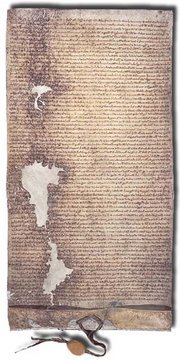
Magna_cartaKnow what yonder document is?

It’s the Magna Carta (Latin, "Great Charter").

The document is considered a landmark in the development of constitutional government.

Basically, a buncha barons twisted King John of England’s arm into ceding a buncha his authority.

It was signed today, June 15, in A.D. 1215 at Runnymede, which is not a kind of soft cheese, despite its name.

The document was immediately repudiated by him, plunging England into a civil war.

He died during the civil war (of dysentery–ouch!).

Pope Innocent III–who had bad relations with John–also didn’t cotton to the document.

LEARN MORE.

AND MORE.

Tradition & The Intercession Of The Saints

A non-Catholic reader writes an e-mail titled "Re Your quote on Gary’s site" and says:

Greetings Mr. Akin

I was reading Gary’s quote of your words:

A: Well, aside from the fact that the Magisterium has ruled on the issue and that Apostolic Tradition teaches it (both of which are sufficient to prove the matter), the Bible also teaches it.

http://www.cin.org/users/james/questions/q040.htm

What "apostolic tradition"?

Could you refer me to the text or material you refer to?

Thanks.

May God grant your house peace

Thanks. Yours, too.

I’m not sure who Gary is, but the link you provide goes to a question I wrote some years ago (like 10 years ago, actually) on how we can be assured that those in heaven can hear our prayers.

This subject is dealt with in apostolic Tradition, which is conveyed in the writings of the Church Fathers. There is a pronounced stream from the early centuries onward showing that Christians recognized the practice of asking the saints (both human and angelic saints) for their intercession. Magisterial intervention has clarified that this is, indeed, part of the deposit of faith and thus apostolic Tradition (meaning that it was present in the deposit of faith at the time of the apostles either explicitly or implicitly).

For sample quotes from the Church Fathers and other early Christians,

SEE HERE.

There is an inscription in a cemetery near St.

Sabina’s in Rome that I find personally very moving. It dates from

about the year A.D. 300 and says:


Pray for your parents, Matronata Matrona. She

lived one year, fifty-two days.


The asking of the saints for their intercession implies an awareness on their part of our prayers. How this is accomplished is a matter of theological speculation. The most common theological speculation is that it is God who makes them aware of our requests for their intercession. They are united with him, and he knows everything, so if they could learn of them through no other means, they could learn of them through God.

Scripture, as I point out in under both of the links provided above, also depicts them being aware of our prayers.

Hope this helps!

Tradition & The Intercession Of The Saints

A non-Catholic reader writes an e-mail titled "Re Your quote on Gary’s site" and says:

Greetings Mr. Akin

I was reading Gary’s quote of your words:

A: Well, aside from the fact that the Magisterium has ruled on the issue and that Apostolic Tradition teaches it (both of which are sufficient to prove the matter), the Bible also teaches it.


http://www.cin.org/users/james/questions/q040.htm

What "apostolic tradition"?

Could you refer me to the text or material you refer to?

Thanks.

May God grant your house peace

Thanks. Yours, too.

I’m not sure who Gary is, but the link you provide goes to a question I wrote some years ago (like 10 years ago, actually) on how we can be assured that those in heaven can hear our prayers.

This subject is dealt with in apostolic Tradition, which is conveyed in the writings of the Church Fathers. There is a pronounced stream from the early centuries onward showing that Christians recognized the practice of asking the saints (both human and angelic saints) for their intercession. Magisterial intervention has clarified that this is, indeed, part of the deposit of faith and thus apostolic Tradition (meaning that it was present in the deposit of faith at the time of the apostles either explicitly or implicitly).

For sample quotes from the Church Fathers and other early Christians,

SEE HERE.

There is an inscription in a cemetery near St.
Sabina’s in Rome that I find personally very moving. It dates from
about the year A.D. 300 and says:


Pray for your parents, Matronata Matrona. She
lived one year, fifty-two days.


The asking of the saints for their intercession implies an awareness on their part of our prayers. How this is accomplished is a matter of theological speculation. The most common theological speculation is that it is God who makes them aware of our requests for their intercession. They are united with him, and he knows everything, so if they could learn of them through no other means, they could learn of them through God.

Scripture, as I point out in under both of the links provided above, also depicts them being aware of our prayers.

Hope this helps!