No Joy In Smurfville

Smurfbomb_6

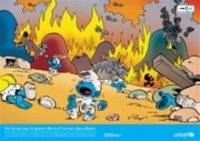
UNICEF is bombing Smurfs in an effort to demonstrate that War Is Bad and that No One Is Safe. While no one would disagree with the first proposition ("War Is Bad"), do we really want a children’s welfare agency informing our children that No One Is Safe from war? The insidious subtext seems to be telling kids (the natural audience for cartoon commercials) that if even Smurfs can be bombed, what about you in your middle-class Western European neighborhood? The Bogeyman of War is lurking Over There and only UNICEF — certainly not your parents — can protect you.

"Smurfette is left for dead. Baby Smurf is left crying and orphaned as the Smurf’s village is carpet bombed by warplanes — a horrific scene and imagery not normally associated with the lovable blue-skinned cartoon characters.

"These are the scenes being shown as part of a new UNICEF ad-campaign on Belgian television.

"’It’s working. We are getting a lot of reactions and people are logging on to our Web site,’ UNICEF Belgium spokesman Philippe Henon said Tuesday.

"The Belgian office of the U.N. children’s fund said it has decided to use the creations of late Belgian artist Peyo to shock a complacent public into backing its fund-raising efforts for ex-child soldiers in Africa.

"The 20-second video commercial clip now being shown on Belgian TV aims to show that war can happen in the most innocent of places, Henon said.

"’We get reactions from all over the place,’ said Henon. ‘People are shocked and want to know the reasons behind this cartoon image.’"

GET THE STORY.

<Tongue in cheek>Well, now I won’t feel like a Scrooge for refusing to give spare change for UNICEF to trick-or-treaters along with their miniature chocolate bars. After all, how could I support an organization that bombs peaceable Smurfs? Perhaps I’ll give the trick-or-treaters a miniature Smurf instead….</tongue in cheek>

(Now that I have removed my tongue from my cheek, I’ll note in passing that I have never refused to give trick-or-treaters spare change for UNICEF for the reason that I’ve never been asked to do so.  I have never before seen trick-or-treaters collecting for UNICEF, although I suppose some have somewhere since it is an American tradition to do so, according to UNICEF.)

Hysterical Criticism

Copperpot2Whodathunkit? While walking downstairs with the painting at left, I suddenly encountered a wormhole in the space-time continuum (located in one of our kitchen cabinets), and the painting was sucked in before I could stop it! Fortunately, I was able to reach in and find it again, but when I pulled the painting out, the following analysis of the painting came out with it, apparently written by some future historian.

Go figger…

"The first thing we must learn about this artwork is who painted it, and this will give us a deeper understanding of the piece.
It is signed T.Jones in the lower left corner, and has been traditionally accepted as the work of Timothy Jones, an obscure, mid-level painter of the early twenty-first century, who signed his work in the same way.

We now know, of course, that this is very unlikely. There are a number of pieces signed T. Jones in existence, and they differ widely in style and content. This painting does not resemble the large, abstract pieces that are also attributed to T. Jones, so most modern scolars no longer accept that this is an original T. Jones work.
Who, then, painted it? Most modern scholars agree that it was the product of several artists, over a period of time. Perhaps it was based on a sketch by T. Jones, but the painting we now see was revised and developed within the Jonesian community, and reflects their concerns at the time.

We may notice that the handling of paint, the brushstrokes, vary throughout the piece. In some areas the paint is applied thinly, in others it is more thickly textured. Some areas seem more expressive and energetic, while others are more controlled and realistic. Clearly this was executed by more than one artist.

The painting appears to be a straightforward rendering of items that might be found around the artist’s studio, but if we look more deeply, we can see that it is profoundly symbolic. We should not make the mistake of thinking that these are necessarily real objects being depicted. In fact, whether these objects really existed or not is irrelevant. What is important is the deeper meaning of the image.

We see depicted a small copper pot, surrounded by some fruit, two glass bottles and two small china dishes. All rest on a simple white cloth, atop a wooden table or plank.

The vessels at the left of the painting (the copper pot and larger china dish) are full of fruit, overflowing with the "fruit of the spirit" that comes from life in Christ. In contrast, the vessels at right are empty, barren. What separates these two groupings, these two ways of life? We see a clump of grapes, representing the "grapes of wrath" that divide us. The "empty vessels" are separated from the others by issues like anger, resentment and judgemental attitudes.

It helps to know that at this period in history the Church in the U.S. was torn between progressive forces on the one hand, and opressive patriarchal forces on the other, and this painting clearly reflects that struggle. The piece calls us all to understand that we are all the same, standing together on the pure, white cloth of love, resting on the sturdy tabletop of the Primacy of Conscience. The deeper meaning of this painting, then (as with all great art), is – Be Nice.

Standing at the center is the copper pot, old and dented, but filled with fruit. this represents the church as a whole, overcoming the ancient and prejudiced ideas of the past to find the living fruit of justice.
Yeah,.. justice.

Or maybe, freedom.

Whatever.

In any case, we could continue to find deeper meanings to this seemingly simple painting, but space does not allow us to discuss all that we might find. Just remember, the important thing about any work of art is what it means to you."

The Effects Of The Accidents

A reader writes:

I have a question about the Atkins Diet.  I sincerely am not trying to be sacrilegious when I ask this.  I believe in my heart and soul that what I receive in Communion is the body, blood, soul and divinity of our Lord and Savior Jesus Christ, but do the accidents affect my blood sugar?  If I am on Atkins and am a daily communicant (which I am not, because we don’t have daily Mass here in the sticks), would there be a problem?  I can’t imagine a problem because Jesus is all Good and cannot hurt us.  I guess I am just asking about the accidents or maybe you could explain it better.

There is no sacrilege involved. You’re simply asking for knowledge.

It’s true that Jesus won’t hurt us, but that doesn’t mean that our bodies will respond the right way to the accidents of bread and wine.

When we receive Communion, our metabolism looks at the elements and responds the same way that our eyes do, saying, "That’s bread and wine!"

This is not a problem as long as you can handle bread and wine, but some folks can’t.

People with celiac disease, for example, may have a toxic reaction to the accidents of bread if they contain too much gluten (if I may put it that way).

People with alcoholism can be subjected to temptation from receiving the accidents of wine from the cup.

If a single minister is consuming what remains of the Precious Blood after Communion and he drinks enough then he will get tipsy.

This is because the physical properties (accidents) of the bread and wine remain. If I may put it this way, the change in the elements is metaphysical (a change of their inner substance), not physical (a change of their outward properties).

This means that your metabolism will treat them as if they contain carbohydrates. If your metabolism is such that you can handle the amount of carbohydrates that the unconsecrated elements contain then you’ll be able to handle the accidents of the consecrated elements.

On the other hand, your metabolism is sensitive enough that you’ll stop losing weight from receiving a certain quantity of the unconsecrated elements then the same thing will happen when receiving the accidents of an equivalent quantity.

So it really depends on your own metabolism and how many grams of carbohydrates you can ingest per day and still continuing to lose weight.


Friends, Americans, Bloggers…

Maybe it’s my current interest in all things Shakespearean — having just read The Winter’s Tale and now about to take on The Merchant of Venice — but this piece of political satire linking the Miers nomination to Julius Caesar had me screaming with laughter:

"Friends, Americans, bloggers, lend me your ears
I come to bury Miers, not to confirm her.
The evil that Justices do lives after them;
The good is oft preserved by rejecting their nominations;
So let it be with Miers.

"The noble Bush hath told you Harriet is conservative;
If it be so, ’tis a glorious qualification,
And gloriously may Miers answer it in her hearings.
Here, under leave of Bush and the rest,–
For Bush is an honorable man;
So are they all, all honorable men,–
Come I to speak before Miers’ hearings."

GET THE POST.

The Call Of Cthulhu!

Cthulhu0A BIG, Texas-sized CHT to the reader who e-mailed me a link to the just-released DVD of The Call of Cthulhu!

For those who may not know, The Call of Cthulhu is one of the keystone stories of early 20th-century weird fiction writer H. P. Lovecraft.

The story dates from 1926, and now the H. P. Lovecraft Historical Society has adapted the story to film–done in the style of a 1926 silent film!

This was an outstanding choice.

Though there have been a number of Lovecraft film adaptations, they are generally regarded as unworthy by Lovecraft fans. Too much of Lovecraft’s ability to create mood depends on his narration, and when you have characters speaking to each other in naturalistic dialogue, the same effect just can’t be created. Also, many filmmakers who have adapted his stories have been notoriously unfaithful in doing so, changing elements left and right so that the film bears little resemblance to what Lovecraft wrote.

This film, being done by a historical society, is extremely faithful to the story and, by chucking out naturalistic dialogue in the manner of a silent film, it is able to capture the eerie mood of a Lovecraft story through the power of image and music.

This film is a REALLY good adaptation. Lovecraft (who did go to the movies and even had a job as a ticket salesman at a movie theater for a while) would have LOVED this flim if it had been made in 1926 so that he could have seen it. He would have raved about it in his letters to friends.

Continue reading “The Call Of Cthulhu!”

I Seem To Be Having Tremendous Difficulty With My (Creative) Lifestyle

Ceramicjar2I know some of you loyal JA.O readers have been wondering where you can find my artwork online, and whether it is available for purchase. Some nice person even made a bid for my last piece in the comments box, which was real flattering.

That particular piece is bound for our state Eucharistic Congress at the end of October, but will be available afterward.

I have been hinting at a web page of my own for some months, but as yet it has not come together (Soon, honest!).

I have been in a kind of transition period, professionally, and things have not always developed in a linear way.
Let me ‘splain-

No, there is too much… let me sum up…

After closing my art gallery in May of ’05 (another story), I endeavoured to set  up a working art studio in my home, with the idea of painting on a regular basis. I had other freelance work as well, but the painting would now be my main focus. My immediate goal was to produce a well-rounded portfolio (at least twenty pieces) so that I could begin to approach some serious regional and national galleries, as well as having some to enter in competitions.

But running my gallery had taken me away from other duties for almost a year, and I found I needed a few weeks just to catch up on chores that I had left undone.

My beautiful family was also home on their summer break, and I found it hard to work with alot of people and activity going on in the house.

So I didn’t really paint that much all summer.

Then fall came, the family was back in school and I could get things really rolling… except my studio wasn’t right. It took me another week to figure out a workable layout and to control the lighting, etc… . Proper lighting is crucial.

Finally, everything was set. All my ducks were in a row. I was in my studio, by myself, all day, with nothing to do but paint.

That’s when I ran into a serious case of "painter’s block". Ugghh.

Discipline was called for, but with prayer and a few weeks of self-examination, I was really, really ready to paint.
And so that’s (finally) what I have been doing.

So with apologies to those who have been so encouraging about my art, I ask for just a little more patience. I should be online within a month or so.

In the meantime, the act of painting has got me thinking about possible parallels to writing, especially in the area of the Gospels and what we might reasonably expect of the gospel writers.

But that is another post.

Mythic Art

"Myth must be kept alive. The people who can keep it alive are the artists of one kind or another. The function of the artist is the mythologization of the environment and the world." –Joseph Campbell

The day after I saw a fabulous performance of Shakespeare’s The Winter’s Tale — although, to be honest, just about any performance would have been "fabulous" to me since I had never seen Shakespeare performed onstage before — was the feast day of St. Wenceslaus, King of Bohemia. If you know the play, then you know that the King of Bohemia is an important character in that play. If you know Shakespeare, then you know that nothing in Shakespeare is coincidental, so I wondered if the play had any connection to the old English Christmas carol Good King Wenceslaus.

Thanks to Google, I found this extremely interesting article on the influence of the English holiday cycle on Shakespeare’s plays. But I’ve also learned that if you surf the host site when Google points you to extremely interesting articles, you can oftentimes find extremely interesting sites. This is not always true. I still remember my consternation when I found that the only online host I could find for the introduction to Dr. Ludwig Ott’s classic Fundamentals of Catholic Dogma was a rabidly radical traditionalist site that seriously proposed that John Paul the Great was a murderer. (The site is so repugnant that you’ll have to Google for it yourself if you’re really that interested in reading its ramblings.  If you want to find the Introduction to Ott’s book, just Google "Introduction Fundamentals of Catholic Dogma Ludwig Ott" for that link alone.)

In any case, the host for the Shakespeare article was much more interesting. It is called The Endicott Studio and is a kind of online gallery for mythic art. The art it hosts is from various disciplines: fiction, poetry, articles, and artwork. It’s a secular site and the secularism shows, but it is interesting. It’s worth a visit.

THE ENDICOTT STUDIO

Cyborgs ‘R Us?

A reader writes:

Hi, Jimmy,

How much of a person could you replace with prosthetics before they cease to be human?

Okay, first a caution. I hope that you are asking this question for purely theoretical reasons and are not planning on acting on the answer. Doing so is likely to result in unpleasant consequences like imprisonment and damnation.

Arms and legs? Digestive tract? Lungs? Heart? A percentage of the brain?

Yeah, all of those can go and still leave a person human. The key one is the brain, which is the indispensible one. Clearly people can lose parts of their brains and remain human, but if you totally get rid of the brain then you ain’t got a human anymore. A brain in a vat would qualify as a human (albeit a severely disfigured human), but an adult body with its brain cut out would not. How much of the brain one could lose and still have a human well . . . there’s not a single identifiable chunk that you could take out–probably you could take out a lot of different chunks–but if you took out so many that as a whole the disembodied brain experiences systemic failure and irretrivably dies then you’ve taken away so much that what remains ain’t a human. It’s a brain corpse.

(NOTE: See previous remarks on "brain death" for the complexity of this question.)


Supposing that you could replace a living body with 100% artificial organs (leaving aside problems of consciousness) – would it continue to be a person but cease to be human?

I’m not sure what you mean here: Do you mean replacing the entire body with synthetic organs INCLUDING the brain or EXCLUDING the brain?

If the former then the resulting brain-in-a-synthetic-body is still a person and a human (although a severely prosthetized human).

If you mean the latter then the question becomes: What do you mean by "synthetic organs"?

If you mean ordinary human organs with a human genetic code that you’ve grown synthetically (e.g., from a stem cell shoggoth) then you could grow an entire person synthetically, which would be either a clone or a designer clone. Such individuals would be both persons and humans.

You might mean something else by "synthetic organs," though. For example, you might mean mechanical organs (like a mechanical heart) or organs that are made of inorganic material or even organic material as long as they don’t have a human genetic code.

If that’s what you mean by synthetic organs then if you totally replace the body, including the critical parts of the brain needed to keep it a live and functioning whole, then what you have is not a human any more. It’s an android or a synthezoid, but not a human being.

Would it be a person, though?

Maybe.

You don’t have to be a human being to be a person, as illustrated by angels and the three Persons of the Trinity. If the resulting entity had a rational intellect then it would be a person.

The problem would be telling a genuine rational intellect from a false one, though. Computers may some day be sufficiently advanced that they can pass the Turing Test and intellectually pass for human beings. Should that ever happen, though, I’m with Justice Katherine Pulaski that they still ain’t persons and have no rights. They’re not really thinking–exercising an intellect–they’re just following very complex programming.

Sorry, no "Android Rights" for Mr. Data!

It could be, though this is a practical impossibility, that someone could design a non-human life form (possibly even based on inorganic molecules) that would have a rational intellect. Such a being would be a person.


Would thus replacing your body be considered suicide?

If you replace the whole thing, including the brain, yep. That’s killing you. It doesn’t matter if you transfer your memories to a new medium. The death of the old medium is the death of YOU, and that’s suicide.

If you’re just talking about replacing everything except the brain, then no. That’s not killing you and so is not suicide. It is, however, immoral to do that without a very good reason (and some might argue that it would be immoral even though, though it wouldn’t be suicide).


How would such a person relate to the church? The sacraments? They’d lack a human nature …

How non-human physical persons would relate to the Church is a theologically open question. I suspect that if they asked for the sacraments on their own then they would be given them, at least conditionally.

How your brain in a synthetic body would relate to the Church is a more clear matter. You would be able to receive the sacraments, but since some sacraments depend on physical contact (e.g., baptism, confirmation), you’d have to let your brain be touched as part of the process. I highly recommend using sterilized water and oil in a sterilized environment for that due to the risk of viral or bacteriological infection.

Would their salvation depend on their status before becoming a machine? Would nothing they do after transformation effect their chances of getting to heaven?

If what you’ve got continues to be you (the brain in a synthetic body model) then you can continue to act as a moral agent and affect your salvation.

On the other hand, if it continues to be you but there’s an accident of some kind so that you can’t function properly mentally (e.g., your brain accidentally gets cooked in the process of transferring it to the new body) then your situation is like that of anybody who goes into a coma during a medical procedure. If you went into it with unrepented mortal sin on your soul, you’re doomed. If you went in with attrition for your sins and receive the anointing of the sick then you’re saved. If you went into it with contrition for your sins or no mortal sins then you’re all set.

If what you’ve got is a synthetic but nonetheless real person then he is capable of acting as a moral agent and affecting his salvation.

Similar considerations apply for a synthetic person who is mentally impaired (as when you went into the coma in the previous example).

If what you’ve got is an imitation person that does not have a real intellect (e.g., a Mr. Data) then he is a non-person and thus has no salvation to gain or lose, regardless of how good an impression of a human being he’s able to pull off.

This applies even if the android (or whatever) thinks that it’s you because your memories have been loaded into it.