Kecharitomene Questions

A reader writes:

I was watching EWTN earlier and it was mentioned that only two people in the New Testament are referred to as “full of grace” – Jesus (John 1:14) and Mary (Luke 1:28). Of course I thought this would be a really neat thing to mention to my Protestant friends (especially if we’re talking about Jesus and Mary being the New Adam and New Eve).

BUT I wanted to go beyond the English and examine the original Greek – but I don’t know a lot about Greek! So I have two twofold questions:

(1) does John 1:14 use kecharitomene as fully (pardon the pun) as Luke’s usage in 1:28 or does John 1:14 follow more closely to Acts 6:8 when Stephen is referred to as “full of grace and power”?

John 1:14 says that Jesus was plErEs charitos, which literally means "full of grace." (Those capital Es arepresent etas, so pronounce them like the e in "they"; the word is thus pronounced PLAY-RACE).

Luke 1:28 uses kecharitomene, which literally means "one who has been graced" or "woman who has been graced" (since the gender is female). It doesn’t literally mean "full of grace," though that is defensible as a free translation.

Acts 6:8 refers to Stephen as plErEs charitos, so again it’s literally "full of grace" and just the same as the description used of Jesus in John 1:14.

If it is the latter, (2) does that mean there really isn’t a literal “full of grace” parallel between Luke 1:28 and John 1:14 or can I find that literal parallel somewhere else in the New Testament?

Not that I’m aware of, and I’d almost certainly be aware of it if there were.

I’m afraid that in establishing Jesus and Mary as the New Adam and Eve, you’ll need to appeal to other considerations. You might try those mentioned HERE and HERE.


Listen Up!

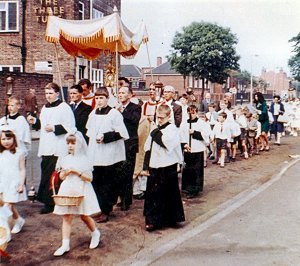
Procession_1

"The guy gal the Pope should listen to"

God has given you the rare gift of bilocation.
With it, you can attend both the First Friday
devotions in honor of Our Lady of Fatima and
the parish bake sale committee meetings. We respect
you, mostly because we fear the incredible power
you wield in our parish.

Are You A Cultural Catholic?
brought to you by Quizilla

So, does anyone know how I let Pope Benedict know that he should be listening to me? In the interests of journalistic honesty and all that, I should note that I got this result on my second try. Seems I have yet to shake off my shady past as a WASP convert because the quiz outed me as one on my first try.

(Nod to Dyspeptic Mutterings for the link. Kudos to The Donegal Express for creating this "Put down the coffee mug, first!"-quiz.)

When The Real Presence Ceases

A reader writes:

Mr. Akin,

What’s the authority you had in mind when you said that the real presence ceases when the precious blood would "no longer would appear to be wine in the common estimation of men"? I’ve heard that before but can’t place it.

This is the standard test for whether Christ is really present or not. It’s common knowledge among theologians, though it is reflected in various authorities. To illustrate, though, I need to broaden the frame of reference a bit.

Christ willed that he would become present under the appearances of (wheat) bread and (grape) wine. Therefore you need wheat bread and grape wine in order to celebate the Eucharist and have valid matter for it.

Neither bread or wine, however, are natural categories (unlike, say, lamb flesh, grapes, or water, which all occur naturally). Bread and wine are prepared by human agency and thus are what one might say are "anthropological" categories rather than natural ones.

This makes us do a little more work in determining validity since anthropological kinds have (or can have) fuzzier boundaries than natural kinds, yet they are what Christ chose to employ in establishing this sacrament.

Since Christ spoke to men and instructed them to perform this sacrament, it follows that he expects men to be able to discern what falls into these categories–at least commonly. Some men might have bizarre expectations about what counts as bread and wine but one can’t rely on any bizarre opinions as a guide to what Christ intended. Therefore, a "common estimation of men" test has evolved. If something would be regarded as bread or wine in the common estimation of men then it will be valid. Otherwise, it won’t be. (Doubtful cases are doubtful matter.)

Because cultures vary, however, we have to throw in one extra qualifier: The common estimation of men has to be tied to the common estimation men in Jesus’ own day. The need for this qualifier is obvious when one considers the fact that to us–in 21st century America–"bread" tends to mean leavened bread while unleavened bread we refer to with a different term (e.g., "crackers"). That was not the case in first century Palestine, though, and to the apostles that Jesus was speaking to, "bread" (lekhem) could be either leavened or unleavened. We know that the latter was valid matter because it was the kind of bread that Jewish people were required to use during the Passover ceremony, which is when Jesus instituted the Eucharist.

So we have to adjust (make broader) what we in our culture would count as bread a little bit in order to take account of this fact.

Once we have the "Is it bread or wine in the common estimation of men?" test, two consequences fall out from that.

The first, which we have already mentioned, is that it isn’t (wheat) bread or (grape) wine then it can’t be used to confect the Eucharist. This is reflected, for example, in Redemptionis Sacramentum:

The bread used in the celebration of the Most Holy Eucharistic Sacrifice must be unleavened, purely of wheat, and recently made so that there is no danger of decomposition. It follows therefore that bread made from another substance, even if it is grain, or if it is mixed with another substance different from wheat to such an extent that it would not commonly be considered wheat bread, does not constitute valid matter for confecting the Sacrifice and the Eucharistic Sacrament [RS 48].

The second consequence gets to your question, which is what happens when the accidents no longer appear to be bread and wine. When that happens, standard Catholic theology holds, the Real Presence ceases because what Christ willed to be present under (the appearances of bread and wine) is no longer present.

Thus St. Thomas Aquinas notes:

[I]f the change [in the consecrated elements] be so great that the substance of the bread or wine would
have been corrupted, then Christ’s body and blood do not remain under
this sacrament
; and this either on the part of the qualities, as when
the color, savor, and other qualities of the bread and wine
are so
altered as to be incompatible with the nature of bread or of wine; or
else on the part of the quantity, as, for instance, if the bread be
reduced to fine particles, or the wine divided into such tiny drops
that the species of bread or wine no longer remain
[ST III:77:4].

The reader continues:

Is the real presence contingent on our subjective sensation, or on the reality of the sacred species themselves? For example, if you have bread or wine imperceptible to our senses, but chemically the same as a larger portion, does the real presence still remain?

Depending on what you mean, the answer may be neither. The Real Presence does not depend on anybody subjectively sensing the bread and wine. The consecrated elements could be reserved in the Tabernacle, with nobody sensing them. On the other hand, bread and wine are such that they can be sensed, and so the quantities do have to be sufficiently large that if someone were looking at them, they would say "That’s bread" or "That’s wine." It is not enough that a tiny particle be put under a microscope and have it be discovered to be chemically identical to bread or wine. We’re dealing with anthropological categories, and the elements have to be "anthropologically" bread and wine, not just chemically bread and wine.

Or is anything that no longer appears to us to be bread or wine necessarily chemically changed?

I couldn’t tell you for a fact with bread since I don’t know if the cell structure of the wheat typically remains in bread. However wine is not chemically changed by the mere fact of being reduced to such a small quantity that it no longer appears to be wine to the senses. I suspect that the same is true of bread as well, I just don’t know for a fact. The key, though, is not chemical composition but what they count as in the common estimation of men (with the needed cultural qualifier).


Or the crumbs on the paten, for instance. I wouldn’t call a crumb of crust "bread," but I still view that as having as much of the real presence as a larger host. Is that correct?

It depends on the size of the crumb. If it’s a particularly large crumb–something you would look at and think "That’s a piece of bread" then the Real Presence would remain. If it’s a particularly tiny crumb, something you would look at and think "That’s a speck of wheat dust" then the Real Presence does not remain. If it’s an ambiguously sized crumb then it is doubtful whether or not Christ is really present.

For safety’s sake, the Church tends to err ont the side of caution both before and after the consecration of the elements. Before the consecration if it is doubtful that the matter is valid then it cannot be used. After the consecration if it is doubtful whether the Real Presence remains then we are to assume that it does.

In obvious cases, though, (e.g., this is clearly cornbread or this clearly looks like a speck of wheat dust) then the Real Presence is not presumed and we are NOT TO SCRUPLE ABOUT THIS.

Hope this helps!
Abortion & Originalism

A reader writes:

Does it matter if the writers of the Constitution/Amendment define or understood the word "life" in "…right to life…" to mean from the moment of conception? That seems pretty likely to me, though I haven’t done any research. In such a case a Catholic (or merely "good") judge would be required to protect life from the moment of conception. I don’t think we *have* to play by their rules.

Perhaps in a generation we may have judges who will interpret the constitution in that way?

Perhaps, but it’s not a given that originalist judges would read the Constitution in this way.

While it’s true that the Fifth Amendment to the U. S. Constitution provides that no one shall "be
deprived of life, liberty, or property, without due process of
law," it is not a slam dunk that the framers or ratifiers of the amendment would have understood life as beginning at conception.

There was still a lot of overhang from the time when bad embryology thought that children were not alive until "quickening" (lit, "making alive" but interpreted as when the mother first feels the baby kick) or Aristotle’s 40/80 day business.

As a result, when the amendment was passed (1791) abortion was generally legal in the United States.

It wasn’t until the mid-1800s when better embryology revealed that children were definitively alive from conception, and American physicians began lobbying their state legislatures to make abortion illegal. That happened in every state of the union and stayed that way until the late 20th century, when certain legislatures began to loosen the requirements, just before The Evil Decision (1973) swept away all regulations and inaugurated an age of triumphal babykilling.

Since abortion was generally legal at the time of the Fifth Amendment’s passage and remained so–uncontested–for many years thereafter, an originalist justice might well look at it and say, "Well, that shows that the framers/ratifiers did not undrstand this amendment to prohibit abortion. Therefore it doesn’t. On the other hand, neither does the Constitution provide a right to abortion. It’s a matter for the legislatures, as it was at all times before Roe v. Wade, so you need a legislative solution if you want abortion banned."

Which is the most likely scenario for how abortion will be ended in this country: A judicial overturning of Roe on originalist grounds, followed by a long, bloody legislative fight to end abortion state-by-state, hopefully (a long way down the road, after the battle is mostly won) eventually resulting in a constitutional amendment protecting life from conception to patch up what the Fifth Amendment doesn’t do on an originalist reading.

That being said, it’s possible that an originalist with a sufficiently strong natural law orientation might look at the Fifth Amendment and say, "Okay. They didn’t understand it as prohibiting abortion, but that was because of the defective understanding of science they had in their day. They meant to protect the life of every human being under U.S. jurisdiction, and now we have a clearer undrstanding of the fact that the unborn are human beings. Therefore, the Fifth Amendment protects them."

That’s possible, but such five such justices aren’t likely to concurrently sit on the Court any time soon. The former reading is more likely to get Roe overturned in the short term.

Sixteen Children … And Counting!

You’re 39, you’ve just delivered your sixteenth child, what are you going to do?

"I’m going to do it again!"

Is that a response that springs to mind for many mothers and many families? Probably not, at least in this day and age. (Although, centuries ago, it may have been. St. Therese of Lisieux was the last of nine children; St. Catherine of Siena was her mother’s twenty-fourth child.) But there are still a few modern families heroically open to life:

"Michelle Duggar just delivered her 16th child, and she’s already thinking about doing it again.

"Johannah Faith Duggar was born at 6:30 a.m. Tuesday and weighed 7 pounds, 6.5 ounces.

"The baby’s father, Jim Bob Duggar, a former state representative, said Wednesday that mother and child were doing well.

"He said Johannah’s birth was especially exciting because it was the first time in eight years the family has had a girl.

"Jim Bob Duggar, 40, said he and Michelle, 39, want more children.

"’We both just love children and we consider each a blessing from the Lord. I have asked Michelle if she wants more and she said yes, if the Lord wants to give us some she will accept them,’ he said."

GET THE STORY.

Sounds like the Duggars have filled one quiver and are working on another (cf. Ps. 127:3-5).

The Nature Of Purgatory

A reader writes:

As a perspective convert to the faith Purgatory is a doctrine that has been giving me a lot of trouble. I struggle with the visions the saints had of purgatory. They are different and do not all agree.

There is a big difference between St. Mary Magadeline de Pazzi’s graphic vision of various tortures in purgatory to St. Catherine of Genoa’s vision in which she says, "the ‘fire’ of purgatory is God’s love ‘burning’ the soul so that, at last, the soul is wholly aflame. It is the pain of wanting to be made totally worthy of One who is seen as infinitely lovable, the pain of desire for union that is now absolutely assured, but not yet fully tasted”. She says that fire burns away sin’s rust which is on the souls not tortures like molten lead, pressers, sharp swords, and ice.

Are the various tortures graphic metaphors to warn us of the damage of sin and the holiness of God or should we take them literal?

That is the way they are commonly understood these days, not as things we would literally encounter in purgatory but–to the extent such images have validity–as symbolic expressions that try to convey what the experience is like.

I don’t see how you can go from a vision telling us how the purifying fires of purgatory reflect God’s love to a visions with demons, fearsome animals, and graphic torments.

This is why I throw in the caveat about "to the extent such images have validity." The images that you are talking about (demons, fearsome animals, graphic torments) are not part of Church teaching. They are things that some visionaries have reported in private revelations but, given the way private revelation works, there is an admixture of the visionary’s own consciousness and cultural background and it can be difficult to untangle what the motions of divine grace the seer was experiencing signify and to what extent they were colored by the visionary’s own consciousness.

This is a special problem when dealing with visions of the afterlife, because the afterlife is so fundamentally different from our embodied experience. There is a much higher risk of "filling in the details" with this-worldly things that are not meant to be understood literally. (Just as angels don’t literally look like men, though that’s how they often appear in Scripture.)

The Church has generally warned people off of some of the more graphic and detailed speculations about purgatory because they are not part of the faith. The Council of Trent (which was occurring at the same time as St. Mary Magdalen de Pazzi was having her visions) specifically warned bishops to be vigilant against people getting too concerned with such matters. The Decree on Purgatory states:

The more difficult and subtle questions [regarding purgatory], however, and those that do not make for
    edification and from which there is for the most part no increase in piety, are to be
    excluded from popular instructions to uneducated people. Likewise, things that are
    uncertain or that have the appearance of falsehood they shall not permit to be made known
    publicly and discussed. But those things that tend to a certain kind of curiosity or
    superstition, or that savor of filthy lucre, they shall prohibit as scandals and
    stumbling-blocks to the faithful [SOURCE].

I should also mention something else: St. Catherine of Genoa’s understanding of purgatory also is not Church teaching. It’s permitted speculation, but not something the Church teaches. It is, however, closer to the way the Church today tends to conceptualize purgatory. The Catechism of the Catholic Church, for example, stresses the difference between purgatory and the sufferings of the damned. Some older writers spoke as if purgatory were the same as hell except that it was temporary instead of eternal. The Catechism goes out of its way to reject that idea:

1030
All who die in God’s grace and friendship, but still imperfectly purified, are indeed
assured of their eternal salvation; but after death they undergo purification,
so as to achieve the holiness necessary to enter the joy of heaven.

1031
The Church gives the name Purgatory to this final purification of the elect, which
is entirely different from the punishment of the damned
[SOURCE].


So even though Catherine of Genoa’s understanding isn’t Church teaching (i.e., the fire of love stuff), it is much more in line with the way the Magisterium is talking about purgatory these days than the former graphic tortures stuff.

When it comes down to it, what is Church teaching is rather modest and might be summarized briefly in a few propositions, such as: (1) There is a purification that occurs after death for the saved who are in need of purification before entering heaven, (2) the faithful on earth can assist those experiencing this purification by their prayers, through Masses, etc., (3) at least some people do not need this purification before heaven, and (4) the purification involves at least some kind of suffering. (Propositions 3 and 4 are more open to question, though, that propositions 1 and 2.)

I know that there is great suffering in purgatory but what is the best theological view on purgatory ecspecially all the theological thought throughout the last century.  Such as Cardinal Ratzinger’s (Pope Benedict) view on purgatory.

I can’t tell you what the best view is, but I can tell you what the Church teaches (see the link to the Catechism above as well as THIS ONE). I can also tell you that Cardinal Ratzinger’s view is much more along the lines of St. Catherine of Genoa’s understanding. In his textbook Eschatology, he conceived of purgatory as an existential encounter with Christ that transforms one. He spoke in these terms:

"Purgatory is not some kind of supra-worldly
concentration camp where one is forced to undergo punishments in a more
or less arbitrary fashion. Rather it is the inwardly necessary process
of transformation in which a person becomes capable of Christ, capable
of God [i.e. capable of full unity with Christ and God] and thus
capable of unity with the whole communion of saints… Encounter with the
Lord is this transformation.  It is the fire that burns away our dross and re-forms us to be vessels of eternal joy."

Hope this helps!

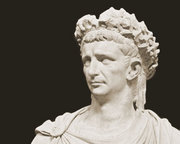
Bye, Claudius

ClaudiusToday–October 13–back in A.D. 54, the Emperor Claudius was poisoned by his slimy fourth wife, Agrippina, who served him a dish of poisonous mushrooms.

Why’d she do it?

So her slimy son, Nero, could become the next emperor and the Beast of Revelation (though she didn’t know about that part).

GET THE STORY.

In other history news, today in 1307 there were mass arrests of the Knights Templar.

GET THAT STORY, TOO.

Hysterical Criticism, Part 2

My last post was an obvious (I hope) attempt to parody some of the excesses of Higher Criticism and it’s devotees.

Now I would like to tell you how I wound up posting such a piece.

As I was in the final stages of the painting that I featured in the aforementioned post (Copper Pot), I ended up thinking a good bit about just how literally I should render a few things, like the pattern on the china.

It occured to me that this process could be analagous to writing, and I thought how it might apply to the Gospels particularly.

There at least a couple of big mistakes one could make about the painting. One would be to think that it was a complete fabrication, a product solely of the imagination. This might lead to absurdities like finding all kinds of hidden meanings where there are none, like the Higher Critic of my parody piece.

The other extreme would be to assume that it was like a photograph, and that even the smallest details were a verbatim reproduction, an exact copy of concrete reality. This might lead to equal absurdities, like if someone were to ask me where they could buy the particular china pattern on the little dishes.

In this particular painting, I simplified and muted the pattern on the china in order that it not draw undue attention in the overall composition. So, in a sense, I did fudge a bit, but that’s my job. Certain shadows are deepened, certain colors are amplified, edges are blurred or sharpened. If I blur the edge of a pear, I doubt anyone would accuse me of asserting that pears are fuzzy, or would assume that I need new glasses.

The truth is that it is a painting, a work of art representing real things, but crafted in such a way as to emphasize certain aspects of reality while downplaying others. All the items depicted are real and could be identified by anyone who bothered to rummage through all the junk in my studio (I love flea markets).

I find reality endlessly fascinating and full of surprises. I strive to be faithful to reality, but not obsessed with minute, photographic detail.

BIG RED DISCLAIMER
– Unlike Jimmy or Michelle, I am not an apologist. I am not a Bible or a literary scholar. I do not claim to know how the Gospels were written, let alone how Plenary Inspiration would work. I am just an artist speculating wildly on how it might have been. If I venture into heresy or nonsense, I am counting on Jimmy and his readers to put me straight.


Based on my experience as an artist, and applying what I know about the creative process to the Gospel writers, I think that I might venture to make a few assertions;

1) The Gospel accounts are faithful representations of real events, but this does not mean that we should expect the same level of detail or attention to exact chronology that we might find in, say, a modern legal document. The writers were concerned primarily that people understand Who Jesus is and what He did, and not with the minutiae of his daily life. We know that Hebrew writers (as well as their audience) were less concerned with the sequence of events than with the substance and meaning of events.

2) The Gospel writers made full use of their human creative faculties (under the inspiration of the Holy Spirit) to emphasize certain aspects of Jesus’ life and message, while downplaying others. For instance, Jesus’ life as a youth simply doesn’t figure as prominently into the proclamation of the Gospel as His passion and death. The writers wanted to present all that was essential, with little extraneous material. Deciding what to include is the first creative step. Some gospel writers included more, some less, but all are faithful representations of real words and events.

3) Being, in some measure, free in setting down the events of Jesus’ life, the Gospel writers may have used different creative or poetic methods to emphasize certain aspects of His teaching. Placing Him in different settings, or at various times, the writers may have symbolically emphasized the substance of His teaching. We needn’t insist, for instance, that the Sermon on the Mount really happened on a mountain or hill. It may have, but it is not essential. Neither could we call this a "mistake" or an "error" any more than my changing the china pattern in my painting was an error. It was a creative choice that placed the non-essential at the service of the truly essential. Both the hyper-literal and the ultra-liberal interpretations would be wrong. The china dish is real, but the pattern is simplified. The pattern is not the essence of the dish, as it would continue to be a dish even with no pattern at all.

In an age before cameras, if I were asked to make a visual record of some object or person, I like to think that I could take some artistic license without being accused of lying or making a mistake, especially if I enjoyed plenary inspiration. We can trust that God guided the process, and that the creative input of the Gospel writers only served to draw out and clarify the essential truth of the historical events depicted.

JIMMY ADDS: Tim, if the painting thing doesn’t work out, you should try apologetics!

Now This Is Good News

I don’t know if y’all’ve heard, but they found this letter that al-Qa’eda’s Number Two Goon, Ayman al-Zawahiri sent to Number Three Goon, Abu Musab Zarqawi (the head evil dude in Iraq).

If you read between the lines of the letter, things sound really good. Good for US, that is. BAD for al-Qa’eda.

Zawahiri is diplomatically warning Zarqawi that he’s screwing things up.

He has to be diplomatic about it, though, because their organization is so weak that he (a) has no effective control over Zarqawi and (b) is so hard up for cash that he politely asks for Zarqawi to send him a donation.

He also outlines what al-Qa’eda’s larger plan is.

I was thinking about doing a detailed mark-up of the letter to point out just how bad things seem to be going for al-Qa’eda–as well as what we in America have to be on guard against–but I had a really LONG day yesterday and don’t have the energy to do a detailed piece of writing at the moment.

FORTUNATELY, JOHN HINDERAKER HAS ALREADY DONE A GOOD ANALYSIS.

YOU CAN ALSO READ THE FULL TEXT OF THE LETTER.