The Monster That Challenged The WorldImperial County!

Monster_that_challenged_the_worldI thought I’d wrap up my series on the Salton Sea by mentioning my favorite movie about the Salton Sea.

No, it ain’t The Salton Sea starring Johnny Depp.

It’s a film called The Monster That Challenged The World starring . . .  well, nobody, really.

It does have the weaselly-voiced Hans Conried (below), better known for playing weaselly-voiced characters on Rocky & Bullwinkle (he was Snidley Whiplash) and other cartoons, but he ain’t the star.

The star, as in any 1950s sci-fi B-movie, is the monster (left).

The premise is that some kind of prehistoric snail eggs buried below the bottom of the Salton Sea have been exposed to . . . (are you ready?) . . . atomic radiation and hatched and released semi-snail monsters of unusual size who may well . . . (are you ready?) . . . CHALLENGE THE WORLD!

Though in the film they never really get past challenging part of Imperial County.

Hans_conried_challenges_the_worldThe flims was made in 1957 when they were trying to pass the Salton Sea off as a resort area for wealthy tourists.

Why wealthy tourists weren’t attracted to the area by tales of giant radioactive snail monsters, I don’t know.

That’s certainly one of the reasons that I went there!

The movie was filmed on-location (for the most part), though in one scene they do try to pass off the beach on Catalina Island as the beach for the Salton Sea (that dog won’t hunt!). They also go to the destert town of Brawley, but most of the action is filmed right there at the wondrous, slime-filled Salton Sea!

YEE-HAW!!!

It’s ’50s sci-fi camp in all its black-and-white glory!

GET THE MOVIE!

Murderous Assistant-Murderess Fired In Sacramento

Okay, so there was this drama teacher at Loretto High School in Sacramento, California. Loretto is an all-girls Catholic high school, and it employs teachers from different faith backgrounds (i.e., Catholic and non-Catholic).

It turned out that it’s drama teacher (who happens to be non-Catholic, though that doesn’t make any difference) is an assistant murderess. In other words, she helps other people commit murder.

When this was discovered by one plucky, anti-murder student at Loretto, her family got involved, reported it to the bishop–with photos as proof–and the bishop ordered that the murder-assisting drama teacher be dismissed.

GO BISH!

Now, the Sacramento Bee (the local liberal newsrag) decided to do a piece on the story outing the anti-murder family publicly and using a variety of the standard journalistic tricks to portray the family’s and the bishop’s actions as hard and unfeeling toward the assistant murderess since there are a lot of people in Sacramento (and the school) who support murder.

Her family now having been outed, the plucky anti-murder student is now free to talk about all the details on her blog–including details left out by the Bee’s sting piece.

This has attracted a lot of ugly evil whacko murder-supporters to the student’s combox.

So may I suggest that you head over yonder and

GET THE STORY

and leave the plucky anti-murder student some positive reinforcement in her combox?

GO PLUCKY ANTI-MURDER STUDENT! BEST OF LUCK TO YOU IN ALL YOUR EFFORTS!

(Oh, and CHT to the reader who e-mailed!)

The Mound. . . . Found!

During his life, H. P. Lovecraft was an impoverished writer who at times made ends meet by "revising" (*cough*ghostwriting*cough*) stories for more literarily-challenged authors.

One of them was Zealia Bishop (nee Reed).

She hired Lovecraft to do a number of stories for her based on minimal premises or plot synopses that she provided for him. Unfortunately, she didn’t pay Lovecraft in a timely manner, and he foreswore working for her.

One of the stories he wrote for her–The Mound–is regarded as one of Lovecraft’s best. In it, as in only two other stories (At The Mountains Of Madness, The Shadow Out Of Time), he envisions an entire non-human civilization. Most remarkably, in The Mound we actually get the narrative of a human character who lives in the eldritch society for some time–rather than just an after-the-fact summary of what the culture was like.

 Though much of the tale deals with a hidden, underground civilization, The Mound is set in the town of Binger, Oklahoma. Binger ("Bing-er")–unlike Arkham and other Lovecraft locations–is a real town, just over 60 miles southwest of Oklahoma City, and it is located in the Oklahoma mound country.

The title of the story refers to one of the Indian mounds in Caddo County, Oklahoma. Specifically, it refers to a mound that Zealia Bishop mentioned to Lovecraft in her premise for the story:

There is an Indian mound near here, which is haunted by a headless ghost. Sometimes it is a woman (S. T Joshi, H. P. Lovecraft: A Life, 467).

Pretty thin for a story premise, huh! It’s also one that Lovecraft found really dull–just another ghost story. So he made up a whole non-human civilization and a 25,000-word novella was an explanation for the premise.

In the story, Lovecraft describes the location of "the mound" this way:

[It was] a huge, lone mound or small hill that rose above the plain about a third of a
mile west of the village—a mound which some thought a product of Nature, but
which others believed to be a burial-place or ceremonial dais constructed by
prehistoric tribes. This mound, the villagers said, was constantly haunted by,
two Indian figures which appeared in alternation; an old man who paced back and
forth along the top from dawn till dusk, regardless of the weather and with only
brief intervals of disappearance, and a squaw who took his place at night with a
blue-flamed torch that glimmered quite continuously till morning. When the moon
was bright the squaw’s peculiar figure could be seen fairly plainly, and over
half the villagers agreed that the apparition was headless.

Now, if you look on GPS/topographical maps of the area around Binger, Oklahoma–like the excellent Delorme Oklahoma guide–you’ll see that ther AIN’T NO mound a third of a mile west of Binger. Lovecraft made that detail up.

BUT!

If you call the officials in Binger (as I did) to track down what Bishop may have been talking about, it’s easy enough to figure out the mystery.

Mound1_1It turns out that there is indeed a mound in Caddo County, where Binger is located, that is reputed to be haunted by ghosts. It’s name is . . . (are you ready?) . . . "GHOST MOUND" (Dum! Dum! Dum!).

 Ghost Mound is more than a third of a mile west of Binger (as well as a bit north-see map to the left). It’s also not the only death-related mound in the county. There is also "Dead Woman Mound"–so named because a local found the body of a dead woman there an buried her at the site. Dead Woman Mound, though, is located father north from Binger, and as far as I know does not have ghost legends associated with it. The best evidence I have is that Zealia Bishop was referring to Ghost Mound, with perhaps an admixture of information about Dead Woman Mound.

The thing, though, is that these mounds are real. They really exist. And folks have been visiting them since Lovecraft’s time. In fact, of late they’ve been using GPS devices to go there. Here are the coordinates:

GHOST MOUND: Lat.
35.4025, Long.
-98.61306.
DEAD WOMAN MOUND: Lat.
35.47583, Long. -98.50444.

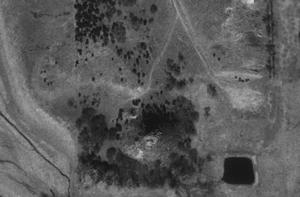
Mound2_3If I’ve read the sattelite maps correctly, this (left) is a picture of Ghost Mound.

I plan to find out for myself, though.

Y’see, I have friends in Oklahoma City, and the next time I go visit them, I plan to stop off on the way and visit Ghost Mound (and Dead Woman Mound).

Hopefully, I won’t get dragged down to the blue-litten realm of K’n-yan!

If I do, DON’T COME AFTER ME! Spare the world and unguessable horror and LEAVE THE MOUND ALONE!

Monologue Of The Messiah

Anne_rice_1

I’m very much looking forward to Anne Rice’s new novel.

Instead of being an interview with a vampire, though, this novel will be a monologue by the Messiah.

In other words: It’s a story told in first-person narration by Jesus Christ.

In the hands of many authors, that kind of story could be an anti-Christian disaster, but Rice is–or has become–a believer. She’s reverted to the Catholic Church, ended her vampire chronicles, and dedicated her future writing to serving God.

Currently she has planned a trilogy of books on the life of Christ, told from his point of view.

That’s a prospect that–as an author–gives me the willies.

It’s the literary equivalent of climing Mount Everest. How on earth do you pull that off? The potential pitfalls associated with such a project are mind boggling! Even if you get the theology right, striking the right tone and style for first person narration by Jesus is nearly unimaginable–especially for something as long as a novel (and certianly for a trilogy!).

That’s one reason I’m interested in reading the first volume, which is about to be released: I want to see how she tackles so daunting a task.

The book is titled Christ the Lord: Out of Egypt and will be released November 1.

In the meantime . . .

READ AN INTERESTING ARTICLE ABOUT RICE AND THE BOOK.

PRE-ORDER THE BOOK VIA AMAZON.

or wait for it to be released on AUDIBLE.COM on November 1.

Incidentally, Rice has moved from her native New Orleans to La Jolla (lah HOY-yah), California, which is here in the greater San Diego area. I wonder if I’ll ever bump into her as a result of interaction with the local Catholic community. That’d be cool.

How Battlestar Galactica Killed Broadcast TV

NumbersixHERE’S A REALLY INTERESTING ARTICLE ON THE FUTURE OF TELEVISION.

The author argues that broadcast TV is in for a major shakeup in the wake of broadband technology.

It’s certain that the Internet is going to change the way television operates–that’s been obvious for some time–but what isn’t clear is what the resulting TV landscape will look like.

At some point we’re going to be downloading TV programs. There are already experiments inthat direction: There’s suppose to be a scaled-down tie-in for the program 24 that you’ll be able to download onto your cellphone. Apple is talking about a video iPod. But these are just experiments.

What has to happen is for someone to come up with an economically viable model–or set of models–for how to pay for TV content to be produced in the age of downloads.

That’s where the above-linked articles comes in. The author speculates on how the economics of TV will work in the future.

Among his predictions:

  • Broadcast TV will go back to being a live medium covering things like news and sports as non-live television programs (e.g., sitcoms and dramas) shift to downloadable distribution.
  • Downloaded TV shows will not have the equivalent of commercials. There will be no interruptions in the show for commercial breaks.
  • Instead, the advertising will be embedded in the show itself–like the station-identification "bugs" that currently appear in the corner of your TV screen (or, though he doesn’t mention this, through product placement).
  • (If I read him correctly) Shows will move back toward having a single sponsor instead of a host of different advertisers.
  • The audience will continue to not pay directly for TV content.

These are interesting ideas, as is the way he fleshes out how it all might work, though I’m dubious about his last prediction. I think that audiences WILL be willing to pay for content. We’re already paying for cable service and for DVDs we buy and for TiVo boxes that cut out the commercials for us.

I suspect that, as the download TV market develops, there will be people who will be willing to pay the producers of the shows in order to get advertising-free versions of the broadcasts, just as is now happening via DVDs. A model may emerge where you can either download the free version of the show, which has embedded advertising, or pay a fee to access an advertising-free version of the show.

I suspect that the latter will at least be experimented with as the market matures.

Now, what role does Battlestar Galactica play in this series of developments? For that you’ll have to

GET THE STORY.

I’m Baaaaaaaaack. . . .

In case you didn’t notice over the weekend, I’m now back from my trip through Arizona and part of New Mexico, and I have the pictures to prove it. More info on all that in coming days.

Before getting back to regular blogging, though, I wanted to say a big THANK YOU to my co-bloggers, and particularly to Tim J, who did an outstanding job filling in!

Kudos, guys! Y’all don’t know how much I appreciate it! Your posts are welcome here, any time!

Watch Out for Large Ungulates

MoosecrossingI grew up in Alaska, so the importance of of THIS ARTICLE (from Reuters)  about not running into moose resonates with me somewhat, even though I now live in Arkansas.
I encountered moose on several occasions as a youngster, both intentionally and  un-.
Moose aren’t just big, they are huge – like a Jersey cow, but
homelier and with longer legs. I mean, you just won’t believe how
vastly, hugely, mind-bogglingly big they are
.
For instance, when the article says that moose can stand 6 feet tall, that means at the shoulder, and the truth is they can be bigger than that.
Encountering moose accidentally is always a little unnerving, and in a moving vehicle it could be especially deadly. In an airplane… well, it would be bad. Looking for a way to keep moose from wandering onto airport runways would therefore be a noble pursuit.
Now the folks in Wasilla, Alaska have installed a Moose Irritating Device that shows great promise in keeping the dumb beasts from wandering into the path of unsuspecting Cessnas.
Archie Giddings, Public Works Director for Wasilla, explained the subtleties of the mechanism;

"They’d feel a shock and they’d also hear a snap. Those two things
would cause the moose to not go in there."

Giddings also described, in refreshingly anthropocentric terms, what a moose/airplane collision would be like;

"If they ever did come to the runway and have a collision with an
aircraft, that could be disastrous to the pilot," Giddings said. "An
airplane could disintegrate if it hits a moose.".

If successful, the device could soon be seen in airports all across the northern U.S., and we will all sleep a bit better, though the moose might be more irritable.
GET THE STORY.

Zuni, new mexico This message

Zuni, new mexico

This message was sent using PIX-FLIX Messaging service from Verizon Wireless! To learn how you can snap pictures with your wireless phone visit
www.verizonwireless.com/getitnow/getpix..

To play video messages sent to email, QuickTime 6.5 or higher is required. Visit www.apple.com/quicktime/download to download the free player or upgrade your existing QuickTime Player. Note: During the download
process when asked to choose an installation type (Minimum, Recommended or Custom), select Minimum for faster download.

Dishing on Immigrants

Dirtydishes3hyAn interesting article from WAPO (via the Seattle Times) reveals that for many immigrants to the U.S, using the automatic dishwasher in their home is the equivalent to Drinking The Kool-Aid.
Many – nay, most – simply won’t use the thing. It is seen as frivolous and unnecessary. According to the article;

If they have a dishwasher — and many do, because it is standard
equipment in most homes — it becomes a glorified dish rack, a
Tupperware storage cabinet or a snack-food bin. It’s never turned on.

Dishwashers are also seen as overly complicated and mysterious. Think about the way alot of Americans feel about programming the VCR (that’s what they had before DVD players, kiddos).
At bottom, though, many immigrants simply think that they can do a better job washing up than any old machine, thanks.

Graciela Andres laments that her daughter, son-in-law and three
grandchildren have abandoned washing by hand. "They do it the American
way: They put everything in the wash machine, no matter if it’s a
little spoon," said Andres, who emigrated from Bolivia in 1981.

You can almost feel the scorn and contempt, can’t you?
I say, good on ’em! "Go not gently…", and all that.
They should start an organization and print T-shirts with the slogan "They can take my dishes away when they pry them from my wet, soapy hands".
GET THE STORY.