Eleanor Clift On Samuel Alito

I was interested to see an article by liberal screech owl Eleanor Clift arguing that Democrats should NOT attempt to use the filibuster in an attempt to block Samuel Alito’s nomination to the Supreme Court.

And she’s right–from the perspective of Evil.

If they use the filibuster to block what seems to be a clearly qualified and non-extremist nominee (no matter how Teddyboy and his associates try to paint him) then the Gang of 14 will allow the constitutional option to be exercised and the Democrats will lost the ability to filibuster judges altogether.

Personally, I hope they DO filibuster Alito so that they DO lose the ability to filibuster future judges–and lose it NOW.

Why now?

Because even if Roberts and Alito turn out to be willing to overturn The Evil Decision, that’s still only four votes to overturn it (counting Thomas and Scalia). There still needs to be one more vote.

That vote is most likely to be gained following the retirement of John Paul Stevens or Ruther Bader Ginsburg sometime in the next three years.

I’d LOVE for the advocates of abortion NOT to have a filibuster in their hip pocket when it comes time to replace one of those two pro-Roe justices.

Eleanor, of course, would like to see them still have it, and so she argues that Alito should not be filibustered.

She seems grimly resigned, though, to the fact that the Supreme Court will be dramatically reshaped as a result of the second Bush term and that the kind of democracy-thwarting jurisprudence that she loves so dearly will be severely curtailed.

I’d just like to see it get curtailed even more by knocking out the filibuster for judicial nominees right now.

C’mon, abortion advocates, MAKE MY DAY!

In the meantime,

LISTEN TO THE CRY OF THE LIBERAL SCREECH OWL.

How Is The Cause For John Paul II’s Canonization Going?

JohnpauliiI’m sure that’s a question many folks would like the answer to.

It seems that the cause is still at a very early stage of development, but there is some news available on it.

HERE’S AN INTERVIEW WITH THE POLISH PRIEST ASSIGNED TO SERVE AS THE POSTULATOR FOR THE CAUSE.

I’m afraid that the Zenit interviewer asked him a number of dopey questions (e.g., about the late pontiff performing "social" miracles–some of those Italian Zenit reporters seem to be from outer space in some of the questions they ask), but he did a good job handling them and it’s nice to get a feel for what’s going on now.

One thing I had not been aware of is that there is an official Internet site for the cause.

HERE IT IS.

Much of it isn’t in English, but look for the little British flags to see the English parts.

Christian Guilt

A reader writes [with slight edits to preserve anonymity]:

"I’ve found my way back to the Church after being away since high school … and I absolutely love my faith now. I want to share it and am thinking about apologetics.

"Problem is, I did some really awful things back in high school and, even though I’ve gone to confession and received absolution, I still can’t get over the guilt. I’m really struggling with trying to be the person I want to be and trying to leave behind the person that I was.

"Any suggestions?"

First of all, welcome home! I hope you are able to make a go of apologetics. The Lord’s field is always in need of new harvesters.

As to your question, there is a difference between the will and the feelings. One cannot help what one feels. One can only choose what one wills. If you feel guilt for forgiven sins, even though you know on an intellectual level that your sins are forgiven, pray for the grace that your feelings will be ordered to what you know is objectively true. Recognize that being haunted by forgiven sins is, in reality, temptation to despair and will to reject such temptations. Offer up the pain that such temptations cause you to Jesus on the cross. Although Jesus himself never sinned, he knows what it feels like to be tempted (cf. Matt. 4:1-11, Heb. 4:15).

A helpful book for further reading might be Understanding Scrupulosity by Fr. Thomas M. Santa, C.Ss.R.

God bless, and I hope this helps!

Rule 20.

Propositions 37-40

HERE ARE THE NEXT FOUR PROPOSITIONS FROM THE SYNOD ON THE EUCHARIST.

Proposition 37 seems to have a mistranslation in Zenit’s rendering of its title. The translation Zenit gives is "Great Concelebrations," but I think what the original meant (in Latin) is "Large Concelebrations." The reason is that, after endorsing the practice of concelebration, it goes on to say that "The competent bodies are requested, however, to study better the
practice of concelebration, when the number of celebrants is very high."

That means either coming up with better ways to do large concelebrations or studying and following the existing norms more closely. Apparently some of the bishops have been in large concelebrations and not been happy with how they were done.

Proposition 38 is basically a big thank you to everyone in the Church who helps with Mass. It also expresses appreciation for the faithful who attend Mass daily and it encourages priests to say Mass daily, even when the faithful do not participate (contra the ideas of some who might say "The Mass is a celebration of the community, and since the community ain’t here at the moment, I shouldn’t say Mass").

Proposition 39 seeks to relate the Eucharist to the spirituality of daily life. It does so in rather general terms of urging people to "draw life" from the Eucharist and to find in the Eucharist strength for a radical following of Christ.

This is all fine, but I hope that the pope elaborates this in a more practical way in his apostolic exhortation. My concern is that, as this passage is phrased, it speaks a poetic language that doesn’t connect with the average person that successfully.

What I’d like to see the pope do is to get practical instead of poetic with Eucharistic spirituality. I’d like him to say things like: "Look, the Eucharist is Jesus. Your relationship with the Eucharist therefore represents your relationship with Jesus. If you want to be a worthy follower of Christ then you need to avoid mortal sin like the plague and seek to grow in holiness and love for God. One of the best ways to do the latter is to go our and start telling people about Jesus and how they need him to be saved. You should also think about Jesus a lot. You should read the gospels and read books about the faith he gave the Church. As you do these things you should constantly pray to Jesus in the Eucharist and tell him how much you love him and how you need his help. When you encounter difficulties–as you will–turn to him and ask for his help and trust that he will give you what you need to get through the difficulty, even if things don’t go your way."

This kind of practical language, I find, helps me a lot more than poetic language about contemplation and "drawing life" does.

You’ll notice that I’ve just said the same stuff (instead of "contemplation" I’ve spoken in terms of thinking aobut Jesus and learning about him and the faith and instead of "drawing life" I’ve spoken of asking Jesus for help and trusting him to give it), but I’ve said it more practically and less poetically.

I think a great many people in the world live in a more practical mode than a poetic mode, and a lot of the quiet, contemplative way that Church documents express themselves just doesn’t reach ordinary people and motivate them to do things differently in their lives.

Indeed, churchmen these days generally acknowledge that the message isn’t getting through to the people, and I think this is part of why. A specialized, poetic vocabulary has been built up around the practice of the faith that most people do not know. It’s the same problem as an Evangelical asking a non-Christian if he’s been "washed in the blood of the Lamb." The non-Catholic doesn’t know what that means.

In the same way, ordinary people in the pews often have an idea that a pious sentiment has just been expressed when they hear the language of Catholic poetical theology, but they don’t know what it means they are to do practically in their lives.

IT’S A PROBLEM I’VE WRITTEN ABOUT BEFORE.

Proposition 40 deals with the problem of Catholics who have divorced and remarried without getting an annulment. These folks are not validly married and for that reason cannot receive the Eucharist if they are having conjugal relations with each other since these relations are objectively gravely sinful.

Many bishops would like to find a way to allow them to receive Communion, and the document refers to this by noting "the painful concern expressed by many Fathers" of the Synod. B16 himself is one who has said that years ago he wanted to find a way to help at least some of these people receive Communion and that more study of this question is needed.

He has also said that, despite his initial views on the subject, his own further study of the question has convinced him that it is a very complicated topic and that the general principles already laid down must be accepted and respected.

This is a topic that we will be hearing more about in times to come, but as far as the Synod’s propositions go, they basically reinforces the current handling of such situations. Without putting it together as concisely as I’m about to, the Synod acknowledge that people in such situations need to either (a) get an annulment and get married for real, (b) stop living together, or (c) stop having sexual relations.

It also stresses that such people are still part of the Church, which cares for them, and that they need to cultivate the Christian life.

It also encourages tribunals handling annulment cases to do so expeditiously and pastorally while following the Church’s law regarding the handling of annulment cases and recognizing how messed up some people are with regard to marriage due to the way their understanding of it has been poisoned by our culture.

This part of the document reflects a delicate balancing of exhortations to tribunals. In some countries the tribunals are barely functional and you simply can’t get them to process annulment cases. This doesn’t mean that they rule against nullity too frequently. It means that they just sit on cases or process them with excruciating slowness that contravenes the pastoral good of the faithful–as well as the law regarding how cases must be heard in a timely manner.

There is also a concern that in other countries the rules aren’t being followed in a different way and that some tribunals hand out annulments too frequently.

But there is also a concern that culture really is poisoning people’s understanding of marriage and, as a result, they’re not exhanging valid matrimonial consent when they attempt marriage.

The Synod tries to balance these concerns in its exhortation to tribunals, though neither this nor B16’s forthcoming apostolic exhortation is really the place to discuss this matter in detail. Instead, his forthcoming address to the Roman Rota (typically held in January or February) is a more likely venue to get a sketch of what B16 thinks tribunals need to do.

Finally, this proposition encourages bishops and pastors to be more vigilant in weeding out people through the marriage preparation process who aren’t ready to get married (or married to each other) and thus decrease the number of divorces and irregular marital situations that way.
Another Synod Needs Your Prayers

ChaldeanlionThough the Synod on the Eucharist is now over, another synod is now underway.

It started yesterday and will run through this Saturday.

What’s the nature of this synod?

It’s for the Chaldean Catholic Church.

The bishops of the Chaldean Church are meeting to go over a number of important matters, including the situation in Iraq, the problem of Chaldean migration out of their homeland due to tough conditions there, the inrush of Evangelicals trying to pull Chaldeans away from their faith, their own particular law for their Church, and their liturgy.

Of these, I gather from my Chaldean friends that the liturgy is topic #1. In fact, they’re looking at what is for them a very significant revision of their liturgy. Apparently their liturgy–which is still celebrated in classical Aramaic–has undergone significant change in recent decades and there is a push to re-tradtionalize it.

This is a controversial topic in the Chaldean Church, as many like the current rite and don’t want to restore the older usages. Others, of course, disagree.

I’d therefore ask your prayers for the Chaldean synod as it meets this week. The Chaldeans are a courageous and very Catholic people who have been beset by countless hardships in recent years (and, indeed, for centuries).

They have a history that stretches back to biblical times. In fact, the city of Mosul, Iraq–where many of them live–is built on the site of the biblical Nineveh, where the Prophet Jonah preached.

Please pray that their patriarch and bishops will make wise decisions this week and that their people will find relief from all the suffering they have had to endure.

MORE INFO ON THE SYNOD.

MORE INFO ON THE CHALDEAN PEOPLE.

Get Out Of Purgatory Free!

Indulgenceaward_1

While surfing through some Evangelical Christian blogs, I noticed a curious award given to Phil Johnson’s PyroManiac. He had been awarded a "Get out of Purgatorio free!"-card, created in the image of Monopoly’s "Get out of jail free!"-cards. Since Evangelicals do not believe in purgatory, and since neither the person who awarded the card or the person who received it believe in purgatory, I assume that the donor of the card was awarding Johnson a free pass out of his own weblog that is named Purgatorio.

If anyone knows of a source of free passes out of Actual Purgatory, let me know. I know of some suffering souls who would be greatly appreciative of the donation.

Red State Blues

BIG RED DISCLAIMER: What’s mine is mine. The blog belongs to Jimmy, of course, but the opinions in my posts on JimmyAkin.org belong to me, Michelle Arnold. Not to Jimmy Akin, not to Catholic Answers, but to me. (Even though JA.org has been a group blog for some time now, there is still some confusion on this point, so it bears repeating, especially in a post like this one.)

Today is Election Day in California, which means that I am willing to use the occasion to answer a reader’s question, one I would ordinarily have ignored as it was phrased in a rather snarky manner and was placed in the combox of a a post that had nothing to do with the subject. Here was the dialogue:

Reader: "You’re not a red stater, Michelle. You’re a wannabe at best."

Michelle: [Flippantly] "Very true…. I’m a native Californian who wants her blue state to be red."

Reader: "Okay, so exactly which issues are you ‘red’ on? By the way, Mark Shea is right about everything political, and he says he hasn’t found a political home.

[Less than 24 hours later, previous paragraph repeated and this comment appended] "Michelle is afraid to respond."

I cannot speak for Mark Shea, although I imagine that he would appreciate the vote of confidence for his political views.

As for my political views, that is something that I can speak about.

On social issues I am solidly red state (e.g., abortion, embryonic stem-cell research, human cloning, euthanasia, homosexual marriage). Because of the preeminent importance of these issues, I place them over and above other issues such as the economy, the environment, the war, etc. My first concern is the life issues and I will do my best to vote for the candidate or proposition that best furthers the cause of life. Failing that, I will do my best to vote for the candidate or proposition that does the least damage to the cause of life.

On the secondary issues, I am more blue state. For example, I plan to vote today to thwart Gov. Arnold Schwarzenegger’s "reform initiatives," apparently so-called because they mask what I believe to be a power grab. At the same time, I will be voting an emphatic "Yes!" on Proposition 73, a California state initiative that seeks to require parental notification of the planned abortion for a minor.

I don’t know whether or not Mark Shea has found a "political home" — I haven’t read what he may or may not have said on the issue — but I do know that I don’t have such a "political home," if by such is meant a political party affiliation. Since I turned 18 some fifteen years ago, I have not been a Republican, a Democrat, or a member of a non-influential Third Party. I am a non-affiliated registered voter, and plan for the foreseeable future to remain that way.

BIG RED DISCLAIMER: What’s mine is mine. The blog belongs to Jimmy, of course, but the opinions in my posts on JimmyAkin.org belong to me, Michelle Arnold. Not to Jimmy Akin, not to Catholic Answers, but to me. (Even though JA.org has been a group blog for some time now, there is still some confusion on this point, so it bears repeating, especially in a post like this one.)

Where The Abortions Are (Part II)

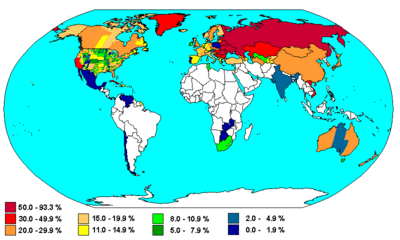
Worldabortionmap3After putting up a world map of abortion law last week, some commenters expressed a desire for a map of abortions by percentage (i.e., which countries had the highest abortion rates rather than the most permissive laws).

One helpful commenter posted a link to such a map, so here it is!

One thing ot note about this map is that it doesn’t have abortion reporting from many countries, particularly in South America and Africa. This may be because the makers of the map did’t have statistics available to them or because these countries don’t keep good abortion statistics (perhaps because it’s illegal in many of these countries and many abortions/crimes go unreported).

Note that on this map the U.S. is broken down by state as well.

SOURCE MAPS.

MORE DATA.

Propositions 31-36

HERE ARE THE NEXT SIX PROPOSITIONS FROM THE SYNOD ON THE EUCHARIST.

Proposition 31 stresses the importance of celebrations of the Word of God and particularly recommends the Liturgy of the Hours.

It also says something rather odd in stating that "Forms of access to the Word of God may also be used which have been
demonstrated to be valid in the catechetical and pastoral endeavor,
such as dialogue, silence or other creative elements like gestures and
music."

Hopefully this will not be taken as license for free-wheeling liturgies of the word.

Proposition 32 deals with celebrations of the Eucharist in "small groups" (i.e., parish cell groups). These groups have been introduced in many places as a way of trying to build involvement in the parish, but there have been numerous problems accompanying them, including the fact that their leaders are often heterodox or emphatic about a particular form of Catholic spirituality that they expect everyone in the group to conform to. There also have been problems with families being separated into different small groups and there have been problems with factionalism in parishes based on the small groups.

Thus the proposition states:

Holy Masses celebrated in small groups must foster a more conscious,
active and fruitful participation in the Eucharist. The following
criteria have been suggested:

— small groups must serve to unite the parish community, not to fragment it;

— they must respect the needs of the different types of faithful,
so that they foster the fruitful participation of the whole assembly;

— they must be guided by clear and precise directives;

— they must keep in mind that, in the measure possible, the unity of the family must be preserved.

Proposition 33 addresses the problem of lay ministries in Mass infringing on the role of the clergy and states that "The tasks of the priest and of other liturgical ministries must be better clarified." Among the clarifications it recommends are:

These ministries must be introduced according to their specific mandate
and according to the real needs of the community that celebrates.

The persons in charge of these lay liturgical services must be
carefully chosen, well prepared and supported by permanent formation.
Their appointment must be temporary. These persons must be known by the
community and must receive grateful acknowledgment from the same. The
liturgical norms and regulations serve to give a clear orientation on
the economy of salvation, "communio" and the unity of the Church.

These recommendations are designed to limit the unauthorized and unnecessary multiplication of lay roles at Mass and of these positions being permanently commandeered by people who are heterodox, unaccountable, and unresponsive to the parshioners they ostensibly serve.

Proposition 34 deals with reverence for the Eucharist and is short and to the point:

To be observed before the consecrated Host is the practice of
genuflection or other gestures of worship, according to different
cultures. The importance of kneeling is recommended during significant
moments of the Eucharistic prayer, with a sense of worship and praise
of the Lord present in the Eucharist. Moreover, thanksgiving after
Communion should be promoted, including with a time of silence.

Proposition 35 deals with the reception of Communion or–more precisely–the non-reception of Communion. It stresses that those who are not allowed to receive Communion (e.g., because they are not Catholics or because they haven’t been to confession) need to have this point explained to them firmly and charitably, with it being pointed out that this is not a personal diss on them.

The proposition also states that "In some situations, a celebration of the Word of God is recommended instead of the Holy Mass." This seems to be a reference to situations in which the best way to prevent people from receiving the Eucharist illicitly would be to not offer Mass but have a liturgy of the word instead. It also says that "Pastors of souls must be concerned to lead the greatest possible number
of men to Christ, who calls all to himself — and not only in Holy
Communion — so that they will have eternal life."

Proposition 36 recommends greater use of Latin in the current rite of Mass, at least in Masses with people from different countries:

To express better the unity and universality of the Church in the
celebration of the Eucharist during international meetings, ever more
frequent today, it is proposed:

— to suggest that the concelebration of the Mass be in Latin
(except Readings, the homily and the Prayer of the Faithful). So also
should be the prayers of the tradition of the Church, and musical
compositions of Gregorian chant should eventually be sung;

— to recommend that priests be prepared in the seminary to
understand and celebrate the Mass in Latin, as well as to use Latin
prayers and know how to value Gregorian chant;

— to not neglect the possibility that the faithful themselves be educated in this respect.

Alito & Abortion

Like many folks, I’ve been disturbed by some of the things I’ve been hearing about SCOTUS nominee Samuel Alito, including previous abortion decisions he’s been involved in.

I recognize, tough, that these opinions may not tell us very much about how he would rule on abortion if placed on the Supreme Court. Lower court judges have to follow Supreme Court precedent, and that means that what they write often doesn’t tell you what they would do if they were elevated to the highest court.

For example, a circuit court judge could not declare abortion unconstitutional or even overturn The Evil Decision. He’s bound by the authority of the Supreme Court. This means that if you hear about him voting to uphold abortion law in a particular case, it may be because he knows that ruling otherwise would clash with what the Supreme Court has established as legal doctrine.

Once he has the change to make that doctrine himself, all bets are off, which is why looking at his overall judicial philosophy is so important.

The same thing plays the other way, though.

Pro-abort forces are up in arms about the fact that Alito once voted to uphold a Pennsylvania statue that had a (watery weak) requirement of spousal notification for a married woman to get an abortion. They’ll use this to try to paint him as a pro-life zealot.

But that doesn’t follow either.

CHARLES KRAUTHAMMER EXPLAINS WHY.