The Last Pope?

Johnpauli_5

That sound you hear is the bottom of the Fiction Writers Think Tank being scraped for the last residue of an original idea. An author who came up short when he did the scraping was Portuguese author Luis Miguel Rocha, who had to rely instead on the old, discredited canard that Pope John Paul I was murdered before he could shovel out the stables of the Vatican Bank.

"Portuguese author and scriptwriter Luis Miguel Rocha said he based The Last Pope on documents he obtained through an undisclosed Vatican source, which he will make public when the novel is published in April.

"The novel puts the theory that John Paul I had become a threat because he was aware of money-laundering involving the Vatican Bank and also because of his plans to liberalise aspects of centuries-old church doctrine.

"’He wanted to be the last wealthy pope. John Paul I wanted to redistribute the riches of the church, open the church to women and authorise the use of contraceptives,’ said Rocha, 29, in a weekend interview.

"The novel depicts the assassination of John Paul I as the result of a conspiracy involving top financial officials, several European governments and a Mafia group that counted top officials of the Roman Curia, including the pontiff’s personal secretary, among its members."

GET THE STORY.

GET THE REAL STORY ON JPI’S DEATH.

Archbishop Fulton Sheen once told the story of being approached by a young priest who demanded to know why the Church was so rich. Archbishop Sheen gave him the standard answer to this common question but the priest wasn’t satisfied. He kept pounding on the question until finally Sheen took him aside and asked him bluntly, "Father, how much have you stolen from the collection plate?" Sheen’s guess was on-target: The young priest was skimming from the parish funds and rationalizing his behavior by convincing himself that the Church was too rich anyway.

I’m no Archbishop Sheen, but my guess is that we can trace Luis Miguel Rocha’s dissatisfaction with the Church not to the alleged "murder" of Pope John Paul I, who Rocha claims would have liquidated the Church’s material assets, but instead to Rocha’s desire for women priests and contraceptives.

B5 Scripts

This is just a note for B5 fans who may want to know about this:

Over the next year JMS is releasing a 15-volume set of all the scripts that he wrote for the TV series Babylon 5 (which is the vast majority of the episodes of the show).

These are the productions scripts and include scenes and dialogue that were filmed but never broadcast.

There are generally seven scripts per volume, plus a lot of bonus materials. The bonus materials include newly written introductions by JMS to the scripts, talking about how they originated, what was going on with the show at the time, what production issues were encountered, etc. The bonus materials also include behind-the-scenes photos from the set and a lot of production memos that he sent out during filming talking about the design of various props, alien races, and characters who were meant to be on the show (some of whom never were–like the The Boss and mysterious Mr. Jones).

I’ve seen the first two volumes (which are out), and they’re actually a lot cooler than I thought from the bare description of them.

Among other things, JMS explains things that weren’t necessarily clear on screen. F’rinstance: An early season 1 episode "Infection," which dealt with a piece of organic technology from the planet Ikara that grabbed a person and turned him into an "Ikaran war machine"–as Mr. Garibaldi once termed it. This episode was one of the first filmed and is generally regarded as one of the least successful of the show’s five year run (it’s basically a man in a rubber suit monster episode),

BUT

in volume 1 on the scripts, JMS explains something that could only have been obvious in hindsight (and wasn’t obvious to me even then until he pointed it out): the Ikaran device is (a) dark and scaly with lots of pointy, insect-like leg thingies, (b) organic technology, (c) that incorporates a living being into itself, (d) seizes control of his brain for its own purposes, and (e) turns him into a form of armament.

Does that sound like anything ELSE we encounter on Babylon 5?

It’s SHADOW TECH.

The Ikarans got ahold of some left over shadow tech from the last Great War and used it to try to impose genetic and ideological purity on their planet, leading to them all being wiped out (since nobody is ever pure enough).

The tech in question was one of the things that the Shadows used to create infantry units since, as JMS points out, an army needs to control the ground as well as the sky.

So. It’s still a man in a rubber suit monster episode, but at least it’s a man in a rubber suit monster episode that fits in to the overall shadow mythology that JMS created for his universe.

The volumes also contain alternate, unfilmed versions of some scripts. For example, volume 1 contains the original, unfilmed version of the series pilot, "The Gathering," which is significantly different from the one that finally got shot.

Volume 3 (coming out in January) is set to explain why actor Michael O’Hare (Cmdr. Sinclair) was forced out of the show by The Powers That Be and the introduction of Bruce Boxleitner (and who ALMOST got his role but at the last minute didn’t).

But the really COOL thing will be volume 15, which will be given FREE (including free shipping) ONLY to those who’ve gotten the rest of the set.

What will be in volume 15?

Take it away, JMS:

"It will also [in addition addition to a bunch of other stuff]contain the Babylon 5 writers bible…the production draft of "The Gathering" as a companion to the original draft offered in volume one…and something very special."

"For over ten years, fans have asked "What would Babylon 5 have been like had Sinclair stayed?" Well, that question will be answered in this volume."

"After we finished the movie, but before we got the series going, WB asked to see a breakdown on this five-year arc thingie. So I wrote a six or seven page, single spaced outline of the ENTIRE FIVE YEARS with Sinclair still in place. The document makes for fascinating reading when compared with the series as it developed. NOT ONLY THAT, but the same document has a brief outline for A POTENTIAL BABYLON 5 SEQUEL SERIES, which would have been entitled BABYLON PRIME."

"Finally, by popular request, the nearly-legendary alternate version of the script for “The Exercise of Vital Powers” containing the Londo/G’Kar seduction scene, written in as an elaborate practical joke on the actors, will also be included.

So, if you want

GET INFO ON THE B5 SCRIPTS.

Incarnation During Annunciation?

A reader writes:

Here’s a really quick one for you.  (I know your time is valuable!)  Father metioned something yesterday I don’t recall ever hearing before, namely, that Mary became pregnant immediately after "fiat mihi secundum verbum tuum [Latin, "May it be to me according to your word," Luke 1:38]."  Does the Church teach this definitively?

No, certainly not.

The Church has very very few Bible verses whose meaning it has addressed infallibly, and this one is not one of them.

I know that it’s customary for individuals to speak of Mary becoming pregnant during the Annunciation, as if the Holy Spirit were coming upon her that moment, but this is not what Scripture indicates, nor is it part of Church teaching.

In fact, that’s not what the Greek text here would suggest. In the Greek of Luke 1:35 ("The Holy Spirit will come upon you, and the power of the Most High will overshadow you") the verbs are in the future tense, indicating that the Holy Spirit would come upon Mary at some point in the future.

Hypothetically, it could have been a few seconds later, but that’s not the natural sense of the text, and if it was then Mary showed no signs from what Luke records of being aware of the event when it happened.

It could have happened at any time up until shortly before Joseph and Mary began cohabiting (because Joseph already knew she was pregnant by this time; Matthew 1:20).

Personally, I tend to think the Incarnation of Our Savior was something that had phenomenal effects–i.e., that it was something Mary was aware of when she was overshadowed by God’s power–and this means that the exact moment of the Incarnation is likely one that is hidden from us–something not recorded in Scripture.

People tend to look at the Annunciation as if it were the moment of the Incarnation because it’s the closest thing we have in Scripture to a description of that moment, but if you read the text itself, it does not suggest that this is what was going on while Gabriel was talking to Mary.

But that’s just my opinion. If someone wants to hold the opinion that when Gabriel said "The Holy Spirit will come upon you" that he meant "in just a few seconds, during this very conversation" then that’s also permitted.

Christmas Day, All Secure

Michelle here.

A local radio station has been playing round-the-clock Christmas music for the past week, and one of my favorites is "A Soldier’s Silent Night," performed by Fr. Ted Berndt, a Catholic priest, former Marine, and Purple Heart recipient. Curious about the origins of the song, I did some searching on Google. There must have been some controversy over the poem’s authorship because the urban-legend debunker Snopes took on the case and verified the claim that it was written by a U.S. serviceman. The author is another former Marine, James M. Schmidt.

This part of the poem always makes me puddle up:

"I didn’t want to leave him so quiet in the night,
this guardian of honor so willing to fight.
But half asleep he rolled over, and in a voice clean and pure,
said ‘Carry on, Santa, it’s Christmas Day, all secure.’
One look at my watch and I knew he was right,
Merry Christmas my friend, Semper Fi and goodnight."

GET THE STORY.

NOTE: I couldn’t find a recording of the performance for sale online. If you find it, please post a link in the combox. Thanks!

More Brokeback Mountain

Steven Greydanus’s review of Brokeback Mountain IS UP.

As you might guess, he gives it significant marks for artistic merit (three and a half stars) but gives it a -4 moral/spirital rating (which is as bad as it can get on his scale), resulting in it having no appropriate audience and an overall recommendability of F.

He thus was able to separate the artistic craftsmanship of the film from its moral content, which is a very important distinction to make. Something can appear beautiful and even moving and still be gravely immorally.

"And no wonder, for even Satan disguises himself as an angel of light" (2 Cor. 11:14).

That’s the thing about sin: If it wasn’t in some way attractive to people, they wouldn’t do it.

Steve also bring out a point that I had been thinking about: When a morally offensive movie has artistic merit, that makes it MORE dangerous, not less, because it is better able to draw the viewer into the immoral worldview of the film than a ham-fisted, low-quality film.

Steve also points out that there are NO sympathetic heterosexual male characters in the film. Homosexual males can get sympathy, and so can heterosexual females, but not heterosexual males. He writes:

The film allows its sexually omnivorous protagonists to be morally ambiguous, and its straight women can be likable or sympathetic. Yet essentially every straight male character in the film is not only unsympathetic, but unsympathetic precisely in his embodiment of masculinity.

In the end, in its easygoing, nonpolemical way, Brokeback Mountain is nothing less than a critique not just of heterosexism but of masculinity itself, and thereby of human nature as male and female. It’s a jaundiced portrait of maleness in crisis — a crisis extending not only to the sexual identities of the two central characters, but also to the validity of manhood as exemplified by every other male character in the film. It may be the most profoundly anti-western western ever made, not only post-modern and post-heroic, but post-Christian and post-human.

GET THE REVIEW.

The Santa Wars

Gisanta_1

When I saw the following news story on a Santa contest turned ugly, I thought I had clicked on the satire news site The Onion by mistake. No such luck. There actually are people out there who take Santa contests so seriously that they darkly suspect fellow competitors of dirty play.

"The British Father Christmas who lost his Santa of the Year world crown has lashed out, citing a suspected campaign to stop him from winning again that has damaged ‘Santa morale.’

"Ron Horniblew, 70, has been authorised by the Master Santa in Greenland and is part of the elite international Santa circuit who compete at the Santa Winter Games, where up to 50 Father Christmases compete for the world title.

"Estonian accordionist Aare Rebban grabbed the crown ‘amid dark mutterings of political voting, professional jealousy and backbiting,’ The Mail on Sunday newspaper said."

GET THE STORY.

I don’t know about you, but if one of these bickering Santas is assigned to visit my home on Christmas Eve, he’s going to find set out for him a lump of coal rather than a glass of milk and a plate of cookies.

More On The Non-Retraction Retraction

I wanted to touch back on something that I meant to mention regarding the non-retraction retraction issued by Catholic News Service regarding its erroneous ranking of Brokeback Mountain as an "L" film ("limited audiences") rather than an "O" film ("morally offensive").

Here is the text of what they wrote:

Editor’s Note: "Brokeback Mountain," originally rated L (limited adult audience, films whose problematic content many adults would find troubling), has been reclassified O — morally offensive. This has been done because the serious weight of the L rating — which restricts films in that category to those who can assess, from a Catholic perspective, the moral issues raised by a movie — is, unfortunately, misunderstood by many. Because there are some in this instance who are using the L rating to make it appear the church’s — or the USCCB’s — position on homosexuality is ambiguous, the classification has been revised specifically to address its moral content.

The part in red is how the L rating is normally explained, and it’s fine. That’s what the L rating means.

But the part in blue is a misinterpretation of the L rating that reveals something interesting.

Note that in blue the editor says that L restricts films "to those who can assess, from a Catholic perspective, the moral issues raised by a movie."

If that’s what L means then y’know what? EVERY movie should be rated L.

NOBODY should be watching a movie if he is unable to correctly assess the moral issues raised by it. If you’re going to get suckered into thinking something immoral in a movie is really moral then you SHOULDN’T be watching that film.

I don’t care whether it’s The Incredibles or Silence of the Lambs. If you can’t accurately handle the moral issues a film raises–whatever those may be–then that film is not for you.

This reinterpretation of the L rating completely steamrollers the need for all other ratings–including O. I mean, if you’re a moral theologian and can correctly "assess, form a Catholic perspective, the moral issues raised by a movie" and that’s a sufficient reason NOT to give it an O then guess what: No films need to be given an O since SOMEBODY (at least the film critic who would have otherwise given them an O, and if not him then the pope) will be able to assess the moral issues they raise.

So ALL films really should have an L.

Clearly this is not what is meant by the ratings system or there would be no other ratings. No A-I, A-II, A-III, or O.

The conventional (in red) description of what L means is correct: These are films that have a limited audience because they contain material that many adults would find troubling.

"Many adults would find troubling" is a different criterion than "morally offensive according to the teaching of the Church." There are a lot of things that many adults would find troubling that aren’t in themselves morally offensive. Showing gruesome murders, for example, is troubling to many, but the mere showing of them isn’t morally offensive as long as the film contains a moral structure that doesn’t ENDORSE the gruesome murders.

Same goes for showing immoral heterosexual and homosexual relationships. That can be troubling for many adults, but it isn’t morally offensive if the film doesn’t ENDORSE these relationships.

So if a film shows evil but does not endorse it, that’s reason to go L.

But if it shows evil AND endorses it then that’s reason to go O.

One of the things presupposed by the distinction between the L and the O rating is that L films are NOT morally offensive. If they were then they should get an O.

As I’ve pointed out before, if the central theme of a movie is morally offensive (e.g., an endorsed-by-the-film homosexual relationship that is what the film is all about–or an endorsed-by-the-film extramarital heterosexual one that is what the film is all about) then the film is morally offensive. (And if the central theme of a movie being morally offensive doesn’t qualify it as a morally offensive picture then I’d like to know what on earth COULD.)

It doesn’t matter whatever aristic merits the film may have in presenting its central theme. If the central theme is morally offensive then those artistic merits simply serve to help the film in delivering an immoral payload to the audience. They’re sugar for the poison pill, and there is all the more reason to slap an O on it so that the faithful can be warned.

Note, incidentally, the elitist attitude of the non-retraction retraction: We who are the cognoscenti and are able to "assess" the moral issues raised by Brokeback Mountain are able to "handle it" and so it is only an L, but because of complaints from the masses, who are too ill-informed to "assess" the moral issues it raises, we’ve got to slap an O on it even though that’s not what it really deserves.

So the non-retraction retraction is not just resentful (blaming the audience) and disingenuous (appearing to classify something as morally offensive but indicating that it really isn’t) and hypocritical (giving something a  rating that one doesn’t believe it deserves), it’s also elitist (viewing the audience as too stupid to handle the truth).

Plenary Indulgence For Christmas?

A reader writes:

To be quite honest I am a pagan, my son, however is not.  I was hoping to give him an plenary ndulgence for his Winter Holiday gift.  It does seem a little more involved than I had thought it would be.  I had been told by someone who used to be a practicing Catholic that it was just a matter of money.  Well, I am not a wealthy person, but, still I thought this a better gift than a sweater or a pair of socks.

Okay, you may be thinking that I am not taking this at all seriously, however, while that may be true, my son, is not me, and therefore should not be confused with me.  His father is, or was, raised Catholic.  I was raised to believe that being a female didn’t matter in any way whatsoever and that religion was just something I had to deal with, and try to impart on any son I may have (whether that is really what the Jewish religion is all about I do not know, all I know is how I was raised).  So, that said, is there a way to purchase a plenary indulgence or am I being silly?  If so, please just say so and I will not bother you anymore.

No, ma’am, you’re not being silly. It is a good thing that you desire to do something to help your son in his Catholic faith at this time of year, and I hope I can help you in this regard.

Indulgences–plenary or otherwise–are not for sale. At one time the Church granted them in connection with people doing the spiritual act of giving alms (though even then they were never "sold"), but that time was long ago.

That does not mean that you can’t do something to help your son in his faith, though. You might consider doing something else for him, like buying him a crucifix or a rosary or a Bible or a Catechism or a book or something. Any of those would be very nice things to do, and I’m sure he’d appreciate it very much.

HERE’S A PLACE THAT YOU COULD LOOK FOR SUCH THINGS ONLINE.

Incidentally, if you ever have questions about the Catholic faith, that site’s a great one to get them answered at. They have lots of online resources, as well as online forums where you can ask questions and get them answered.

Hope this helps, and God bless! Thanks for reading the blog and taking the time to write!

Here Comes Scary Santa

Scarysanta_1

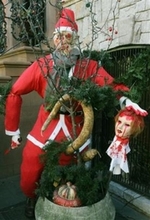
Christmas has evolved a great deal over the centuries. It gone from being a sacred holiday to a secular vacation to a political football. What is the next logical step? Perhaps what we might call a winter Halloween. Halloween has long been a time for satirizing popular culture, but one New York couple has decided to move that Halloween custom to Christmas by decking their halls with a Serial Killer Santa, all in the name of decrying the commercialization of the holiday.

"Joel Krupnik and Mildred Castellanos decked the front of their Manhattan mansion this year with a scene that includes a knife-wielding 5-foot-tall St. Nick and a tree full of decapitated Barbie dolls. Hidden partly behind a tree, the merry old elf grasps a disembodied doll’s head with fake blood streaming from its eye sockets.

"In a telephone interview Wednesday, Krupnik explained that his family thought it would be a fun way to make a comment about the commercialization and secularization of Christmas.

"’It is a religious holiday, but they have turned it into a business. And it shouldn’t be,’ he said. ‘We didn’t put it up to offend anybody. It was just something that came out of our imagination.’

[…]

"Walter Garofalo, a musician from Brooklyn who wandered by wearing a black bandanna covered in skulls, was awe-struck.

"’I wonder if these people would let me use this as our next album cover,’ he said. ‘It’s perfect!’"

GET THE STORY.

I can the album now. Coming soon to a music store near you: "The Silence of the Elves."

That does it. I’ve had about enough of the cultural Christmas spirit for one year, thank you very much.

A Christmas Invitation

Just before Thanksgiving, I suggested that if folks have benefitted from my blog that they consider volunteering for, donating to, or otherwise helping holiday relief programs at their local parishes or churches.

We’re now a little bit out from Christmas, and I’d like to renew my suggestion: If you feel that you have benefitted from the blog, and if you have the ability to do so, please consider doing something for the less fortunate this year for Christmas (or even afterwards if there’s not enough time).

Please constant your local parish, church, soup kitchen, homeless shelter, nursing home, or what have you, and do something for those who need help this Christmas. There are more of them than you know, and you can help make a real difference for them this year.

Whether you’re young or old, Christian or not, you can be a help and can an instrument of God’s love at a time when many are hurting.

There is nothing more bitter than feeling alone and afraid at Christmas.

Help show them Our Savior’s love on the feast of his Birth.