The Beat Goes On

Heartbeat

Michelle here.

Unlike Mark Shea, who has confessed to his Northern European squeamishness over relics, I happen to love them and to enjoy a lot of the folk piety of Catholics throughout history. But even I have to admit that a report of a Polish Dominican friar trying to obtain a recording of John Paul II’s heartbeat for playback at a Christmas Mass is just, uhm, how shall I say it gently … weird.

"A Polish Dominican monk [sic] has asked the Rome clinic that treated John Paul II to give him recordings of the late pope’s heartbeat, which he hopes to play to ardent Catholics at Christmas midnight mass.

"’For years, our hearts beat for him. Today, we want to symbolically listen to his heart,’ Brother Jan Gora was quoted by the Glos Wielkopolski daily as saying.

"’We have taken the first steps’ to obtaining recordings of the heartbeat of John Paul II, who died on April 2 in his private apartment at the Vatican, after being hospitalised at the Gemelli Clinic, he said.

"If Brother Gora obtains the recording, the late Polish-born pope’s heartbeat will be played back during the Agnus Dei at midnight mass in Lednica, in southwestern Poland."

GET THE STORY.

(Nod to Mark and to Amy Welborn for the link. Be sure to see the discussion of the story over at Amy’s.)

My guess is that John Paul II would be flattered but insist that the sound of his heartbeat is not an appropriate liturgical hymn and that the congregation’s focus ought really to be directed to the Eucharist.

A Warning To The Pro-Life Community: This Stinks To High Heaven

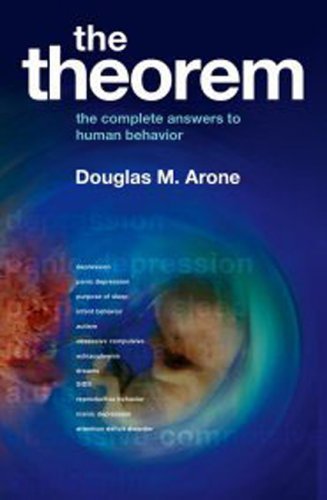
Thetheorem_1Okay, so I’m surfing the web and I find

THIS ARTICLE ABOUT A NEW BOOK THAT’S SUPPOSED TO SHAKE UP THE ABORTION DEBATE.

Here’s what the article says:

An American scientist is set to publish a crucial new book on the pre-natal behavior of babies that is expected to have a profound impact on the issue of abortion.

“The Theorem: A Complete Answer to Human Behavior” by Douglas M. Arone is set for release in the United Kingdom by John Hunt Publishing Ltd.  The book has already provoked reaction among scientists, such as Dr. B. Abolade, psychiatrist for children and adolescents in Montgomery, Alabama, who calls the theory, "A discovery of great genius that will advance mankind’s march towards progress".

"I specifically wanted The Theorem to be published in the U.K. to avoid the focus on the abortion debate that seems to consume America. It was, and still is my hope that over here the work can be appreciated for the other equally important aspects such as; why we talk, the purpose of sleep and the identification to the possible origins of autism, and not just focused on identifying exactly when the fetus gains a limited consciousness", states Mr. Arone.

The publisher has prohibited any pre-release and review copies, which has fueled interest in the book on the part of both pro-life and pro-abortion groups.  The Theorem is scheduled to be released on December 26.

First, notice the hype in the opening sentence. It’s a "crucial new book" expected to have "a profound impact" on the issue of abortion. Really? How many individual books have been released in the last 32 years that had a "profound impact" on the abortion juggernaut? Not many. Now, this could just be the publicist’s hype and may not be reflective of the views of the scientist who wrote the book, so let’s keep reading.

The next graph gives us the name of the book: “The Theorem: A Complete Answer to Human Behavior.” Now, I work for a publisher, and I participate in product titleing meetings all the time, and while titles are the ultimate purview of publisher (they’re part of the marketing of a book), a significant degree of deference is shown to the author. At a minimum, you want the author to be "on board" with the title. If he hates it then it can hurt sales of the book (even if he never says so in public).

You don’t want to give a book a title that will cause the author to freak out, regret ever signing a contract with you, and refuse to promote the book with enthusiasm. So there’s a great degree of mutual agreement in coming to a title, and it is reasonable to assume that the author of this book–Douglas M. Arone–is on board with this title.

That’s a problem because any scientist worth his salt would FREAK OUT at having a book published with a title like that under his name. The pretentious title "The Theorem" is going to draw the ire of the scientific community. (Every scientist works with theorems. What makes Arone’s so special that it qualifies as THE theorem, compared to everyone else’s?)

And the subtitle will send other scientists INTO ORBIT. "The Complete Answer to Human Behavior"? What? Really? One guy has mastered all the manifold areas of psychology, neurology, embryology, pediatrics, medicine, anthropology, sociology, economics, and the host of other disciplines needed to provide THE COMPLETE answer to human behavior? Just how many doctorates does this guy have? Where is the research team that provided him with all this data? What billion-dollar fund is funding his research team?

Grand unified theories are extraordinarily hard to come by, and when someone tries one, it usually fails. Physics hasn’t come up with a settled Unified Field Theory after decades of trying, and the squishy sciences like psychology are lightyears behind in terms of being able to rigorously explain their subject matter.

What REAL scientists do is publish MODEST claims that offer TENTATIVE proposals to explain SMALL areas–usually in scientific journals–and then slowly, over the course of time, let these build up into big picture proposals.

The title of the book and its subtitle are screaming "AMATEUR PHONY!" to anyone with ears to hear and eyes to see.

Then we’ve got some (apparently clinical, not research) psychiatrist referring to this as a work of "great genius" and saying it will "advance mankind’s march toward progress." Huh? What kind of overblown 19th century progress rhetoric boat did THIS guy step off of?

Actually, what boat did he step off of, because it turns out that the guy’s from Nigeria, where he did his residency. Since then he’s practiced in a number of different FIELDS of medicine (can’t settle on a specialty for some reason? legal or ethical review board troubles in one or more maybe?). And, although his bio says he’s licensed to practice medicine on three continents, there are enough stories in the press about problems associated with doctors educated in the third world to raise suspicions about this guy’s qualifications with regard to recognizing theories of "great genius" that will "advance mankind’s march toward progress."

Then we’ve got a quote from the author saying that–for some reason–he’s hinky about publishing the book in America–his homeland–but hopes that "over here" in England "it can be appreciated" properly. As if truth isn’t truth regardless of which side of the Atlantic you’re on? As if Americans will be denied the benefit of all his stunning research? As if (upon checking his web site) you don’t see them advertising that it will be available IN EVERY MAJOR BOOK CHAIN IN AMERICA?

This smells.

And what it smells like this this: The guy COULDN’T FIND a reputable American publisher who was willing to do this book and now he’s spinning why he’s gone to an overseas publisher.

Now, just from this piece (which is essentially a press release
rewritten as a news story) there are multiple warning bells going off.
(NOTE: I have no idea if his British publisher, O Books, an imprint of
John Hunt Publishing Ltd. is respectable or not. I do know that I’ve
never heard of them.)

And then note the way the author "scientist" is referred to at the end of the graph: as MISTER Arone.

What? Not "Doctor"? This guy’s got no PhD? No MD? No nothing? Does he even have a masters degree?

Is this guy QUALIFIED to tell us ANYTHING regarding "The Complete Answer to Human Behavior"?

And then note the sensationalism and secrecy of the last graph: No review copies sent out, which is standard industry practice to build buzz for a book. Again, this stinks. Real scientists don’t go in for this kind of showmanship. And why wouldn’t the publisher send out review copies? It’s not like anybody’s been waiting with baited breath for this book by MISTER Arone to come out. This wasn’t the script for Episode III: Revenge of the Sith or anything (which at least had die-hard Star Wars fans waiting for it).

Is the real reason that the publisher didn’t send out review copies just to engage in cheap showmanship so they could CLAIM that interest was being "fueled" among pro-lifers and pro-aborts, when in fact nobody in the abortion debate even KNEW about the book until this press release was put on the PR wire?

The last line in the article says to go to the book’s website, www.thetheorem.com, for more info, so let’s do that.

What do we find when we get there?

Is there a bio of Mr. Arone telling us his qualifications as a "scientist"? Nope. Not that I could find.

Okay, is there a phone number for his publicists so you can call and ask for a bio? Nope. They want everything through snail mail, e-mail, or faxes. They seem to be averse to giving you a telephone number for some reason. (And the author publicist is listed as having a P.O. Box in Jackson, Wyoming of all places–apparently the new hotspot for New York and L.A. publicists wanting to get out of the city).

Now there’s a page of FORTY ONE "Endorsees" one can look at, and it’s basically a bunch of psychiatrists and sociologists and PhDs and MDs around the country, BUT WAIT! Down at the bottom of the page of "endorsees" we find THIS statement:

These individuals are currently reviewing The Theorem: The Complete Answers to Human Behavior for endorsement. We will post the specifics of the endorsements on this Website when received.

So these people aren’t endorsees AT ALL! The publisher has simply sent them review copies hoping for endorsements. I wonder how they feel about the fact that their names are being used as "endorsees" of a book that they’ve only just got in the mail and have, in fact, issued NO endorsement for.

I know I’d be hopping mad if one of the publishers I occasionally get books from looking for endorsements did that to me!

There’s also a Q & A page on the site where, no matter what the question(s) is (are) the answer is:

After reading The Theorem:
No More Questions – Only Answers!

And there’s NO CLUE what "The Theorem" itself actually is.

If you check Amazon’s US and UK websites, you find out that this is
the ONLY book Arone has ever authored, and if you Google his name and
start subtracting out references to "the theorem" then the number of
mentions of him on the web shrinks towards zero. In fact, I couldn’t
find ANY mentions of him on the web that weren’t connected with this
book. There are no research papers by him in scientific journals.
Nothing. His entire web footprint is this one thing.

The capstone of all this is a LONG LETTER in which MISTER Arone agonizes about how, like a parent, he birthed and raised The Theorem and is now, regretfully, letting his child leave the nest and go out into the world (all the while giving the reader NO CLUE what The Theorem is).

The freaky thing is that he sounds like a character in a Lovecraft story:

While the discovery was born unto me, I never really owned it, as I was not responsible for its greatness, for this grand design. No, all of the honors went to Nature herself. I was just a witness at an indescribable moment in time, seeing a part of her that I am convinced no man was ever meant to see.

No, this discovery never belonged to me, but I must confess that I treated it as though it was mine. I did everything I could to nurture and support it, for while I never owned it— Nature’s secret into mankind’s behavior— it certainly owned me. I surrendered entirely to the obsession it undoubtedly deserved, and then gave more. If it swallowed me whole, well, that mattered little, as it quenched any and all intellectual curiosity that I, any one man, could generate.

Then I went back through history, and the model answered all of those questions as well. Deeper and deeper, day upon day, I began breaking through levels of consciousness that no drug could provide, no religion could promise and no meditation could silence. This model simply possessed the answers. There were no more questions, only answers, some as complex as Nature herself seemed to be, others were more basic, but nonetheless important.

Yes, for the first time in my life I was free
from the intellectual chains that had bound not only me, but
had bound all men since the beginning of time.

Of course not all of the answers were a joyous discovery,
as a few I would rather not have known, for they challenged
my long held beliefs. The facts were the facts however, and
I was very grateful for the peace and the freedom.

The best
part of it all was that whenever I felt uneasy with my findings,
whenever I feared drifting into some abyss of consciousness
or any level that I was uncomfortable with, I could quickly
ground myself with the scientific evidence that proved the
validity of the original model. And ground me it did, for
unlike all theories that fear scientific evidence, (this of
course because they are incorrect and fear being exposed),
this model, on the contrary, embraced it.

Oh, man! This thing is TOO FUNNY! I’ve never read a real-life example of mad scientist/horror story scientific megalomania before!

READ THE WHOLE THING.

Oh yeah, and he explains that once he got hooked on his theory he realized that he didn’t want to be distracted by things like going to med school and becoming a doctor.

Shades of Charles Dexter Ward!–who "refused to qualify for college on the ground
that he had individual researches of much greater
importance to make."

Let’s hope he comes to a better end than young Mr. Ward did.

But in the meantime, pro-lifers should take warning: This guy is NOT a scientist, he is a quack. Do not WASTE your time and money reading his book. If you’ve pre-ordered it, go back and cancel the order. And, whatever you do, DO NOT give him positive publicity. Rely on stuff from this guy and pro-aborts will eat you alive.
Christ’s Unique Presence In The Eucharist

A reader writes:

Please help me.  I live in a parish where members are pushing for the emphasis on community during the Mass.  They are citing an article in St. Anthony’s Messenger by a Fr. Lawrence E. Mick entitled Finding Jesus in the Eucharist:  Four Ways He is Present.  Even the title does not make sense to me.  It seems as though he is only present one way in the Eucharist—and that’s by being in the Eucharist.  Hey, maybe I’m too concrete a thinker.

I respect you.  You are a lucid thinker and you have the integrity to back up your arguments with primary (vs. secondary) sources.  In short, I know that Jesus is present in the the Blessed Sacrament, the Priest, the Word, and the people—but isn’t He most ‘substantially’ present in the Eucharist—and doesn’t that mean something?  If it didn’t mean something, why mention it in Sacrosanctum Consilium, ect.

What is the best way to argue against an overemphasis on Jesus’ presence in the community during Mass; what is the best way to argue against the notion that Jesus is equally present all four ways?

Am I wrong in my thinking?  Even the head of our Archdiocesan Worship office told me "we need to get the emphasis on the community, make the mystery accessible to the people, ect."

Regarding the nonsensicalness of the title, I think that they’re using the term "Eucharist" as an overall term for the celebration of Mass, at which the Sacrament, the priest, the word, and the people are all present. (Admittedly, it’s a dumb title.)

This kind of effort to flatten the uniqueness of Christ’s presence in the Eucharist has been around since during the Second Vatican Council, when some theologians were going nuts and proposing a number of false ideas such as the idea that Christ is equally present in things besides the Eucharist. As a result, Paul VI rushed out an encyclical during the Council called Mysterium Fidei ("The Mystery of Faith") to set matters straight. It’s worth a rather lengthy quotation from the encyclical to show what authentic Catholic teaching on this matter is. The money quote is at the end. Here goes:

Various Ways in Which Christ is Present

35. All of us realize that there is more than one way in which Christ is present in His Church. We want to go into this very joyful subject, which the Constitution on the Sacred Liturgy presented briefly, (30) at somewhat greater length. Christ is present in His Church when she prays, since He is the one who "prays for us and prays in us and to whom we pray: He prays for us as our priest, He prays in us as our head, He is prayed to by us as our God" (31); and He is the one who has promised, "Where two or three are gathered together in my name, I am there in the midst of them." (32) He is present in the Church as she performs her works of mercy, not just because whatever good we do to one of His least brethren we do to Christ Himself, (33)but also because Christ is the one who performs these works through the Church and who continually helps men with His divine love. He is present in the Church as she moves along on her pilgrimage with a longing to reach the portals of eternal life, for He is the one who dwells in our hearts through faith, (34) and who instills charity in them through the Holy Spirit whom He gives to us. (35)

36. In still another very genuine way, He is present in the Church as she preaches, since the Gospel which she proclaims is the word of God, and it is only in the name of Christ, the Incarnate Word of God, and by His authority and with His help that it is preached, so that there might be "one flock resting secure in one shepherd." (36)

37. He is present in His Church as she rules and governs the People of God, since her sacred power comes from Christ and since Christ, the "Shepherd of Shepherds," (37) is present in the bishops who exercise that power, in keeping with the promise He made to the Apostles.

38. Moreover, Christ is present in His Church in a still more sublime manner as she offers the Sacrifice of the Mass in His name; He is present in her as she administers the sacraments. On the matter of Christ’s presence in the offering of the Sacrifice of the Mass, We would like very much to call what St. John Chrysostom, overcome with awe, had to say in such accurate and eloquent words: "I wish to add something that is clearly awe-inspiring, but do not be surprised or upset. What is this? It is the same offering, no matter who offers it, be it Peter or Paul. It is the same one that Christ gave to His disciples and the same one that priests now perform: the latter is in no way inferior to the former, for it is not men who sanctify the latter, but He who sanctified the former. For just as the words which God spoke are the same as those that the priest now pronounces, so too the offering is the same." (38) No one is unaware that the sacraments are the actions of Christ who administers them through men. And so the sacraments are holy in themselves and they pour grace into the soul by the power of Christ, when they touch the body.

The Highest Kind of Presence.

These various ways in which Christ is present fill the mind with astonishment and offer the Church a mystery for her contemplation. But there is another way in which Christ is present in His Church, a way that surpasses all the others. It is His presence in the Sacrament of the Eucharist, which is, for this reason, "a more consoling source of devotion, a lovelier object of contemplation and holier in what it contains" (39) than all the other sacraments; for it contains Christ Himself and it is "a kind of consummation of the spiritual life, and in a sense the goal of all the sacraments." (40)

39. This presence is called "real" not to exclude the idea that the others are "real" too, but rather to indicate presence par excellence, because it is substantial and through it Christ becomes present whole and entire, God and man. (41) And so it would be wrong for anyone to try to explain this manner of presence by dreaming up a so-called "pneumatic" nature of the glorious body of Christ that would be present everywhere; or for anyone to limit it to symbolism, as if this most sacred Sacrament were to consist in nothing more than an efficacious sign "of the spiritual presence of Christ and of His intimate union with the faithful, the members of His Mystical Body." (42) [SOURCE.]

Thus, the Catechism of the Catholic Church also notes:

1373 "Christ Jesus, who died, yes, who was raised from the dead, who is at the right hand of God, who indeed intercedes for us," is present in many ways to his Church:195 in his word, in his Church’s prayer, "where two or three are gathered in my name,"196 in the poor, the sick, and the imprisoned,197 in the sacraments of which he is the author, in the sacrifice of the Mass, and in the person of the minister. But "he is present . . . most especially in the Eucharistic species."198

1374 The mode of Christ’s presence under the Eucharistic species is unique. It raises the Eucharist above all the sacraments as "the perfection of the spiritual life and the end to which all the sacraments tend."199 In the most blessed sacrament of the Eucharist "the body and blood, together with the soul and divinity, of our Lord Jesus Christ and, therefore, the whole Christ is truly, really, and substantially contained."200 "This presence is called ‘real’ – by which is not intended to exclude the other types of presence as if they could not be ‘real’ too, but because it is presence in the fullest sense: that is to say, it is a substantial presence by which Christ, God and man, makes himself wholly and entirely present."201 [SOURCE.]

Hope this helps!

Just Say No To Condom Machines

Muslim groups in India are speaking out against a proposed plan to install five hundred condom distribution machines in one of the Indian states most plagued by HIV/AIDS. They argue that fighting AIDS is a good thing but that the machines promote sex, degrade women, and contribute to the corruption of youngsters.

"Plans to install 500 condom vending machines in the capital of one of India’s worst HIV/AIDS-affected states have angered Muslim groups so much they have taken to the streets to protest a ‘condom culture.’

"Critics of the plan by the Tamil Nadu government and India’s National Aids Control Organisation to put 500 machines in the capital of Chennai and 1000 more across the state later said it would degrade women and corrupt the young.

"’We must fight AIDS, but these machines at public places will only promote sex outside marriage among the younger generation,’ said MH Jawahirullah, who heads Tamil Nadu’s largest Muslim group, the Muslim Munnetra Kazhagam (Muslim Progressive Party).

"Over 200 Muslim women, many in veils, hit the streets of Chennai waving placards denouncing the plan and shouting: ‘Don’t ruin our culture, Remove these machines.’"

GET THE STORY.

As you may know, the late John Paul II was not granted the Nobel Peace Prize in part because of his determined defense of the Church’s traditional teaching against artificial contraception (source, scroll to item 6). By not allowing condoms as a "protection" against disease, the Pope killed millions, or so went the chatter from ideologues (source).

I wonder if those same ideologues will now turn their wagging fingers to the Indian Muslims protesting condom machines and denounce them for killing AIDS sufferers by their opposition to the "condom culture."

Full-Body Transplants

Guest blogger Ron Belgau writes:

I read your blog post today on face transplants, and it provoked a tangential train of thought.  It’s not one I’d want to endorse, but thought I’d send it along for your enrichment (if that is the right term).

Two things caught my attention: first, the prohibition on brain transplants due to the fact that the brain is the seat of the personality, and second, the statement that brain death may be a legitimate criterion for death.

It seems to me that, based on those two considerations, one could make an argument for brain transplantation, with a twist.

Suppose that A receives a gunshot wound to the head which causes brain death (we will assume brain death of a sort that would be acceptable to the most pro-life physician, not just medical community vulture brain death), but leaves his body undamaged.  Meanwhile, B is in a very serious car accident in which his body is damaged beyond all repair, but his brain is undamaged.

It seems to me that within the framework you have offered, one *could* argue that, if it were technically feasible, it could be morally justifiable to transplant B’s brain into A’s body.

In any case, the proper description for this situation would be to say that A had died, and that B was alive in A’s body.  Although from the medical perspective, it probably makes sense to say that we transplanted B’s brain into A, from the moral perspective, what we would want to say is that we had transplanted A’s body to B.

I’m not sure what I want to say about a case like this.  It seems like it could be justified, on the grounds that if we don’t do it, both A and B will die (assuming brain death is a legitimate criterion for death, which *seems* legitimate if we say that the brain is the seat of the personality), while doing it will allow B’s personality to live on, and potentially live a long and productive life.

At the same time, the personal and social identity issues with this case are far more problematic than those involved in the face transplant issue.  One can also imagine a number of particularly ugly ways that this kind of technology could be abused: criminals seeking a new identity, aging Hollywood stars and starlettes looking for the ultimate makeover, etc.

No, you’re quite correct. IF "brain death" (suitably defined and verified) is an adequate criterion for death then you could do PRECISELY this kind of full-body transplant.

Under the scenario you describ you could also snip off both their heads and sew B’s head onto A’s body.

This is one of the things that causes me and others to have significant questions about whether "brain death" in an adequate criterion for somatic death. While the death of the brain may be a necessary condition for the death of the body, it isn’t clear to me that it’s a sufficient condition for the death of the body. I kinda want the rest of the body to die, too–as a whole. I’m not talking about fingernail beds and hair follicles and minor systems like that. I kinda want overall systemic failure before I say that the system of the body is dead, not just the technologically irreversible cessation of brain or higher brain function.

I also think that what counts as technologically irreversible cessation or brain or higher brain function is going to look VERY different once nanotechnology comes online over the next 20-30 years, making our present understandings of what counts as brain death JUST AS INVALID as the cessation of heartbeat definitions of death that were used a hundred years ago.

If you started cutting someone up back then just because their heart stopped beating 20 seconds ago then you would be cutting up someone who was really not yet dead.

People back then weren’t dead the moment their hearts stopped beating. More has to happen to the heart for death to occur than just a cessation of its activity. If it can be jumpstarted then the person simply was not at the point of death, even if his heart could not THEN have been brought back online due to lack of technology.

In the same way, just because a person’s brain has ceased functioning does not mean he’s dead if it turns out that there’s a technology 30 years from now that will jumpstart his brain.

If nanotechnology has the promise that it seems to at this point and we use brain death as a criterion then half a century from now we are LIKELY to find out that we’ve been cutting up people for parts who were STILL ALIVE, we just didn’t have the ability to bring their brains back online yet.

The Incarnate Pope?

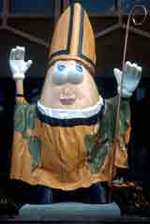
Potatoheadpope_1

In a new twist on the old routine of men not elected to the office claiming to be pope, one Puerta Rican man has claimed to be the incarnation of the late John Paul II.  According to CNN, he has now been excommunicated by Mayaguez Bishop Ulises Casiano Vargas.

"A Roman Catholic bishop here has excommunicated members of a communal sect whose leader allegedly claims to be a manifestation of the late Pope John Paul II.

"Sect leader Edwin Gonzalez Concepcion and his followers can no longer receive communion or participate in [C]hurch activities, according to the order issued by Mayaguez Bishop Ulises Casiano Vargas.

"Gonzalez, a former firefighter in the town of Aguada, has told his followers that he became a manifestation of John Paul when the pope died in April and that Pope Benedict XVI is the ‘antichrist,’ according to the order, which priests in the diocese read to their congregations Sunday."

GET THE STORY.

You’d think that someone claiming to be a "manifestation" of John Paul II would have done enough research into his role to know that the real JPII would never denounce Joseph Ratzinger as "the Antichrist."

NOTE:  The image accompanying this post was chosen because it reminded me of an old This Rock cover image of a Mr. Potato Head Pope that illustrated an article on "Do-It-Yourself Popes."

GET THE ARTICLE.

OFB Film Ratings

A reader writes:

Jimmy-

For the first time in a long time I checked the USCCB film suitability rating for "Lion …" and was really disappointed to see that it received an "A-II — adults and adolescents" rating." The review is at http://www.usccb.org/movies/c/thechroniclesofnarnialionwitchwardrobe.shtml .

The two germane paragraphs are:

The climactic battle may be too intense for young children, as may be scenes involving a pack of vicious wolves serving as Jadis’ henchmen. Hardest of all to watch is Aslan’s atoning sacrifice, surrounded by hellish legions seemingly conjured from a Hieronymus Bosch painting. His apparent "defeat" is trumpeted by Jadis’ victory cry, "So much for love." Some parents may feel it inappropriately upsetting for a "family film," but Lewis himself argued that it was proper not to shield children from knowledge that they are "born into a world of death, violence, wounds, adventure, heroism and cowardice, good and evil."

and

The film contains some battlefield violence, intense scenes of child peril and menace, and several frightening sequences. The USCCB Office for Film & Broadcasting classification is A-II — adults and adolescents. The Motion Picture Association of America rating is PG — parental guidance suggested.

I contrast that with Steve Greydanus’ rating of "Kids & up – discernment required" at http://www.decentfilms.com/sections/reviews/2641 .

At any rate, I don’t know whether to be glad or not that few people apparently read and heeded the warning (as evidenced by the strong opening weekend box office, http://today.reuters.com/business/newsArticle.aspx?type=media&storyID=nN11596039).

I was wondering

   1. if you you know anything about the film review office / effort of the USCCB?

Yes, I do.

   2. who actually does the reviews?

It changes over time, but generally by laypeople who have been hired to work for the office. Currently duties are divided between a pair of gentlemen named Harry Forbes and David DiCerto, who wrote the Narnia review, which can be seen HERE along with his byline. (When the reviews appear on CNS you generally get the byline of the person doing it. The OFB site, though, does’t use bylines.)

3. how strong is the authority of the Bishop’s office behind these guidance efforts?

The film reviews do not engage the Church’s Magisterium, nor are they legislative acts, so they do not have doctrinal or judicial "authority."

They are opinions written at the bishops’ behest by laypeople who have been hired to bring a Catholic sensibility to film criticism and who have done well enough that they have been able to continue in their positions–which is to say, the bishops would like to provide these as a helpful service, but they’re not going to invest any kind of "authority" in them.

No Catholic is obligated to agree with these reviews, nor the ratings assigned to the movies, and the bishops don’t intend that. They’re just a service in hopes of being helpful.

For my own part, I have been impressed with how well the ratings were done a number of years ago when I was doing film criticism, though more recently I think they’ve had a significant number of incorrect ratings (or that was my impression the last time I paid attention to the ratings; I haven’t really hung out on their site of late and things may have improved.)

One thing to note about the lower end of the OFB scale is that it has a design flaw separating the A-I (general patronage) and A-II (adults and adolescents) ratings. Because there is no middle rating or qualifier here, if the movie would be disturbing to a significant number of kids then that makes it hard for them to give it an A-I rating and there is pressure for them to put it in the A-II category. The way the rating system is set up, there is no way for them to say "This would be okay for some pre-adolescents but not for others."

That’s an especial problem because there is just a world of difference between a five year old movie goer and an eleven of twelve year old movie goer. Also, children of the same age can be very different in their readiness to see particular movies due to maters of temprament and movie viewing experience.

The same thing happens at the jump from A-II (adults and adolescents) to A-III (adults). There’s no way to say "This is okay for some adolescents but not others."

Sometimes the reviews will assign a rating but clarify it in the review itself (e.g., we’re ranking it this way but it would also be okay for mature members of the next age group down) to try to get around the design flaw.

The MPAA gets around the children’s age problem by having G, PG, and PG-13, with the first meaning it’s okay for everyone, PG-13 meaning recommended for adults & adolescents, and PG meaning okay for some younger children but needing parental guidance.

Steve Greydanus does something simliar by having kids, kids with discernment (meaning: parents need to exercise discernment about whether a movie is suitable for the kid because it won’t be suitable for all kids), and teens, which are roughly equivalent (in theory) to G, PG, and PG-13 (though Steve might quibble with those rough identifications).

The OFB, though, just has the two rankings A-I and A-II for everybody under 18, and that creates some awkwardness when ranking movies like this.

The reader continues:

Btw, speaking with a friend of mine with younger kids (Paul Masek http://www.stlyouth.org/blogs/paul who started and runs www.reapteam.org, they do nearly 200 retreats a year for middle to high-school kids as part of the St. Louis Archdiocese), our non-scientific sampling after Mass had all of their kids really pumped after seeing the movie, and they talked about their fairly timid  six or seven year old cousin who was not only not frightened, but called this "his favorite movie ever".

Wouldn’t surprise me at all.

Communion For Non-Catholics

A reader writes:

I just had a friend of mine inform me of something that I found troublesome.  He is a Lutheran and married a Catholic woman.  He told me that they are registered parishioners of a Catholic church and that he receives Communion there.  He claims that his wife explained the situation to the pastor and he said it would be alright for him to receive communion.  Of course I asked if there was any way that this could have been misinterpreted by his wife to which he claims not.  In a brief questioning of my friend he does not have a full Catholic undertanding of the Eucharist is and that this is “no big deal”, and that this priest is “very liberal” and accommodating.

I have e-mailed this priest to see if there was a misunderstanding.  I am all for my friend to receive the wonderful gift of the Holy Eucharist but he must go through the Church procedures for all the sacraments.  Please give me information to help with this situation.  It seems to me if this is indeed correct that this priest is handing Communion out like crackers…..

If the priest’s attitude is as reported then there is indeed a problem.

The Church’s law regarding this matter is found in Canon 844 §4 of the Code of Canon Law, which provides:

If the danger of death is present or if, in the
judgment of the diocesan bishop or conference of bishops, some other grave
necessity
urges it, Catholic ministers administer these same sacraments [Communion, confession, anointing of the sick] licitly
also to other Christians not having full communion with the Catholic Church [e.g., Protestants],
who cannot approach a minister of their own community and who seek such on
their own accord, provided that they manifest Catholic faith in respect to
these sacraments and are properly disposed [SOURCE].

This law is given pastoral expression by the bishops of the United States in their document on the reception of Communion, which states:

For our fellow Christians

We welcome our fellow Christians to this celebration of the Eucharist as our brothers and sisters. We pray that our common baptism and the action of the Holy Spirit in this Eucharist will draw us closer to one another and begin to dispel the sad divisions which separate us. We pray that these will lessen and finally disappear, in keeping with Christ’s prayer for us “that they may all be one” (Jn 17:21).

Because Catholics believe that the celebration of the Eucharist is a sign of the reality of the oneness of faith, life, and worship, members of those churches with whom we are not yet fully united are ordinarily not admitted to Holy Communion. Eucharistic sharing in exceptional circumstances by other Christians requires permission according to the directives of the diocesan bishop and the provisions of canon law (canon 844 § 4). . . .

For those not receiving Holy Communion

All who are not receiving Holy Communion are encouraged to express in their hearts a prayerful desire for unity with the Lord Jesus and with one another [SOURCE].

Given the above, if your Lutheran friend wishes to receive Communion on a regular basis in a Catholic church then he will need to embrace the Catholic faith and become a Catholic. (Which he should do anyway, for the sake of his soul.) Otherwise, he will need to abide by Church law and practice, as compassionately set out above.

Hope this helps!

Time Capsule

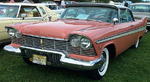
Plymouth_1

I consider a time capsule to be a box or tube. Some people in 1957 thought a great time capsule would be a 1957 Plymouth Belvedere, so they filled it with souvenirs of the time period and buried in a concrete vault. When the time capsule is opened in 2007, the person or his heirs who most accurately guessed Tulsa, Oklahoma’s 2007 population will win the capsule and a bank account that is now worth approximately $1200. … If the account can be found, that is.

"The 1957 Belvedere is underground next to the Tulsa County Courthouse. Also buried with it were five gallons of gas and a case of beer.

"Old news reports indicate the gas was buried in case internal combustion engines became obsolete by 2007 and no fuel was available. Other buried items include the contents of a woman’s purse: 14 bobby pins, a lipstick, a pack of gum, tissues, a pack of cigarettes and matches and $2.43.

"There was also an unpaid parking ticket, a bottle of tranquilizers and a spool of microfilm, which records the entries of a contest held to determine the winner of the car. The person to guess Tulsa’s population in 2007 or the heirs of that person were to win the car and a $100 savings account.

"Assuming an average annual interest of 5 percent compounded quarterly, such an account would be worth almost $1,200 today, if the account could be found.

"The account was set up at a savings and loan that was taken over by Sooner Federal, which was liquidated during the savings and loan bust of the early 1990s. The committee has been trying to find the account, so far without success."

GET THE STORY.

It’s interesting that the capsule’s creators thought that gas might no longer be available in 2007. The way things are going these days with laws created by Big Nanny and legions of agitated activists lobbying Big Nanny for more legislation, my guess would be that the product in the capsule most likely to be obsolete in two years would be the cigarettes.

Face Planters Do Face Plant?

Recently a reader e-mailed me regarding the ethics of face transplants, such as the one recently done in France.

I haven’t had a chance to fully research the facts of that case–and researching them is apparently somewhat difficult since there is considerable (and MOUNTING) dispute over what the facts in the case actually are.

Let me give what I think are some general principles, though:

  1. Any part of the body–except the brain as a whole (since it is the seat of the personality)–is in principle transplantable provided (a) that you don’t kill the donor and and (b) that you don’t do more OR EQUAL harm to the donor than the benefit that the recipient will derive and (c) that the donor’s wishes aren’t violated and (d) there isn’t an acceptable alternative to transplantation–though let’s ignore this criterion for the moment.
  2. If you were to transplant a face from a deceased person then (a) and (b) are taken care of, leaving you with (c). If the donor donates his face after his death, I don’t presently see a fundamental moral barrier to the procedure (ignoring condition [d]).
  3. If the person is not "dead" but only "brain dead" then the question of whether (a) and (b) are met depends on whether you consider "brain death" an adequate criterion for "death." John Paul II expressed openness (in a document whose level of magisterial authority is not fully clear, though it certainly is not infallible) to using brain death as a criterion of death, but many Catholic moral theologians, physicians, and others (including myself, Bishop Fabian Bruskewitz, Bishop Robert Vasa, Fr. Benedict Groeschel,
    Charles Rice, Paul Byrne [past president of the Catholic Medical Assn.]) have significant reservations about this, both on a theoretical and practical level. On the theoretical level, is "brain death" really an adequate criterion for somatic death? On a practical level, the medical establishment has been infected with an anti-life ethic whereby numerous physicians have sought to expand "brain death" via loosey-goosey criteria that make it a declaration of brain death untrustworthy for practical purposes. If, though, you view "brain death" in the current environment as an adequate criterion of death then this case becomes equivalent to (2), above. If not, it becomes equivalent to (4), below.
  4. If the donor is not dead and transplanting the face can be done without killing him (which is possible if fatal infection can be prevented) then condition (a) is satisfied. If the person also does not object to his face being transplanted then condition (c) is satisfied. That leaves us with condition (b). Here we run into a HUGE problem. While faces are non-vital organs (you CAN potentially live without them, as some accident victims can attest), it is difficult under normal circumstances to see how the removal of one person’s face so that another may have it would not constitute an immoral MUTILATION of the first person. While one person can sacrifice a good in order to provide a greater good for someone else, mere exchange of one face for another does not does that. It’s sacrificing one bodily good for (at most) an equal bodily good, which seems to be an impermissible mutilation of the donor.
  5. To avoid the problem in (4), some have suggested removing faces from donors who are in a "persistent vegetative state." The argument, presumably, would be something like, "Hey, the donor isn’t using his face anyway, so why shouldn’t the recipient have the benefit of it? This way the good to the recipient outweighs the harm to the donor." This seems like an extraordinarily problematic course of action. First, a declaration that a person is in a PVS is another one of those things that–in the present, anti-life medical environment–is notoriously unreliable due to loosey-goosey criteria. Second, the fact that someone is in a persistent vegetative state does not mean that the person is in a permanent vegetative state. There is a chance (that will GROW WITH TIME as medical technology advances over the next few decades as nanotechnology comes online) that the person will recover from their "vegetative" state. Because of this possibility, it is not clear that the benefit to the recipient will outweigh the harm to the donor. How would you like to wake up and find that your face had been given to someone else?
  6. One could say, in response to the concern that a patient might wake up and find his face gone is that, as medical technology advances we could also build him a new face. But this sword cuts both ways. As medical technology advances we could ALSO build a better face for the recipient WITHOUT a transplant. And we can do that NOW. This brings us back to the ignored condition, (d). True, an artificial face is not as good as a natural one, but it is a REAL POSSIBILITY. We can get skin and cartilage and bone–OR SUBSTITUTES FOR THEM–from a variety of sources that don’t require transplanting someone’s face. An artifically constructed face may not be as good as a natural one, but it may be "good enough" given the need for the harm done to the donor not to equal the benefit to the recipient.

It therefore strikes me that the prospect of face transplants is beset by extraordinary difficulties, even if a categorical rejection of it (per point [2]) is not immediately clear.

While the face may not be a vital organ, it is nevertheless a part of the body to which humans naturally attach ENORMOUS significance, and this puts it in a special category.

We might propose a taxonomy of body parts ranging from (1) the seat of the personality [the brain] to (2) unique vital organs [the heart, the liver] to (3) unique crucially important organs [the face] to (4) non-unique vital organs [lungs, kidneys] to (5) non-unique, non-vital organs [corneas, patches of skin, volumes of blood]–with it being progressively harder to have morally legitimate transplants as one moves up the scale, with it being impossible to transplant from a live person by the time one hits (2) and impossible to transplant from any person by the time one hits (1).

To point to the elephant in the living room: We naturally feel a profound sense of horror and revulsion at the idea of transplanting a face, particularly from a non-dead person, and we should GO WITH THAT FEELING.

I am reminded from the scene in Jurassic Park where Jeff Goldbulm says, "You were so preoccupied with whether or not your COULD that you didn’t stop to think if you SHOULD!"

That sounds very much like the current situation in France.

Many research-oriented doctors today are so concerned with trying out new techniques and being the first to do something that they totally ignore moral considerations such as those expressed above.

As the current French situation seems to be illustrating.

GET THE STORY.