ATTENTION PRIESTS! How Well Are You Doing Your Job?

Preacher_6_tnb

Let me begin this post by offering an apology to priestly readers for using a rather provocative headline. It is not my intention to question whether you are doing your job in general. Nobody likes that kind of question, and I don’t mean to put you on the spot in that way.

I do, however, need a strong headline of some sort to call attention to a particular task that many priests, at least in recent years, have not been very good at.

The priestly readers of the Register are almost certainly above average on this point, but we all—priests and laity alike—are called to continual conversion, to an ongoing improvement of how well we are serving Christ, and periodic self-assessments are needed.

If you conclude that you are doing an outstanding job in the aspect of your ministry that I’m about to name then great! You’re part of the solution!

But the problem is real.

So real, in fact, that Pope Benedict just created a whole new department at the Vatican to deal with it.

The problem is this: The Catholic Church has an appalling lack of evangelistic activity, especially in the developed world.

That’s why Pope Benedict created the Pontifical Council for the New Evangelization.

This council is more aimed at Europe than America, but we’ve got the same sickness here, if in a less advanced stage.

Recently I wrote about an encounter I had with an Evangelical gentleman who—though I was a total stranger—came up to me with the express purpose of evangelizing me.

I admired him for it. It wasn’t an easy thing for him to do. He was nervous. He was an ordinary church member, not an expert or anything. And yet he did it.

If you want to know why Catholic Churches in America lose so many members of Evangelical churches, this is the primary reason: Evangelicals evangelize.

Catholics don’t.

At least not in the developed world, at least nowhere near as frequently, by comparison.

It didn’t used to be that way. Catholics used to be great evangelizers. But in the developed world a kind of evangelistic scleroticism has set in.

Why is that?

Various reasons can be proposed, but there is one fundamental reason, one key difference between Catholic parishes and Evangelical churches, that is the biggest single factor.

I know, because before I was a Catholic, I was an Evangelical, and I experienced the difference firsthand.

Evangelicals are not made of sterner stuff than Catholics. They are share the same broad, American culture. They are subject to the same general societal factors we are. And yet they engage in way more personal evangelization than we do.

Why?

By far the biggest reason is this: Their clergy tell them to.

Someone famous once said, “You have not because you ask not.” The context was one of prayer, but the principle applies all over the place. Lots of people wouldn’t have become priests if someone hadn’t asked them to consider the possibility. Lots of people wouldn’t have gotten married if someone hadn’t asked them. Historically, lots of people wouldn’t have embraced the gospel and become Christians if someone hadn’t asked them. And lots of people—in the Evangelical world—wouldn’t have become evangelizers if someone (their ministers) hadn’t asked them to.

Lots of people in the Catholic world haven’t become evangelizers, precisely because their clergy haven’t asked them to.

(BTW, the famous person who supplied the above quote was not Our Lord. If you don’t recognize the quote, a little New Testament reading might be in order. You might want to start with the book of James.)

I cannot remember the last time I heard a homily in which I heard a priest tell those of us in the pews that need to evangelize. In fact, I can’t be sure that I’ve ever heard a homily like that. If I have, it’s been so infrequent that it has failed to make a memorable impression.

Oh, sure, I’ve heard the “be nice to everybody” homilies. And, yes, I know the saying commonly (though uncertainly) attributed to St. Francis of Assisi: “Preach the gospel always. Use words when necessary.”

Let me assure you, words are necessary.

And too often the alleged St. Francis quotation is used as an excuse for not evangelizing. Properly used, the quotation means that the whole of our lives should be suffused with the Gospel, but it’s not an excuse to avoid the difficult task of evangelization.

People don’t become Christians without someone telling them the content of the Christian faith.

As someone famous once said, “Everyone who calls upon the name of the Lord will be saved. But how are men to call upon him in whom they have not believed? And how are they to believe in him of whom they have never heard? And how are they to hear without a preacher?”

(This quote also wasn’t from Our Lord. If it’s not familiar, some Bible reading would be great. Try starting with the book of Romans.)

So words are necessary—and specifically words like “Jesus Christ is the Son of God, and you should become a Christian.” Not those words in all cases, but a paraphrase of them, adjusted to circumstance.

If they’re too much for a particular occasion then something like, “I’m going to church this Sunday. Want to come with me?”

Yet it’s not easy to say such words, and so people need to be encouraged to say them.

That’s where priests come in. Priests can’t do the work of evangelization alone. They need to get the laity actively engaged in doing it. And for that they need to encourage the laity to actively do it.

So I suggest the following as a Lenten evangelistic examination of conscience for priests:

• Do I regularly tell people—particularly my own parishioners—that Jesus Christ is the Son of God, that he is the Savior of all men, and that all human beings need to embrace him for the forgiveness of their sins? (The possibility of salvation for those in innocent ignorance notwithstanding.) How often do I say this in homilies?

• Do I regularly tell my parishioners that they need to evangelize others by communicating the above message to them, inviting them to Church, inviting them to become Christians, and (more specifically) inviting them to become Catholics? How often do I say this in homilies?

• Do I regularly give my parishioners advice on how to evangelize and how to deal with the kind of situations they may encounter? How often do I do this in homilies?

• Do I regularly tell my parishioners that evangelization is important work and that they need to be courageous and do it in spite of their fears? How often do I do this in homilies?

• Do I encourage evangelization programs in my parish? If others aren’t taking the lead in setting them up or running them, have I done so? Have I at least asked for volunteers to set up and run such programs? Have I done this in homilies?

Some priests may read down this list and have the satisfaction of knowing that they place regular emphasis on all of these points in their ministry.

Others may conclude that there is more that they could do along these lines.

If so, why not start this Sunday?

What do you think?

Are Catholics Chicken or Something?

Chicken27

Recently I was getting into my truck, and a gentleman I didn’t know came over to talk to me.

He was out front having a smoke and spotted me while I was getting into my vehicle, so he came over and introduced himself.

Turns out he’s my neighbor’s father-in-law.

He wanted to talk to me about Jesus and the end of the world.

Now, he wasn’t one of the Family Radio people who think that Judgment Day is going to occur May 21, 2011 (just watch; Harold Camping’s prediction will turn out to be wrong again), but he was—if I understood him correctly—a Calvary Chapel Evangelical who, like many in that community, think the end of the world is near, that people will be suddenly raptured away before a thousand year earthly reign of Christ, etc.

His primary interest in talking to me, though, wasn’t to swap views on the end of the world. Instead, he had something else in mind.

He didn’t actually use the following terms—our conversation took another path—but translating from Evangelicalese to Catholicese, he was concerned that I might not be saved (i.e., in a state of grace) and wanted to make sure that before I die I got to know Jesus (i.e., experienced a conversion to Christ), so he wanted to witness to me (i.e., evangelize me) so that I wouldn’t go to hell (i.e., hell).

That was right nice of him!

Turns out I was already full-up in the witnessing department—what with being an apologist and all that—but the sentiment was very much appreciated, he was a really nice guy, and we had a delightful conversation.

I hope we can chat again in the future!

I couldn’t help admiring about the gentleman the fact that he was bold enough to go up to a total stranger and start talking about sensitive personal things like whether the stranger has a properly configured relationship with God.

That’s one of the more sensitive and personal topics that can be broached, especially in a one-to-one conversation—as opposed to preaching to a big group of people and asking them individually to consider their relationship with God. The latter is peanuts. Any decent public speaker could do that. Going face-to-face with a single person and making the rectitude of his relationship with God the topic, that requires courage!

I could tell that the gentleman was nervous at the beginning of our conversation, so I did my best to set him at easy and signal that I wasn’t threatened or put off. While I didn’t have a lot of time (I was, after all, getting in my car to go somewhere), I engaged the subject with him happily and enthusiastically, and we had a great (if brief) truck-side conversation.

It brought back pleasant memories of my own time as an Evangelical.

And as I drove away, there was a prominent thought in my head: Catholics almost never do what he just did.

Why?

Why Catholics so seldom work up the courage to approach a total stranger with the message of Jesus.

One might think it’s because Catholics are chicken, that they’re afraid to do so. And of course they are. Evangelicals are, too! You have to screw up your nerve to do this kind of thing. That’s only human!

Yet Evangelicals do it and Catholics—for the most part—don’t.

Why is that?

In my next post I’ll discuss my own thoughts about why that is, but until then . . .

What are your thoughts?

RE: Your Brains


I was pleased by how much of the video I was able to understand, even though it's been several years since I used ASL regularly.

My skills with ASL definitely aren't enough, though, to do an ASL translation of the Secret Vatican Zombie Hunters' Guide. However if, once it's out in English, anyone wants to do a version in ASL or another language, I'm definitely open to editions in other languages.

Proper zombie defense is essential no matter what language you use!

FRINGE Fans! You Can Own Walter’s Favorite Music!

Fringe-Violet-Sedan-Chair-album-Seven-Suns-p In episode 2.10 ("Grey Matters"), Walter asks Astrid to drive him back to the lab so he can hear an album by a band called Violet Sedan Chair (he says listening to it helps him come down from being high on Valium).

In episode 2.21 ("Northwest Passage"), Walter picks up the album–Seven Suns–as pictured here. We also get to hear part of one of the songs ("She's Doing Alright").

In episode 2.23 ("Over There, Part 2"), there is a deleted scene where Peter and Walternate are driving in a car and listening to another song from the album ("Hovercraft Mother"). They also discuss the meaning of the band's music in Peter's life and how the band is different in the alternate universe. Here's the scene:

In episode 3.10 ("The Firefly"), we meet Roscoe Joyce, the keyboardist and songwriter for Violet Sedan Chair.

Now let's put on our grey business suits and fedoras, shave off our hair and eyebrows, flash over to our universe (the real one), and go back in time to Observe an event occurring in April, 2009.

In this event, J.J. Abrams, creator of FRINGE, is guest-editing an issue of Wired magazine. One of the pieces in it is called Musical Mystery Tour: Messages Embedded in Your Favorite Album. It has a timeline of different albums with messages (easter eggs) embedded in them. One item in the timeline is this:

1971 The liner notes on Violet Sedan Chair's album Seven Suns list a missing 11th song, and the penultimate track is rumored to produce hallucinatory effects when played on multiple turntables.

Seven-suns-back-cover The eleventh song on Seven Suns (according to the back cover of the album, same as held up by Walter in the picture, but here is a clearer version) is titled "Greenmana." The penultimate (next to last) track is titled "Re Fa Mi Si Sol La."

If you look on the album's back cover, you'll also see a circle with part of a piano keyboard in it, only it has an extra black key. This is the logo of Seven Suns' record company, 13th Tone Records.

On April 14, 2009, just few days after the Abrams issue of Wired came out, 13th Tone Records was trademarked.

Now let's flash forward in time to Observe an event in a record store in Seattle in early 2011. A human being named Kiki Kane makes a purchase. It is a copy of Seven Suns, published by 13th Tone in 1971. Like any record that old, it is worn and beaten.

Seven_suns1 Word spreads on the Internet that copies of Seven Suns are turning up in record stores around America. Some, after they are discovered, are sold on eBay.

FRINGE fans frantically search record stores for more copies.

HERE'S AN INTERESTING ACCOUNT BY A RECORD STORE EMPLOYEE.

Of course, the number of the vinyl records seeded in independent record stores is nowhere near enough to meet fan demand. Fortunately, you can now purchase your very own copy of Seven Suns in .mp3.

BUY IT HERE ON AMAZON. THEY'LL ALSO STORE IT FOR YOU FOR FREE IN THEIR NEWFANGLED "CLOUD DRIVE" SO YOU CAN ALWAYS DOWNLOAD IT AGAIN WHENEVER YOU WANT (E.G., WHEN YOU GET A NEW COMPUTER; YOU WON'T HAVE TO BUY IT AGAIN).

Rumor has it that there are buried clues in the album that relate to what's going to happen on the show. Maybe. If so, they aren't obvious in advance, so you don't have to worry about spoilers. (I have theories on which lyrics may be clues, but I'll save that for another time.) The album is thus safe for people who haven't yet seen season 3 (or 1 or 2 for that matter).

One word about the band's name. "Violet Sedan Chair" may sound more weird to our ears than it is. We typically think of a sedan and a chair as two different things. To us, a sedan is a type of car and a chair is … well … a chair. But this isn't just an arbitrary juxtaposition of nouns.

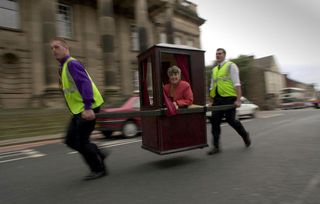
Historically a sedan chair (also just called a sedan) is what we sometimes think of as a litter–the kind of chair fancy people used to be carried around in so they wouldn't have to walk. Y'know, like this:

Sedan_Chair
Those things used to be big business before taxis were invented, and they're where we get the name for the type of car.

So a violet sedan chair is just a violet one of those.

"Violet Sedan Chair" is also an anagram of "Olive Can Read This."

In any event, as said, you can now own Walter's favorite music. The songs are actually pretty authentic in terms of period sound (and subject matter), the tunes are catchy, and their lyrics are awesome in a cheesy way.

GET THE MUSIC!

My favorites are "Hovercraft Mother," "She's Doing Fine," "500 Years," and "Last Man In Space."

What are yours?

Secret Vatican Document on the Last Things *Revealed*!

Italy-vatican-museum I have some rather exciting news. The short version is: I have received a previously-confidential document of the Holy See that sheds important light on the Last Things (what theologians call “eschatology”), and I will be publishing the full text of it in English soon.

Now let me give you a somewhat longer version.

One of the things I try to do whenever I can is study documents issued by the Holy See that have not come to the attention of the public. There are often fascinating things to be found within them. Lately I’ve been reading documents by the International Theological Commission, which is an advisory body working for the Congregation for the Doctrine of the Faith.

While their document’s aren’t official Church teaching, they must receive the approval of the head of the CDF, which according to the statutes laid down by John Paul II, means that the Holy See does not have any problem with them. At a minimum, therefore, the approved documents of the ITC represent legitimate Catholic opinion, and they go into some fascinating areas.

Over the last few years I have been able to publish some obscure Vatican documents in English translation. One of these was the 1970s document that was privately circulated to the world’s bishops concerning how they were to evaluate reports of apparitions in their dioceses.

Just in my work for the Register I have published and commented on multiple little-known documents connected with the sexual abuse scandal, some of them not originally published in English.

In fact, I’ve tried to make the publication and analysis of official Church documents one of the signatures of my efforts.

I’m therefore pleased to announce that I’ve obtained a new document that, up to now, has been privately circulated to the world’s bishops and that will be appearing in English for the first time.

Continue reading “Secret Vatican Document on the Last Things *Revealed*!”

When You *Don’t* Have to Say Something in Confession

Confessional

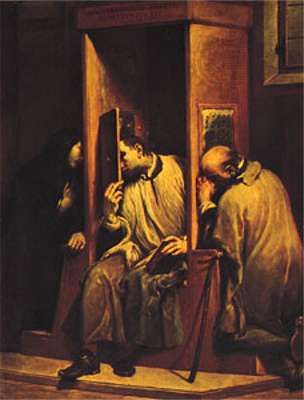
Properly catechized Catholics know that, when we have committed mortal sins, we are obliged to confess them, how many times we committed them, and any circumstances that affect the moral species of the act (e.g., stealing from a church is different than ordinary stealing because of the element of sacrilege is involved, ditto for lying after having taken an oath before God as opposed to ordinary lying, adultery vs. fornication, etc. Note that these distinctions all involve the kind of sin being committed, not the degree of sinfulness; the Church has not required that we confess circumstances that affect the degree of sinfulness, only the kind).

Often times it is difficult for one reason or another to make this kind of confession, and if you read older moral and pastoral theology manuals they offer extensive discussions of the situations in which penitents are excused from making this type of confession.

Recently I received an email inquiry about how this fact relates to the 1983 Code of Canon Law’s statement that:

Can.  960 Individual and integral confession and absolution constitute the only ordinary means by which a member of the faithful conscious of grave sin is reconciled with God and the Church. Only physical or moral impossibility excuses from confession of this type; in such a case reconciliation can be obtained by other means.

Individual confession and absolution is the kind of sacramental confession we normally make: One person (an individual) talking to a priest, who absolves him. This is opposed, for example, to a priest offering a general absolution to a bunch of people at once in a grave circumstance (e.g., they’re all in an airplane that is about to crash and there is no time for individual confession). This latter is allowed in rare and grave circumstances. By nature it is an extraordinary situation, as opposed to individual confession and absolution being the “only ordinary means” of reconciliation.

The term “integral” confession is less familiar. What “integral” means is “complete.” In other words, the kind of confession we talked about at the top of the post, where for all your mortal sins, you say what each sin was, how many times it was committed, and anything that affected the species or kind of sin it was.

Why my correspondent was wondering was—since Canon 960 says that “only physical or moral impossibility excuses from confession of this type,” does the 1983 Code of Canon Law override all of the treatments given in older works of moral and pastoral theology about when one is excused from integral or “complete” confession.

The basic answer is no. The 1983 Code is not trying to change prior Catholic practice on this point. It had been the common teaching of Catholic theologians long before the 1983 Code that only physical or moral impossibility excused from making an integral confession. The Code is recognizing and incorporating this common teaching and thus giving canonical expression to what was already the traditional view. It thus does not override prior moral and pastoral thought on when one is excused from an integral confession. Whatever the older manuals said about this subject, to the extent it was sound then, is sound now. The 1983 Code didn’t change anything.

Of course, readers will wonder what some of these principles were, so let’s talk about that (which will allow me to answer some related queries sent by my correspondent).

The first concept we need to mention is physical impossibility. What’s that? Pretty much what it says. If, for example, you are in a crashing plane and there is no time to make a complete confession, you’re excused from doing so and can be absolved anyway. If you’ve had a stroke and are unable to communicate, you are similarly excused on grounds of physical impossibility.

What about moral impossibility? This category is meant to cover situations where it is physically possible to make an integral confession but there is some other factor that makes it very difficult to do so. Where the precise line on the next obvious question—“Just how difficult are we talking about?”—is a question that requires a judgment call, and it is here that the old moral/pastoral theology manuals play a useful role. This is exactly the kind of question they explore, using examples and principles to sketch out the answer.

For example, to take a very common example, let’s suppose you have forgotten how many times you committed a particular sin. Theoretically, you might be able to think harder and longer on the question and maybe come up with the exact number, but maybe that wouldn’t happen. Maybe you’d never get the exact number—or know with confidence that you had gotten it—and waiting to go to confession in that case would deprive you of the grace of the sacrament indefinitely, which is itself a grave thing. It could also send you tumbling off into the pits of scrupulosity—also a grave thing. Consequently, sound moral and pastoral theologians down through the ages have judged that one should only make reasonable efforts to determine the number of times one has committed a sin. If you’ve made a reasonable effort (i.e., what a normal faithful Catholic, not a living saint, would do) and can’t name the exact number, you are excused from doing so. You should, to the extent possible say things like, “I did this at least once” or “I did it a few times” or “I did it a lot of times,” but you are not bound to name any specific number.

Another situation—again very common—that excuses from an integral confession is scrupulosity. People suffering from this condition often get in destructive patterns of confession where they repeatedly confess sins over and over, go into agonizing and unnecessary amounts of detail, confess numerous sins of a venial nature because they can’t tell whether they were mortal, etc. Sound confessors have, down through the ages, developed rules for helping penitents fight such scrupulosity, such as telling (or even ordering) the penitent not to confess a sin unless he is absolutely sure it was mortal and that it was committed since the penitent’s last confession. If there is doubt about either of these points, the penitent should not confess it. (Note: This is the opposite of the advice given to people who don’t have scrupulosity, in which case a “confess it just to be safe” rule applies; it is the condition of scrupulosity that makes the difference in what is appropriate for the penitent to do).

Another common example—closely linked with scrupulosity—is obsessive-compulsive disorder (OCD). Sufferers of this condition have painful and distressing thoughts, and the more they dwell on these thoughts, the worse they become. They need, to the best of their ability, to ignore them, relax, and move on. Thus if a penitent with OCD (or anyone, for that matter) is having compulsive sexual thoughts or disturbing religious thoughts or similar things and if confessing them would tend to stir up these thoughts, it is very easy to justify a non-integral confession regarding them. First, if they are compulsive then the person is not fully consenting to them and they are not moral. Even if the person has consented to them, if mentioning the details in confession would stir them up then the penitent should not go into detail. If he can get away with saying, “I’ve had impure thought” or “I’ve had bad thoughts” with out stirring them up then he should do that, but in principle even that can be omitted if the danger of stirring them up is significant enough.
rom an integral confession. If the tendencies are strong then there may well be.

For people who have conditions like this, I recommend that they discuss the matter with their priest or spiritual director and ask the question directly, “Should I confess this kind of material.” That way, if they are later confessing to a new or unfamiliar priest and he says, “What kind of bad thoughts are you talking about?” they can reply, “I have scrupulosity/OCD and my priest/spiritual director has told me not to go into detail on this because it will only stir up the thoughts.” That will satisfy almost any confessor (actually, it will satisfy any confessor who is exercising sound judgment).

My correspondent asked about the situation of a penitent with “tendencies toward scrupulosity” but not full-blown scruples or OCD. Here there is a judgment call that must be made by the penitent and his confessor or spiritual director. If the tendencies are only mild then there may not be an excuse from integral confession. If the tendencies are strong then the penitent may well be excused.

Of course, the penitent should always maintain the attitude that he would confess the sins, with number and species-changing circumstance, if there wasn’t a situation preventing this (e.g., if I remembered, if it wouldn’t stir up these thoughts). If he has the attitude that he willfully would not confess a particular mortal sin no matter what then he is deliberately withholding something from confession that must be confessed. That would invalidate the sacrament. But as long as he has the will to confess everything he is supposed to then the confession will be valid, even though there are reasons that excuse him from confessing certain things.

There is a lot more that can be said on this subject. Indeed, there are whole chapters in the older moral and pastoral theology manuals. But I hope this much brings comfort to those who find themselves in such situations.

Olivia. In the Lab. With the Pyrokinesis.

OliveIncidentHere's a little Fringe speculation. For those who have not seen any of Season 3, waiting for it to come out on DVD/BlueRay, don't worry. This post won't spoil anything. It's just my putting together a few pieces from Seasons 1 and 2 and guessing at something that may be revealed at some point in the future.

So here goes . . . 

When we first meet Walter Bishop in the Pilot, he has been institutionalized since 1991. Olivia Dunham explains:

An assistant was killed in his lab. Rumors about Dr. Bishop using humans as guinea pigs. He was charged with manslaughter, but was deemed mentally unfit to stand trial.

We later learn more about both the charges Olivia mentions, the assistant who was killed in the lab and the experiments on humans.

In episode 1.12, The No-Brainer (the one where hands come out of computer screens and grab people's heads) a woman named Jessica Warren starts trying to see Walter. She first approaches Peter, who turns her away. After which Olivia says:

I think I know who that woman was… outside.

PETER: What do you think you know?

OLIVIA: That she's the mother of the lab assistant… that was killed in the fire here almost twenty years ago. It's none of my business.

When Jessica Warren finally gets to meet Walter, we learn:

My daughter's name was Carla Warren.

WALTER: Oh,dear.

JESSICA WARREN: Do you remember her?

WALTER: Yes.

JESSICA WARREN: I want to see you because… you were the last person to see my daughter alive, and…I've always wanted to ask… Was there anything else I could know? Anything,anything else…you could tell me about my daughter.

WALTER: She was… a wonderful girl. What I remember… is her smile. She had a wonderful smile.

WALTER: I miss Carla.

JESSICA WARREN: Me,too. I miss her.

(Walter embraces Jessica Warren.)

Okay, so the assistant's name was Carla Warren and she died in a fire in the lab and Walter was there when it happened (something we could probably have inferred from his being charged with manslaughter, anyway).

Now about fires in labs on Fringe.

In episode 1.17, Bad Dreams (the one where Olivia meets a fellow Cortexiphan kid who mentally forces people to stand along the edge of a building's roof with him, with the threat of making them jump), we get the following exchange:

WALTER: Where’s the fire? I always loved that expression, which is curious, since my lab assistant was killed in a fire.

OLIVIA: What can you tell me about Cortexiphan?

WALTER: Oh, that takes me back. I remember 'Belly' whipping up a peyote mash–

OLIVIA: Walter!

WALTER: Cortexiphan was a highly experimental drug. William theorized that it might enhance certain abilities in predisposed children.

PETER: Let me guess– you experimented on people.

WALTER: Oh, no, no. not me. William. We had quite a disagreement about it.

OLIVIA: What abilities?

WALTER: It worked on perception. Carlos Castaneda, Aldus Huxley, Werner Heisenberg, all focused on one single elementary truth. Perception is the key to transformation.

PETER: Reality is both subjective and malleable. If you can dream a better world, you can make a better world.

WALTER: Or perhaps travel between them.

PETER: What did you just say?

OLIVIA: So if Nick Lane was treated with Cortexiphan, he could change reality with his thoughts. He could make somebody do something just by thinking it.

WALTER: Not his thoughts. It’s how you feel that determines your view of the world.

OLIVIA: You’re saying that Cortexiphan worked on feelings.

WALTER: That’s reductive, but essentially, yes.

Olivia then figures out that she also was subjected to a Cortexiphan trial. At the end of the episode:

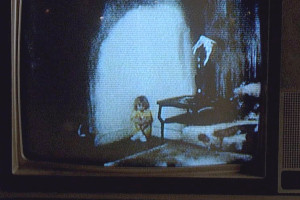
(rummaging through a storage box, Walter finds some old cassette tapes and starts watching one. haunted by what he sees and hears – a small blonde child sits huddled on the floor while voices dialogue from off the screen)

WILLIAM BELL: Is the incident contained?

FEMALE VOICE: Yes, Doctor Bell.

WILLIAM BELL: How bad?

FEMALE VOICE: Bad.

WILLIAM BELL: Casualties?

FEMALE VOICE: Not sure yet. We can't locate Brenner.

WILLIAM BELL: Is SHE okay?

FEMALE VOICE: SHE is fine.

WILLIAM BELL: Hell, do we know what triggered it?

WALTER: Obviously she was upset, William. (to the child) It's okay. It's alright now. Nobody is angry with you. You didn't do anything bad. It's alright Olive… everythings going to be okay.

(Walter sits silently, alone in the dark lab and stares at the screen)

The transcript doesn't say it, but Olive (Olivia) is huddled in a small, unburned corner of a room which has apparently been subjected to intense fire as part of the "incident" William Bell refers to.

This is confirmed in episode 2.15, Jacksonville (the one where Olivia revisits the day care center where she was experimented upon), where Olivia gets to watch the same video tape and recognizes herself:

OLIVIA: That's me. What happened?

WALTER: This was the first time you saw the other side. You were frightened. Started a fire with your mind. It should have worked. This is the very sort of thing that William and I were preparing for.

Olivia also indicates that she has no memory of the Jacksonville experiments:

I have a freakishly good memory. I remember everything. But not this. There's just nothing that's familiar.

PETER: Maybe that's a good thing.

And earlier in the ep, Walter also commented on her not remembering her Cortexiphan-produced abilities:

OLIVIA: Walter, when did I see things from the other side?

WALTER: Twenty-six years ago when you were a little girl. The Cortexiphan Trials. As I've said, the drug worked on perception. Of the thirty children that William Bell and I experimented on, you were the first with the ability to identify things from the other side. We gave you the ability.

PETER: Walter, you were conducting illegal drug trials on children. Don't make that sound like charity work.

OLIVIA: Was it me who described it as a glimmer? Well, I can't see it anymore.

WALTER: Because I believe you stopped wanting to. When you did, there were consequences, but I was able to elicit the ability once. I believe I may be able to do it again.

So Walter's lab assistant, Carla Warren, died in 1991 in a laboratory fire and Walter was there.

Olivia, who would have been around 12 in 1991, was given Cortexiphan as a child and, among other things, occasionally started fires with her mind (pyrokinesis) when frightened or upset. However, there were "consequences" to her use of the Coretexiphan abilities, and she decided she didn't want them any more–and today has no memory of the experiments.

What's the dramatically obvious way to connect these facts up?

The very next episode, 2.16, Peter, is the one in which we get a flashback to 1985, when Peter was a boy–and we get to meet Carla Warren for the first time, six years before her death in the lab fire.

My guess is that, at some point in the future, we will have a flashback episode to 1991, when Olive is 12, and the experiments have been relocated from Jacksonville, Florida to Harvard, where the lab fire occurred.

Something momentous will be at stake (very possibly with Observer involvement). Walter and Olive and Carla will be in the lab. Something horrible will happen, pushing Olive over the edge and triggering her pyrokinetic abilities. Carla (who was likely trying to stop Walter from doing something, possibly to Olive) will die. 

Olivia and Walter live, but both will be shattered. Olive will either repress all memory of the Cortexiphan trials or someone (possibly William Bell) will cause them to go dormant.

Walter will have either just had William Bell perform the operation to remove bits from his brain or he will have it immediately after this event, as it is what frightened him of what he was becoming.

In any event, the aftermath of the event will find him mentally and emotionally shattered and he will be committed to St. Claire's for the next 17 years.

Until Olivia Dunhman walks into St. Claire's and recruits him to help solve the case in the Pilot episode.

Now, there are other ways this could work. Other Cortexiphan kids have been shown to have pyrokinesis, but c'mon! This is the obvious, dramatically satisfying way to do it.

How did Carla Warren die?

My money is that it was Olivia. In the lab. With the pyrokinesis.