The Morals of Killing bin Laden: Catholic Perspective

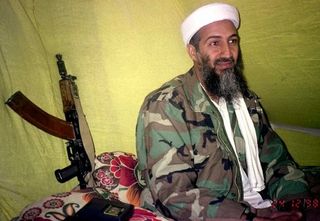
Osama-bin-laden-1998-thumb

So it has been announced that Osama bin Laden is dead.

Good.

The twisted, evil mastermind responsible for the deaths of thousands of innocent human beings has been shuffled off this mortal coil.

This provides a measure of justice. Not full justice. That’s in God’s hands. But some justice.

Of course, Our Lord’s command to love our enemies and pray for those who persecute us still applies. We must hope that Osama bin Laden repented at the last second, or that he had been crazy for years and not responsible for his actions, or that God might provide for his salvation in some other way.

And we must remember that Christ himself died to make salvation possible for all men, Osama bin Laden included.

But possibility does not equal actuality. As Pope Benedict has reminded us in various works, evil is real and hell is a real choice. If anyone, judging by outward, human appearances, was ripe for going there, Osama bin Laden was a plausible candidate.

This may have even applied to his final moments. Reports are still sketchy, but it is reported that he died resisting the offensive against his compound, which may mean he was wielding a weapon. It is also reported that a woman who was one of the five people killed in the compound was used as a human shield. This may mean — and future reports may clarify this — that bin Laden himself grabbed the woman himself and tried to use her as a shield while he pointed a weapon at her or at others.

Not the kind of choices one wants to make just before one meets one’s Maker.

After his death, steps were reportedly taken to confirm bin Laden’s identity, including the taking of a DNA sample that is still being processed. Then his body was taken out of Pakistan and buried at sea.

That’s a good choice, actually. It denies future Islamist fanatics of a burial site where they could alternately go on pilgrimage or bomb something.

Of course, they will be trying to bomb things anyway, but they would have done that even if bin Laden were alive. It’s what they do.

The question is: How do you minimize that?

Burial at sea is one measure. Another is found in the response issued today by the Vatican spokesman, Fr. Federico Lombardi, and reported by my colleague Edward Pentin:

Osama Bin Laden—as everyone knows—has had the gravest responsibility for spreading hatred and division among people, causing the deaths of countless people, and exploiting religion for this purpose.

Faced with the death of a man, a Christian never rejoices, but reflects on the serious responsibility of everyone before God and man, and hopes and pledges that every event is not an opportunity for a further growth of hatred, but of peace.

I was surprised that the Holy See had a statement so quickly and that it was so well done. This is what the Vatican needed to say, something that did not appear to let bin Laden off the hook morally but also did not appear to rejoice at his passing and that was an appeal for interreligious harmony and peace.

The statement that a Christian never rejoices at the death of a man is a positive affirmation that the Vatican needed to make. It’s also true in the sense that death as a physical evil is not to be wished upon anybody for its own sake. That is not to say that one cannot be glad that justice has been in some measure served, that bin Laden won’t be masterminding any more plots, etc.

Of course, it would be foolish for the Vatican to point out those things. They would be precisely the things that would inflame anti-Christian anger in the Muslim world and subvert the peace message the Holy See is trying to send.

We will, of course, have to see how well that works out. According to Wikileaks, bin Laden’s lieutenant Khalid Sheikh Mohammad said the organization had a nuke hidden in Europe for use if bin Laden were captured or killed.

Let’s hope that’s bad intel. And let’s pray that if such a device exists that it is quickly found and the plot to use it disrupted.

In fact, let us all pray hard about this and other potential reprisals, both here in the West and in Muslim-majority countries, where Christian minorities are at risk (Pakistan, where bin Laden was killed, is one such country; so is Iraq).

The fact that we may now face reprisals — and the fact that we might even get hit hard — may be cause for people to wonder whether killing Osama bin Laden was worth it.

Let’s hope so. Let’s pray so.

The decision required a judgment call, weighing the potential risks and benefits. History teaches that killing your enemies, and especially their leaders, is a good way to discourage them from attacking you. On the other hand, making a martyr of someone doesn’t always work (cf. Roman Empire, Christianization Of).

There are other moral dimensions to the decision to kill bin Laden. According to some sources the mission was to kill, not capture. That’s a potentially defensible choice based on the heightened risks that would be involved for the personnel responsible for trying to bring about a capture rather than a kill. Also, and even more so, a capture would create a security nightmare by having a live, captured bin Laden as the focus of “Free Osama” reprisals.

A mysterious disappearance would result in the same thing. Even if we didn’t announce his capture, his own people would know he’d been snatched and assume he was still alive.

“He’s dead. He was buried at sea. Move on with your lives” is a better message for the Islamist community.

The big question, still, is what kind of reprisals may be coming and whether bin Laden will long-term be perceived as a martyr or a failure.

Let’s pray.

What do you think?
Prayer Request for a Little Boy

Prayer_1 I would like to ask for prayers for a little boy who is seriously ill. He has been admitted to the hospital and may be admitted to ICU with bacterial pneumonia. He is four years old and is the brother of one of my godsons. I would like to invite prayers for him, his family, the medical professionals who are caring for him, and for all who are in similar situations. Thank you, and God bless you!

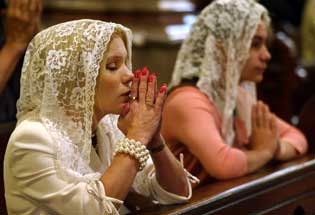
Women’s Head Coverings at Mass: Won’t Say I Told You So, But . . .

Mantillas

Some time ago I did a post (possibly more than one) dealing with the subject of women’s headcoverings at Mass—a practice that was required by the 1917 Code of Canon Law but that then fell into desuetude after the Second Vatican Council and was abolished by the release of the 1983 Code of Canon Law.

I have no problem with women wearing head coverings. In fact, I’m rather partial to the practice, and I fully support any woman’s right to wear one.

But I’m not going to falsify what the law requires concerning them.

My post was occasioned by queries I got from time to time about whether the former practice of women wearing some form of headcovering at Mass is still required.

Some of these queries were prompted by a maker of headcoverings who was trying to gin up business by running ads that quoted the old law as if it was still in effect.

Others, including canonist Dr. Edward Peters and Fr. John Zulhsdorf, also wrote on the subject, pointing out the same thing: The law requiring head coverings ceased no later than the release of the 1983 Code of Canon Law, which abrogated the prior law requiring this (found in the 1917 Code).

Yet that hasn’t stopped people from making spurious arguments to the contrary.

Now Ed Peters has a post in which (after noting Fr. Z’s and my replies and saying some extremely kind things about us) he reports Cardinal Raymond Burke has weighed in on the subject as well.

For those who may not be aware, Cardinal Burke is the prefect of the Supreme Tribunal of the Apostolic Signatura, which “functions as the supreme tribunal [in the Roman Curia] and also ensures that justice in the Church is correctly administered” (John Paul II, Pastor Bonus 121). That means: He heads the highest Church court.

In a letter to an inquirer, Cardinal Burke writes:

The wearing of a chapel veil for women is not required when women assist at the Holy Mass according to Ordinary Form of the Roman Rite. It is, however, the expectation that women who assist at the Mass according to the Extraordinary Form cover their heads, as was the practice at the time that the 1962 Missale Romanum was in force. It is not, however a sin to participate in the Holy Mass according to the Extraordinary Form without a veil.

Ed notes:

Burke’s note is not an “authentic interpretation” nor a formal sentence from the Signatura: It’s simply a calm observation by the world’s leading canonist (not to mention a man deeply in love with the Church and her liturgy) about whether women have to, as a matter of law or moral obligation, wear veils at Mass. Any Mass. And the answer is No.

I’d like to add a couple of remarks to Ed’s concerning Cardinal Burke’s reply. I think it is extraordinarily balanced and well phrased.

His first statement—that the use of chapel veils is not required when women assist at (i.e., attend) the ordinary form of the Mass—is quite true. The 1983 Code abolished the requirement established by the 1917 Code. That much is absolutely clear and straight forward. But what about the celebration of the extraordinary form of Mass according to the Missal of 1962 (i.e., the approved form of the traditional Latin Mass)? Here is where Cardinal Burke’s statement is remarkably well crafted.

He makes two points: First, it is “the expectation” that women attending this form of Mass will wear a head covering, but “it is not … a sin” to refrain from doing so.

Note that Cardinal Burke does not say that the use of a chapel veil is required under the 1962 Missal. This is because it wasn’t the 1962 Missal that contained the requirement. It was the 1917 Code of Canon Law, and that requirement has been abolished. Thus there is no clear legal obligation to do so. The degree to which an obligation that existed in 1962 but that is not mentioned in the Missal would be applicable to the celebration of the Mass according to this Missal today would be, at the least, debatable. According to the 1983 Code,

Can. 14 Laws, even invalidating and disqualifying ones, do not oblige when there is a doubt about the law.

Because of the debatability of such a requirement in the extraordinary form of the Mass today, the law concerning head coverings does not bind (at least until such time as we get further clarification from Rome on the matter).

Thus a woman attending the extraordinary form of the Mass could not be accused of violating the law, much less of sinning.

Nevertheless, it is clear that those who participate in the extraordinary form of the Mass are intending to celebrate it as it was celebrated in 1962, to the extent provided by present law, and that included head coverings. Those regularly celebrating this form of the Roman Rite thus have an expectation that head coverings will be used. Failure to use them could be cause for puzzlement, even if it is not legally required. And the expectation (without legal requirement) may extend higher up the hierarchical chain, though Cardinal Burke does not make this clear.

In any event, it strikes me that Cardinal Burke’s statement is exceptionally well crafted. It acknowledges the clear lack of legal requirement for the use of head coverings (at both the ordinary and extraordinary forms of Mass) while acknowledging the practical expectation but not-legally-required use of them at the extraordinary form of Mass, together with the non-sinfulness of their non-use.

It’s a difficult set of points to make in a short space, but Cardinal Burke’s statement navigates these difficulties well.

If only everyone were so careful on this issue.

What do you think?

Jimmy Alt.kin?

Although I played a good number of RPGs in high school and college–and though I even did game design work–I don't regularly play games of any sort. No computer games. No video games. No online games. No FaceBook games. None of that. (Too much else to do!)

But I recently ran across a game that Sprint is running in connection with FRINGE, which I am a fan of, and I thought, "Why not?" This game is called FRINGE: DIVISIONS (the plural makes me think that the Other Side may try to recruit me) and appears to have only five installments, being released once a week or so, so it's not a huge time investment. You can either play via your FaceBook account (the option I chose) or anonymously.

If you play by FaceBook, they personalize the game to you and tell you about your Red Universe counterpart.

How could I resist?

In chapter 1 of the game, SAIC Broyles greets me in his office, welcomes me to FRINGE DIVISION, warns me that anything I will learn is classified, and tells me that Dr. Walter Bishop will be joining us for a briefing.

Walter rushes in, apologetic about the fact he was (ahem) delayed. (I won't say by what.)

He then tells me that our universe is closely linked with another one, where just about all of us have counterparts. He puts his phone on Broyles' desk to show what he found out about my counterpart.

I took screen caps, so here is what is presently known about Jimmy Alt.kin (click to embiggen images):

Altme1
Walter says, "As you can see your double looks exactly like you–just slightly better looking."

Altme2-married this person
Walter says, "In the alternate universe, you married this person."

Guess there wasn't a picture available or something. Perhaps a faulty transmission from the Other Side.

Altme3-work for government

Walter says, "You work for the government."

Well, y'know, church, state, whatever.

Looks like I'm based in Philadelphia and have a contract through January 2018.

Altme4--this is interesting
Walter says, "This is interesting."

Hmmm! That alt universe apple didn't fall too far from the tree. Maybe there's a Church connection after all.

Altme5--oh my look at this
Walter says, "Oh my, look at this."

Cool! I've always wanted children! And I am, apparently, married to someone, even if her image didn't get transmitted.

Walter then picks up the phone, looks me in the eyes, and says, "You'll be contacted by my assistant, Astro, should we need you for anything else."

Cool. I can't wait. I think Jasika Nicole is the cutest, sweetest person on FRINGE!

So that's what's known about my Red Universe self: looks the same (only a little better), married to someone whose image didn't transmit, works for a branch of the government based in Philadelphia, lives in Rome, and has two children.

Meanwhile, the Blue Universe me is waiting for a call from the lovely and elegant Astrid Farnsworth.

Don't know how to choose between those two.

If you'd like to play, CLICK HERE.

And tells us about your alternate self in the combox!

The Last Supper, Good Friday, And Transubstantiation

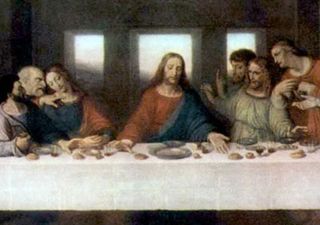
Last-supper-2 A reader writes:

Hello Mr. Akin,

I am a recent convert to the Catholic Church (this Easter will make two years). Your and Mark Shea's writings have helped me tremendously in better understanding our Faith. However, I have asked a certain question several times and have never been given a satisfactory answer. I hope you can help.

My question is: How does one explain transubstantiation at the Last Supper? If Jesus had not yet sacrificed His human nature, how could he offer his body and blood to the Apostles in the form of bread and wine?

The basic answer is that it is not necessary for Jesus to have sacrificed himself on the Cross in order for transubstantiation to occur. 

In transubstantiation, two things happen: (1) The substances (i.e., the ultimate, underlying realities) of bread and wine cease to exist, leaving only the properties detectable by our senses and (2) the substance of Christ's body, blood, soul, and divinity become present.

For neither of these things to happen does Christ have to have offered himself on the Cross. God created all matter out of nothing (Latin, ex nihilo), and he can similarly cause it to return to nothing (ad nihilo = where we get "annihiliate").

Similarly, God can make any object he wants present at any location he wants, including multiple locations simultaneously. This phenomenon, known as multilocation, is possible for Christ and for anything else God chooses.

Some years ago when I was first studying Christian apologetics, I established a principle for myself which went like this: If I'm trying to explain a miracle, and I can think of at least one way to accomplish it in comprehensible scientific terms, then God knows at least that way to accomplish it (and probably many more ways as well).

Consequently, offering a scientifically possible way of accomplishing a miracle shows that it is indeed possible and, with God's omnipotence, it will be infinitely easy for him since he does not expend resources in causing things to happen. Thus it is as easy for God as anything else. Once it's been shown that something is logically possible, it is not problem for God to do it, being neither easier nor harder than anything else for him. He may not use the way I've thought of, but he's able to do it.

I can think of several ways to make an object appear at more than one place at a time. Folding Einsteinian spacetime is just one way. There are others also. In fact, some quantum phenomena at least appear to involve particles being in more than one place at a time, so there may be a second way there.

It's also worth mentioning that there are historic reports of saints bilocating (appearing in two places at once). So the phenomena may not be limited to Jesus or subatomic particles. It may be something God does in different ways on a more frequent basis.

In any event, making something appear in more than one place at a time is clearly within the ability of God's omnipotence to bring about. Unless he for some reason determines that Christ must be offered on the Cross before he will do it in Christ's case then he can do it for Jesus whenever he wants.

The evidence of Jesus' words at the Last Supper strongly suggests that God has not determined that Jesus must be sacrificed before he can multilocate, and thus there is no barrier–at the Last Supper–to either component of transubstantiation happening. 

Thus in 1968 in the Credo of the People of God, Pope Paul VI proclaimed:

24. We believe that the Mass, celebrated by the priest representing the person of Christ by virtue of the power received through the Sacrament of Orders, and offered by him in the name of Christ and the members of His Mystical Body, is the sacrifice of Calvary rendered sacramentally present on our altars. We believe that as the bread and wine consecrated by the Lord at the Last Supper were changed into His body and His blood which were to be offered for us on the cross, likewise the bread and wine consecrated by the priest are changed into the body and blood of Christ enthroned gloriously in heaven, and we believe that the mysterious presence of the Lord, under what continues to appear to our senses as before, is a true, real and substantial presence.

The magisterium thus holds that at the Last Supper the elements became the body and blood of Christ prior to the sacrifice of the Cross (the blue highlight) and that today they become the body and blood of Christ "enthroned gloriously in heaven," which is the state in which he has existed subsequent to the sacrifice of the Cross.

Note also that Pope Paul is careful to say that the sacrifice of the Cross is made sacramentally present on the altar.

Trent elaborates this more fully (session 22, chapter 2), explaining that the sacrifices are the same in that they have the same victim (the same thing is being offered to God–i.e., Christ himself), that the primary sacrificing priest is the same (again, Christ himself, working now through the agency of earthly priests), and that the fruits of the sacrifice (our salvation) are the same, with only the manner of offering being different–Calvary involving a bloody sacrifice and the Eucharist involving an unbloody one. This is the meaning of what the Church says when it says that the sacrifice of Calvary is made sacramentally present on the altar.

Some have proposed a view in which spacetime gets bent (or something) in such a way that Good Friday in A.D. 33 (or whenever) is timewarped onto the altar. While I'm about as theologically timewarp friendly as one could want (cf. my above comments on multilocation), this view ultimately is not supported by the magisterial sources.

Instead, as the Credo of the People of God makes clear, the idea is that at the Last Supper Christ became present under the elements as he was then but in a way that looked forward to the sacrifice of the Cross and today he becomes present under the elements as he is now (enthroned gloriously in heaven) but in a way that looks back to the sacrifice of the Cross and that makes it sacramentally present in the way described above.

Hope this helps!

Does Easter have a pagan origin? And was Jesus crucified on Wednesday or Friday?

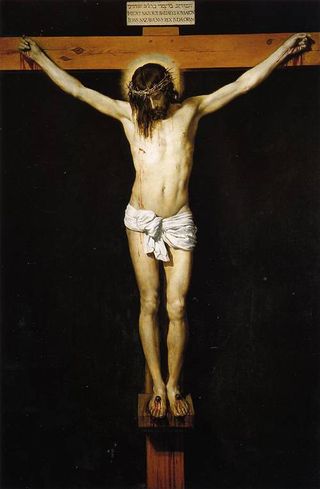
Diego-Velazquez-The-Crucifixion-1632

There has been some talk recently about a new book by Cambridge University professor Colin Humphreys that proposes the Last Supper was held on Wednesday of Holy Week (GET IT HERE), rather than on Thursday as it has been traditionally commemorated. I haven’t had a chance to review his arguments yet, but there is room for discussion here. In fact, in his recent, second volume of Jesus of Nazareth (GET IT HERE!), Pope Benedict wrestles with the subject of the Last Supper without coming to a definite conclusion.
Regardless of when precisely the Last Supper took place in Holy Week, one thing both the Cambridge professor and the pontiff are agreed upon is that the Crucifixion took place on Friday. There are, however, people who dispute this.

In some Protestant churches, especially Fundamentalist ones, every year at Easter time there are sermons explaining that Jesus didn’t really die on a Friday but on a Wednesday. This claim is based on Matthew 12:40, where Jesus states that “as Jonah was three days and three nights in the belly of the whale, so will the Son of man be three days and three nights in the heart of the earth.”

“If Jesus rose from the dead on Saturday night,” the argument goes, “then he couldn’t have been crucified and died on Friday afternoon, because there aren’t three days in there. There’s only one, so we need to back up his death from Friday afternoon to Wednesday afternoon.” This is often accompanied by the claim that Easter is based on a pagan holiday; the “moving” of Jesus death to Good Friday is explained as the result of some unspecified pagan cause.

None of this is true. Easter is not based on a pagan holiday but on a Jewish one: Passover. Easter originated as the first Sunday following Passover, when Jesus was crucified.

Neither is the name Easter derived from the pagan goddess Ishtar. Ishtar was a Mesopotamian goddess who was worshiped over in Iraq, centuries before Christ, not in Medieval England where the English language was born.

In two languages—English and German—the name for Easter may be connected with a Germanic goddess of spring, but this is unclear since her name (Eostre) had already become the name of a whole month on the calendar and there may have been no more pagan significance to the name to Medieval Christians than terms like “Wednesday” (Odin’s Day) or “Thursday” (Thor’s Day) or “January” (Janus’s Month) or “March” (Mars’s Month) have to us. The Medieval English Christian scholar the Venerable Bede, for example, is reported to have observed that pagan feasts for Eostre had died out by his time, even though the name of the month remained, and Christians were now celebrating the resurrection of Christ as a paschal feast in the manner of other Christian countries.

Which brings up an interesting point: Only a speaker of English or German (where the holiday is called Ostern) would even think the holiday has a pagan origin.

In virtually every other language, the name of Easter is derived from the Jewish word Pesach or “Passover.” Thus in Greek the term for Easter is Pascha; in Latin the term is also Pascha. From there it passed into the Romance languages, and so in Spanish it is Pascua, in Italian Pasqua, in French Paques, and in Portugese Pascoa. It also passed into the non-Romance languages, such as the Germanic languages Dutch, where it is Pasen, and Danish, where it is Paaske.

Also, because of the way Christianity spread (from Jerusalem, then around the Mediterranean basin, arriving in far-flung places like England and Germany later on), Christians had long been celebrating Easter—under Passover-derived names—long before English or German came into existence. If, in a couple of countries, new languages happened to use words that had pre-Christian etymologies for the day then that in no way shows that it has pagan roots. Its roots are well known and predate these languages. The holiday was celebrated all over the Christian world long before the names were attached to it in England and Germany.

If Easter is free of pagan origins, so is Jesus’ crucifixion on Friday. The premise of the “three days and three nights” argument — that Jesus rose from the dead on what we would call Saturday night — might well be true. In Jesus’ day, the Jews reckoned the day as beginning at sunset.

When Scripture indicates that Jesus rose on the first day of the week, therefore, it means that he rose on the day that began at sunset on Saturday and lasted until sunset on Sunday. Since we are told his tomb was found empty “after the Sabbath, toward the dawn of the first day of the week” (Matt. 28:1), he must have risen between sunset Saturday and dawn Sunday. Whether this was before or after midnight Scripture does not say. He might have risen either Saturday night or Sunday morning before dawn, though, for purposes of determining when he was crucified, it doesn’t matter.

In the Bible, parts of time units were frequently counted as wholes. Thus a king might be said to have reigned for two years, even if he reigned for only 14 months. In the same way, a day and a night does not mean a period of 24 hours. It can refer to any portion of a day coupled with any portion of a night. The expression “three days and three nights” could be used as simply a slightly hyperbolic way of referring to “three days.”

As Protestant Bible scholar R. T. France notes: “Three days and three nights was a Jewish idiom to a period covering only two nights” (Matthew, 213).

Similarly, D. A. Carson, another highly esteemed conservative Protestant Bible scholar, explains: “In rabbinical thought a day and a night make an onah, and a part of an onah is as the whole. . . . Thus according to Jewish tradition, ‘three days and three nights’ need mean no more than ‘three days’ or the combination of any part of three separate days” (Expositor’s Bible Commentary, 8:296).

If Jesus was crucified and died Friday afternoon, that would be the first day; at sundown on Friday the second day would begin; then at sundown on Saturday the third day would begin. So Jesus was indeed “raised on the third day” (Matthew 20:19).

Scripture repeatedly tells us that Jesus was crucified on “the day of preparation,” which was the first-century Jewish way of referring to Friday, the day of preparation for the Sabbath. This is why the women were not able to anoint his body before he was buried — because Jesus was hurriedly buried late in the afternoon, just as the Sabbath was beginning. The women thus had to rest until the Sabbath was over (Luke 23:56).

We are also told that the Jewish leaders asked Pilate to order the legs of the crucifixion victims broken so they would die faster (from asphyxiation due to an inability to push themselves up on their crosses and take a breath), “in order to prevent the bodies from remaining on the cross on the Sabbath” (John 19:31).

Some advocates of a Wednesday crucifixion concede that Jesus was crucified on the day before a Sabbath, but deny that this was the regular, weekly Sabbath. In later times, the phrase “day of preparation” came to be used to refer to the day before Passover and, this argument goes, Passover counted as a Sabbath in the sense that it was a day of rest, even though it usually did not fall on the weekly Sabbath. Thus Jesus was crucified on the day before Passover and had to be buried hurriedly on that account.

But this explanation will not do. For a start, I am unaware of anything in biblical or post-biblical Jewish tradition that regards Passover as a “sabbath.” Indeed, later rabbinic tradition held that if Passover fell on a Saturday that it overrode the Sabbath laws (so you could do the work needed to kill and eat the Passover lamb, e.g.). However that may be, in the first century, “the day of preparation” referred to Friday, not the day before Passover. Further, we know from Scripture that the Sabbath following Jesus’ crucifixion was the regular, weekly Sabbath, the seventh day of the week: “Now after the Sabbath, toward the dawn of the first day of the week, Mary Magdalene and the other Mary went to see the sepulcher” (Matt. 28:1).

We can thus reconstruct the chronology of the crucifixion, death and Resurrection of Christ as follows:

Friday, the Day of Preparation: Jesus is crucified with two thieves. From noon to three in the afternoon, a darkness covers the land (Matthew 27:45). Then, “[s]ince it was the Day of Preparation, in order to prevent the bodies from remaining on the cross on the Sabbath … the Jews asked Pilate that their legs might be broken, and that they might be taken away” (John 19:31). Then Joseph of Arimathea obtains Jesus’ body and buries it: “It was Preparation Day [that is, the day before the Sabbath]. So as evening approached, Joseph of Arimathea, a prominent member of the Council, who was himself waiting for the kingdom of God, went boldly to Pilate and asked for Jesus’ body” (Mark 15:42-43, NIV).

Saturday, the Sabbath: “On the Sabbath they [the women] rested according to the commandment” (Luke 23:56b). Also on this day, “that is, after the Day of Preparation, the chief priests and the Pharisees gathered before Pilate” and asked for a guard to be placed on the tomb (Matthew 27:62).

Sunday, the first day of the week: “Now after the Sabbath, toward the dawn of the first day of the week, Mary Magdalene and the other Mary went to see the sepulcher” and found that Jesus had risen from the dead (Matthew 28:1).

The time of Christ’s death is indeed Good Friday, not a hypothetical Crucifixion Wednesday.

Vatican Preparing Action on Biblical Inerrancy: Prayers Needed!

Bible1

You may remember that back in 2008 the Holy See held a session of the synod of bishops devoted to the theme “The Word of God in the Life and Mission of the Church.” The synod of bishops is a gathering of bishops from around the world, shy of a full ecumenical council, who gather in Rome to reflect on a particular topic and then deliver their recommendations to the pope. In 2008 they were called to reflect on the word of God, as contained in Scripture and Tradition.

Among the topics that they dealt with, at least in brief, was the inerrancy of Scripture. This has been a fractious subject in the last several decades, with many people claiming that Scripture is not, in fact, inerrant or free from error.

This debate has been facilitated by the fact that the Second Vatican Council’s constitution Dei Verbum contains a passage (see section 11) that is ambiguous on the subject. At first glance it might appear to restrict the scope of inerrancy only to truths having to do with our salvation. On other subjects, the Bible might be chocked full of errors.

But a closer reading reveals that it contains principles which would seem to be incompatible with that interpretation. According to Dei Verbum, the human authors of Scripture recorded everything that the Holy Spirit wished them to and no more. Consequently, whatever is asserted by the Scriptures is asserted by the Holy Spirit. Since the Holy Spirit is omniscient, infallible, and all holy, any assertions made by him are true.

Even if one allows maximal room for non-literal readings of various passages Scripture, it seems that Scripture contains at least some assertions that are not directly related to our salvation—for example, that Andrew was the brother of Peter according to some accepted first century usage of the term “brother.” But if Scripture makes assertions that aren’t directly related to our salvation, and if those are asserted by the Holy Spirit and therefore guaranteed to be true, then one can’t reduce Scripture’s inerrancy to just truths connected with our salvation.

A good bit more about the debate over this passage can be said, but the bottom line is that it is not as clear as it should be and is basically a compromise text worked out at the council between parties on different sides of the debate. (The behind-the-scenes history of it is quite interesting; it’s recorded in then Father Joseph Ratzinger’s contribution to the Vorgrimler commentaries on Vatican II, but these are very hard to come by).

When the 2008 synod of bishops came around, I was quite concerned how this topic would be handled, because while the synod is a function of the magisterium and thus is guided by the Holy Spirit, we do not have a guarantee of its infallibility. Consequently, though human weakness, the synod could conceivably have muddled the waters on this question even further or, God forbid, said something false regarding biblical inerrancy.

I was heartened, therefore, when the final list of propositions they submitted to the pope contained the following:

Inspiration and Truth in the Bible

The synod proposes that the Congregation for the Doctrine of the Faith clarify the concepts of inspiration and truth of the Bible, as well as the relationship between them, so as to better understand the teaching of Dei Verbum 11. In particular, we need to emphasize the originality of the Catholic Biblical hermeneutics in this area.

There were also press accounts at the time suggesting that the answer from the CDF would likely come back along solidly inerrantist lines, acknowledging that Scripture must be understood according to its ancient cultural context and that many things in it are not intended to be read literally, but when it does assert something as a matter of fact, that assertion is true.

So I was relieved. And I’ve been waiting to see what would happen.

Well, the CDF apparently decided, before preparing a potential document of its own, to consult with the Pontifical Biblical Commission. This is a group of biblical scholars that the Holy See appoints to advise the CDF on Bible-related questions. The president of the PBC is the prefect of the CDF (currently Cardinal Joseph Levada), who oversees its operations.

The CDF thus apparently asked the PBC to produce a document reflecting on the “inspiration and truth of the Bible.” This document will presumably inform whatever action the CDF may choose to take in addition.

And so for the last couple of years the PBC has been working on a document dealing with this subject.

HERE’S A MESSAGE POPE BENEDICT GAVE THEM IN 2009 DEALING WITH THE TOPIC.

So why am I telling you about this now?

Because a few days ago, the following came across the wire from Vatican Information Service:

VATICAN CITY, 14 APR 2011 (VIS) – The Pontifical Biblical Commission will hold its annual plenary session [that is, their big annual meeting where all the members of the commission fly to Rome for a face-to-face] from 2 to 6 May in the Domus Sanctae Marthae (Vatican City), under the presidency of Cardinal William Joseph Levada. Fr. Klemens Stock, S.J., secretary general, shall direct the work of the assembly.

According to a communique issued today, “during the meeting the members will continue their reflections on the theme ‘Inspiration and truth in the Bible’. In the first phase of study the Commission will attempt to examine how the themes of inspiration and truth appear in the Sacred Scriptures. Subsequently, on the basis of their individual competences, each Member shall present a report which shall then be discussed collectively in the Assembly”.

So they’re gearing up for this year’s big session on the topic, and they could use our prayers.

Because the PBC (these days) is an advisory body, it is not part of the magisterium, and its documents do not represent official Church teaching. Nevertheless they are important and influential and if they get botched it can create a worse problem than existed before.

If Vatican II, which was not just an exercise of the magisterium but an extraordinary exercise, and therefore even more under the protection of the Holy Spirit, could produce a problematically worded passage on the subject of inerrancy, how much more are prayers needed for a non-magisterial advisory body.

It may be some time—years even—before we see what the PBC comes up with (if we ever see it), but the issue of biblical inerrancy is an important one.

I therefore invite you to join me in praying that the Pontifical Biblical Commission, the Congregation for the Doctrine of the Faith, and the pope are all guided to provide an accurate and clear statement that recognizes both the many human and literary aspects to the Bible but also the fullness of the divine truth that it conveys without error, so that the faith of scholars and the simple alike may be strengthened with regard to the Scripture God gave us through the Holy Spirit.