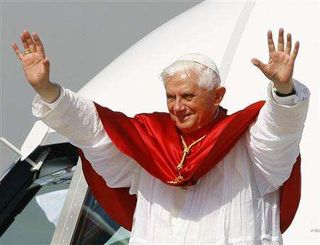
Pope Benedict’s remarks concerning Jewish individuals in his recent book Jesus of Nazareth (vol. 2) (GET IT HERE! GET IT HERE!
For example, the book contains a passage which some have interpreted as saying that the Church should not seek to convert Jewish individuals. It is not at all clear to me that this is what the Pope is saying. The passage is complex and bears more than one interpretation. So let’s dive in and see what we can make of it.
The beginning of the discussion (which is not usually quoted by people commenting on the text) is this. Starting on p. 44 of the book, Pope Benedict writes:
At this point we encounter once again the connection between the Gospel tradition and the basic elements of Pauline theology. If Jesus says in the eschatological discourse that the Gospel must first be proclaimed to the Gentiles and only then can the end come, we find exactly the same thing in Paul’s Letter to the Romans: “A hardening has come upon part of Israel, until the full number of the Gentiles come in, and so all Israel will be saved” (11:25–26).
The full number of the Gentiles and all Israel: In this formula we see the universalism of the divine salvific will. For our purposes, though, the important point is that Paul, too, recognizes an age of the Gentiles, which is the present and which must be fulfilled if God’s plan is to attain its goal.
So Pope Benedict is contemplating the two-stages of phases of history that precede the end of the world. First, there are what Our Lord refers to as “the times of the gentiles,” in which the Gospel is preached to all nations and the gentiles are given the chance to convert, and then the second stage in which the partial hardness that has come upon Israel is removed and so “all Israel will be saved”—a reference to a corporate conversion of the Jewish people at the end of history.
Note how this viewpoint differs from two rival viewpoints: First, it differs from the “Jews don’t need Jesus, they have their own covenant” perspective. This idea, which has been trendy is some Catholic circles of late, is manifestly contrary to the teaching of the New Testament and to the historic teaching of the Church’s Magisterium. It also is not what Pope Benedict is advocating here. He is not saying that Jews don’t need Jesus or that they don’t need to become Christians. He is saying that they will corporately convert to Christ, but not until the end of time. Prior to that point, individual Jews may become Christians—as with the apostles and the very first Christians and with other converts from Judaism down through history. But the full, corporate conversion of Israel (which even then might not involve every single individual without exception) is something to be found only at the end of the world.
Secondly, the viewpoint that the Pope is articulating is different than the “Jews don’t matter anymore; they don’t have any special relationship with God or mission; their role has been completely supplanted by the Church and they have no further special significance.” Again, this position is contrary to the New Testament, which ascribes an ongoing special place for the Jewish people in God’s plan (as illustrated by the end of the world being contingent on their corporate conversion), and it is not the viewpoint that Pope Benedict is articulating. He recognizes, as we will see him say even more explicitly in a moment, that the Jewish people has a special and ongoing mission.
He then speaks of the early Church’s attitude toward this two-phase understanding of Christian history (the preaching of the Gospel to the gentiles, followed by the corporate conversion of Israel):
The fact that the early Church was unable to assess the chronological duration of these kairoí (“times”) of the Gentiles and that it was generally assumed they would be fairly short is ultimately a secondary consideration.
The essential point is that these times were both asserted and foretold and that, above all else and prior to any calculation of their duration, they had to be understood and were understood by the disciples in terms of a mission: to accomplish now what had been proclaimed and demanded — by bringing the Gospel to all peoples.
The restlessness with which Paul journeyed to the nations, so as to bring the message to all and, if possible, to fulfill the mission within his own lifetime — this restlessness can only be explained if one is aware of the historical and eschatological significance of his exclamation: “Necessity is laid upon me. Woe to me if I do not preach the gospel!” (1 Cor 9:16).
In this sense, the urgency of evangelization in the apostolic era was predicated not so much on the necessity for each individual to acquire knowledge of the Gospel in order to attain salvation, but rather on this grand conception of history: If the world was to arrive at its destiny, the Gospel had to be brought to all nations. At many stages in history, this sense of urgency has been markedly attenuated, but it has always revived, generating new dynamism for evangelization.
What the Pope says in the last paragraph is quite interesting. The idea that individuals in the apostolic age were motivated to evangelize “not so much on the necessity for each individual to acquire knowledge of the Gospel in order to attain salvation, but rather on this grand conception of history,” is quite interesting.
It is certainly true that the early evangelists, including Paul, were motivated by the fact that Christ had indicated the Gospel must be preached to all the nations and that this plays a role in God’s plan of the ages. If it’s part of God’s plan and Christ said to do it, that’s reason to get to work evangelizing! And the first evangelists certainly understood that.
It’s questionable, however, how much they also saw “the necessity for each individual to acquire knowledge of the Gospel in order to attain salvation” as playing a role. Certainly later in Church history the theological tides shifted very strongly in favor of the idea that concrete knowledge (and acceptance) of the Gospel is necessary for salvation. In our own day the tides have shifted back a bit, with the Magisterium indicating (especially from the mid 20th century onwards) that an explicit knowledge of the Gospel is not an absolute necessity and that people can, if they otherwise cooperate with God’s grace, come to salvation if they are in innocent ignorance of the Gospel.
Similar themes are found in the writings of the Church Fathers, who hold that some gentiles prior to the time of Christ could be saved if they lived according to the Logos or “Reason” of God, though they lacked knowledge of his word in the Scriptures.
In the apostolic age, it would be fair to assume that something of this idea was present as well. In the early chapters of Romans, Paul alludes to some gentiles potentially being excused by their consciences on the day of judgment because they followed the law of God written on their hearts, even though they didn’t have knowledge of the Mosaic Law.
On the other hand, Paul also uses language that suggests knowledge and acceptance of the Gospel is quite important for salvation, saying that he preaches the Gospel so vigorously, in part, to provoke some of his Jewish brethren to envy of the grace God is working among the gentiles and thus, via their conversion, “save some of them” (i.e., Jews end up accepting the Gospel). On other occasions, he spoke of those who reject the Gospel as considering themselves “not worthy of salvation.”
Given the strong connection made between accepting the Gospel and salvation in the New Testament, it is hard to simply set aside the salvation motive as a significant part of the impetus toward preaching the Gospel in the first century.
I don’t know that the Pope is doing that. In the English translation, his language (“not so much”) suggests at least something of a downplaying of the salvation motive, but it does not rule it out altogether. (Also, this is precisely the kind of exegetical point on which he indicated people are free to contradict him. “How much did the salvation motive play a role in first century evangelization according to the New Testament?” is an exegetical question, not a dogmatic one.)
Now Pope Benedict takes up the question of Israel’s ongoing mission:
In this regard, the question of Israel’s mission has always been present in the background. We realize today with horror how many misunderstandings with grave consequences have weighed down our history. Yet a new reflection can acknowledge that the beginnings of a correct understanding have always been there, waiting to be rediscovered, however deep the shadows.
Here is something we need to note very carefully, because this is the hinge that takes us into the passage about evangelizing Jewish people. The subject at hand is not (certainly not primarily) the evangelization of Jews. It is the recognition of Israel’s unique role in history. Christians have, the Holy Father indicates, often failed to recognize that role and this has resulted in many horrific “misunderstandings with grave consequences [that] have weighted down our history.” Despite that, he indicates “the beginnings of a correct understanding” of Israel’s role “have always been there, waiting to be rediscovered, however deep in the shadows.”
Pope Benedict is thus about to cite an example designed to show how—even at a much different stage in Church history—there was nevertheless a shadowy, partial understanding of Israel’s unique role. That is the Pope’s primary point:
Here I should like to recall the advice given by Bernard of Clairvaux to his pupil Pope Eugene III on this matter. He reminds the Pope that his duty of care extends not only to Christians, but: “You also have obligations toward unbelievers, whether Jew, Greek, or Gentile” (De Consideratione III/1, 2). Then he immediately corrects himself and observes more accurately: “Granted, with regard to the Jews, time excuses you; for them a determined point in time has been fixed, which cannot be anticipated. The full number of the Gentiles must come in first. But what do you say about these Gentiles? … Why did it seem good to the Fathers … to suspend the word of faith while unbelief was obdurate? Why do we suppose the word that runs swiftly stopped short?” (De Consideratione III/1, 3).
So Bernard of Clarivaux at one point alluded to the two-phase understanding of Christian history, with the set time of Israel’s conversion being confined to the unknowable future. This the Pope documents his major theme (it’s what started out this section, remember?) has been understood in Christian history, and thus there has been at least some recognition of Israel’s unique and ongoing mission, whatever crimes and misunderstandings concerning the Jewish people have also accompanied it.
St. Bernard also seems to suggest that Pope Eugene has an excuse not to evangelize Jews as vigorously as gentiles because their corporate conversion is still future, and Pope Benedict appears to give support to this view, saying that this observation of St. Bernard’s is more accurate than his initial summary. The Holy Father then cites Hildegard Brem (a German nun of our own day):
Hildegard Brem comments on this passage as follows: “In the light of Romans 11:25, the Church must not concern herself with the conversion of the Jews, since she must wait for the time fixed for this by God, ‘until the full number of the Gentiles come in’ (Rom 11:25). On the contrary, the Jews themselves are a living homily to which the Church must draw attention, since they call to mind the Lord’s suffering (cf. Ep 363) . . .” (quoted in Sämtliche Werke, ed. Winkler, I, p. 834).
This passage, at least as it is translated in English, contains the strongest statement in the entire passage concerning evangelizing Jews. What does it mean? Romans 11:25 is one of the base texts that undergirds the two-phrase conception of Christian history that the pope has been discussing. It is where St. Paul says:
Lest you be wise in your own conceits, I want you to understand this mystery, brethren: a hardening has come upon part of Israel, until the full number of the Gentiles come in.
In light of this, what does it mean to say that “the Church must not concern herself with the conversion of the Jews”? It could mean any number of things.
I think it would be reasonable to say that the Church should not worry or be concerned or upset if the Jewish people do not corporately convert in our own age. It would also be reasonable to say on the basis of Romans 11:25 to say that the Church should not expect the corporate conversion of the Jewish people in an age prior to the end. If any of these are the kind of “concern” the Church shouldn’t have then the statement is quite reasonable.
On the other hand, if what is meant is that the Church should not share the Gospel with Jewish people prior to the end then the statement is highly problematic. One reason is that we won’t know when the end has arrived until it really does arrive. At any point prior to the Second Coming we could be facing a situation that looks like the end but really isn’t. If this is the criterion the Church would never share the Gospel with the Jewish people.
Further, this understanding would be flatly in contradiction with that of the apostles and other New Testament authors who were themselves evangelized Jews!
And it’s not as if acceptance of the Gospel has nothing to do with salvation. Even if we recognize the possibility of salvation for the innocently unaware, the Church has repeatedly stressed that this is no reason to slack off in our efforts to evangelize! What’s good for the Jew is good for the gentile in this regard, for we all deal with the same merciful God, and if his mercy to the innocently unaware is reason to slack off evangelizing Jews then it’s reason to slack off evangelizing gentiles, too. (Which we know not to be the case.)
It also rubs against the grain of St. Paul’s characterization of the Jewish people in Romans 11 as olive shoots from a cultivated olive tree, whereas gentile believers represent wild olive shoots that have been grafted on to the cultivated tree. The tree nevertheless remains a cultivated one, and St. Paul comments that on account of this Jewish people who embrace the faith will be all the more readily grated onto “their own tree.”
In this light, suggestions that the Church ought not to evangelize Jewish people have (rightly) provoked comments from Jewish Christians like, “How dare you suggest that the fullness of my own faith not be shared with me! How dare you suggest that I as a Jew shouldn’t be taught about my own Messiah and all of his teachings! Your proposal would effectively disinherit me from the fullness of my own heritage!”
Most fundamentally, though, any suggestion that the Church should not evangelize Jewish people because of the hardness that has come upon Israel would contradict Romans 11:25 itself. It doesn’t say that Israel has become completely hard. It says that a hardness has come upon it “in part.” But only in part. Thus St. Paul makes the point that God has not rejected the Jewish people and that he himself is a Jew. The fact that Israel has been hardened in part toward the Gospel does not change the fact that part of it has not been hardened and is receptive to the Gospel.
The Church thus has an obligation to preach the Gospel to all mankind, including the part of Israel that has not been hardened.
Any total non-proclamation-of-the-Gospel-to-Jewish-people view is thus a non-starter.
What about a middle position?
Could one say, “Well, we know that Israel is partly hardened and partly not, so we should put some efforts into evangelizing Jewish people but not apply as much of our efforts there as elsewhere, with nations that do not display this hardening in the present age?”
Economics is the study of the use of limited resources that have alternative uses, and since there are a limited amount of evangelistic resources at our disposal and since they could be used to evangelize other peoples, so evangelization is subject to the laws of economics as much as any other field. This means we must make choices about who to evangelize and when. We even see decisions of that nature being made in the New Testament itself, as when Paul has a dream of a man from Macedonia and turns to evangelize there rather than in Asia Minor. One could argue that the two-stages of Christian history as they have been revealed to us constitute a similar revelation with implications for where we should spend the bulk of our evangelistic resources.
But there are only a few million Jews in the world, and there are over a billion Catholics. We’re not going to save that much of our evangelistic energy by adopting a limited evangelization policy for the Jewish people.
There is also something repugnant about the idea of hindering Christ’s own people, as a matter of policy, from learning about him. Certainly this was contrary to St. Paul’s practice, which was to preach to the Jewish community first and then to the gentiles.
So there is considerable ambiguity on this point. I don’t know what Hildegard Brem meant. If she meant we must not evangelize Jewish people or that we should be unconcerned about that subject then I think she is wrong. If she means that we should adopt a policy of minimal evangelization toward them, I am quite uncomfortable with the proposal. If she means that we should make reasonable efforts at evangelization but not be concerned that these will not bear full fruit until the end then I am entirely in agreement.
I know that, in view of the history of anti-Semitism, many Europeans (even moreso than Americans) are quite uncomfortable with the idea of evangelizing Jewish individuals. This discomfort is all the more acutely felt among many in Germany, for whom the Holocaust can be a powerful source of guilt and shame, even if they were not personally involved and even if they personally resisted it. This may play a role in coloring some statements regarding the question of evangelizing Jewish people, and sometimes these statements can be poorly phrased. That could be playing a role here with Hildegard Brem’s. I don’t know. I don’t know her or her work (or what is said in the original German!) well enough to assess that.
But what about Pope Benedict’s use of her work here?
He seems to cite her to build on the previous remarks of St. Bernard concerning the Jews’ unique role in history. Presumably he views what Brem says as elaborating more fully the general theme established with the quotations from St. Bernard. That includes Brem’s ambiguous statement regarding the Church not needing to be “concerned” with “the conversion of the Jews” (not the same thing as the evangelization of the Jews). It also includes Brem’s statement that “the Jews themselves are a living homily to which the Church must draw attention, since they call to mind the Lord’s suffering.”
This statement would not be described as “politically correct” from an interfaith standpoint. Brem is speaking from a uniquely Christian standpoint that would not be shared by non-Christian Jews. She appears to mean that the Church should call attention to the Jewish people because of their special role in God’s plan of the ages. This makes them “a living homily” (what Isaiah called “a light to the nations”), and the sufferings they have endured through history call to mind the sufferings that Christ also endured. She thus seems to suggest a form of historical, mystical identification between the suffering nation of Israel and the suffering Messiah who is its eschatological head. Thus through the innocent sufferings of Israel—both the nation and its Messiah—God brings about his plan for the world.
Or maybe she means something else. The quote is brief, and we do not have much context.
However that may be, the statement that the Church should not be “concerned” with Israel’s “conversion,” coupled with her distinctly Christian take on Israel’s role in history, do not add up to anything like a clear statement that the Church should refrain from sharing the Gospel with Jewish people or even that it should limit it as a matter of deliberate policy.
A more sensible approach would be to say that we should preach the Gospel always, in and out of season, to all, including Our Lord’s own people, and leave the results up to God, knowing that the corporate conversion of Israel is something that will only happen at the end of time.
We also shouldn’t prejudge the idea that we are not at the end of time. We might be. We also might not be. The Catechism stresses that the Second Coming is unpredictable as to its time. If God wanted, it could happen with amazing suddenness (that would affect the interpretation of some prophecies, but the nature of prophecy is such that its correct interpretation is often only determinable in hindsight).
In view of the ambiguity of Brem’s statement, I think we need to be cautious in what we attribute to Pope Benedict.
I also think it is significant that he chose to quote her rather than speak in his own voice. One of the things characteristic of his writing is he often borrows what others have said when he wishes to propose an idea without imposing it. He knows that people will take what he says in his own voice as if he is speaking with papal authority even when, as in this book set, he has said everyone is free to contradict him and that it is not a matter of magisterial teaching.
So even if Brem is saying something more than what I think can reasonably be concluded from Romans 11:25, I think Pope Benedict is likely proposing it for consideration rather than imposing it as a matter of obligatory belief.
I also would cite to final pieces of evidence regarding Pope Benedict’s handling of this subject.
First, he drops the discussion of the conversion of Israel and what concern the Church should have for it. He concludes by returning to the general theme of the two-stage understanding of Christian history—the same theme he began with—and the fact that the gospel must first be preached to the nations. He concludes:
The prophecy of the time of the Gentiles and the corresponding mission is a core element of Jesus’ eschatological message. The special mission to evangelize the Gentiles, which Paul received from the risen Lord, is firmly anchored in the message given by Jesus to his disciples before his Passion. The time of the Gentiles — “the time of the Church” — which, as we have seen, is proclaimed in all the Gospels, constitutes an essential element of Jesus’ eschatological message.
Finally, this is the same pope who in 2008 re-wrote the Good Friday prayer for the Jewish people that is part of the extraordinary form of the Mass. That prayer, as he personally re-wrote it, reads:
Let us also pray for the Jews: That our God and Lord may illuminate their hearts, that they acknowledge Jesus Christ is the Savior of all men. (Let us pray. Kneel. Rise.) Almighty and eternal God, who want that all men be saved and come to the recognition of the truth, propitiously grant that even as the fullness of the peoples enters Thy Church, all Israel be saved. Through Christ Our Lord. Amen.
He wrote this knowing that it would not please many in the Jewish community, who would have preferred no prayer at all or at least a more muted one.
Whatever else may be the case, it does not seem to me that Pope Benedict is opposed to reasonable efforts to share the Gospel with Our Lord’s own people.
What do you think?