Starring On The Antiques Roadshow

Well, not really; but it makes for an intriguing post title.

In my post Made In America, I mentioned that I had once appeared on The Antiques Roadshow. A reader commented:

"Michelle, you have teased us and now you must produce — what is your Antiques Roadshow experience?"

A couple of years ago the show filmed in San Diego. A coworker had been asked to attend the taping by a friend who had won two tickets to the show. The coworker was unable to go, knew that I loved the show, and asked her friend if I could have the ticket. Friend said yes, so off we went.

Continue reading “Starring On The Antiques Roadshow”

UFOs On Google!

Google_ufoWhat’s this?

Okay, it’s a sattelite picture of a Florida neighborhood that you can view over yonder on Google’s new satellite map service.

HERE.

But what’s the circular thing in the middle of the picture?

Nobody knows!

BUT FOLKS OVER AT THE GOOGLE SIGHTSEEING BOARD ARE HAVING FUN TRYING TO FIGURE IT OUT.

Incidentally, in case you’re not familiar with this Google service, you can access it by going to

MAPS.GOOGLE.COM

typing in an address, say your house, and then clicking the "Satellite" link up to the right and get a sattelite view of your house! (Or whatever other address you typed in.)

These images ain’t realtime (othwise the whole service would go dark every night) but folks have been finding all kind of interesting things in them (e.g., airplanes in flight).

Happy hunting!

Mmmmmmmm . . . Cold Pizza . . .

A reader writes:

I was wondering if you could help me with a question about Church
teaching and destiny or the end of ones life. I hope this doesn’t come
off sounding stupid but… what does the Church teach, if anything, on
when we die.

If I am eating cold pizza for breakfast on Wednesday, May 18, 2005 at
7:57am, choke on a pepperoni and die. Did I die because I chose the path
to eat cold pizza this morning? Could I have gone on another day if I
had eaten Fruit Loops?

Or, was Wednesday, May 18, 2005 at 7:57am it was my TIME to go? So, if I
hadn’t eaten the cold pizza, at that exact time, I would have had a
heart attack, choked on a Fruit Loop, or an anvil could have dropped on
my head because my number was up and my choices in life had nothing to
do with my death.

Obviously the "choices" I am speaking of do not include actual dangerous
activities, smoking or anything like that.

If the Church doesn’t have a position on things like this, would you
please give me your opinion?

This is one where the Church has not formally advanced a teaching. The issue seems to involve two questions:

1) Does God predestine the deaths of individuals? and

2) Does God predestine particular ends or does he predestine the end with the means leading to it.

In regard to the first question, the whole subject of divine predestination is up in the air at the moment. We know that God does predestine things, but which things and the manner in which he predestines them is quite disputed.

Scripture uses language that at time seems to ascribe a greater role to God’s activity in predestining events, as if he were actively causing the event to take place, while other times it seems to ascribe a larger role to the choices of individuals, with God foreknowing and allowing the event and thus predestining it in a more passive sense.

In the Middle Ages the more active interpretation of predestination was assumed to be true. This was the position of Augustine & Aquinas, for example. While this view is still quite permitted, of late both theologians and the Magisterium seem to have been inclining more toward that more passive understanding of predestination. John Paul II and Benedict XVI (when he was a cardinal) have both said things that place strong emphasis on human freedom and responsibility and that suggest a view of God as allowing humans to make their choices rather than causing them to make their choices.

How that shakes out, only time will tell, but I don’t expect it to be resolved in my lifetime. The pressure to get a definitive settlement of how predestination works ain’t there at present (though this was a HUGE controversy a few hundred years back).

If one takes the more passive view then if you don’t eat the cold pizza (mmmmm . . . cold pizza)–or if you eat it more carefully than in your hypothetical–then you don’t end up dying.

But what if you take the more active view of predestination? Here is where the second question kicks in.

A number of years ago, back when I was a Presbyterian (and thus in a church that mandated an active view of predestination), I was once having a discussion with the pastor of the Church and its minister to college students. There were a number of really good theological minds in the congregation, and we often had discussions of a fairly theoretical nature. In this discussion the pastor was mentioning an idea that he’d heard from someone who suggested that if a particular person failed to preach the gospel to you then you wouldn’t have become a Christian.

He was very dismissive of this idea. Since certain people are, in the Presbyterian view, "the elect" (meaning that they are actively predestined from all eternity to come to God and be saved), it seemed to the pastor that it was inconceivable that someone not preaching the gospel to you would affect your salvation. Instead, somebody else would end up preaching the gospel to you so that you’d be saved.

The pastor was quite certain of this conclusion, but the college minister and I both instantly had a negative reaction to it.

On our view, the pastor was taking an unduly simplistic view of how divine predestination operates: Not only does God predestine particular ends (like your salvation) but also with those ends he predestines the means to their accomplishment (like Person X preaching the gospel to you).

Therefore, if God had chosen differently with regard to the means then the end is no longer guaranteed. If he hadn’t chosen to predestine Person X to preach the gospel to you, you can’t assume that he’d predestine somebody else to do so. Maybe he would, but maybe not. Your membership in the elect is not known to be a first-order divine decree around which other, more contingent events in the universe must arrange themselves.

It may be that it’s the other way around–that God has predestined the means that lead to your becoming one of the elect (e.g., someone preaching the gospel to you, you having the efficacious grace required to respond positively to it), and if you change those means then you change your status as a member of the elect.

It strikes me that the same would apply to the question of when one dies. Even on the more active theory of predestination, if God predestines you to die at a certain point then that might be a first-order divine decree that other, more contingent matters must adjust for (so that if the cold pizza doesn’t kill you, the fruit loops or something else will) or it may be that God predestines your-death-at-a-particular-time-and-by-a-particular-means, so that if you throw the means up in the air it takes the time of death with it.

On balance, since on the more passive view of predestination your not eating the pizza leads to you not dying, and since on the more active view of predestination your not eating the pizza may lead to you not dying, I suspect that if you don’t eat the pizza, you don’t die.

Mmmmmmmm . . . Cold Pizza . . .

A reader writes:

I was wondering if you could help me with a question about Church

teaching and destiny or the end of ones life. I hope this doesn’t come

off sounding stupid but… what does the Church teach, if anything, on

when we die.

If I am eating cold pizza for breakfast on Wednesday, May 18, 2005 at

7:57am, choke on a pepperoni and die. Did I die because I chose the path

to eat cold pizza this morning? Could I have gone on another day if I

had eaten Fruit Loops?

Or, was Wednesday, May 18, 2005 at 7:57am it was my TIME to go? So, if I

hadn’t eaten the cold pizza, at that exact time, I would have had a

heart attack, choked on a Fruit Loop, or an anvil could have dropped on

my head because my number was up and my choices in life had nothing to

do with my death.

Obviously the "choices" I am speaking of do not include actual dangerous

activities, smoking or anything like that.

If the Church doesn’t have a position on things like this, would you

please give me your opinion?

This is one where the Church has not formally advanced a teaching. The issue seems to involve two questions:

1) Does God predestine the deaths of individuals? and

2) Does God predestine particular ends or does he predestine the end with the means leading to it.

In regard to the first question, the whole subject of divine predestination is up in the air at the moment. We know that God does predestine things, but which things and the manner in which he predestines them is quite disputed.

Scripture uses language that at time seems to ascribe a greater role to God’s activity in predestining events, as if he were actively causing the event to take place, while other times it seems to ascribe a larger role to the choices of individuals, with God foreknowing and allowing the event and thus predestining it in a more passive sense.

In the Middle Ages the more active interpretation of predestination was assumed to be true. This was the position of Augustine & Aquinas, for example. While this view is still quite permitted, of late both theologians and the Magisterium seem to have been inclining more toward that more passive understanding of predestination. John Paul II and Benedict XVI (when he was a cardinal) have both said things that place strong emphasis on human freedom and responsibility and that suggest a view of God as allowing humans to make their choices rather than causing them to make their choices.

How that shakes out, only time will tell, but I don’t expect it to be resolved in my lifetime. The pressure to get a definitive settlement of how predestination works ain’t there at present (though this was a HUGE controversy a few hundred years back).

If one takes the more passive view then if you don’t eat the cold pizza (mmmmm . . . cold pizza)–or if you eat it more carefully than in your hypothetical–then you don’t end up dying.

But what if you take the more active view of predestination? Here is where the second question kicks in.

A number of years ago, back when I was a Presbyterian (and thus in a church that mandated an active view of predestination), I was once having a discussion with the pastor of the Church and its minister to college students. There were a number of really good theological minds in the congregation, and we often had discussions of a fairly theoretical nature. In this discussion the pastor was mentioning an idea that he’d heard from someone who suggested that if a particular person failed to preach the gospel to you then you wouldn’t have become a Christian.

He was very dismissive of this idea. Since certain people are, in the Presbyterian view, "the elect" (meaning that they are actively predestined from all eternity to come to God and be saved), it seemed to the pastor that it was inconceivable that someone not preaching the gospel to you would affect your salvation. Instead, somebody else would end up preaching the gospel to you so that you’d be saved.

The pastor was quite certain of this conclusion, but the college minister and I both instantly had a negative reaction to it.

On our view, the pastor was taking an unduly simplistic view of how divine predestination operates: Not only does God predestine particular ends (like your salvation) but also with those ends he predestines the means to their accomplishment (like Person X preaching the gospel to you).

Therefore, if God had chosen differently with regard to the means then the end is no longer guaranteed. If he hadn’t chosen to predestine Person X to preach the gospel to you, you can’t assume that he’d predestine somebody else to do so. Maybe he would, but maybe not. Your membership in the elect is not known to be a first-order divine decree around which other, more contingent events in the universe must arrange themselves.

It may be that it’s the other way around–that God has predestined the means that lead to your becoming one of the elect (e.g., someone preaching the gospel to you, you having the efficacious grace required to respond positively to it), and if you change those means then you change your status as a member of the elect.

It strikes me that the same would apply to the question of when one dies. Even on the more active theory of predestination, if God predestines you to die at a certain point then that might be a first-order divine decree that other, more contingent matters must adjust for (so that if the cold pizza doesn’t kill you, the fruit loops or something else will) or it may be that God predestines your-death-at-a-particular-time-and-by-a-particular-means, so that if you throw the means up in the air it takes the time of death with it.

On balance, since on the more passive view of predestination your not eating the pizza leads to you not dying, and since on the more active view of predestination your not eating the pizza may lead to you not dying, I suspect that if you don’t eat the pizza, you don’t die.

Welllllll . . . Ain’t That “Special”

A lotta folks have been using Photoshop to come up with images involving Benedict XVI. My favorite of these thus far is but the Curt Jester:

UT UNUM SINTRUM . . . NOW WITH B16!

That one’s hysterical. The only thing he needs to add is how much "Holy C" the supplement has.

Others I’m less tickled by. The one with Pope Benedict presiding at Mass with a huge beer mug in front of him on the altar (which doesn’t look like a German beer stein), isn’t really to my taste. (Though I may be in the minority here as a buncha folks have e-mailed it to me.)

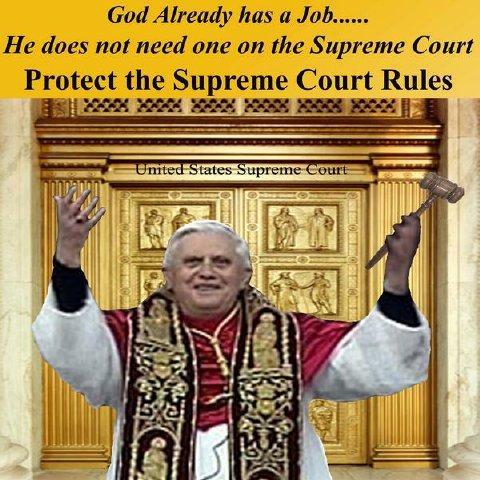
But here’s one from the folks at MoveOn.Org that manages to combine offensiveness with simple stupidity:

Moveon_pope

[CHT: Southern Appeal.]

Just think about the Einsteinian level of "wit" this thing shows us:

  • It tells us that God already has a job and so it shows us a picture of . . . the pope.
  • It tells us that we need to "Protect the Supreme Court Rules"–whatever rules those may be.
  • The gavel isn’t enough to tie the image of the pope in to the Court, so just to make sure all the peabrained redstaters in the audience get the joke, it has the words "United States Supreme Court" typed on the door behind him.

Then there’s the "professional" quality of the Photoshopping. Man, The folks at Worth1000.Com have nothing on this artiste.

According to Kay Daly, the image was originally posted here:

http://moveonpac.org/rallyhelp/photos/5883/full.jpg

But they moved it off their site.

Guess they got some flack and decided to . . . MoveOn.

Welllllll . . . Ain't That "Special"

A lotta folks have been using Photoshop to come up with images involving Benedict XVI. My favorite of these thus far is but the Curt Jester:

UT UNUM SINTRUM . . . NOW WITH B16!

That one’s hysterical. The only thing he needs to add is how much "Holy C" the supplement has.

Others I’m less tickled by. The one with Pope Benedict presiding at Mass with a huge beer mug in front of him on the altar (which doesn’t look like a German beer stein), isn’t really to my taste. (Though I may be in the minority here as a buncha folks have e-mailed it to me.)

But here’s one from the folks at MoveOn.Org that manages to combine offensiveness with simple stupidity:

[CHT: Southern Appeal.]

Just think about the Einsteinian level of "wit" this thing shows us:

  • It tells us that God already has a job and so it shows us a picture of . . . the pope.
  • It tells us that we need to "Protect the Supreme Court Rules"–whatever rules those may be.
  • The gavel isn’t enough to tie the image of the pope in to the Court, so just to make sure all the peabrained redstaters in the audience get the joke, it has the words "United States Supreme Court" typed on the door behind him.

Then there’s the "professional" quality of the Photoshopping. Man, The folks at Worth1000.Com have nothing on this artiste.

According to Kay Daly, the image was originally posted here:

http://moveonpac.org/rallyhelp/photos/5883/full.jpg

But they moved it off their site.

Guess they got some flack and decided to . . . MoveOn.

Wednesday Photo Caption

[SOURCE.]

STARTING CAPTIONS:

  1. Early Glimpse Of Padme Amidala From Episode III–She Mutates!
  2. New Hindu Goddess Has More Arms, Gains More Worshippers.
  3. Flapping Arms At Super-Speed Still Does Not Result In Human-Powered Flight.
  4. All The Better To Hug You With, My Dear.
  5. Peacock Woman Struts Her Stuff At Superhero Convention.
  6. WORLD CLOCK: At The Tone, The Correct Time Will Be . . .

Consecration Validity

A reader writes:

Hello again Jimmy,

What do you do, or rather, what is the appropriate response and/or teaching about the following situation:

I have been at Mass several times where the priest changes the words of consecration.   For the words of consecration for the bread, he says "Take this, all of you, and eat it.  This is My Body, which will be given up for all of you."   For the consecration of the wine he says, "Take this, all of you, and drink from it: this is the cup of my blood, the blood of the new and everlasting covenant.   It will be shed for you and for everyone
so that sins may be forgiven.  And as often as you do this, you do it in memory of me."

Are these extra words and the changing a big deal? 

Yep. The words of consecration are the most important words in the whole Mass, and it is objectively gravely sinful to knowingly and deliberately tamper with them in any way, even a way that does not invalidate the consecration.

So far, whenever it has happened (and it happens at other places too, not just with this priest, but I am specifically asking about this priest because I’ll be at an event this week where he will celebrate the Mass), I pray for him,

Good reaction.

for the Church,

Also good.

for an increase in love for the Blessed Sacrament,

Very good.

and I refrain from communing because I’ve never been sure if this is a valid consecration or not.

Not good.

If the changes are of the nature you say then the consecration is going to be valid. As long as he conveys the ideas "This is my Body" and "This is . . . my blood" then the consecration will take place because the words he uses signify the reality of transubstantiation.

Is it a valid consecration? 

Yes, as indicated.

If it is not, am I doing right to stay in the pew? 

If it were not valid then you should, of course, refrain from receiving, but since the consecration is valid the Church would encourage you to receive as long as you are otherwise qualified and properly disposed (e.g., you’ve fasted for an hour before Communion, you aren’t in a state of mortal sin, etc.).

When I am at the Mass with him it is usually a small group and all the rest of the group is Catholic and in the past, everyone else has gone for communion except me. 

God is pleased by your willingness to honor him by allowing yourself to be left out in this manner, even though it has not been objectively necessary.

A couple of times Father has actually motioned to me or asked if I would like to come to communion, too. 

Father is behaving irresponsibly. (But then you already knew that.) Neither priests nor anybody else should ever put pressure on individuals to receive Communion. They particularly should not do so publicly. This is unconsionable. They may preach about the good of frequent, properly disposed Communion (as long as they are not giving the impression of targeting any particular person or group of persons with this preaching), but if someone is refraining from coming then it is an abuse of the rights of the faithful to pressure them into coming. Church law and teaching is clear that nobody is to be forced to the sacraments, and that includes putting public pressure on them to receive the sacraments.

Is there a way to approach Father and ask him about this or have an apologetic moment?  I’m not 100% sure that I am going to teach him anything new that he didn’t learn in seminary.

It sound as if there is a good deal he didn’t learn in seminary that you could teach him. That being said, you know the saying: "You can lead a horse to water, but you can’t make him drink." It is a judgment call whether you think that he’s teachable and what the benefits and costs would be of trying to educate him on the matter.

One thing, if you conclude that the thing to do is to talk to him about it, that can maximize your chances is quoting official Church documents. He’s not likely to care about what I’ve said on a blog. Arguing on that basis will distract and bog down the discussion. But if you show him official Church documents, you have a better chance of helping him to see the difficulty with what he is doing.

To that end, I suggest that you look up

CANON 846 §1 OF THE CODE OF CANON LAW.

Since this canon says that in celebrating the sacraments the liturgical books are to be faithfully observed, with no one adding, deleting, or changing anything in them, and since the words of consecration are printed in the liturgical books (specifically, the Sacramentary) it is impermissible to tamper with the words of consecration.

20

Here’s A Man Who Lives A Life Of Danger

I mean, how many Islamic dudes do you get writing for the L.A. Times who say things like:

One can appreciate the Koran’s inherent worth, as I do, while recognizing that it contains ambiguities, inconsistencies, outright contradictions — and the possibility of human editing. This is not simply a reform-minded Muslim speaking. This is Islamic tradition talking.

For centuries, philosophers of Islam have been telling the story of the "Satanic Verses." The Prophet Muhammad accepted them as authentic entries into the Koran. Later, he realized they deify heathen idols rather than God. So he belatedly rejected the verses, blaming them on a trick played by Satan. Which implies that the Prophet edited the Koran.

Let’s push this point further. Because pious Muslims emulate Muhammad’s life, those who compiled the Koran’s verses after his death might have followed his example of editing along the way. The compilers were, after all, only human — as human as Muhammad himself.

Moreover, they collected the Koran’s verses from sundry surfaces such as bones, stones and bark. How did the passages get there? According to Islamic lore, the Prophet, an illiterate trader, couldn’t personally record them. His companions served as scribes, often writing from memory. Given so much human involvement, isn’t it possible that errors infiltrated the "authoritative" Koran?

In asking this question, I’m neither impugning the allegorical wisdom of the Koran nor inviting another fatwa on my life [EARTH TO THOUGHTFUL DUDE: Actually, you are inviting "another" fatwa against your life, but more power to you]. I’m saying that Muslims have to get comfortable asking such questions — and not merely whispering them — if we’re going to avoid a further desecration of human life. Riots in Afghanistan have already resulted in at least 14 deaths. Aid workers have been attacked; their offices burned. How does this benefit the cause of dignity — for anyone?

What this gentleman points out is all true, and all part of Islamic tradition, but it is deliberately neglected. It’s surprising to find a Muslim willing to take on this subject with such frankness in such a major newspaper–even here in America.

The guy’s got moxie!

GET THE STORY.

Here's A Man Who Lives A Life Of Danger

I mean, how many Islamic dudes do you get writing for the L.A. Times who say things like:

One can appreciate the Koran’s inherent worth, as I do, while recognizing that it contains ambiguities, inconsistencies, outright contradictions — and the possibility of human editing. This is not simply a reform-minded Muslim speaking. This is Islamic tradition talking.

For centuries, philosophers of Islam have been telling the story of the "Satanic Verses." The Prophet Muhammad accepted them as authentic entries into the Koran. Later, he realized they deify heathen idols rather than God. So he belatedly rejected the verses, blaming them on a trick played by Satan. Which implies that the Prophet edited the Koran.

Let’s push this point further. Because pious Muslims emulate Muhammad’s life, those who compiled the Koran’s verses after his death might have followed his example of editing along the way. The compilers were, after all, only human — as human as Muhammad himself.

Moreover, they collected the Koran’s verses from sundry surfaces such as bones, stones and bark. How did the passages get there? According to Islamic lore, the Prophet, an illiterate trader, couldn’t personally record them. His companions served as scribes, often writing from memory. Given so much human involvement, isn’t it possible that errors infiltrated the "authoritative" Koran?

In asking this question, I’m neither impugning the allegorical wisdom of the Koran nor inviting another fatwa on my life [EARTH TO THOUGHTFUL DUDE: Actually, you are inviting "another" fatwa against your life, but more power to you]. I’m saying that Muslims have to get comfortable asking such questions — and not merely whispering them — if we’re going to avoid a further desecration of human life. Riots in Afghanistan have already resulted in at least 14 deaths. Aid workers have been attacked; their offices burned. How does this benefit the cause of dignity — for anyone?

What this gentleman points out is all true, and all part of Islamic tradition, but it is deliberately neglected. It’s surprising to find a Muslim willing to take on this subject with such frankness in such a major newspaper–even here in America.

The guy’s got moxie!

GET THE STORY.