When Vampire Novels Get It Wrong–Part II

In my life, I think I’ve read three vampire stories: The Vampyre, Interview with the Vampire, and Dracula.

Each is a major landmark in vampire fiction (which is why I read them; the genre doesn’t have a lot of native appeal to me, but I’m not opposed to reading the classics in it). Yesterday I was listening to an audiobook that I made out of Dracula, and it got me to thinking about the medical aspects of vampirism, which led me to do a pair of posts on the subject.

I must say that I’m impressed with the way Bram Stoker wrote Dracula. Though, from what I can tell, Stoker was an Irish Protestant, his novel is remarkably Catholic-friendly and spends a great deal of time discussing spiritual matters.

It’s also quite cosmopolitan culturally. Though the main characters are British, there are not only representatives from different English social classes but also a lot of characters from and portraits of other cultures. As he goes to visit Count Dracula in Transylvania, Jonathan Harker describes various eastern European cultures in significant detail. Dracula himself is Transylvanian. Dracula’s nemesis–Dr. Van Helsing–is Dutch. And there’s even a major character who is a cowboy from Texas.

A special treat for me is the way that different languages and dialects bleed through into the language of the novel–as when Van Helsing speaks of things that in English are neuter using the masculine or feminine genders they would have in Dutch. (E.g., referring to "corn" [i.e., wheat] as "he" instead of "it.")

The novel is told in semi-epistolary form. An epistolary novel (in the strict sense) is one told exclusively through the use of letters written by characters in the novel, though in Dracula not only letters are used but also diary entries, telegrams, and newspaper articles. (I’m sure one day soon someone will write an e-pistolary novel told entirely through e-mails.)

So it’s a cool read.

But there are still flaws.

Some of these occurred to me when Stoker got to a particular point in the plot in which a character named Lucy had become the object of Dracula’s predations and her health was suffering. Dr. Van Helsing determines (I presume correctly) that her blood loss is sufficient that she needed transfusions in order to survive. He then sets about arranging these.

At the time, this would have been REALLY cool. I don’t know of ANY prior vampire story in which they tried to bring (then) modern science to bear on the problem of vampirism by giving blood transfusions. So megakudos to Stoker for that!

But there are some oddities for the modern reader.

One of the first things that struck me about the way the novel treated them was how DRAMATIC the transfusions were held to be. I mean, the characters were making a WAY bigger deal over transfusions than we would today.

Some of that may be natural for the time period, though, since I assume transfusions weren’t done as regularly as they are now.

One of the ways that a bigger deal is made of transfusions is that there is a big hullaballoo over who can be a donor for the procedure. Van Helsing is willing to do it himself, but his student–the English Dr. John Seward–points out that he is younger and ought to do it. Better yet is Lucy’s fiance, an even younger lord who is simple and healthy and uncomplicated–unlike the two doctors who, being engaged in intellectual pursuits by their profession, have higher strung "nerves" and are less suitable donors.

This sounds very suspicious. Old people give blood all the time today. In fact, blood banks rely HEAVILY on the generosity of older people; the young frequently being unable to be bothered with giving blood. And having an intellectual career has NOTHING to do with the ability to give blood.

Still, this may have been the 19th century understanding of things.

Another way a bigger deal is made of the transfusions than we would make of them is that discussion is made of giving the donors an opiate in order to knock them out during the procedure. I guess maybe folks back then were so horrified at the thought of giving blood that they wanted to be knocked out for it, though today people give blood all the time without any sedation at all. (I’d also have a hesitancy of giving the donor a sedative as anything that goes into his bloodstream is, of necessity, going to go into the recipient’s bloodstream in short order as the transfusion progresses–see below.)

After the transfusions are over, Van Helsing orders that the donors "eat and drink much," which is fine by modern medical science. They should do that to help their bodies replenish their blood supply.

I’m less sanguine (pun intended) regarding his advice that one of the donors should be given port wine to drink after a transfusion. I’m not sure about the effects of alcohol on a person who has just given blood (won’t that at least make him EXTRA woozy?), but I can let that pass.

What really set off alarm bells was Van Helsing administering to LUCY (the blood recpient) an opiate BEFORE the transfusion in order to knock her out.

WAIT A MINUTE! Lucy is suffering from acute posthemorrhagic anemia! She’s lost so much blood that she’s going to DIE if you don’t get more blood into her. Her blood pressure is DOWN and her heart is STRUGGLING ot beat fast enough to keep her blood pressure up and her cells oxygenated. Is giving her a sedative that will depress her system REALLY the thing to do at this moment?

"Please, Jim! Don’t leave her in the clutches of 19th-century medicine!"

Where Dracula really loses it, though, is in the fact that Van Helsing administers the blood transfusions with NO ATTEMPT WHATSOEVER to establish whether the donors have blood types that are compatible with Lucy’s blood type or not.

I’m sorry, but Dracula came out in 1897, and blood typing began (in a rudimentary form) almost a hundred years earlier. Doctors had realized that far back that the reason that people often died from blood transfusions was that they had different types of blood than the donors. It was the discovery of blood typing that ALLOWED transfusions to begin to become commonplace. Previously it was too dangerous.

Now, I’m not an expert on the history of medicine, and it could be that a doctor in 1897 would have made no attempt to type the blood of a donor and a recipient, but it seems to me that almost a century after this discovery–when it was this discovery that really allowed blood transfusions to take off–that a supergenius such as Dr. Van Helsing should have been on top of this one.

So, like later authors of vampire stories, I think that Stoker could have done with a little more medical research amidst his admirable cultural and historical researches.

That doesn’t stop the book from being a really cool read, though.

GET THE STORY (FROM PROJECT GUTENBERG).

UPDATE: Further investigation reveals that Van Helsing did just fine by not checking for blood typing. The original criticism was based on a Wikipedia statement that blood typing was discovered in the first decade of the 19th century, but whoever wrote that was wrong. It now appears that blood typing was not described in medical literature until three years after Dracula appeared.


When Vampire Novels Get It Wrong–Part I

I admit it: I nitpick the science in novels I read.

Take Anne Rice’s Interview With A Vampire–those best-known vampire novel of the last few decades. When I read this novel, I couldn’t help being distracted by the fact that, when the vampires in it are draining blood from someone they can hear the person’s heartbeat (okay, I can buy that part; Rice’s vampires have supersensitive senses, including hearing) and the person’s heartbeat is getting slower and slower until the vampire drains so much blood that the person dies.

"This is not what would happen," I said to myself.

A person about to die from vampire predation would be suffering from acute posthemorrhagic anemia, whose symptoms are known, though in the real world they are more commonly caused by accidents than vampire predation. The symptioms include faintness, dizziness, thirst, and sweating. Gradually slowing heartbeat AIN’T one of them, though.

In fact, you get just the opposite.

If you suddenly lose a whole bunch of blood then there is a mechanical process that takes place which is relatively easy to understand. With the sudden subtraction of a bunch of your blood volume that means you’ve got LESS blood in your circulatory system. That means that your blood pressure goes DOWN. That means that your heart will pump FASTER to try to keep your blood pressure up so that oxygen can keep getting to your cells, and you will go into TACHYCARDIA.

Eventually, the amount of blood loss will overtax the heart’s ability to pump fast so that it can’t push through enough blood because the chambers don’t have the chance to fill completely and the heartbeat will be rapid and weak. The heart itself will also start suffering oxygen deprivation and you’ll have a myocardial infarction or "heart attack." Eventually you get things like uncontrollable falling blood pressure and fatal cardiac arrythmias.

Not quite so romantic–eh?

But in Interview with the Vampire it’s such a seductive experience that the vampires have to STOP themselves from draining a victim so that they don’t get drug down into death with him.

Why that is, I’m not sure. If all you’re doing is moving blood from the victim to yourself then (assuming you can metabolize blood), you’d be STRONGER as the victim gets closer to death.

What’s more, the process of killing a victim by vampirism would be so revolting that it would have built-in factors that would cause you to want to let go at a certain point.

Unless vampires do something that allows them to bypass the normal rules of cardiology, their victims’ hearts won’t just slow gently down as they drop into the sleep of death. It’ll be a much more traumatic thing than that with the victims’ hearts speeding up, getting faster and weaker and more irregular until the victim dies, possibly amid classic heart attack symptoms like chest pain and numbness in the left arm and nausea and vomiting and dizziness and things like that.

ICK!

What vampire wouldn’t want to pull away before THAT happens!

Reading the novel, I also found myself wondering: "Just how long do these vampire predations go on? Wouldn’t it take quite a long time to get enough blood out of a person to kill him?"

It turns out that the amount of blood you can lose without dying depends on how fast you lose it. If you lose it rapidly, you can only stand to lose about 1/3rd of your blood volume (3-4 pints). But if you lose it slowly–say, over a 24 hour period–you can lose up to 2/3rds of your blood volume (6-8 pints). If a vampire sucked you dry slowly, over the course of a day, he could get a lot more out of you before you died, but that isn’t the way vampire predations are typically depicted. They’re much faster things.

So in a classic vampire attack, the vampire would only be able to pull 3-4 pints of blood out of a person before the person died.

That’s still a LOT of blood–especially if it’s being taken from two little holes in the blood vessels of the neck. I mean, I assume from the way that vampire attacks on the neck are classically depicted that they’re either going after the carotid artery or the jugular vein, but even though these are large blood vessels, it seems to me that it would take a significant amount of time to suck 3-4 pints out of one of these, especially (in the case of the carotid artery) without starving the brain of oxygen and causing the victim to go unconscious for that reason (as opposed to hypnotism or something).

Such long predations might be possible in the seclusion of a house, but not in a darkened alley in London with lots of people walking around and stuff.

Now, I know that vampires are supposed to be supernatural beings who may have ways of circumventing what would normally happen in the real world in such situations (like their ability to hypnotize the victim into staying still for all of this), but I still think that the authors of vampire stories could do with some medical research as part of all the other research (e.g., of a historical nature) that they do for their stories.

The Economics Of Execution

There are certain pieces of "conventional wisdom" that I’m quite skeptical of. One of them is "The death penalty doesn’t really deter murders." Really? How do we know this? Whether one supports or opposes capital punishment, this claim is at least counterintuitive.

It would seem that executing a murderer would at least prevent him from committing repeat offenses and deter those murders–whether or not it scares off potential murderers from killing others. Further, isn’t the whole idea of having penalties attached to laws generally regarded as providing a deterrent? Why should this penalty be any different? Could the "it doesn’t save lives" argument be just wishful thinking?

I can imagine arguments that having the death penalty fosters a culture of death such that it actually leads to more murders. Maybe. Weird things like that happen. But where’s the data?

That’s why it’s nice that God created economists. They can be a big help in testing received bits of conventional wisdom and seeing if they hold up or if they’re just wishful or prima facie thinking.

The Sydney Morning Herald recently carried an op/ed piece touching on this that was startling:

NEVER have those of us who oppose the death penalty felt more convinced that we are right. And never has there been a series of more impressive-sounding arguments to suggest that we are wrong.

For most of the past century we have been secure in the belief that executing murderers does little to stop murder. That’s what the psychologists and the criminologists have told us.

But now economists have entered the debate. And they have brought to the task a dazzling range of highly sophisticated techniques originally developed to answer more prosaic questions, such as whether tax breaks encourage saving.

More often than not the economists find that executions do save lives.

As they starkly report their central finding: each execution results in an average of 18 fewer murders. Or, to present the finding in an even more unsettling way: any state that refuses to impose the death penalty for murder is condemning 18 or so innocent people to death.

Now, I know that claims of this nature are controversial and subject to testing and revision and reversal themselves, but it’s nice to have additional research being done. That’s how science–including criminology–moves forward.

READ THE STORY.

READ THE SUNSTEIN-VERMUELE PAPER. (WARNING! Evil file format [.pdf]!)

DISCUSS.

Christmas Wars Episode I: The Puritan Menace

Slate has an interesting piece on the history of Christmas and the war conducted against it by Puritans et al. in of all places (are you ready?) Massachusetts.

EXCERPT:

Between 1659 and 1681, Christmas celebrations were outlawed in the colony, and the law declared that anyone caught "observing, by abstinence from labor, feasting or any other way any such days as Christmas day, shall pay for every such offense five shillings." Finding no biblical authority for celebrating Jesus’ birth on Dec. 25, the theocrats who ran Massachusetts regarded the holiday as a mere human invention, a remnant of a heathen past. They also disapproved of the rowdy celebrations that went along with it. "How few there are comparatively that spend those holidays … after an holy manner," the Rev. Increase Mather lamented in 1687. "But they are consumed in Compotations, in Interludes, in playing at Cards, in Revellings, in excess of Wine, in Mad Mirth."

After the English Restoration government reclaimed control of Massachusetts from the Puritans in the 1680s, one of the first acts of the newly appointed royal governor of the colony was to sponsor and attend Christmas religious services. Perhaps fearing a militant Puritan backlash, for the 1686 services he was flanked by redcoats. The Puritan disdain for the holiday endured: As late as 1869, public-school kids in Boston could be expelled for skipping class on Christmas Day.

GET THE STORY.

Christmas Eve Homilies

Last night I went to Mass at a local Catholic Church other than my usual parish. It’s a good parish, where a friend of mine who is a priest often says Mass. This priest is an excellent homilist, and I was delighted when he came out to do the homily last night.

Unfortunately, I basically heard none of his homily. The priest himself was heroically battling with the sound system, which was misbehaving, but that wasn’t the major problem.

The major problem was that there was a father with a young baby walking up and down in the world-class echo chamber that serves as a vestibule for this parish, and the baby was exercizing the full capacity of its lungs.

It was also crying so loudly that it occasionally threatened to set off rounds of sympathetic crying among other babies in the congregation.

I was sitting in the back, and the baby positively destroyed my ability to hear anything that the priest was saying. I suspect he did so for much of the congregation–perhaps all of it.

Now, I don’t mind a little bit of baby tearfulness in the congregation, because it signifies two good things: (1) there are babies in the congregation and (2) their parents are religiously active. Those are two wonderful things, and I normally smile and remind myself of them when I hear a baby sounding off during church services.

But when a baby is totally out of control, his parents need to do something, because they do have some responsibility not to allow their child to ruin everybody else’s ability to hear.

Taking the wailing infant into a large, tiled echo chamber is not among the most responsible things I can think of to do in such a situation.

The ushers were quite useless in this situation. Indeed, though they were standing right in front of the doors of the nave, they didn’t even close the doors to the echo chamber for several minutes, lest the young father feel excluded, which made it impossible for the congregation (or much of it) to hear the priest’s Christmas Eve homily. Finally, they did close the doors–which are quite thin and so provided next to no relief from the sound.

"Perhaps the person minding the baby would like to know that there is a cry room," I suggested to one of the ushers.

"I think he knows," the usher replied, indicating that he would do nothing to alleviate the situation. "It’s too cold to go outside."

"Oh yeah," I thought to myself. "This is Southern California. It’s in the 50s outside and there is a think blanket of Christmas FOG in the parking lot. I didn’t even have to turn on the heater in my truck on the way over. That baby will really get sick and die if the father takes it outside for twenty seconds so that he can take the face-saving route to the cry room instead of having to walk in front of part of the congregation."

The ushers having determined to be useless and the baby continuing to destroy everyone’s ability to hear the homily, I *almost* took matters into my own hands to kindly and politely and warmly and helpfully inform in the young father that there was a cry room on the premises, but the homily ended (meaning that we were now in a part of the Mass where the congregation could at least roughly follow what was going on by memory) and the child seemed to settle down anyway.

I admired the priest for being able to soldier on with his homily under these conditions, beset as he was on two fronts (the baby in the echo chamber and the sound system’s refusal to behave). I was a little surprised that he didn’t pause the homily to gently invite the use of the cry room to help with one of these, but he soldiered on anyway. (And, yes, I know the reasons he might not want to.)

Yet I was disappointed that I didn’t get to hear the Christmas Eve homily of a particularly good homilist.

But I was able to read one!

This morning I discovered that the folks who do the Vatican web site have (mirabile dictu) put THE POPE’S Christmas Eve homily online–and he’s a good homilist, too!

HERE’S THE LINK.

I was interested to compare what the pope actually said with the highly political reading given to his homily in THIS REPORTAGE (which is better than most you get). The pope’s homily wasn’t just about stopping war and abortion. It was much more focused on Christ and the spiritual meaning of Christmas than the political stuff the press is interested in.

Which is as it should be.

So all seems right in the world: There are good homilies out there for Christmas Eve. There are babies with excellent lung capacity. There are echo chambers for those who need them. And there is a surplus of cry room space for those who wish to use it.

YEE-HAW!

International Man Of Mystery

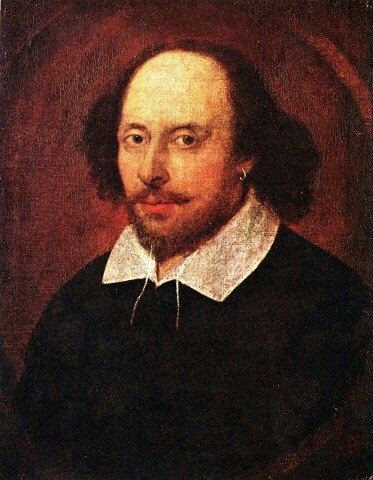
Shakespeare"Who wrote Shakespeare’s plays?" has a much more controversial answer than "Who is buried in Grant’s tomb?"

In fact, numerous facts about the Bard continue to be hotly disputed, almost three hundred years after his death.

One of the controversies is whether Shakespeare himself may have been a Catholic.

In his day English Protestants were putting tremendous pressure on Catholics to accept the newly imposed faith, and laws were passed against those who would refuse to attend Protestant services (known as "recusants").

The result was that many people hid their Catholicism but continued to consider themselves Catholic and, when possible, to practice Catholicism in secret (e.g., by aiding and hiding priests who would covertly say Mass and hear confessions).

Others were more bold and openly declared their Catholicism.

Among those were Shakespeare’s father and his daughter, both of whom recused themselves from Protestant services.

In fact, Shakespeare was in the middle of a hotbed of secret and not-so-secret Catholics.

HERE’S AN INTERESTING INTERVIEW BY AN AUTHOR ARGUING THAT SHAKESPEARE’S PLAYS CONTAIN COVERT CATHOLIC MESSAGES.

HERE’S WHERE YOU CAN BUY HER BOOK.

HERE’S SOME ADDITIONAL PERSPECTIVE ON THE QUESTION FROM WIKIPEDIA.

The Schism Of St. Stanislaus Kostka Parish

For those who may not be aware, the Archidiocese of St. Louis recently received a most unwelcome Christmas present.

One of its parishes has gone into schism.

The parish in question, St. Stanislaus Kostka Parish, was a personal parish for those of Polish language or heritage.

For decades the parish has acted in a manner that has been a thorn in the sides of the archbishops of St. Louis. The previous archbishop, Justin Rigali, took canonical steps to deal with the parish before his transfer to Philadelphia. The unwelcome task of having to deal with the parish then fell to his successor, Archbishop Raymond Burke.

The directors of the civil corporation of St. Stanislaus Kostka Parish, which have legal control of the parish under civil law, have modified the bylaws of the corporation to eliminate any reference to the authority of the archbishop or the pastor assigned by the archbishop over the parish.

Rigali and Burke have both insisted that the bylaws be amended to correct this, in accord with canon law, and the Congregation for the Clergy in Rome has insisted that they do so as well.

The directors have refused to do so and have conducted a campaign in the local media against Archbishop Burke, alleging that–among other things–the dispute is over money and that the archbishop is trying to seize the funds of the parish so that it will be unable to properly serve the faithful of the parish.

The Archbishop points out that he has no authority to seize the parish’s funds, but he does want to make sure that the funds are being properly used for the good of the faithful of the parish and that they are not being misappropriated. To that end, he has called for a public audit of the parish’s goods to prevent any misappropriation.

The Archbishop has gone to great lengths to try to reconcile the parish, including a pastoral visit by the Most Reverend Ryszard Karpinski, auxiliary bishop of Lublin in Poland and the delegate of the Polish Conference of Bishops for Polish faithful living outside their homeland.

But instead of pursuing reconciliation with the archdiocese, the parish–which has already been under interdict–has now hired an AWOL priest from a neighboring diocese to attempt to exercise priestly ministry there.

This constitutes an act of schism both on the part of the directors and the priest. Archbishop Burke, one of the most respected canonists in America, writes:

The act of schism, committed by the board of directors of the civil corporation of St. Stanislaus Kostka Parish, was the hiring of a suspended priest, that is a priest who is not in good standing in the Church, for the purpose of attempting to celebrate the sacraments and sacramentals at St. Stanislaus Kostka Church. The priest in question, Father Marek B. Bozek, a priest of the Diocese of Springfield-Cape Girardeau, has left his priestly office of assistant pastor of St. Agnes Cathedral in Springfield against the explicit direction of his bishop, the Most Reverend John J. Leibrecht, and after Bishop Leibrecht had explained to him more than once the gravity of his action and its consequences.

The fact of the matter is that only a priest who is not in good standing would agree to employment by a group of parishioners without the appointment of the diocesan bishop, that is, a group of parishioners who are breaking communion with the Church. All priests serve in communion with the diocesan bishop who serves in communion with the Roman Pontiff. When Father Bozek left his assignment without his bishop’s permission, he was rightly suspended. The penalty of suspension prohibits him from the exercise of his priestly office (cf. can. 1333, §1).
A priest, who knowingly and willingly chooses to attempt to exercise priestly ministry outside of the communion of the Church and, thereby, assists and encourages others in breaking communion with the Church, clearly also commits the ecclesiastical crime of schism. To be clear, it is not only the members of the board of directors of the civil corporation of St. Stanislaus Kostka Parish who are in schism, but also the priest whom they have presumed to hire and who has agreed to be hired.

As a result of this tragic circumstance, the parties in question have automatically excommunicated themselves, and the implications are grave. Archbishop Burke spells some of them out:

The ordained priest who goes into schism, in addition to being bound by the above-listed prohibitions, is also rendered irregular for the exercise of Holy Orders (cf. can. 1044, §1, 2º). In other words, he may not exercise the Sacrament of Holy Orders which he has received. Any Mass celebrated by a suspended and excommunicated priest is valid, but illicit. To knowingly and willingly celebrate the Holy Mass, when one is legitimately prohibited from doing so, is a most grave sin. A priest under the penalty of excommunication does not give valid sacramental absolution (cf. can. 966, §1). Neither can he validly officiate at a wedding (cf. can. 1108, §1).

The celebration of the Sacrament of Confirmation by a schismatic priest is invalid because he no longer has any faculty to do so, either by universal Church law or the granting of the faculty by the diocesan bishop (cf. can. 882). Baptism and the Anointing of the Sick are conferred validly but not licitly (cf. cann. 862; and 1003, §§1-2).

The faithful who approach a schismatic priest for the reception of the sacraments, except in the case of danger of death, commit a mortal sin. All of the faithful of the archdiocese should guard against any participation in the attempt to celebrate the sacraments or sacramentals at St. Stanislaus Kostka Church. Also, they should caution visitors and others who are unaware of the status of St. Stanislaus Kostka Parish, lest they unknowingly participate in the schismatic acts.

Finally, since the civil legal control of St. Stanislaus Kostka Parish belongs exclusively to the  members of the board of directors of the civil corporation and they have chosen to lead the members of the parish into schism, I will be obliged to suppress St. Stanislaus Kostka Parish. It is not possible for St. Stanislaus Kostka Parish to remain a parish of the Archdiocese of St. Louis and, at the same time, to operate completely independently of the Apostolic See and the Archdiocese of St. Louis.

READ THE FULL TEXT OF THE ARCHBISHOP’S PASTORAL LETTER.

MORE BACKGROUND ON FR. BOZEK (WARNING: .pdf).

An additional canonical problem is pointed out by Edward Peters, one of the most respected lay canonists in the country. On his blog, he notes:

Fr. Bozek needs to know something here: contumacy for an excommunication imposed for an act of schism is itself punishable, this time, by penal dismissal from the clerical state (1983 CIC 1364 § 2). Moreover, once imposed, penal dismissal from the clergy—not being a censure (1983 CIC 1336 § 1, 5°)—is not reversible by what amounts to offering a sincere apology. Indeed, reinstatement of a “defrocked” priest is reserved to Rome (1983 CIC 293) and is so rare as to be non-existent.

Fr. Bozek should stop and think about that and let the parties to the dispute in St. Louis work out their situation in accord with law.

In other words, if Fr. Bozek does not promptly reverse himself, he could PERMANENTLY destroy his ability to minister as a priest in the Catholic Church.

GET THE STORY.

To all this, I’d like to append two additional thoughts:

1) I am aware that ethnic tensions can, over time, lead to schisms. Ethnic tension between Greeks and Latins played a major role in the Great Schism, and the same thing can happen on a small scale.

But I’m detecting that something else may operating below the surface here. Remember the public audit that the Archbishop has called for? The one to make sure that there is no misappropriate of parish funds? Just suppose that there were misappropriate of funds going on at St. Stanislaus Kostka Parish. Y’think that the desire to avoid an audit and the exposure of this misappropriation could play a role in why the directors of the parish civil corporation seem hell bent on schism despite everything that has been done to reconcile them to the Church?

If it were exposed, misappropriation of funds (or other goods) could result in a loss of power for the individual directors or fines or (for all I know) even jail time. Those could be powerful incentives NOT to reconcile with the Church and allow the audit to be conducted.

And then the directors of the civil corporation seem notably concerned with money–charging (falsely) that the Archbishop wants to seize the parish funds . . . which THEY control.

I have no proof of any wrongdoing, and I am not making any allegations of wrong doing. But my spider sense is tingling and I am suspicious.

2) In his pastoral letter, Archbishop Burke writes:

Let us, through the intercession of Our Lady of Czestochowa, implore our Lord Jesus Christ, the Divine Mercy, on behalf of the reconciliation of those who have gone into schism. Christ, Divine Mercy Incarnate, accomplishes all things. Let us place the dolorous situation of St. Stanislaus Kostka Parish into [his] all-merciful and loving heart.

Amen.