Frozen Embryo Adoption

A reader writes:

I happened to bump into someone’s blog, and I was just curious about her personal blogs about what she plans with her husband. What she stated is below.  Can you please advise about the Church’s stance if any on what she is referring to below, which is "In Vitro Fertilization Adoption."  Correct me if I’m wrong, but adopting embryos still seems like its morally unacceptable or at least questionable according to Catholic Moral Theology, since you’re still harvesting them?   

"Yes I am Catholic. And yes I know that in vitro is wrong. That is why I want to adopt an embryo. I told my husband before I married him that I didnt feel right about in vitro because I hold to the doctrine of the church. My husband just converted and is more of a liberal catholic. I have already talked to a priest about our situation. Adopting an embryo is taking the embryos that other couples that did in vitro didnt use and instead of throwing them away or giving them to research, couples can adopt. I find this a better alternative for these little lives then letting them stay frozen, die, or even to research."

Thanks, please advise,

Rome has not yet issued a finding regarding the moral acceptability of adopting embryos who would otherwise die in the freezer or be actively destroyed. I anticipate a decision in the coming years, quite possibly during the current pontificate, but for right now Rome is letting moral theologians kick this one around and work out the issues involved.

At present the community of orthodox moral theologians is split: Some have the intuition, as you do, that this is wrong–not because it involves harvesting embryos (implanting them isn’t harvesting them; "harvesting" refers to killing them so that they can be used for possible medical treatments) but because they feel it is intrinsically wrong to implant an embryo from one woman into another. In arguing this, they may appeal to the idea that the development of the child in the womb is part of the reproductive process and is thus inviolable.

Other moral theologians have the opposite intuition, that embryo adoption is morally justifiable in this case becaues the alternative is letting the child die (or be actively killed when the embryo bank decides to junk it). This is not the same situation as surrogate motherhood, where one woman has a child on behalf of another and thus circumvents the normal reproductive process. It is allowing one’s womb to be used to rescue a child who has already been created and who would otherwise die.

Catholics are permitted at present to take either view.

My own instincts are with the second group–that it is morally permissible to adopt embryos in order to keep them from dying.

To my mind, the definitive moment of reproduction is conception. When that happens is when you have a new human being. What happens to it next is not reproduction, because the reproduction has already taken place and we have a new person. What follows (implantation in the womb and subsequent gestation) is simply caring for a new person who already exists and thus is not subject to the same kind of moral unalterability as the act of reproduction itself.

In other words, human reproduction is inviolable, which is why IVF (like adultery) is wrong, but most of what is happening during pregnancy is not reproduction. A new human is produced–and thus reproduction takes place–at the very beginning of pregnancy. What follows is growth, development, and care.

I would analogize the frozen embryo adoption situation to that of a wet nurse. If a child’s own mother is unable or unwilling to nurse the child, it has been a practice throughout human history to have another woman–who is willing and able to nurse the child–to do so. The second woman thus provides the nourishment from her breasts that the child needs when the biological mother is unable or unwilling to do so.

Adopting a frozen embryo strikes me as the same thing, morally: In this case a second woman provides the nourishment and protection from her womb that the child needs and that the biological mother is unable or unwilling to do so.

In both cases care is being provided for the infant by a second woman, the difference being the age of the infant and thus which organs of the overall reproductive system (breasts or the womb) is being used to provide the care that the infant needs at that stage.

This, from my perspective, deals with the intrinsic moral nature of the act. Some might wish to bring in extrinsic considerations, such as whether doing this would encourage people to create more snowflake babies (as they are called).

I do not think that this argument has weight for two reasons;

1) The number of children who can be so-adopted is miniscule compared to the number of frozen embryos that there are. There is no way that anything more than a small fraction of them could be adopted, and thus I do not see that allowing embryo adoption would have an appreciable effect on the number that are created.

2) It could likewise be argued that allowing wet nurses–or even adoption–also encourages people to create children that they are unable or unwilling to care for. No doubt some people do–and certainly they historically have been–sexually looser than they otherwise would have been, in the knowledge that they could put the children that might result up for adoption. That doesn’t mean you let the resulting kids die of neglect. You do what you can to save them, even if you can’t save all of them. In fact, historically Christians were known for picking up foundlings, caring for them, and raising them as Christians.

To my mind, this is a high-tech version of the same thing.
Non-Catholic Brother Planning New Marriage

A reader writes:

My brother, who is a
baptized Catholic but has not practiced since he was little (my
parents left the Church for a Protestant one at that time and have
since returned, though my brother is still Protestant) has
married outside of the church in a Protestant ceremony is now in the process of divorcing his wife, who is pregnant.
He also already has a new girlfriend whom he has expressed the intent
to marry. 

I have told him that I could not attend this wedding and
that I should not have attended his first wedding as it was outside
of the Church and he is a baptized Catholic, even though he has
rejected Catholicism. 

I know that he has not formally (that is
written to Rome) left the Church.  Have I done the right thing? 

This
is creating a huge amount of tension and stress in my family,
especially because I am trying to inform my now Catholic parents of
what the correct position is to take in regards to the potential
second wife, whom my brother has asked to be allowed to live at their
house (though not in his room…After separating from his first wife,
he moved back home). 

Though it is not in the planned future, I have
also told my family that I cannot attend my other brother’s wedding,
when and if he decides to marry, unless it is within the Catholic
Church.  Is this correct?  Please help.  Many hearts are hurting over
these matters.

This is a really tough situation, and my heart goes out to you.

The Holy See recently released a document on what is required in order to formally defect from the Church, and it took a startlingly restrictive view. One does not have to write to Rome to formally defect, but one does have to go through one’s local bishop.

The question in my mind is whether Rome intends this to apply to previous marital situations or just those from here on out. According to the Code of Canon Law,

Can. 16 ยง2. An authentic interpretation put forth in the form of law has the same force as the law itself and must be promulgated. If it only declares the words of the law which are certain in themselves, it is retroactive; if it restricts or extends the law, or if it explains a doubtful law, it is not retroactive.

It does not seem to me that the recent document merely declared the plain meaningof the words of the law which were already certain. What constituted formal defection was notoriously uncertain, and the canonical commentators I am aware of universally interpreted it more broadly than how the recent document did. The recent document therefore seems to me to either function as restricting the interpretation of the law or explaining a doubtful one. In either case, it would not be retroactive and thus your brother would not have needed to go through the local bishop in order to formally defect.

Unfortunately, Rome has not yet given us an authoritative statement on whether the new document is ot be understood retroactively, though I suspect that is coming since an awful lot of marriage cases have been adjudicated based on the prior understanding of formal defection, and that is bound to lead to confusion.

Even then, it is not clear to me whether your brother formally defected from the Church. One of the reasons that this concept was in need of clarification was that how it applied to situations like your brother’s was unclear. In other words: What about the case of children who are taken to other churches by their parents and made members of them? Does that mean that the child formally defected despite his lack of age and responsibility for doing so? Does he need to reaffirm the defection once he is an adult? Does he need to reaffirm it formally?

We now know the answers to these questions going forward, but at the time your brother was made a member of another church, the answers were unclear.

I thus can’t tell–both because of the unclarity of the law at the time and because it is at least arguable whether the law is retroactive–if your brother has formally defected.

The best way I know to handle the question is thus to split it and ask what would apply if he did formally defect and if he did not.

First, let’s suppose that he did formally defect.

Canon law provides that if a person has formally defected from the Church then he is not bound to observe the Catholic form of marriage. If your brother had formally defected then he would have been free to marry his first spouse. Marriage enjoys the favor of the law so, until the nullity of his first marriage is established, he must be presumed to be married to his first wife and thus not free to marry his current girlfriend. Any union with his current girlfriend must be presumed to be adulterous, per Jesus’ statements in Mark 10.

On this understanding, it would have been permissible for you to attend his first wedding but I could not recommend that you attend his second because your presence would lend credence to an objectively adulterous relationship.

Similarly, I could not recommend allowing two people who must be presumed to have an adulterous relationship to live under my roof, for the same reason: Doing so lends credence to an objectively adulterous relationship, as well as providing scandal (in the technical sense of setting a bad example that may lead others into sin). The same applies even if they are living chastely prior to attempting marriage. Your brother is not presumptively free to have a relationship with this woman, and letting her live there lends credence to the idea that he is.

Now let’s suppose that your brother did not formally defect.

In this case he was still bound to observe the Catholic form of marriage and his first marriage was invalid. He is thus free to marry someone else–however, this marriage too will be invalid unless he either observes the Catholic form of marriage or obtains a dispensation from it. In order to do either, he will for practical purposes need to have his first marriage investigated by an ecclesiastical tribunal and declared null (which is not certain for reasons indicated above, even though at the moment I’m assuming that he did defect and so it was null; that still has to be shown).

Your brother, as a non-Catholic, is presumably not willing to go through the above steps, in which case his new attempt at marriage would be invalid. I thus could not recommend attending it (or the previous one) nor letting him live in my house with his girlfriend (married or unmarried) since their planned future union would be invalid.

Thus, while one of the key facts of the case (whether or not he formally defected) is unclear, the practical conclusions are similar: I couldn’t recommend attending the new attempt at marriage nor allowing his girlfriend to live in the house, either before or after the attempt.

It is to be understood that, as a Protestant, your brother may be acting in good conscience in all this (though he would need an awful good reason to be divorcing a pregnant wife), and he cannot be expected to understand or appreciate the reasons outlined above.

Nevertheless, he needs to understand the reality of his situation. It does not do him any favors to confirm him in an adulterous or otherwise invalid union. If he is going to get his marital situation straightened out before God, he needs to be made aware of the truth and to be aware of it as soon as possible. Letting him get confirmed in a new, invalid union will only create a larger mess to be cleaned up later.

The merciful thing–as hard as it is–is to be honest with him now about his proposed union (honest both in word and in deed) and give him all the support and encouragement one can to help him avoid making a terrible mistake.

I would therefore explain to him as charitably as possible, and with as many family members as possible in agreement, why he needs to re-evaluate the situation, which also involves re-evaluating the question of his religious affiliation. If he is unwilling to do so, that is understandable. Nevertheless–as painful as it would be for him–he should respect the fact that as a Catholic you must follow your consciences even as he follows his.

None of this, I would hasten to point out, has anything to do with how much you love him. You still love him and, in fact, it is precisely because of your love for him that you are handling the matter in this manner.

I hope this helps, and I encourage my readers to pray for this situation!

20


Missing Mass To Go To Class

A reader writes:

My boyfriend and I live in
Rome and he is going back to the states for about a month long
vacation in August/September.  He is attempting to take a weekend-
long motorcycle training course as he is hoping to obtain a scooter
when he comes back to Rome to make life in Rome easier. 

The only
possible times for the class eliminate any possible time when he
could go to Holy Mass that weekend to fulfill his Sunday obligation.
We have looked everywhere for a Mass early or late enough for him to
attend, but it seems to be impossible.  It is absolutely necessary
that he take this class before attempting to drive a scooter in Rome
for safety reasons and licensing.  He cannot miss ANY of the class
because if he does he will not able to obtain the certification to
drive in Italy that is necessary. 

What should he do?  Does he need a
special dispensation to miss Holy Mass on Sunday?
He thinks he has to have a dispensation from the local Ordinary but I
think he doesn’t. Who’s right?

One is excused from one’s Sunday obligation for a moderately serious reason, and the need to take a driving class to obtain licensing will count as a sufficient reason. Things like being required to work or attend weekend classes for non-trivial subjects (and how to drive safely and get a vehicle license is a non-trivial subject) definitely excuse.

Your boyfriend therefore does not need to obtain special permission in order to miss Mass.

Also, when one doesn’t have a moderately serious reason and one does need to get permission to miss Mass, it isn’t the local ordinary that one needs to approach but just one’s own pastor. In this case, only a "just cause" (a much weaker standard) is needed for him to provide permission. The Code of Canon Law provides:

Can.  1245 Without prejudice to the right of diocesan bishops mentioned in can. 87, for a just cause and according to the prescripts of the diocesan bishop, a pastor can grant in individual cases a dispensation from the obligation of observing a feast day or a day of penance or can grant a commutation of the obligation into other pious works. A superior of a religious institute or society of apostolic life, if they are clerical and of pontifical right, can also do this in regard to his own subjects and others living in the house day and night.

Needing to take the kind of class that you describe is certainly a just cause, and if the pastor is half-way reasonable, he should recognize this.

Even if he didn’t, though, the reason itself is sufficient to allow your boyfriend to attend the class and miss Mass this once.

20

Clerical Garb

A reader writes:

I’ve recently been wondering about what kinds of clothes priests should wear according to the letter of the law.  specifically, I know that one of my parish priests likes to sit in the back of other parishes and observe mass when he goes on vacation.  Now I know that is not what he is supposed to do, and he knows it too, so I’m not looking to concern you with the fine points of whether he should be in choir dress, cassock+surplice or vested and exercising his priestly faculties at those masses.  I am however interested in what kinds of clothes priests can and should wear day to day. This is particularly of interest to me as I have recently been
accepted to the seminary for pre-theology studies in my home diocese.

 
Anyhow, some specifics might include:
  • when is it appropriate/allowable for priests not to wear the roman collar but to dress in purely secular clothing?
  • is it permissible for a priest to wear the Roman cassock outside of church grounds, e.g. out to dinner or shopping?
  • who is responsible for setting these norms – national conferences, individual bishops, the Code of Canon Law?

For priests belonging to the Latin Church, the universal law regarding this matter is found in the Code of Canon Law, which states:

Can. 284

Clerics
are to wear suitable ecclesiastical garb according to the norms issued by the
conference of bishops and according to legitimate local customs.

As you can see, the Code simply states that they are to wear some kind of distinctive garb and authorizes the authorizes the conference of bishops (as well as local custom) to determine this more precisely, which answers the third of your bulleted questions.

Before we look at the complimentary norm for this canon here in the United States, though, let’s look at a passage from the 1994 Directory for the Life and Ministry of Priests, which goes into the matter in more depth and says:

66. Obligation of Ecclesiastical Attire.

In a secularised and materialistic society, where the external signs of sacred and supernatural realities tend to disappear, it is particularly important that the community be able to recognise the priest, man of God and dispenser of his mysteries, by his attire as well, which is an unequivocal sign of his dedication and his identity as a public minister. The priest should be identifiable primarily through his conduct, but also by his manner of dressing, which makes visible to all the faithful, indeed and to all men, his identity and his belonging to God and the Church.

For this reason, the clergy should wear "suitable ecclesiastical dress, in accordance with the norms established by the Episcopal Conference and the legitimate local custom”. This means that the attire, when it is not the cassock, must be different from the manner in which the laity dress, and conform to the dignity and sacredness of his ministry. The style and colour should be established by the Episcopal Conference, always in agreement with the dispositions of the universal law.

Because of their incoherence with the spirit of this discipline, contrary practices cannot be considered legitimate customs; and should be removed by the competent authority.

Outside of entirely exceptional cases, a cleric’s failure to use this proper ecclesiastical attire could manifest a weak sense of his identity as one consecrated to God.

Now, here’s the U.S. complimentary norm:

The National Conference of Catholic Bishops, in accord with the
prescriptions of canon 284, hereby decrees that without prejudice to
the provisions of canon 288 [which exempts deacons from the clerical dress requirement], clerics are to dress in conformity with
their sacred calling.

In liturgical rites, clerics shall wear the vesture prescribed in the
proper liturgical books. Outside liturgical functions, a black suit and
Roman collar are the usual attire for priests. The use of the cassock
is at the discretion of the cleric.

In the case of religious clerics, the determinations of their proper
institutes or societies are to be observed with regard to wearing the
religious habit [SOURCE].

As you can see from this, "the use of the cassock is at the discretion of the cleric," which means that it would be permitted outside church grounds, answering the second of your bulleted questions.

This leaves your first bulleted question, which is in what circumstances they can simply go about in civvies, without the black suit and Roman collar that this norm requires.

The answer is . . . the law doesn’t say.

We know that there are exceptions, because the Directory for the Life and Ministry of Priests alludes to "entirely exceptional cases" being sufficient to excuse a priest from wearing clerical garb, but it doesn’t say what those might be.

This therefore strikes me as an area of the law that could stand further clarification.

One note about the phrase "entirely exceptional cases": That’s a pretty strong phrase and it might be taken to mean that you need an awful strong reason not to wear clericals in a particular situation. But this might misread the intent of the Directory. It could easily be argued that the Directory is concerned with getting priests to wear clerical garb in general and thus it reqiures an "entirely exceptional case" to justify not wearing ecclesiastical garb in general. In other words: a priest needs a powerful reason–like government prohibition or the possibility of violence against him–in order to justify never wearing clerical garb.

That being said, given the pastoral reasons behind the law as articulated by the Directory and the fact that the law assumes that he will be wearing clerical garb as a general matter, a conscientious priest will not lightly excuse himself from wearing it in public.

And if I may add an additional pastoral reason why he should not do so: It will confuse the faithful if they see him sometimes in clerical dress and sometimes not and undermine his ability to minister to them effectively as doubts are sewn in their minds about whether his "failure to use this proper ecclesiastical attire could manifest a weak sense of his identity as one consecrated to God."

Incidentally, for readers overseas, I did a quick check of the complimentary norms for canon 284 a number of other countries in the English-speaking world (England, Ireland, Canada, Australia, New Zealand) and was mildly surprised to discover that the U.S. is far more specific in spelling out the requirements for clerical dress. England’s complimentary norm simply says that existing customs regarding clerical dress are to be observed (thus devolving the matter to existing custom). Ireland and Canada’s norms say that a priest is to be recognizable by his dress as a priest (thus implicitly devolving the matter to custom). And Australia and New Zealand say that the dress needs to identify him as a priest but then says the diocesan bishop will make further determination of the matter (thus devolving it on the local bishop). Some of these countries also add that the garb must be suitable to the occasion.

Prayer Requests

I haven’t decided how often to have prayer request posts here on the blog (probably not every week as was suggested, but once in a while).

I’d like to begin one today, though, and with a special prayer request of my own: SDG and his wife are expecting a new baby and, since the little one is significantly overdue, they are finally having labor induced today. I’d like to ask folks to pray for the safe delivery of mother and baby.

So that’s my prayer intention.

Please use the combox to add your own prayer intentions.

Superheroes Go Postal

Superherostamps

Just in case anyone here at JA.org happens to like superheroes, y’all may be interested to know that your favorite caped crusaders are coming soon to a postage stamp near you.

"Faster than a speeding bullet, comic book superheroes are coming to a post office near you. Batman and Superman, Wonder Woman, Supergirl and a half dozen other superheroes will star on new postage stamps being released Thursday.

"The new 39-cent stamps and 24-cent postal cards will be made public at a comic book show in San Diego, and will go on sale nationwide Friday.

"The stamps are sold in a sheet of 20, half featuring the individual superheroes and half showing covers of comic books starring them.

"The Postal Service reports this is its first set of super hero stamps, indicating more are likely to follow."

GET THE STORY.

The super stamp models are slated to include, among others, Batman, Wonder Woman, The Green Lantern, and Supergirl. No word yet on whether letters posted with the superhero stamps will arrive at their destination faster than a speeding bullet.

The Baby Harvesters Vs. The Baby Heroes

The following is a list of U.S. Senators who voted in favor of harvesting babies currently frozen in order to get at their stem cells:
Baby_harvesters

Now here is a list of those senators who voted to defend the babies against being harvested in order to steal their stem cells:
Baby_heroes

Kindly remember which individuals stood up for the babies and which voted to kill them for medical experimentation.

(CHT: Southern Appeal)

If you’d like to look up how your state’s two U.S. senators voted, CLICK HERE.

Rendering Unto Caesar

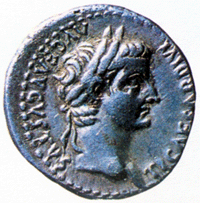
Coin_tiberiusA reader writes:

It is my understanding that the Church tells us to pay taxes and obey our
civil government EXCEPT when the civil government is asking its citizens
to sin.  I base this off CCC 2242:


"The citizen is obliged in conscience not to follow the directives of
civil authorities when they are contrary to the demands of the moral
order, to the fundamental rights of persons or the teachings of the
Gospel. Refusing obedience to civil authorities, when their demands are
contrary to those of an upright conscience, finds its justification in the
distinction between serving God and serving the political community.
"Render therefore to Caesar the things that are Caesar’s, and to God the
things that are God’s." "We must obey God rather than men":


When citizens are under the oppression of a public authority which
oversteps its competence, they should still not refuse to give or to do
what is objectively demanded of them by the common good; but it is
legitimate for them to defend their own rights and those of their fellow
citizens against the abuse of this authority within the limits of the
natural law and the Law of the Gospel."


Now, with that stated, if I know that my money I pay to taxes is
supporting mass murder of innocent humans, should I pay taxes?  By paying
taxes I am indirectly supporting the actions of the government in this
injustice.  For example, I know that taxpayer money is supporting the
blood thirsty abortion mill Planned Parenthood:


"Finally, the Planned Parenthood empire has been built and sustained in
large part by money from the U.S. taxpayers. Planned Parenthood’s own
annual reports indicate that it received $2.2 billion of taxpayer money
between 1987 and 2001. Thirty percent ($202.7 million) of Planned
Parenthood’s income ($672.6 million) in its 2000/01 fiscal year came from
government grants or contracts. Incredibly, PPFA made $454 million of
profit from 1987 to 2001!" – American Life League


Thus, should I continue to pay taxes?  Thanks.

The argument that you are making faces several hurdles.

The first is that the passage in the Catechism that you cite involves disobedience in matters in which you are directly being commanded to do evil (e.g., if you were being ordered to perform an abortion or abort one of your own children).

Catholic moral theology recognizes a distinction between different forms of cooperation with evil, ranging from immediate, personal action to what is known as remote material cooperation. This passage is dealing with things toward the former end of the spectrum: Things you are being personally ordered to do that are evil.

Giving money to the government is not evil. If the government then takes it–against your wishes–and does something evil with it then your cooperation is both material and–given the way the government works–remote. Thus if you pay taxes and your taxes go into a government fund and then the government takes some of the money from that fund and gives it to Planned Parenthood then your cooperation with the evil that Planned Parenthood does is (extremely) remote material cooperation.

Catholic moral theology acknowledges that remote material cooperation is morally justifiable when there is a proportionate reason. So: Is there a proportionate reason to pay your taxes, knowing that a tiny fraction of them may go toward Planned Parenthood?

It would seem that there is, and it may be articulated as follows:

1) The government will ruin your life if you don’t pay your taxes.
2) By ruining your life, the government will also gravely harm the lives of any who are financially dependent on you (e.g., your children).
3) You have a duty to protect yourself and those who are dependent on you from being needlessly ruined.
4) Failure to pay your taxes will not materially decrease the money that is given to Planned Parenthood. They’ll get their money anyway.
5) If you are convicted of a felony you may lose your right to vote, which is a tool you possess to bring about change within the system.
6) By refusing to pay your taxes, you deprive the government of money that would be used for good as well as evil, including the basic good of maintaining civil order that is the foundation of civic and economic life for the populace.

It thus seems to me that, in the American setting, the kind of tax protesting you are talking about would not be authorized by Catholic moral theology.

If we had an "opt-out" box on our tax forms that let us withold money from Planned Parenthood (or any other evil thing that is receiving government money) then we would be morally obliged to use it, but since we do not have such a box then–given our inability to disentangle money from going to bad as well as good causes and given the fact our cooperation would be (extremely) remote and material and given the existence of a proportionate reason (having our lives ruined, if nothing else) then it seems to me that Catholic moral theology requires the payment of taxes in the American context.

The Church acknowledges that there are situations in which governments may be so horrible that they may be legitimately overthrown, and if you’re in a situation like that (e.g., Nazi Germany, Pol Pot’s Cambodia ,the Taliban’s Afghanistan) then it seems that you would be warranted in withholding taxes from the government as well as taking up arms against it. However, the conditions that have to be met for that are exceedingly high. The Catechism explains:

CCC 2243 Armed resistance to oppression by political authority is not legitimate, unless all the following conditions are met: 1) there is certain, grave, and prolonged violation of fundamental rights; 2) all other means of redress have been exhausted; 3) such resistance will not provoke worse disorders; 4) there is well-founded hope of success; and 5) it is impossible reasonably to foresee any better solution.

Here in the United States those conditions are simply not jointly fulfilled. Certainly the pope isn’t going to agree that they are.

Therefore, I would say that you are morally obliged to pay your taxes and do what you can within the democratic process to end government funding for evil programs and organizations.

You’ve got a vote and the ability to make your voice heard in the public square. Make the most of them.

Note for purposes of historical comparison: The basis of the "Render unto Caesar" passage was the question of tax protesting against the Roman Empire, which Jesus’ questioners recognized as an evil abomination (see Revelation chapter 13 if you’d like heaven’s perspective on it).  Yet Jesus said that one should "render [taxes] unto Caesar"–despite the horrendous evil that the Roman Empire represented and inflicted on its subject nations.

Kudos To Mr. Siegel

SiegelWhy?

Because he walked out of a disgusting Kevin Smith film in protest.

EXCERPTS:

DON’T joke about women, donkeys and bestiality if you expect Joel Siegel to watch your movie. That’s what director Kevin Smith found out when the pun-loving "Good Morning America" film critic stormed out of a press screening of Smith’s "Clerks II," which opens Friday – an act that’s sparked a vicious war of words between the two.

"Time to go!" roared Siegel to his fellow critics. "First movie I’ve walked out of in 30 [bleeping] years!" His tirade came 40 minutes into the long-awaited Weinstein Company sequel to Smith’s 1994 cult classic about two foul-mouthed Long Island convenience store clerks who razz customers and goof off.

GET THE STORY (WARNING: Disgusting subject matter clinically discussed.)

Shame on Kevin Smith, too, for his disgraceful and BLEEP-filled response to Mr. Siegel.

And for making such disgusting trash to begin with.