Credit Where Credit Is Due

President Bush has used the first veto of his presidency to kill a stem cell bill that would have led to the death of many children.

EXCERPTS:

"It crosses a moral boundary that our decent
society needs to respect, so I vetoed it," Bush said at the White House.

"We must also remember that embryonic stem cells come from human embryos that are destroyed for their cells. Each of these human embryos is a unique human life with inherent dignity and matchless value," Bush said in his comments to specially invited families at the White House.

"Some people argue that finding new cures for disease requires the destruction of human embryos," Bush said, before adding: "I disagree.

"I believe that with the right techniques and the right policies we can achieve scientific progress while living up to our ethical responsibilities."

GET THE STORY.

MORE.

Shame on all those in the House and Senate–including members of the Republican majority in both houses–who voted in favor of the bill.

YEE-HAW!!!

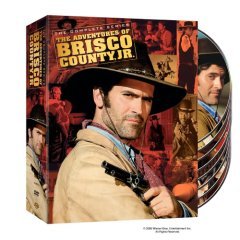
Brisco_dvdsJust got these in the mail, and I can’t wait to watch them (though at the moment I’m still making my way through the new Doctor Who season that was just released).

For those of you who missed it, The Adventures of Brisco County Jr. was a 1993 TV series that blended two of my favorite things . . . the Old West and science-fiction. Two great things that go great together (sometimes . . . like this time . . . or Firefly).

(It also blended in some of my other favorite things, like humor and action and romance and whiskers on kittens and brown paper packages tied up with string . . . well, maybe not the last couple.)

I didn’t see the series when it was on the air (because Fox’s advertisements for it make it look a lot more salacious than it actually is), but I discovered it in reruns on TNT and really enjoyed it.

Unlike many of the series on the air back then, it had a definite story arc spanning the entire season (I just love big story arcs) with significant character evolution a surprises as the story evolves. In fact, the main character, Brisco County Jr. (played by Bruce Campbell) starts the series as an ex-Harvard law professor turned bounty hunter to being the agent of 19th century robber barons who want him to track down the gang that killed his father to being a secret agent for the government.

Along the way we run across mysterious orbs from the future that give people superpowers (or kill them), evil robots, neurotic outlaws, a 19th century version of Elvis, Comet the Wonder Horse, and a bunch of anachronistic humor (before Hercules and Xena made it popular)–all of it fitting into a single, overarching Wild West saga.

And then there’s the show’s great theme music, which just makes you feel like it’s a warm, hopeful new day on the range, where anything can happen . . . and will.

Unfortunately, Fox aired the show in the Friday Night Death Slot and it didn’t get picked up for a second season.

Fortunately, the show’s creators did a rousing two-part season finale that tied up all the outstanding plot threads, so it works well as a season-long miniseries.

It took Warner Brothers FOREVER (13 years!) to release it on DVD, but now that it’s out you can

GET THE ADVENTURE!

JP2 Intercession Pack

Jp2_1

Sometimes I don’t know whether to smile or wince over the huckstering spirit of many American Christians. I used to think it was a mainly Evangelical thing, but I’ve had second thoughts lately. Exhibit A: The John Paul II Intercession Package. Yours today for the low, low price donation of $29.95 (not counting shipping and handling or applicable sales tax, no doubt):

"Financial needs, Health needs, Family needs … let us invoke Pope John Paul the Great!

"Claims of JP II"s interecession have poured in. As an article on www.Spiritdaily[.com] noted: ‘From lost son to cancer to headaches … claims of JP II’s intercession keep pouring in!’

"We can not ignore JP II as a POWERFUL intecessor for our needs!

"We believe he will prove to be one of the most powerful intercessors of this century!

"Let us INVOKE him to intercede for our needs … no matter if they be big or small! Financial needs, Health needs, Family needs … We all have something in our lives that we could use a little help with! I know I do!"

GET THE STORY.

It looks like the vendors of the John Paul II Intercession Package "could use a little help with" rounding up some exclamation marks. They seem to have used up their supply in this ad. Perhaps JPII will put in a good word for them for that need.

What exactly do you get in your Intercession Pack? Let’s see. Among other things there’s a "New, Exclusive John Paul II Intercession Prayercloth"; a "Special St. Peter (the first Pope!) oxidized silver medal from Italy"; and "Exclusive ‘Pope John Paul II Intercession Chaplet Beads’ with Special OFFICIAL Prayer for His Intercession!" And much, much more!

As someone with a special devotion to John Paul the Great — in part because of his providential passing on the same day as my natural dad — this kind of crass exploitation of a saintly man’s intercession annoys me. Although American Evangelicals are no slouches when it comes to turning a buck on the gospel message, this is just the kind of thing that raises specters in non-Catholic minds of Johann Tetzel‘s "peddling" of indulgences.

Attention, Cold & Flu People At Mass! (Part Deux)

From the current (July 2006) edition of the Bishops’ Committee on Liturgy Newsletter:

Among the most important recommendations offered to the Bishops is important advice which applies to all circumstances where the potential for the transmission of pathogens is a significant risk:


All parishioners should be encouraged to remain home at the first sign of illness, out of respect
for their brothers and sisters.
During the time of the pandemic, even if schools and public
institutions are not closed, parishioners should be reminded of the importance of basic health
measures.

Hand-washing is a necessary and effective means of preventing the delivery of infectious material
(e.g., nasal secretions, saliva or other body fluids that may contain viruses) from soiled hands to
the mouth, nose or eyes, where it can enter the body. Cleaning one’s hands with soap and water
removes potentially infectious material from one’s skin. Hands should be cleaned before
preparing food, eating, or touching one’s face and after handling soiled material (e.g., used
tissues, lavatory surfaces, and door knobs), shaking hands, coughing or sneezing, and using the
toilet. Waterless alcohol-based hand gels may be used when soap is not available and hands are
not visibly soiled.

TOLD YA.

Who’s Pius?

A reader writes:

My brother and I were talking and he was asking if I knew why some of the popes in history have the name “Pope Pius” and then the number but no “name” to speak of and he was also wondering what that title meant.  My answer was that the word pious means humble and that I would assume that they were trying to emulate that word into their being and how they worked within their pontificate.

However I am sure if this is the case it is only the tip of the iceberg.  Can you give me any information on this?

Sure thing!

This is a natural thing to wonder about since in the English-speaking world we don’t hear the name "Pius" very often, but it actually is a name, so popes who have the name Pius actually do have a name–just not one that we’re used to hearing in English.

The Italian version of this name is Pio. You may have heard, for example, of the famous Italian priest (now a saint) who in life was called Padre Pio ("Father Pius").

What we English-speakers tend to think of when we hear the name Pius, though, is not a name but the adjective pious, which we get from the Latin adjective pius (spelled the same as the name, but being used as an adjective).

In Latin, the adjective pius means things like "conscientious; upright; faithful; patriotic/dutiful, respectful; rightous; good affectionate, tender, devoted, loyal (to family); pious, devout; holy, godly."

Latin-speaking parents who wanted their children to be these things might thus name him Pius (or, if she was a girl, they might name her Pia, the feminine equivalent of pius), the same way that we might name a baby "Christian," hoping that he will grow up to fulfill his name.

The first pope to be named Pius was . . . well, Pius I (big surprise), who was the tenth pope and reigned between A.D. 140 and 155. In his day, popes didn’t take new names when they were elected, so Pius seems to have been his birth name.

That had changed by the time of the next pope named Pius (Pius II–again, big surprise) who was the 211th pope and who reigned between 1458 and 1464.

Presumably, he picked the name Pius partly in memory of the first Pope Pius but also because he wanted to display the virtue of being pious (i.e., piety) during his reign as pope.

Although in Latin Pius and pius are spelled the same (which could lead to confusion in some contexts), we have a handy way of distinguishing the name from the adjective in English. If you see Pius (capitalized and no O), it’s the name, but if you see pious (with an O, whether it’s capitalized or not) then it’s the adjetive.

Hope this helps!

The Immortal Johnny Cash

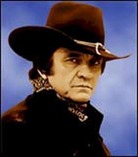
Johnnycash_2 There have been a lot of sightings lately of the recently-deceased Johnny Cash. No, he hasn’t been backing-up Elvis at Memphis honky-tonks. His music has been selling like hotcakes.

"In life, Johnny Cash was merely a legend. In death, he is proving immortal.

"Almost three years after he died at the age of 71 after a decade of poor health, the country outlaw is the most popular artist in the United States, currently at No. 1 on the pop and country charts with an album of new material.

"The album, ‘American V: A Hundred Highways,’ recorded in Cash’s final months as he looked forward to reuniting with his late wife, June Carter Cash, sold 88,000 copies in the week ended July 9. It’s his first chart-topper since 1969’s live prison album ‘Johnny Cash at San Quentin.’"

GET THE STORY.

I suppose most of the Cash fans these days hopped on the bandwagon with the success of the bio-flick Walk the Line. Having grown up in a family of country-music lovers, I liked Johnny Cash before it was cool to like Johnny Cash. Some of my favorites are A Boy Named Sue, Ring of Fire, and One Piece at a Time.

[JIMMY ADDS: Those are three of my favorites, along with Folsom Prison Blues.]

The only thing that ever really annoyed me about Cash was not Cash himself but the idealization by many people of his marriage to June Carter Cash … a relationship that began when at least one of them was married to someone else. I forget the full details of their "love story" but my repulsion at the popular idealization of adultery is one of the reasons I skipped Walk the Line when it was in theaters. (To be perfectly clear, I’m not saying anything here about Johnny and June Carter Cash. My disgust is with those who seemed to think their marriage one of the Greatest Love Stories of All Time.)

As a side note, reporters can be a real hoot sometimes:

"Almost three years after he [Cash] died at the age of 71 after a decade of poor health…"

Wow, whoever heard of dying after a bout with "poor health"? And here I thought that only the healthy died.

The Disposition of Cremains

A reader writes:

I know that The Church allows for cremation, and that there is a law that says that the ashes must be buried.  Is this a moral issue?

I ask because my recently-passed-away mother was cremated, and my sister has the ashes in her house and wants to keep them.  I have expressed my desire to have them buried, but she does not want to bury them.  My mother was not Catholic, so should I be concerned?

First, let me say that I am sorry for your loss and will pray for the repose of your mother’s soul and for your family.

There is ecclesiastical law that requires the burial or other interment of the cremated remains of an individual. According to the Order of Christian Funerals:

"The cremated remains of a body should be treated with the same respect given to the human body from which they come. This includes the use of a worthy vessel to contain the ashes, the manner in which they are carried, the care and attention to appropriate placement and transport, and the final disposition. The cremated remains should be buried in a grave or entombed in a mausoleum or columbarium. The practice of scattering cremated remains on the sea, from the air, or on the ground, or keeping cremated remains in the home of a relative or friend of the deceased are not the reverent disposition that the Church requires. Whenever possible, appropriate means for recording with dignity the memory of the deceased should be adopted, such as a plaque or stone which records the name of the deceased." (Order of Christian Funerals, Appendix No. 417)

If your sister, like your mother, is not Catholic then neither of them are bound by this norm legally. That still leaves the other question you ask, which is whether your sister is bound by it morally.

The answer appears to be no.

What natural law requires is that the remains of the dead be treated with reverence, and the above norm expresses the way in which reverence is to be shown to cremated remains in Catholic circles. However, it does not appear that natural law requires that reverence be shown in this particular way.

It may be helpful here to realize that there is an enormous amount of diversity in different cultures regarding the proper way to show reverence for the remains of the departed.

This was made clear to me a number of years ago when I was talking with a friend of mine who as raised in a different culture and she expressed horror at the idea of archaeologists digging into graves to learn about previous cultures. To her this was an unacceptable desecration, and the respectful thing to do would be to leave the graves alone.

Coming from an American cultural perspective, my reaction was exactly the opposite: Opening the graves (e.g., tombs in Egypt) so that we could learn about past cultures was precisely the means needed to honor the people who built them. Examining the tombs of past cultures would enable us to learn more about them and thus appreciate and respect them more fully. For some of these cultures, their tombs were the best-preserved things about them we had, and to refuse to examine them would deprive us of precious knowledge about a people who would otherwise be lost to history.

There are many other examples of how respect for the remains of the departed varies from culture to culture. In Jesus’ own day–as you may recall from the "St. James ossuary" incident–it was customary for some individuals to be placed in a tomb while their bodies decayed and then, a year later, their relatives would clean the bones and place them in an ossuary.

In Rome it is customary to honor the dead in the catacombs not just by doing archaeological excavations in them but by going on pilgrimages through them.

There is also the Capuchin church of Santa Maria della Concezione, where the bones of numerous Capuchins (some collected as late as 1870) are displayed in the most striking fashion.

Now, as an American, I find some practices that other cultures use as creepy as I’m sure many readers do, but the point is that there is a huge amount of variation culturally in how respect for the dead is to be shown to their remains.

And then there is the whole custom of venerating the relics of the saints, which are parts of their remains that are not buried.

Thus when we get to the question of what natural law requires interment it seems that it does not.

If it did then the Church would not have the relics of the saints on display in reliquaries. They would all have to go into graves or tombs.

To look at it another way, there is nothing about the molecules that once formed part of a person’s body that requires that these molecules be housed in a particular structure, such as a grave or a tomb. We the living can show our respect for the dead by so housing them, but this is a means of showing respect–and thus subject to cultural variation–rather than something required by the molecules themselves.

If your non-Catholic sister (assuming that she is non-Catholic) wishes to keep your mother’s cremated remains in a sealed container in her house the way that you as a Catholic might keep the relic of a saint in a reliquary in your house then there is not a violation of natural law here. Both are ways that respect can be shown for the dead. Her way is not the Catholic way of doing it–and I personally would not show my respect in that fashion even if Church law permitted me to–but it is not prohibited by natural law.

As to whether you should be concerned about the situation, I would say two things: (1) You need not be concerned that the natural moral law is being violated by your sister’s proposal but (2) it would be desirable if a solution could be found that was acceptable to all of the surviving relatives (assuming that your mother didn’t herself indicate what she wanted the final disposition of her remains to be). One sibling being the exclusive arbiter of what happens to the remains is not the most desirable solution. Whether a mutual solution could be reached and whether it would be prudent to push for it would be a judgment that those involved in the situation would be in the best position to make.

In The Mail

Doctor_whoI’m now working my way through

THE COMPLETE FIRST SEASON OF THE NEW DOCTOR WHO SHOW.

For those who are keeping score, this is the first and only season to feature the ninth incarnation of the Doctor (Christopher Eccleston).

I’ve seen some of the episodes in the series, though I also missed a bunch because they conflicted with square dancing, and I’d be too tired to stay up to watch the repeats on Sci-Fi.

Like most Americans (or at least, most Americans who know about Doctor Who), I was introduced to the character when he was being played by Tom Baker (the fourth doctor) and the show was running on PBS stations across the country.

I have to say that, in the main, I like what I’ve seen of this series, though there are things I don’t.

I like the fact that there is an overall story arc to the series and the fact that they try to deal with the impact of time travel on the ordinary life of the Doctor’s main companion (Rose Tyler). Her mom and her boyfriend and her deceased father are significant characters in the series, and it’s nice to see what the effects would be on those close to a person if that person suddenly started jaunting about time.

I also like Eccleston’s portrayal of the doctor. He has a kind of enthusiastic optimism that he uses to hide an inner crushing grief, and the way that these two play off of each other is interesting.

Interestingly, Eccleston (who is a native of Lancashire) is one of the few doctors allowed to speak with a non-BBC accent, leading to one of my favorite lines in the episodes I’ve seen. When Rose has explained to a 21st century woman that the Doctor is an extraterrestrial, the woman asks, "Then why does your friend talk like he’s from the North?" to which Rose replies, "Lots of planets have a North!"

Still, if you’re a dyed-in-the-woolen-scarf Tom Bakerite, you might want to check out the other, recently-released complete Doctor Who season with its own season-spanning storyline,

THE COMPLETE KEY TO TIME SERIES.

Vive La Difference

Earlier today I commented on the hypothetical "Green Beard Effect" that may lead organisms to behave favorably toward other organisms displaying the same trait or traits.

The "Hey, we’re the same" instinct–whether it specifically captures what Dawkins et al. have in mind with the Green Beard Effect–is definitely something present in higher species (and many lower ones as well).

But there’s also the contrary impulse–what we might call the "Vive la difference" instinct–which causes us to favorably regard others specifically because their traits are different than ours.

Perhaps the most obvious example of this is the fact that we find the opposite sex attractive. If we didn’t, mating and reproduction wouldn’t occur and the species would die out. We are therefore genetically programmed to find those with the opposite sexual characteristics to be sexually attractive.

This instinct manifests in other ways, too.

For example, all human societies have an incest taboo. The nature of the taboo (i.e., exactly who you can’t marry) varies from culture to culture, but there is always an incest taboo of some kind. It is a human universal and thus seems to be based in our genetics.

The reasons for the incest taboo are debated.

One of the most common explanations you hear for why the incest taboo exists is that, if it didn’t and if a lot of incest went on as a result, it would harm the population by causing children to have birth defects due to inbreeding.

Maybe.

If that’s the reason for the taboo then it isn’t a conscious one. The ancients, who didn’t have access to modern science, didn’t seem to justify the prohibition of incest on those grounds.

St. Thomas Aquinas, for example, says nothing about it in his discussion of why incest is wrong.

I did some research a number of years ago on the subject (as part of answering the regular question "Where did Cain get his wife?") and found individuals arguing that the birth defects resulting from incest are not as common as is commonly supposed and that, if really severe, survival-affecting ones appear in a population, they’ll die out (or cause the population as a whole to die out). Also, until very recently, many humans lived in small, fairly isolated communities and didn’t have a lot of opportunity for marrying outside their neighbors, with the result that there has been a lot more inbreeding (if not incest) in human history than is often supposed.

Then there are people who argue the opposite of all this.

I don’t know which side is correct, but I mention the former position just to call attention to its existence, for you seldom hear it articulated.

My own suspicion is that we have the incest taboo because it’s just in us genetically and we have historically and are presently trying to come up with intellectual justifications for why something that we instinctively feel to be wrong is actually wrong.

In other words, it’s just part of the law of God written on the hearts of men.

God’s laws are for our good, and so I’m sure that there is a benefit–or several benefits–that come to mankind as a result of the incest taboo. One of them may be that it helps to prevent birth defects, but I’m not sure that there aren’t other, greater reasons.

In general, the incest taboo has the effect of bringing new genes into a family line and thus increasing its genetic diversity. Genetic diversity will allow it to withstand hardships better since there is a greater likelihood that some in it will be able to better weather the latest plague, famine, forced migration, or what have you.

A prohibition on inbreeding also helps broaden social ties, which result in an individual having greater social resources to draw upon. Of all the arguments that St. Thomas makes against incest, the one that strikes me as having the most force is this:

[Incest] would hinder a man from having many friends: since through a man taking a stranger to wife, all his wife’s relations are united to him by a special kind of friendship, as though they were of the same blood as himself. Wherefore Augustine says (De Civ. Dei xv, 16): "The demands of charity are most perfectly satisfied by men uniting together in the bonds that the various ties of friendship require, so that they may live together in a useful and becoming amity; nor should one man have many relationships in one, but each should have one."

If people marry outside their own families then the social fabric is strengthened and the society does better as a result.

Whatever the benefits God intends us to have as a result of the incest taboo–whether it’s avoidance of birth defects, increase of genetic diversity, stronger social ties, or a combination of these or something else entirely–we do have an aversion to incest that appears in all societies and that is likely genetic.

It would thus seem to involve a preference (at least in terms of mating) for those who are different from us in that they aren’t too closely related.

But the preferential option of those who are different goes beyond a preference for the opposite sex and beyond a preference for those who aren’t too closely related to us. There is some, though weaker, evidence that there is at least something of a drive in us toward exogamy, or marriage outside our own group.

The fact that most people marry within their own group and have done so historically suggests that this is a weak desire, but there is still an attraction to the exotic. People from other cultures can seem mysterious and romantic or their accents may be perceived as sexy.

Or not.

Like I said, it’s a weak desire in humans or people would have gone further afield to find mates than they historically did most of the time.

Nevertheless, we’re attracted not only by similarities but also by differences.