Some Food in the Morning & Evening

To wrap up our treatment of the law of fasting, let's look at a question that has occurred to lots of people upon reading Paenitemini's provision that:

The law of fasting allows only one full meal a day, but does not prohibit taking some food in the morning and evening, observing—as far as quantity and quality are concerned—approved local custom.

The question that occurs to people is how much this constrains when people can eat their full meal and their two lesser amounts of food. Do they have to confine one of the smaller portions to the A.M. hours, eat a big lunch as their full meal, and then have only a small amount in the evening (whenever that starts)?

On its face, the passage seems to reflect the eating practice of having only a small breakfast, a big midday meal, and a small evening meal. This practice is common in Italy, and in some other parts of the world, such as (formerly) in the American South (I remember as a boy that my family in Texas referred to the larger midday meal as "dinner" and the evening meal as "supper") and other places where agriculture was a key means of making a living (you need those calories while you're still working, not when you're done or near done for the day). 

Is the pope mandating this eating pattern for Catholics all over the world on days of fast, regardless of their culture and what their bodies are used to?

This does not seem plausible.

First, as we have noted (and will see further in my Monday post), the overall project here is one of relaxing the legal requirements regarding penance. This is obvious just from looking at the dramatic drop in the number of days on which fasting was required. Prior to Paenitemini there were waaaaay more days of fast on the calendar than afterwards. This document dropped it from dozens to two.

Combine this with the following passage from the 1917 Code of Canon Law regarding the law of fasting and an interesting situation results.

Can. 1251 §2. It is not forbidden to mix meat and fish in the same meal; or to exchange the evening meal with lunch.

The first part of this refers to a prior requirement (prior to the 1917 Code) that prohibited mixing meat and fish during the same meal on days of fast (but not abstinence) during Lent.

The second part expressly permits exchanging lunch and supper as the full meal (I'm avoiding the word "dinner" to avoid confusion).

This was part of the law up until Paenitemini, when the Church's laws regarding penance were integrally reordered.

Ordinarily when something expressly allowed in the former law is not repeated in the newer law, it could be a signal that this allowance is revoked, but that seems remarkably implausible in this case, given Paul VI's unmistakable intent to relax legal requirements and allow even greater adaptation to local situations and the exigencies of (rapidly changing) 20th century life.

It seems much more plausible that he simply took it as obvious that the two meals could be exchanged.

One reason is that, even before the 1917 Code expressly allowed the switching around of the meals, it had already become a recognized and accepted practice. See the article on Fasting in the Original Catholic Encyclopedia, which predates the 1917 Code.

Also note this: He doesn't identify when the full meal can be taken. He doesn't say anything about lunch or noon or midday.

Given only what he says, you could have the full meal at 12:01 a.m. or 11:59 p.m. (eat fast if you want to get it done before midnight!) and then also have "some food in the morning and evening."

Another thing to keep in mind is that Italians themselves don't eat the midday meal exactly at noon. Depending on the region of the country you're in, they may start it around 12:30 p.m. to 2:30 p.m., and they may finish eating it as late as 4:30 p.m. So there is considerable flexibility there as well.

The subject of when evening begins is a thorny one in canon law. You hear different starting times for it, ranging from noon to 5:30 p.m. In the absence of a legal definition, and in keeping with the trend of the foregoing considerations, the broader interpretation (i.e., any time after noon) may be presumed in terms of legal requirement (per can. 14).

So, while Paul VI may have been thinking in terms of the normal Italian eating pattern of the time, it does not seem plausible to think he was legally mandating it on days of fast for Catholics the world over.

I consequently don't see any reason why one could not legitimately do any of the following eating patterns on days of fast:

  • (AM) full meal + some food; (PM) some food
  • (AM) some food + full meal; (PM) some food
  • (AM) some food; (midday-ish) full meal; (PM) some food
  • (AM) some food; (PM) full meal + some food
  • (AM) some food; (PM) some food + full meal.

That's assuming you exercise the full amount of eating. You don't have to do that, of course.

What is less clear is the status of patterns like this:

  • (AM) nothing; (PM) some food + full meal + some food
  • (AM) full meal + some food + some food; (PM) nothing

In other words, if you're going to have "some food" twice in the day, does one of the instances have to be AM and the other PM?

I can see opinion legitimately diverging here. My sense of the legislator's intent isn't strong enough. 

I could see one legitimately holding that Paul VI is simply being illustrative and not normative regarding the times, in which case you could have "some food" twice in either the A.M. or the P.M. (but not both).

I could also see one saying, "No, he says 'morning and evening' and means it; if someone has a really compelling reason to need to eat in a different way then that reason itself will excuse from the law of fast."

So I could go either way on that question, at least at the present state of my thought.
More on “No Second Meal”

I expect this'll be the last I post on this topic (at least for a while), but regarding the idea that the two times you can take "some food" on a day of fast can't add up to a second full meal, a reader writes down yonder:

Perhaps it is simply from the fact that one is allowed only "one full meal" and thus ….since one is allowed only one…and yet are permitted 'some food' at two other times…it is simply the case that these can not add up to 'a full meal' for one is only allowed one 'full meal' (if the other two add up to another full meal…well then you will have had 2 full meals!)

This makes sense to me. (of course each persons judgment of a full meal may be different)

Let's look again at Paul VI's language:

The law of fasting allows only one full meal a day, but does not prohibit taking some food in the morning and evening, observing—as far as quantity and quality are concerned—approved local custom.

The possibility that the reader raises is consistent with the first part of what Paul VI says. He could have meant:

(a) The law of fasting allows only one full meal a day, but does not prohibit taking some food in the morning and evening, so long as they don't add up to a second full meal.

But he could also have meant:

(b) The law of fasting allows only one full meal a day, but does not prohibit taking some food in the morning and evening, so long as neither is a full meal.

If the pope had said either of these things, we would know what he meant and nobody would be charging that the added statement (the part in red) contradicts the first part of what he said. The two added interpretations in red are thus both consistent with the first part of the statement.

Therefore, from the language of the first part alone, we cannot rule out either interpretation.

But there are additional considerations that allow us to decide which interpretation is correct:

1) In law liberty is presumed. Therefore the less restrictive interpretation (b) is presumed until the more restrictive interpretation (a) is proved.

2) The overarching thrust of Paul VI's labors in this document is a relaxation of ecclesiastical discipline (more on that a couple of posts from now, when I deal with the question of "substantial observance"). Therefore, if it is known that the mind of the legislator is an overall relaxation of discipline and one has two interpretations of what he says–one more restrictive and one more relaxed–it seems unwarranted to suddenly assume the more restrictive interpretation. This is inconsistent with the overall tone of what the legislator is trying to accomplish.

3) This one is the real clincher: While both interpretations in red are consistent with the first part of what the pope says, there is also the second part, in which he goes on to say: "observing—as far as quantity and quality are concerned—approved local custom." This explicitly kicks the question of the quantity of the two "some food" down to the local area. He is thus not dealing with the question of how much (quantity) you can eat on one of these occasions. If the pope expressly refers us to approved local custom to determine the quantity of this food then we cannot insist that the quantity be restricted to any particular amount based on what he said. (Beyond the obvious that each be less than a full meal, per the first part of what he said.)

4) Since our previous post (so far as I can tell) demonstrates that there is no approved local custom in America that restricts the two occasions where we can take "some food" to less than a second meal, the restrictive interpretation above (i.e., option [a]) does not obtain in the United States.

Finally, even if the above line of reasoning is wrong, it still shows that there is a substantial doubt as to whether the law requires this. That triggers canon 14, which is as follows:

Can. 14 Laws, even invalidating and disqualifying ones, do not oblige when there is a doubt about the law. When there is a doubt about a fact, however, ordinaries can dispense from laws provided that, if it concerns a reserved dispensation, the authority to whom it is reserved usually grants it.

Next: The Morning and Evening Issue

When Does the Liturgical Day Begin & End?

Down yonder, a reader writes:

Hi, I have a question. This has sort of been bothering me, although I undertake a stricter fast this question is mostly academic for me anyway. What are the limits of "Ash Wednesday"? Sundown to sundown? Sundown to sunup on thursday? Midnight to midnight? Whenever you go to bed to whenever you wake up?

Ash Wednesday–like the liturgical day in general–runs from midnight to midnight. According to the General Norms for the Liturgical Year and the Calendar:

3. Each day is made holy through the liturgical celebrations of the people of God, especially through the eucharistic sacrifice and the divine office. The liturgical day runs from midnight to midnight, but the observance of Sunday and solemnities begins with the evening of the preceding day.

Note the difference between the "observance" of certain days beginning on the evening of the preceding day even though they day itself doesn't begin until midnight. 

Ash Wednesday is not a solemnity and so does not have a preceding evening celebration of this sort.

Oh, and for what it's worth, the day also (typically) runs from midnight to midnight in canon law (as opposed to liturgical law). The Code of Canon Law provides:

Can. 202 §1. In law, a day is understood as a period consisting of 24 continuous hours and begins at midnight unless other provision is expressly made; a week is a period of 7 days; a month is a period of 30 days, and a year is a period of 365 days unless a month and a year are said to be taken as they are in the calendar.

§2. If time is continuous, a month and a year must always be taken as they are in the calendar.

“Approved Local Custom”

Recently I noted that Paenitemini allows that on days of fast one may eat one full meal and also take “some food” in the morning and evening. It also states that the quantity and quality of this food may be regulated by approved local custom.

I then noted that the U.S. bishops do not have a complementary norm further specifying the quantity of food and that, as far as I know, no bishop has legally bound his subjects on this matter.

Therefore, so far as I know, American Catholics are not canonically required to adhere to the common idea that the two times they can eat “some food” on days of fast must not add up to a second full meal. That’s not what Paenitemini says, and I know of no requirement that they do this–which is problematic anyway since meals vary in size, and size can be measured in different ways (e.g., calories vs. volume vs. weight vs. fillingness or satiety).

People certainly can try to apply this rule if they wish. One may well choose to keep a stricter fast than what the law allows, and it can be very praiseworthy to do that, but this is a separate issue than what is legally required.

In response, a reader writes:

Regarding the “approved local custom”…does not the fact that it is expressed in this way constantly in the USA…in parish bulletins or diocese newspapers etc and that it is actually then the way it is observed…
does that not amount to “approved local custom”???

He also suggests:

perhaps Pope Paul VI was not speaking the language of Canon Law when he said ‘approved local custom’??? …and of course it came out prior to the 1983 Code….

Actually, Paul VI was speaking in canonical terms when he referred to approved local custom. The 1917 Code of Canon Law has a section on custom that is quite similar to the parallel section in the 1983 Code. One of the things that both Codes require for a local custom to attain the force of law is that it must be approved by the competent authority. Paul VI’s phrase “approved local custom” is a direct reference to the 1917 Code’s requirements for custom being able to regulate this subject.

Since the 1983 Code’s treatment of custom is very similar, and thus not an integral reordering of the law on this point, Paenitemini’s statement regarding approved local custom will still apply today (mutatis mutandis).

But the “two smaller meals that don’t add up to a second meal” concept simply does not have the status of an approved local custom in the United States under the Code of Canon Law.

To see why, consider the following canons:

Can. 23 Only that custom introduced by a community of the faithful and approved by the legislator according to the norm of the following canons has the force of law.

Can. 24 §1. No custom which is contrary to divine law can obtain the force of law.

§2. A custom contrary to or beyond canon law (praeter ius canonicum) cannot obtain the force of law unless it is reasonable; a custom which is expressly reprobated in the law, however, is not reasonable.

Can. 25 No custom obtains the force of law unless it has been observed with the intention of introducing a law by a community capable at least of receiving law.

The basic difference between a law and a custom is that a law originates with a legislator, while a custom originates with a community. The community cannot make its customs legally binding, however, without the consent of the legislator, though, which is part of the point of canon 23. Rome doesn’t want communities of the faithful telling their members that they must (or must not) do something unless the legislator competent for that community approves.

The custom also has to be reasonable, per canon 24 (more on that in a moment).

The canon also alludes to the difference between customs contrary to law and customs that go beyond the law. The alleged “can’t add up to a second meal” custom would be the latter since it adds an additional condition not found in Paenitemini.

Paenitemini just says that besides one full meal you can also have “some food” in the morning and evening. It goes beyond this law to add, “provided that this doesn’t add up to a second full meal.”

Finally, per canon 25, the custom the community of the faithful must observe the custom with the intention of introducing a law.

That did not happen in this case.

At no point has the community of faithful Catholics in America gotten together and said, “Hey, let’s start observing a custom that goes beyond the law Paenitemini establishes by requiring that the two receptions of “some food” doesn’t add up to a second meal, and let’s do with with the intention that it will eventually attain the force of law by the approval of our conference of bishops and thus restrict our actions beyond what Paenitemini requires.”

The basic condition required by canon 25–that the community of faithful, apart from its legislator, starts observing a custom with the intent that their future freedom be bound upon obtaining the legislator’s approval–simply has not happened.

This means that we don’t even have to get into the question of whether the legislator has approved the custom. The community of the faithful, nationally, has not introduced a custom with the intent of restricting their future freedom beyond what universal law requires.

If you went to 999 out of 1,000 Catholics (let’s make it among those who have heard the “can’t add up to a second meal” idea) and said, “Did you know that the law allows us to have one full meal and also take ‘some food’ in the morning and evening, without further specifying quantity?” they would say, “Huh?”

This shows that they don’t understand the “can’t add up to a second meal” idea as a matter of a custom introduced by the community.

They think it’s a law introduced by the legislator.

Which simply means that the law has been explained to them badly.

Some noble soul, out of a well-intentioned desire to offer pastoral guidance to help the faithful observe the spirit of the law, decided at some point to add the “can’t add up to a second meal” idea to his explanation of the law and it caught on as an ecclesiastical meme.

But a meme that misstates the law does not have legal force.

Badly explaining the law to someone does not restrict their actual legal freedom, much less create an approved legal custom.

It’s just making people mistakenly think they have less freedom than they do.

Now, as I said, I think the requirements regarding fast and abstinence today are quite mild, and I would certainly encourage people–if they are willing and able to do so–to go beyond those requirements.

But we should be clear about what the law actually is.

On another note, it appears that the “doesn’t add up to a second meal” idea does not pass the test of reasonableness required by canon 24. Given the fact that meal sizes vary and that “size” can be measured in different ways (some of which are noted above), this rule is so vague that it will frustrate and foster scruples among the faithful as they try to apply a test this confusing and ambiguous.

Hope this helps!

Lenten Resolutions

Lent_1 Growing up in a non-Catholic family in the South, Lent was totally not part of my experience. I didn't even know it existed.

I knew that there was at least one day of the year when the (very few) Catholic kids in school went to Church to do something with a cross or a statue of Jesus or something, but that was the extent of my exposure.

As a result, I didn't have my parents encouraging me to do anything special for Lent. That's something I discovered as an adult, after I became Catholic.

I usually try to make a lot of small, impromptu sacrifices during Lent, but as far as making a big, overall resolution I tend towards doing something extra–a good work that is a special Lenten commission rather omission. (Don't know why that is, but I guess it's my natural tendency. Maybe I'll rethink it in the future.)

In any event, here's my 2010 overall Lenten resolution: I'm going to blog EVERY day (except Sundays).

It may not be anything big, but it'll be something.

(And, in its way, that's a denial. I'm denying myself an amount of time spent on things other than blogging. Rather than doing something else, I'll be devoting time to researching and writing blog posts for others to enjoy/derive benefit from.)

What's your overall Lenten resolution?

What If . . .

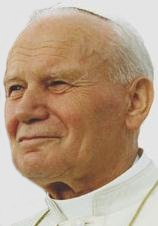
JohannesPaul2-portrait  Apparently, we were closer than commonly realized.

Recently the blogosphere and the mainstream media have been discussing John Paul II’s practice of self-mortification. Though some of the details had been known before, new life was given to the story by Msgr. Slawomir Oder’s new book on John Paul II, which revealed new information.

Oder’s book has ruffled some feathers at the Vatican, because Oder is the postulator of John Paul II’s cause for sainthood, and it is not customary for postulators to write tell-all books including the kind of behind-the-scenes information that Oder’s does. Worries include that this book may make it harder for future postulators to get witnesses to be frank if they think their comments will appear in public.

Reportedly, the chill about the book has grown so strong that Oder is no longer willing to publicly comment on his own book.

GET THAT STORY.

But amid the hoopla about John Paul II’s self-flagellation and questions of the prudence of the book, another very interesting subject has been neglected: Just how close were we to a papal resignation during the reign of John Paul II?

For years rumors had circulated that John Paul II would resign when he turned 75, which he did in 1995.

The logic was that bishops submit their resignations at age 75 (though they can serve longer if the pope chooses not to immediately accept their resignation). Perhaps the pope should resign at that age, too. If the burdens of pastoral office for an ordinary bishop are such that submitting a resignation at age 75 is appropriate, surely the even greater pastoral burdens of a pope would make this reasonable, too.

John Paul II apparently spent years considering this line of thought, as revealed in Msgr. Oder’s book. He also made contingency plans in case he became unable to fulfill his pastoral responsibilities. (Apparently Pius XII did the same thing, penning a letter specifying that he was to be considered as having resigned if he was kidnapped by the Nazis, as he thought he might be.)

Catholic News Service reports:

Msgr. Oder’s book also marked the publication for the first time of letters Pope John Paul prepared in 1989 and in 1994 offering the College of Cardinals his resignation in case of an incurable disease or other condition that would prevent him from fulfilling his ministry.

For years there were rumors that Pope John Paul had prepared a letter instructing cardinals to consider him resigned in case of incapacity.

But even a month before his death in April 2005, canon law experts in Rome and elsewhere were saying the problem with such a letter is that someone else would have to decide when to pull it out of the drawer and apply it.

Church law states that a pope can resign, but it stipulates that papal resignation must be “made freely and properly manifested”—conditions that would be difficult to ascertain if a pope were already incapacitated. . . .

The 1989 letter was brief and to the point; it says that in the case of an incurable illness that prevents him from “sufficiently carrying out the functions of my apostolic ministry” or because of some other serious and prolonged impediment, “I renounce my sacred and canonical office, both as bishop of Rome as well as head of the holy Catholic Church.”

In his 1994 letter the pope said he had spent years wondering whether a pope should resign at age 75, the normal retirement age for bishops. He also said that, two years earlier, when he thought he might have a malignant colon tumor, he thought God had already decided for him.

Then, he said, he decided to follow the example of Pope Paul VI who, in 1965, concluded that a pope “could not resign the apostolic mandate except in the presence of an incurable illness or an impediment that would prevent the exercise of the functions of the successor of Peter.”

“Outside of these hypotheses, I feel a serious obligation of conscience to continue to fulfill the task to which Christ the Lord has called me as long as, in the mysterious plan of his providence, he desires,” the letter said.

GET THAT STORY, TOO.

I must say that I think John Paul II made the right decision by not resigning at 75, for a whole host of reasons. Being elected pope is like being married to the Church. Barring truly grave problems, the union should remain. Merely turning a certain age should not mark its end.

And imagine what would happen if he had resigned at this age: It would create a precedent that would put pressure on future pontiffs to also resign at this age, giving encouragement to those who don’t like them (and there are always people who don’t like a particular pope) to put further pressure on him to resign—or to ignore what he says, knowing he will be gone at a foreseen date (making him a lame duck), and then hating him all the more if he doesn’t resign. In other words, it could be a recipe for chaos.

And, indeed, some dissident Catholics were openly enthusiastic about a papal resignation when John Paul II turned 75 in 1995. They didn’t like the stability he was trying to restore to the Church—a project the pope had been pursuing in an effort to reign in the post-Vatican II dissident movement.

So how close were we to a resignation in 1995?

Notice that the second of the two letters was written in 1994, the year before. Also, the CNS story notes:

Msgr. Oder wrote that in Pope John Paul’s 1994 letter the stressed syllables in spoken Italian are underlined, making it appear that the pope had read it or was preparing to read it to the College of Cardinals.

The idea is that John Paul II, not a native speaker of Italian, annotated the text to help him stress the right syllables for reading the letter aloud. And perhaps he did read it in private to the Cardinals.

The letter says that he has rejected the idea of retiring at 75, but it also says that two years earlier (i.e., 1992, when he had a tumor removed from his colon) he thought God might have mooted the question. That suggests he was still actively considering an age-based resignation as late as 1992 and perhaps as late as 1994, when the second letter was written.

That’s rather close for comfort.

About That Pro-Life Super Bowl Ad . . .

Here ’tis:

So the much commented-upon Tim Tebow Super Boal ad is now out.

I thought it was really, really . . . sweet.

Tim Drake offers similar thoughts on the beauty of the ad.

The ad was disarmingly non-controversial. It was just really, really sweet.

Yes, I did see a comment from NOW proclaiming that the ad fostered violence against women due to the unexpected mom tackle in the ad, but . . . c’mon. This is an ad to be aired in a football game. It’s a joke. Even I, a total non-football fan, “get it.” And mom even has the “You’re nowhere near as tough as I am” line as the capper. This is all playful, not threatening.

It’s sweet.

And that’s about all.

The pro-life issue was so buried in the ad that you’d have to know that it was there in order to perceive it at all. The only way an uninitiate would ever find out that this ad had anything to do with abortion would be to go to Focus on the Family’s web site and read more.

So this was definitely pro-life lite in its approach.

Maybe it had to be. Maybe the network wouldn’t have run the ad with an explicit reference to abortion.

But that raises the question—given the large amounts of money paid for Super Bowl ads—of whether the effort was worth it.

The ad may have too little bang for too many bucks.

Maybe it was worth it. Maybe enough people will go to the link to make it worthwhile. Or maybe the controversy that preceded the ad got enough helpful discussion going that it would make it worthwhile to run the ad.

Or maybe not.

I can certainly see why people who had high hopes for the ad would be disappointed.

It would have been strengthened 500% if mom’s line, “I call him my miracle baby. He almost didn’t make it into this world. I remember so many times when I almost lost him,” had been augmented even just by the words “Some people told me not to have him.” That would have at least gotten the real issue on the table, without having to use the “A” word (if that would have been a dealbreaker with network).

So it definitely seems that it’s debatable whether the ad was worthwhile.

Anyone care to debate?

Persistent “Vegetables” Speak!

Vegstatetete-1  File this one under “Dr. Frankenstein’s Medicine Show.”

Let’s deal with the medicine part first and the Frankenstein part second.

On the medical front, good news! Researchers have found a way to communicate with patients who are in a “persistent vegetative state.”

Turns out that they, or some of them, ain’t so vegetable-like after all!

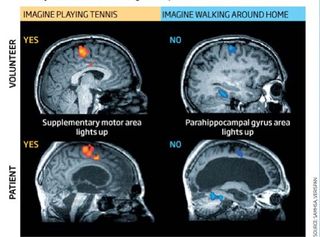
Here’s how it works: Hook the “vegetable” up to an MRI machine and ask the

vegetable

person to think about playing tennis. Note what areas of the brain light up.

Then ask the person to think about walking through their house. Note what areas light up then.

Then say, “I’d like to ask you some questions. If you want to answer ‘yes,’ think about playing tennis. If you want to answer ‘no,’ think about walking through their house. Do you understand?”

If the tennis-playing areas light up, go ahead and ask your questions. If the house-walking areas light up, explain again. (Or assume that the person is really smart and having a joke on you by thinking “no” when really he does understand.)

This really works!

At least with some patients. (Not with others, unfortunately.)

What it shows, though, is that these patients aren’t “vegetative” at all—at least mentally. They’re able to process and respond meaningfully to questions based on thinking about remembered/imagined actions.

That shows advanced cognitive functions! Remember: The person isn’t just thinking about saying “yes” or “no.” The person is thinking about other actions as a way of saying “yes” and “no.” That shows sophisticated mental processes in action!

So! Good news for the pro-life side, right?

Yesssss . . . but . . . here’s where Dr. Frankenstein—or at least Dr. Kevorkian—comes into the picture.

Already people are talking about using this technology to ask PVS patients questions like “Are you in pain?” and “Do you want to die?”

The first question is entirely legitimate! If someone’s in pain, let’s do what we can to alleviate it! By all means!

But let’s not proceed so quickly to the “Do you want to die?” question.

Other questions would be good ones, like “Do you need to change positions?”, “Are you hungry or thirsty?”, or “Would you like me to get a nurse?” or—once the immediate pain is dealt with—“Would you like me to get a priest to come pray with you and give you the sacraments?”, “May I squeeze your hand to show that I care about you?” (or even just do this one and don’t ask!), “Would you like me to turn the TV on?”, “Would you like to listen to some music?”, “How about an audio book? I could get you a subscription to Audible.com.” Or even, “Let’s use ‘yes’/‘no’ with the alphabet so you can tell me what you want. Think about what you’d most like, and we’ll spell it out.”

There are all kinds of compassionate alternatives to “Do you want to die?”

But folks are already noting that the new technique may put more pressure on people suffering from PVS to just go ahead and die.

So what can—and by rights should—be a vindication for pro-lifers may get twisted into a new way to promote euthanasia.

Hence: Dr. Frankenstein’s Medicine Show. . . . turning legitimate medicine to the service of evil.

Watch this one, folks. It’s going to be a BIG one as brain scanning technology becomes more common and more robust—allowing easier, richer communication with people in this state. It’ll be a major new feature of the discussion.

The work “changes everything”, says Nicholas Schiff, a neurologist at Weill Cornell Medical College in New York, who is carrying out similar work on patients with consciousness disorders. “Knowing that someone could persist in a state like this and not show evidence of the fact that they can answer yes/no questions should be extremely disturbing to our clinical practice.”

GET THE STORY.