Blog Status Update

I've been studying a question for some time, and I'm still working out the answer, but I thought I'd give a status update.

The question I've been working on is this: How can I best use this blog and integrate it with other online activity I'm working on.

As alert reader Paul H notes down yonder, I'm doing some blogging over at the National Catholic Register.

HERE'S THE LINK.

But though I am blogging there, I don't want to shut down this blog, for a number of reasons. One of them is that here I can do posts that don't fit the word count or subject matter parameters of the Register gig.

So I've been trying to figure out the best way to let folks know where and when I'm blogging, regardless of the venue.

I've settled for the moment on at least posting here links to what is going on there. So if you come here, you'll find out what's going on on this blog and what's going on on my Register blog. 

If you're into RSSes, you can also just subscribe to the RSSes for the two blogs.

I'm also looking into additional forms of notification.

For example–after several decades of resisting–I have now joined Facebook and Twitter.

HERE'S MY FACEBOOK PAGE, IF I UNDERSTAND THINGS ARIGHT.

(AND HERE'S MY FACEBOOK PROFILE; THANKS FOR THE CORRECTION IN THE COMBOX!)

AND HERE'S MY TWITTER FEED.

I'm taking baby steps at this point with these media, but the goal I'm pursuing is to try to provide more, better, and better-linked online content for folks.

Advice very much appreciated, particularly on how to get these different things to work together.

And others; e.g., I know Google has some social networking doo-dads that have cross-service functionality I'm interested in trying.

Pet Phrases

JohnLAllen I very much like and respect the work that John Allen does for the National Catholic Reporter (the same cannot be said for the rest of the paper).

But Allen has a waggish tendency that sometimes manifests in the form of a tin ear.

I still cringe whenever I remember a piece he did a while back in which he said that "some people" referred to the 2004 controversy over pro-abortion politicians (esp. John Kerry) receiving Communion as "the 'wafer' wars."

Whenever Allen says "some people" refer to some thing by a joking name of this sort–or that "a wag" might refer to it as such–I can't help thinking that he's just playing with a pet phrase he's come up with.

It brings to mind the classic piece of writing advice: Kill your darlings.

"Wafer wars" is just too unserious a phrase to use when discussing if Our Lord should be received in Holy Communion by people that advocating the mass slaughter of babies (or that the mass slaughter of babies should be legal–if you want to let them use the "Personally opposed but" dodge).

Now Allen's come up with another one.

Can your heart stand the shocking truth about . . . "TALIBAN CATHOLICISM"?

The Age of the World–Part III

Piusxii Some time ago I did a couple of posts (part Ipart II) on the age of the world, in which I looked at Vatican documents dating from recent years–the Catechism of the Catholic Church and the International Theological Commission's document on our being created in the image of God. 

Both of these documents took an open stance regarding the findings of mainstream modern science concerning the age of the universe and the existence of some form of biological evolution. 

They did not impose these as matters of faith, for they are not matters of faith–which was precisely the point. At present the Magisterium and related bodies like the ITC have determined that the sources of faith do not conflict with the findings of mainstream modern science on these points, and so one may follow the scientific evidence where it leads. (On other points, such as the creation of the world out of nothing and the special creation of each human soul, including those of the first humans, the faith does have something to say and the same liberty is not enjoyed.)

You might question how long the Magisterium has held this position, and that's a good question. I, for one, would love to know the answer.

Certainly, though much of Christian history a young earth view was common, though there were also voices urging that the biblical creation accounts, especially Genesis 1, should be handled with care and that they might not be the kind of chronological guide many thought. (St. Augustine, in particular, went into a great deal of depth on this point.)

It seems to me that this view is correct, that a careful reading of Genesis 1 shows that it never intended to offer a purely chronological account, and that it overtly signalled this to the original audience by placing the creation of the sun three days after the creation of the day/night cycle. People back then understood that the sun is a light, that it lights up the sky, and that it thus causes the day/night cycle.

Indeed, the ancient world was full of people whose religion was intensely bound up with this fact, such as the Egyptians, who held that the sun god Ra had to fight with the serpent monster Apophis every night so that the solar barge could return to the sky and bring daylight again. An occasional Apophis attack on Ra during the day was the explanation for eclipses and the darkness they bring. The idea was that Apophis swallowed the solar barge earlier than normal in the daily cycle, and Ra's forces were able to cut him free in a short space of time.

Genesis 1 rejects this pagan understanding of matters and simply refers to the sun as a "light." It doesn't even use the Hebrew word for "sun"–shamash–because this word as also the name of the Canaanite sun god and the author didn't want any confusion about God creating the Canaanite solar deity. So he just calls the sun a light, with the implication: "It's just a light, Don't worship it."

The point is, though, that the ancients understood the fact that the sun is the source of daylight and thus by putting the creation of the sun after the creation of the day/night cycle, the author of Genesis 1 is showing us a topically-structured rather than chronologically-structured account.

At least in my humble opinion.

For those who came from different cultural traditions, who were not as in touch with ancient Semitic ways of writing, this kind of detail could be easily missed and the whole account taken as what it superficially appeared to be–a chronologically-organized description of the creation of the world in one, seven-day week.

The need to be careful in such matters was stressed by Pius XII in his 1943 encyclical Divino Afflante Spiritu:

35. What is the literal sense of a passage is not always as obvious in the speeches and writings of the ancient authors of the East, as it is in the works of our own time. For what they wished to express is not to be determined by the rules of grammar and philology alone, nor solely by the context; the interpreter must, as it were, go back wholly in spirit to those remote centuries of the East and with the aid of history, archaeology, ethnology, and other sciences, accurately determine what modes of writing, so to speak, the authors of that ancient period would be likely to use, and in fact did use

36. For the ancient peoples of the East, in order to express their ideas, did not always employ those forms or kinds of speech which we use today; but rather those used by the men of their times and countries. What those exactly were the commentator cannot determine as it were in advance, but only after a careful examination of the ancient literature of the East. The investigation, carried out, on this point, during the past forty or fifty years with greater care and diligence than ever before, has more clearly shown what forms of expression were used in those far off times, whether in poetic description or in the formulation of laws and rules of life or in recording the facts and events of history.

A bit earlier in the same encyclical, Pius XII notes some of the historical difficulties in interpreting the early chapters of Genesis:

31. Moreover we may rightly and deservedly hope that our time also can contribute something towards the deeper and more accurate interpretation of Sacred Scripture. For not a few things, especially in matters pertaining to history, were scarcely at all or not fully explained by the commentators of past ages, since they lacked almost all the information which was needed for their clearer exposition. How difficult for the Fathers themselves, and indeed well nigh unintelligible, were certain passages is shown, among other things, by the oft-repeated efforts of many of them to explain the first chapters of Genesis; likewise by the reiterated attempts of St. Jerome so to translate the Psalms that the literal sense, that, namely, which is expressed by the words themselves, might be clearly revealed.

A few years later, in his 1950 encyclical Humani Generis, which deals with biological evolution, he also commented on the literary character of the early chapters of Genesis in a way that anticipates the approach taken by the Catechism:

38. . . . the first eleven chapters of Genesis, although properly speaking not conforming to the historical method used by the best Greek and Latin writers or by competent authors of our time, do nevertheless pertain to history in a true sense, which howevermust be further studied and determined by exegetes; the same chapters . . . in simple and metaphorical language adapted to the mentality of a people but little cultured, both state the principal truths which are fundamental for our salvation, and also give apopular description of the origin of the human race and the chosen people. If, however, the ancient sacred writers have taken anything from popular narrations (and this may be conceded), it must never be forgotten that they did so with the help of divine inspiration, through which they were rendered immune from any error in selecting and evaluating those documents.

Now, I don't quote these passages from Pius XII as having a great deal of bearing on the age of the universe. They are illustrative of the Magisterium's attitude toward the early portions of Genesis.

So what does Pius XII say on the age of the world from a scientific perspective?

This is found in a speech he gave in 1951 to the Pontifical Academy of the Sciences. In it, he says [My comments added in red–JA]:

35. First of all, to quote some figures–which aim at nothing else than to give an order of magnitude fixing the dawn of our universe [so he's not signing off on any specific date], that is to say, to its beginning in time–science has at its disposal various means, each of which is more or less independent from the other, although all converge. We point them out briefly [Note that in what follows Pius XII mixes evidences regarding the dates for the origin of the universe and the origin of the solar system, both of this he is evincing regarding "the dawn of our universe." He does not clearly distinguish between the two–a conflation which may have been common at the time. This conflation is in part responsible for the range of dates he considers.]

(1) recession of the spiral nebulae or galaxies: 

36. The examination of various spiral nebulae [i.e., galaxies], especially as carried out by Edwin W. Hubble at the Mount Wilson Observatory, has led to the significant conclusion, presented with all due reservations [so even the scientists are being tentative about this and the Church isn't signing off on it as a certainty or an article of faith], that these distant systems of galaxies tend to move away from one another with such velocity that, in the space of 1,300 million years, the distance between such spiral nebulae is doubled. If we look back into the past at the time required for this process of the "expanding universe," it follows that, from one to ten billion years ago, the matter of the spiral nebulae was compressed into a relatively restricted space, at the time the cosmic processes had their beginning. [Ten billion is a little on the small side, viewed by 2010 mainstream science; 13-14 billion is the common estimate today, though this doesn't matter since Pius XII is only aiming for an order of magnitude.]

(2) The age of the solid crust of the earth: 

37. To calculate the age of original radioactive substances, very approximate data are taken from the transformation of the isotope of uranium 238 into an isotope of lead (RaG), or of an isotope of uranium 235 into actinium D (AcD), and of the isotope of thorium 232 into thorium D (ThD). The mass of helium thereby formed can serve as a means of control. This leads to the conclusion that the average age of the oldest minerals is at the most five billion years[This agrees with the common age held for the formation of the earth and the solar system: 4.6 billion year.]

(3) The age of meteorites: 

38. The preceding method adopted to determine the age of meteorites has led to practically the same figure of five billion years[Meteorites, as part of the solar system, ditto.] This is a result which acquires special importance by reason of the fact that the meteorites come from outside our earth and, apart from the terrestrial minerals are the only examples of celestial bodies which can be studied in scientific laboratories. [This was, of course, before we went to the moon and started bringing back samples from there and–robotically–from elsewhere in the solar system.] 

(4) The stability of the systems of double stars and starry masses: 

39. The oscillations of gravitation between these systems, as also the attrition resulting from tides, again limit their stability within a period of from five to ten billion years

40. Although these figures may seem astounding, nevertheless, even to the simplest of the faithful, they bring no new or different concept from the one they learned in the opening words of Genesis: "In the beginning . . .," that is to say; at the beginning of things in time. The figures We have quoted clothe these words in a concrete and almost mathematical expression, while from them there springs forth a new source of consolation for those who share the esteem of the Apostle for that divinely inspired Scripture which is always useful "for teaching, for reproving, for correcting, for instructing" (2 Tim., 3, 16). 

E. THE STATE AND QUALITY OF ORIGINAL MATTER 

41. [In this section, the pontiff again seems to conflate the origin of the universe with later events–the later events in this case being the creation of heavy elements. This may be because the concept of stellar nucleosynthesis–the creation of heavier elements in stars rather than in the Big Bang–was a new concept in his day that had just been proposed and was still being worked out.] In addition to the question of the age of the cosmos, scholars have, with similar earnestness and liberty of research and verification, turned their daring genius to the other problem which has already been mentioned and which is certainly more difficult, concerning the state and quality of primitive matter. [Here he seems to mean the matter at the beginning of the universe, at or just after the Big Bang.] 

42. According to the theories serving as their basis, the relative calculations differ in no small degree from one another. Nevertheless, scientists agree in holding that not only the mass but also the density, pressure, and temperature of matter must have reached absolutely enormous proportions as can be seen from the recent work of A. Unsold [Albrecht Unsold], director of the Observatory of Kiel (Kernphysik und Kosmologie ["Nuclear Physics and Cosmology"–see a short English language abstract of the paper via Google Bookshere.], in the Zeitschrift fur Astrophysik, 24, B. 1948, pag. 278-306). Only under such conditions can we explain the formation of heavy nuclei and their relative frequency in the periodic system of the elements. [Perhaps at the time this was the only way they could see such elements being formed; later thought–and according to a recently proposed theory by Hubble at the time–the pressures and densities found in the life cycle of certain stars will do the trick just fine. This is now the received view.] 

43. Rightly, on the other hand, does the mind in its eagerness for truth insist on asking how matter reached this state, which is so unlike anything found in our own everyday experience, and it also wants to know what went before it. In vain would we seek an answer in natural science, which declares honestly that it finds itself face to face with an insoluble enigma. [Both of the preceding sentences seem to confirm that he is thinking about the Big Bang and the state of matter in it.] It is true that such a question would demand too much of natural science as such. But it is also certain that the human mind trained in philosophical meditation penetrates more deeply into this problem. 

44. [Now Pius XII begins to meditate on the religious implications of the foregoing.] It is undeniable that when a mind enlightened and enriched with modern scientific knowledge weighs this problem calmly, it feels drawn to break through the circle of completely independent or autochthonous [i.e., native, indigenous] matter, whether uncreated or self-created, and to ascend to a creating Spirit. With the same clear and critical look with which it examines and passes judgment on facts, it perceives and recognizes the work of creative omnipotence, whose power, set in motion by the mighty "Fiat" pronounced billions of years ago by the Creating Spirit, spread out over the universe, calling into existence with a gesture of generous love matter bursting with energy. In fact, it would seem that present-day science, with one sweeping step back across millions of centuries, has succeeded in bearing witness to that primordial "Fiat lux" ["Let there be Light"] uttered at the moment when, along with matter, there burst forth from nothing a sea of light and radiation, while the particles of chemical elements split and formed into millions of galaxies. [Note the quickness to associate the creation of light with the Big Bang; though this can be done in a literary or poetic way, one must be cautious not to take it too literally; see the link in the next paragraph.]

45. It is quite true that the facts established up to the present time are not an absolute proof of creation in time [VERY important point, as written about before; good to see the point being made in this context!], as are the proofs drawn from metaphysics and Revelation in what concerns simple creation or those founded on Revelation if there be question of creation in time. The pertinent facts of the natural sciences, to which We have referred, are awaiting still further research and confirmation, and the theories founded on them are in need of further development and proof before they can provide a sure foundation for arguments which, of themselves, are outside the proper sphere of the natural sciences. [This theme very much taken up in later documents: Science can take us to a certain point but not farther.]

46. [Now the pontiff comments on what an earthquake the Big Bang turned out to be for the previously accepted view in mainstream science.] This notwithstanding, it is worthy of note that modern scholars in these fields regard the idea of the creation of the universe as entirely compatible with their scientific conceptions and that they are even led spontaneously to this conclusion by their scientific research. Just a few decades ago, any such "hypothesis" was rejected as entirely irreconcilable with the present state of science. 

47. As late as 1911, the celebrated physicist Svante Arhenius declared that "the opinion that something can come from nothing is at variance with the present-day state of science, according to which matter is immutable." (Die Vorstellung vom Weltgebaude im Wandel der Zeiten, 1911, pag. 362). In this same vein we find the statement of Plato: "Matter exists. Nothing can come from nothing, hence matter is eternal. We cannot admit the creation of matter." (Ultramontane Weltanschauung und Moderne Lebenskunde, 1907, pag. 55). 

48. On the other hand, how different and much more faithful a reflection of limitless visions is the language of an outstanding modern scientist, Sir Edmund Whittaker, member of the Pontifical Academy of Science, when he speaks of the above-mentioned inquiries into the age of the world: "These different calculations point to the conclusion that there was a time, some nine or ten billion years ago, prior to which the cosmos, if it existed, existed in a form totally different from anything we know, and this form constitutes the very last limit of science. We refer to it perhaps not improperly as creation. It provides a unifying background, suggested by geological evidence, for that explanation of the world according to which every organism existing on the earth had a beginning in time. Were this conclusion to be confirmed by future research, it might well be considered as the most outstanding discovery of our times, since it represents a fundamental change in the scientific conception of the universe, similar to the one brought about four centuries ago by Copernicus." (Space and Spirit, 1946, pag. 118- 119). 

Conclusion: 

49. What, then, is the importance of modern science for the argument for the existence of God based on the mutability of the cosmos? By means of exact and detailed research into the macrocosm and the microcosm, it has considerably broadened and deepened the empirical foundation on which this argument rests, and from which it concludes to the existence of an Ens a se [i.e., a being not contingent on another], immutable by His very nature. 

50. It has, besides, followed the course and the direction of cosmic developments, and, just as it was able to get a glimpse of the term toward which these developments were inexorably leading, so also has it pointed to their beginning in time some five billion years ago. Thus, with that concreteness which is characteristic of physical proofs, it has confirmed the contingency of the universe and also the well-founded deduction as to the epoch when the cosmos came forth from the hands of the Creator. 

51. Hence, creation took place in time. Therefore, there is a Creator. Therefore, God exists! Although it is neither explicit nor complete, this is the reply we were awaiting from science, and which the present human generation is awaiting from it.

The takeaway message from this is that the Magisterium's openness to the idea that the universe is billions of years old is not some new, sinister, modernist, post-Vatican II thing. It was accepted–enthusiastically–by Pope Pius XII–the pope who defined the Assumption of Mary and, incidentally, just the year after he defined it.

He also used the finding of Big Bang cosmology and Old Earth science to buttress the idea of the existence of God, while noting a number of important caveats that this reasoning from science cannot be taken as definitive. 
Mea Culpa, Mea Culpa, Mea Maxima Culpa

I'd like to make a quick apology for not blogging recently. I've had a lot going on (including a bout of food poisoning last night–ick!–when I was otherwise planning to blog), and I haven't been able to get to it.

So . . . my apologies.

And I'll keep this short so that I can now–immediately–proceed to putting up a post of substance.

Say WHAAAAT?

(Cross-posted on The League of Bearded Catholics blog)

Hello, is this thing on?

*Harrumph*… perhaps I was busy trimming my beard, or maybe my nose hair (which requires far greater concentration), but I seem to have completely missed out on any national conversation or debate over this, which I'm sure must have been vocal and abundant.  Far be it that anyone should get all worked up over such a trivial matter, but in looking over the instructions for the IRS Form 1040, I recently found the following;

Expiring tax benefits.

The following benefits are scheduled to expire and will not be available for 2010.

The exclusion from income of qualified charitable distributions


Tax-deductible charitable contributions are… just gone? In the words of my old Building-and-Loan pal, George Bailey… "Do you realize what this means?"

Did I read this wrong? Am I dreaming?

UPDATE: So, a couple of knowledgable commenters have pointed out that, unlike the "charitable tax deduction", the "exclusion from income" is limited to direct contributions of things like IRAs to charitiy. So, a follow up question: how will this affect charities and donors? How greatly do charitable organizations count on this sort of funding?

Thanks for the combox clarification, by the way. It doesn;t sound as dire as I had imagined.

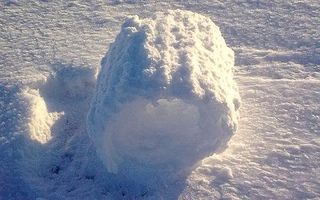
Strange Fluffy Snow Cylinders

In his novella At the Mountains of Madness, which is set in Antarctica, H. P. Lovecraft's narrator at one point writes:

The newspapers have printed the bulletins we sent from the moving plane, telling of our nonstop course, our two battles with treacherous upper-air gales, our glimpse of the broken surface where Lake had sunk his mid-journey shaft three days before, and our sight of a group of those strange fluffy snow cylinders noted by Amundsen and Byrd as rolling in the wind across the endless leagues of frozen plateau.

This reference to rolling snow cylinders intrigued me, and I imagine that in Lovecraft's research for the story he did turn up references to them in reports by polar explorers Amundsen and Byrd, but Googling the phenomenon did not turn up any hits–at least back when I did the search, with the search terms I had.

So I was very interested to see a story about the phenomenon in The Telegraph reporting that it also occurs in the U.K.–and in North America for that matter.

The article came complete with pictures, so . . . behold!

Snow_cylinders
Snow_cylinder2
I just hope that the appearance of these snow cylinders in the U.K. and North America don't indicate a parallel appearance of shoggoths.

GET THE STORY.

Doing the Math

Over at CatholicCulture, Uncle Di has an interesting post about conflicting poll numbers in Massachusetts concerning which candidate is likely to win Ted Kennedy's former seat. 

He writes:

Last week, a Boston Globe poll of likely voters show the Democratic candidate, Martha Coakley, leading the Republican, Scott Brown, by a comfortable margin: 50- 35%.

A Public Policy Polling survey of likely voters, released the same day, showed Brown ahead, 48- 47%.

The Globe poll claimed a margin of error of +/- 4.2%; the PPP poll said its margin of error was 3.6%. Go ahead: try the numbers. They don't work.

Wait; there's a possible explanation. The Globe poll was taken January 2- 6; the PPP poll was January 7-9. So you might say that as a Little Christmas gift, Scott Brown got 13% of the likely voters.

Alternatively, you might say that there's a margin of error to the pollsters' margin of error.

Di is exactly right that there is a "margin of error" to the pollsters' margin of error–a margin that pollsters very seldom talk about.

What pollsters mean when they say that a poll has a margin of error of 4 percentage points (or whatever number) it does not mean that the true figure is really within 4 percentage points of the figure they name. They have no independent way of knowing what the true figure is. All they can do is estimate what the true figure is based on the sample of data they got.

But sometimes you get unrepresentative data, which is what the margin for error is supposed to allow for. It's a fudge factor that means, in essence, if we ran the same poll a bunch of times, the result would vary but would tend to remain within the stated margin of error.

Yet sometimes you get really unrepresentative data, and this is what pollsters don't generally point out.

In standard polling, the margin of error is based on what the result would be approximately 95% of the time, or nineteen out of twenty times. ( . . . keeping this simple so we don't have to get into standard deviations and normal distribution and confidence intervals and other technical minutiae).

So, for example, if pollsters went out and polled the right number of people to give them a 4 percent margin of error, and 48 percent of the people said that they'd vote for Candidate X then what this means is that if you re-ran the poll that nineteen out of twenty times the result you would get back should be between 44 and 52 percent, all else being equal.

But one time out of twenty the result you would get back would be wildly off, either below 44 or above 52.

So . . . bear that in mind when looking at poll numbers.

Even when the poll is properly done, one in twenty polls produces a reading so anomalous that it falls outside what the margin of error would be if you ran it another nineteen times.

On average.

We think.

Padre Pio & Three Days of Darkness


A reader writes:

Somebody asked me in regard of this article: is it true or false, is it authentic or just regular pious writings to threaten people?

http://www.divinemercyinc.com/St%20Padre%20Pio%20Prophecies.htm 

To me, any document not published by the Catholic Church is not authentic.

Nevertheless, I need to hear from you, what do you say in regard of this article?

First a clarification: It is true that any document not published by the Church is not “authentic” in the sense that this term is used in magisterial statements. In Church documents the term “authentic” typically means “authoritative,” and it is true that documents not published or endorsed by the magisterium are not authoritative for the faith of Catholics.

This is particularly true with regard to alleged or apparent private revelations, which at most receive an endorsement from the Church indicating that they are credible, but not that they are binding or authoritative.

This is not to say that any document not published by the Church should be dismissed out of hand. Current canon law does not require that material can be published only for approved apparitions. Under present law, seers may publish legitimate private revelations even though these have not received ecclesiastical approval.

So I wouldn’t dismiss something simply because it hasn’t been published by or approved by the Church.

Now let’s deal with the site in question. It features quotations attributed to Padre Pio regarding the supposed “three days of darkness” that have been discussed among some students of private revelations.

The first thing that leaps out regarding the Padre Pio quotations is that no identifiable literary source is given for them. They are simply introduced by the statement “Words of Christ to St Padre Pio” and concluded with “(Blessed Padre Pio).”

Just when and where did Padre Pio record these words? How do we know that he claimed to have received them from Christ at all?

Without a trackable source, we don’t know anything of the kind.

So let’s go a little further and see what we find. If we Google the opening words of the revelation we find that it only has three hits: the page the reader is asking about, a forum inquiry asking if the revelation is genuine, and a Google Books hit for a book by the psychic medium Sylvia Browne (MORE INFO).

This does not inspire confidence in the alleged revelation. If this were an authentic quote, it should have a bigger cyber-footprint than that, with some sources directing us to a traceable source (something that none of the hits do, including Sylvia Browne’s book).

I haven’t done a great deal of research on the “three days of darkness” literature, but someone who has is Desmond Birch, author of Trial, Tribulation, & Triumph, a 600-page book on prophetic ideas. I can’t assess the book as a whole (because I haven’t read it), but I would note the following section. The author (who himself seems to favor the idea that there will be a “three days of darkness”) writes:

“1. Padre Pio Did Not Predict Three Days of Darkness [emphasis in original]

“. . . There are printed materials containing prophecy of three days of darkness which attribute such a prophecy to Padre Pio. But the author [i.e. Birch] has in his possession sworn documents from the Capuchin Order stating that no such prophecy ever emanated [sic] from Padre Pio. All the author’s attempts to track down an authentic source from Padre Pio have led to the conclusion that; [sic] some person(s) either accidentally or willfully created these attributions of such a prophecy to Padre Pio” (Trial, Tribulation, & Triumph, p. 283).

It would be nice if Mr. Birch had included the full text of the documents he refers to, perhaps as an appendix, so that the reader could evaluate them for himself. That’s the purpose of 600-page books, after all. Were they written by someone qualified to speak for the Capuchin Order as a corporate entity? Were they really sworn? Why? And just what do they say?

While I’m not sure that Mr. Birch phrased himself in the best way, and while his publisher definitely should have provided better copy editing and proofreading for his text, I want to commend him for looking into this matter and reporting back what one would suspect from the use of the quotation on the Internet–that Padre Pio does not appear to have made such predictions.

In the absence of better sourcing, I would conclude that the quotation on the page linked above is most likely a fake.


What If You Suddenly Remember in Confession?

Sorry for the lack of blogging. I've been having computer problems. So let's get things back on track with this Saturday post. 

A reader writes:

As you know, if someone forgets to confess a mortal sin in confession, it is forgiven, but the penitent still must confess it the next time he goes to confession. My question is this: What if one remembers the sin after confessing his sins but before leaving the confessional? For example, what if one remembers it while the priest is saying the words of absolution? Does the penitent have the obligation to add it when the priest is done, or can/should he "save"it, so to speak, until the next time he goes to confession?

The answer depends on when the penitent remembers and how difficult it would be to make the additional confession. 

Let's use the when question as our organizing principle. There are several different points at which the penitent might remember:

1) Immediately after naming all of the individual sins he intended to name. If the penitent remembers at this point then he should go on and name the additional sin.

2) Immediately after making a concluding general accusation (e.g., the "and for all my sins I am sorry" statement that most penitents make after naming the individual sins that they intended to confess). If the penitent remembers at this point then it usually will not be too difficult for the penitent to say, "Oh, and I forgot to confess this . . . " He should do so.

3) After he has finished the act of confessing but before the priest has begun the formula of absolution. The answer is least clear in this time period and will require a judgment call on the part of the penitent, depending on his presence of mind, composure, and the opportunities that present themselves. 

For example, if the priest begins to offer advice to the penitent or ask questions about what has been confessed or otherwise starts engaging in a dialog of some sort then a clear-headed penitent may recognize an opportunity to slip in, "Oh, and I forgot to confess this just now . . . " without it being a problem. If so, he should do so.

On the other hand, the priest may not do that. He may be very businesslike and simply elicit an act of contrition if the penitent hasn't made one already (e.g., "Repeat after me: 'Lord have mercy on me'") or he might go straight to the formula of absolution, in which case we'd be at stage 4, below.

Assuming that we're still at stage 3, though, the penitent technically could stop the priest and make the additional confession, or slip it in before or after the act of contrition if the priest has elicited one, but there may be significant difficulties in doing this.

First, after the penitent has made his act of confession, the interpersonal dynamic shifts and he is no longer "in control" of the exchange. The priest is. Second, the fact that he's dealing with a priest (which many penitents may find intimidating) makes it harder to interrupt. Third, the matter he needs to confess may be particularly shameful or complex to explain, making it still harder to stop the proceedings and get it in.

Many penitents would not have the presence of mind, fortitude, or composure to slam on the breaks and insist the the priest stop and listen to one last sin. 

I don't think that the Church expects them to. It also doesn't want them scrupling over the matter.

Therefore, I would say that once "control" of the exchange has been shifted back to the priest (i.e., when the penitent has finished his act of confession), the penitent is not obligated to slam on the breaks for a suddenly remembered sin. He is permitted to retain it until next time, and his intent to make a complete confession suffices, even though he suddenly realized afterwards that it wasn't complete.

On the other hand, if the penitent is clear-minded and composed enough to serenely say, "Wait. I forgot this . . . " then fine. He can go ahead and confess, but I don't think he's obligated to do so at that point–either by canon law, liturgical law, or moral/pastoral/sacramental theology.

4) During the formula of absolution. If the penitent remembers at this time then he should not stop the priest for the additional confession. He would be interrupting the form of the sacrament, and that shouldn't be done any more than interrupting the formula of baptism or the formula of consecration of the Eucharist. He should save it for next time.

5) After the formula of absolution but before he leaves the confessional. At this point the sacrament is over. It's finished and so the penitent should retain the unconfessed item until next time.

The above seems to me to be a sound pastoral approach to a subject on which the Church has not laid out detailed rules to guide us. The absence of such rules suggests that the Church wants us to apply common sense and not scruple beyond that.

Hope this helps!

The Chicken’s Questions

Here we go:

1. Is a validly baptized baby baptized into the Catholic Church or are they merely baptized as a Christian (whatever that means)? Is it better to say that they are baptized into Christ, but not necessarily the Church (although I do not see how that is possible)

All people who are baptized are placed in communion with Christ and his Church. This communion will be complete is nothing obstructs it. If something does obstruct it then the communion will be real but incomplete.

If someone baptizes a person intending that person to be Catholic then there is nothing obstructing on these grounds and the person's communion with the Church is full, the person counts juridically as a Catholic and is subject to canon law.

If someone baptizes a person intending that the person will not be Catholic then there is something obstructing the person's communion with the Church and so it is partial and the person is not juridically a Catholic and is not bound by canon law.

If someone baptizes a person and is unclear about whether the person is to be Catholic or not then the situation is legally unclear and we'd need further guidance from the Church on how to handle such cases juridically.

2. If they are baptized Catholic, is the relationship merely material or formal? If the relationship is merely material (whatever that means in this case, borrowing from a poster, above), when do they become a formal Catholic? At no time, unlike those entering the Church from a Protestant denomination, are cradle Catholics required to take an oath of allegiance.

The Church does not use the categories "formal" and "material" in this context, so far as I know, and I'm not sure what they would mean here.

A person becomes a Catholic by baptism at the moment they are baptized with the intention that they be Catholic. No further act is needed to make them Catholic, though their communion with the Church will grow through the other sacraments of initiation and their assimilation of the teachings of the faith.

If the relationship is formal, then since no formal defection is now possible, such baptized babies, if raised as a Protestant or worse, are really being spiritually abused since their natural heritage is being damaged.

I don't know that the Church would use the language of abuse, but there is a contradiction between what the child objectively, ontologically, and juridically is and the way it is being raised.

3. Since formal defection is not possible, once a Catholic, always a Catholic, so the old argument that Canon Law does not bind people outside of the Church is harder to apply to those cases where the baptism is in the Catholic Church and the person leaves for a Protestant denomination. 

Correct, although it was only in the three marriage canons that there ever was an exception for formal defection. All other laws were still binding on a person who had been baptized or received into the Church. There was no automatic dispensation, e.g., from needing to observe holy days of obligation or days of fast and abstinence. Now it's (going to be) consistent across the board, marriage laws included.

They are no longer to be considered outside of the Church, since there is no process by which this may happen, except by excommunication. 

Correct, except that excommunication does not place one outside the Church. Despite its name, excommunication's effects do not include making one not-a-Catholic (cf. CIC, can. 1331).

As such, unless there are exceptions provided for in the Canons (the in extremis exceptions of Can. 1116 have already been mentioned), such people must seek to be married in front of a priest or else their marriage will be invalid.

Yes.

4. I thought, however, that the marriage of any two baptized people was sacramental. 

Yes. Any valid marriage between two baptized people is sacramental.

By law, the marriage can be blocked (rendered invalid) by a defect in form. 

Yes. 

However, simply exchanging vows without a priest (two witnesses are required), in extremis, must be the minimal form necessary for a valid marriage. 

Under current canon law, yes. Before Trent, that wasn't the case. Witnesses were not needed for validity. Nor was a priest. This caused lots of problems, which is why form was established in the first place.

This implies that there must be something in addition to the minimum form required for a normal form Catholic marriage, just as in the case of baptism, where, ordinarily, it is to be done in a Church by a priest.

"Minimum form" is not the right way to phrase it, but essentially, yes. The conditions that are required for form are spelled out in canons 1108-1116.

5. Since baptism performed in a Protestant assembly, where considered valid by the Church, is not administered by a priest but a laymen, these baptism are considered not normal, but of an emergency variety. 

I don't know that this is the best way to put it. Such baptism are valid. Applying additional categories like ordinary/extraordinary/normal/emergency/etc. may not add much, conceptually, outside of a Catholic context.

Are weddings performed in a Protestant assembly also to be considered of an emergency or in extremis variety?

Ditto. They're valid. And there is even less basis for calling them extraordinary or emergency or anything like that since if you are not bound by canon law there is no requirement whatsoever to observe the Catholic form of marriage.

6. In any case, do Catholics incur any responsibility to inform other Christians of the requirements of the Church, since they cannot defect from it (probably not, under the usual rules for fraternal correction, I assume).

If someone has never been baptized into the Catholic Church or received into it then the person is not bound by canon law (CIC, can. 11) and there is no need for Catholic to inform them of the requirements of canon law because they don't apply to them . . . . unless the non-Catholic is doing something like trying to marry a Catholic outside the Church without a dispensation from form, in which case a Catholic is involved and the Catholic party is subject to canon law.

7. How can there be a dispensation from cult if a Protestant cannot defect from the Church?

Protestants do not need a dispensation for disparity of cult (e.g., to marry a Jew or a Muslim or whatever) because they are not subject to canon law and thus the impediment arising from disparity of cult does not apply to them.

These questions were all easier to answer when I thought the statement, "Those outside of the Church are not bound by her laws." Now, I am not sure who is outside and who is inside the Church. This is the fundamental question on which all of the other questions are based.

Divine and natural law binds everyone. Divine positive law (e.g., don't get baptized again if you've already been baptized) applies to all the baptized. Latin rite merely ecclesiastical law binds those who are members of the Latin rite of the Catholic Church, per canon 11:

Merely ecclesiastical laws bind those who have been baptized in the Catholic Church or received into it, possess the efficient use of reason, and, unless the law expressly provides otherwise, have completed seven years of age.

Hope this helps!