Once a Catholic . . .

Pope Benedict has released a new motu proprio titled Omnium in mentum which revises the Code of Canon Law on two points.

First, before getting into the changes, let me offer a high five to canonist Edward Peters for predicting, over ten years ago, that this would be the model followed in the future for changing canon law. Following the codification of canon law in 1917, the Code underwent a thorough revision in 1983. Rather than letting issues build up and then having another thorough revision at some point, John Paul II issued a motu proprio in 1998 that amended specific canons. Ed thereupon predicted that this would be the model for the foreseeable future–tweaking the text of the Code here and there as needed rather than leaving things sit until time for a massive revision.

So what's new in the motu proprio?

Two things: First, some language in the Code has been modified to describe the way that the office of deacon is understood. This brings the language of the Code in line with the language of the Catechism, which was itself brought in line with the language of Vatican II's decree Lumen Gentium (n. 29). I need to do further study on this point before commenting on it in any depth, though, so I'll pass on to the second change.

Second, the exemptions in the Code's marriage laws for those who have formally defected from the Church are now gone (or, rather, they will be when the motu proprio goes into force three months after its publication in Acta Apostolicae Sedis; CIC, can. 8).

This is quite interesting.

One of the things introduced in the 1983 Code was a set of exceptions in the Church's marriage law for those who had defected from the Church by a formal act. Specifically, if you had so defected then you were not obligated to

1) get a dispensation if you want to marry a non-baptized person (cf. can. 1086), 

2) observe the Catholic form of marriage (i.e., "get married in the Church;" cf can. 1117), or 

3) get permission to marry a non-Catholic Christian (cf. can. 1124).

The purpose of doing this was to allow people who had left the Church to validly enter into marriages of the kinds indicated.

Unfortunately, a lot of problems were generated by the law. For a start, it was unclear what constituted a formal act of defection. To try to rectify the problem, in 2006 the Holy See issued a clarification which set very specific requirements for the act, requirements which resulted in basically nobody committing acts of formal defection.

The clarification was, to my mind, bad law, and it raised a bunch of new headaches which have not subsequently been clarified, so far as I have been able to determine.

The Holy See also seems to have come to the conclusion that the formal defection law was not working as desired, and so it has now gotten rid of the whole thing.

As of the time the motu proprio goes into effect, therefore, anybody who has ever been a Catholic (even if they were baptized one as an infant and then raised something else) must follow the same marriage laws as those who consider themselves Catholic or their marriages will be invalid.

It brings to mind the old saying, "Once a Catholic, always a Catholic." I'm not sure what people always had in mind by this saying–whether they were saying that Catholic culture runs deep in the soul, even if one joins another church; whether they were asserting that it is impossible to truly leave the Church; or whether they were asserting something else.

Whatever was meant, though, and whatever nuances have been introduced theologically about kinds or degrees of ecclesial communion, going forward everybody who has ever been Catholic will be juridically Catholic, attempts at formal defection or no. It was only in its marriage law that the Church made exceptions for formal defection, and now those exceptions are being retired.

This is one way of cutting the Gordian knot. It may or may not be the optimal one, but it's what the law is going to be for now.

As far as I can tell, this creates the following timeline for handling the above marital situations:

  • For marriages attempted prior to the promulgation of the 1983 Code, the old law was in force and there was no exception for formal defection.
  • From the promulgation of the 1983 Code to the 2006 clarification, the formal defection exception was in effect and was to be interpreted broadly, in keeping with the language of the law. (The 2006 clarification went beyond the language of the law and thus should not be retroactive in force; CIC, can. 16).
  • From the 2006 clarification to the effective date of the new motu proprio, the formal defection exception was in effect but formal defection was to be interpreted much more narrowly.
  • From the effective date of the motu proprio (should be some time in early 2010), the law reverts to the status quo ante the 1983 Code, so there will be no exception for cases of formal defection.

The potential validity of a marriage involving a case of formal defection will thus depend on which of these four time periods it was attempted in–so far as I can tell.

MORE FROM ED PETERS.

HERE IS GOOGLE'S MACHINE-ASSISTED/COLLABORATIVE TRANSLATION FROM THE ITALIAN OF THE MOTU PROPRIO.
I Told You So! (Well, Maybe.)

The reliability of data used to document temperature trends is of great importance in this debate. We can’t know for sure if global warming is a problem if we can’t trust the data.
The official record of temperatures in the continental United States comes from a network of 1,221 climate-monitoring stations overseen by the National Weather Service, a department of the National Oceanic and Atmospheric Administration (NOAA).
Until now, no one had ever conducted a comprehensive review of the quality of the measurement environment of those stations. During the past few years I recruited a team of more than 650 volunteers to visually inspect and photographically document more than 860 of these temperature stations.
We were shocked by what we found. We found stations located next to the exhaust fans of air conditioning units, surrounded by asphalt parking lots and roads,
on blistering-hot rooftops, and near sidewalks and buildings that absorb and radiate heat. We found 68 stations located at wastewater treatment plants, where the process of waste digestion causes temperatures to be higher than in surrounding areas.
In fact, we found that 89 percent of the stations – nearly 9 of every 10 – fail to meet the National Weather Service’s own siting requirements that stations must be 30 meters (about 100 feet) or more away from an artificial heating or radiating/
reflecting heat source.
In other words, 9 of every 10 stations are likely reporting higher or rising temperatures because they are badly sited.
It gets worse. We observed that changes in the technology of temperature stations over time also has caused them to report a false warming trend. We found major gaps in the data record that were filled in with data from nearby sites, a practice that propagates and compounds errors. We found that adjustments to the data by both NOAA and another government agency, NASA, cause recent temperatures to look even higher.
END EXCERPT
The above information has to at least give the average person doubts about the science behind supposed man-made global warming/climate change.
Take care and God bless,
Inocencio
J+M+J

In the combox down yonder, a reader writes:

I'm surprised you're not blogging about Climategate at all. I thought for sure, if anyone would be talking about it, it would be you.

Yeah, it's true. I've been following the Climategate with great interest, but as I mentioned in my previous post, my blogging time has been severely limited of late, though that is changing. 

It is now clear that, as I've held all along (in private conversations if not on the blog), the man-made global warming claim is based on junk science. 

Key researchers have now been exposed as having massaged data to get the desired result, destroyed original data, rigged the peer-review process to keep contrary studies from being published–and then turned around an tried to discredit the studies on the ground that they weren't published in peer-reviewed journals–used junk code to analyze data–which even years of trying by a programmer couldn't fix–and flat out broken the law regarding Freedom Of Information requests.

And it's not just this one group of rogue scientists in England and America. The same thing has popped up in other countries.

Unless the next nine decades are very unusual, this is the scientific scandal of the 21st century. This is what Piltdown Man was to the 20th–only vastly worse since unlike Piltdown Man the warm-mongers have embarked upon useless enterprises on a global scale that, if fully implemented, would drastically constrict the world economy and thus (like a government takeover of medical care) kill vast numbers of people due to the effects of economic underdevelopment both in the third world and in the so-called developed countries.

We can only hope that this proves to be a learning experience–for science, for the public, and for the political class–and that the devastations the warm-mongers want to foist on the human population will go by the wayside.

I know there are some who are calling for the hacker(s) or whistle-blower(s) who exposed the data to be prosecuted, but whoever did this is one of the great heroes of science. They should be awarded a Nobel Prize (if nothing else, the peace price for all the lives that stand to be saved). The Roman Senate should vote them a full triumph (not just triumphal ornaments). And they should be given a lifetime supply of carbon.

MORE.

STILL MORE.

YET MORE.

STILL YET MORE.

BRIDE OF STILL YET MORE.

SON OF STILL YET MORE.

HOUSE OF STILL YET MORE.

STILL YET MORE: THE REIMAGINED SERIES. (MUST READ)

MORE YET STILL: THE SPINOFF.

Well, Darn

I've been busy with a home improvement project of late and haven't been able to blog (that's now getting toward being done; yay!).

I was going to blog this morning about the apparent discovery of magnetic monopoles that was recently announced.

Monopoles, for those who may not be aware, are magnets that effectively have only one pole. They are a staples in science fiction as, if we found them, they could be used to create a number of new technologies.

So I was delighted when it was announced that scientists had finally found them.

Unfortunately, a lot of science–or science announcements–turn out to be wrong (about 1/3 if memory serves), and that seems to have happened in this case.

Wikipedia is claiming that the publications announcing the discovery got it wrong by confusing a different phenomenon with true magnetic monopoles.

So now I can't blog on this.

Darn.

Opus Dei Movie On The Way

Hey, Tim Jones here, again. Hoping JA.O's resident film critic par excellence, Steven D. Greydanus, might have some more information or thoughts on this project;

It looks like Jose Maria Escriva, founder of the Catholic organization Opus Dei, is the subject of a movie soon to be out in theaters.

The movie has finished shooting and is in post-production under the watchful eye of director Roland Joffe, who also directed The Killing Fields and The Mission.

I haven't seen The Killing Fields, but The Mission
I thought was a great film, and in one particular sequence gave one of
the most powerful demonstrations of the value of penance I've ever
seen. Not so much the value of penance in what they call the Economy of
Salvation, but the deep human need for meaningful penance… the longing all spiritually healthy people have to do something to make up for our selfish acts.

This is not at all
to say that we can earn our salvation through acts of penance apart
from the grace of God. Without his grace, we could not even begin to
repent, and our actions would be worthless.

Repentance and the desire
to do penance is one of the surest indications of the working of God's
grace, so the idea that acts of penance – actions we take to help make
up for our sins – are somehow opposed to faith is self contradictory.
Our sins can be forgiven only through the shed blood of Christ, but
that does not relieve us of the responsibility to do all we can to contribute to the process of our own salvation (which is also called "sanctification" – they are two names for the same process).

Anyway,
I'm sure members of Opus Dei will be looking forward to the film, as I
will be. It sounds pretty highly fictionalized, but Joffe is reportedly
sympathetic to the teachings of Jose Maria Escriva. I hope the movie
provides some cultural balance to counter the loony speculation that
followed in the wake of The Da Vinci Code.

Get The Story!

(This was cross-posted at Tim Jones' blog Old World Swine)

The League of Bearded Catholics

Hey, Tim Jones, here.

For those who like their Catholic Culture full and neatly brushed, The League of Bearded Catholics is here to provide a convenient excuse constructive outlet for testosterone-infused merry making.

A hearty and hirsute celebration of the literary tradition of Tolkien, Lewis, Belloc and Chesterton.

TLBC_LogoColor 

"Break the conventions. Keep the commandments."

– G.K. Chesterton

Not What The Mikado Expected

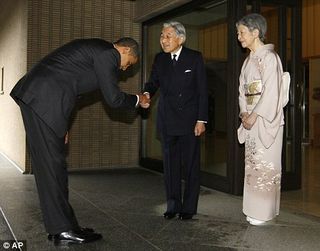
Bownumbertwo I'm sure most folks have seen the picture of President Obama bowing to the Emperor of Japan.

We'll it's not the first time he's done that with a foreign head of state, though this time it's even more impossible to argue (as some of his defenders, including his own press secretary, Spokesbot Robert Gibbs, did when he bowed to King Abdullah) that he was just bending over to shake the hand of a short foreign leader.

No, this was a bow–captured unmistakably in the photo from the side.

No doubt, he did it out of a belief that this is a polite way to greet people in Japan.

But one has to be careful about imitating the customs of people from other cultures, lest one send unintended messages.

For example: Does bowing to the Mikado convey politeness or subservience?

Knowing that kind of nuance is not part of a president's job requirements–but it is the reason he has a protocol office that is supposed to advise him about such things, and as Allahpundit points out, Obama's protocol office is "famously run by imbeciles."

I'm not instantly enraged at the idea of a president bowing to someone. Actually, I'm more disturbed by seeing American leaders dressing up in foreign garb at diplomatic events. But then presidents of both parties do that. I understand that it can be construed as conveying honor to another culture to adopt its dress, but clothing is so personal–and so much more perduring than a simple bow–that my preferred solution would be to have everybody show up in his own native garb (business suits for American presidents; plus formal attire for formal events).

There's always a question of how much to defer to local custom when in a foreign land, and a bow–like every gesture–has the meaning that is invested in it. It need not always convey subservience, and if there were a land where not bowing was insulting and in which their leader would reciprocally bow to our leader then I could understand.

But look at who's not bowing in the picture above.

And look at who's not bowing in the following video:

So. President Obama is made to look like a fool by what is clearly another protocol office mistake.

That raises a disturbing question: Why hasn't Obama learned his lesson from the protocol office's previous mistakes and replaced the appropriate individuals with more knowledgeable ones?

Thomas Sowell wonders what the real-world consequences will be of Obama making himself–and by the extension the United States–look weak in foreign eyes. And it does seem inevitable that this event would be read in light of Obama's tendency to apologize (in the "I'm sorry" sense) for the United States when on foreign soil.

Which brings up something else Allahpundit notes:

For another thing, and somewhat notably, Japan isn’t a stop on The One’s world apology tour. It could have been, but he declined the opportunity to turn it into one.

And he's right. Here's a case where–because of the bombing of Hiroshima and Nagasaki–the United States really does have something to apologize to Japan for. Defending ourselves in World War II was morally justifiable, but nuking cities to put pressure on the Japanese government was not.

Magic Carpet Ride

My colleague at Catholic Answers Jim Blackburn was telling me about a stop-motion video made by his son Justin, with help from his brother James. The two boys appear in the film, which stars their cousin, Jackie Jo and also features her sister, Jamie Sue. (Notice anything about the letter J in this family?)

Here's the video. Enjoy! 

Astonishing

President announces violent shooting of U.S. soldiers at Ft. Hood.

But first . . . !

He thanks his cabinet, gives "shout outs," talks his political agenda, and gets crowd whooping and hollering and clapping.

Then he announces the tragedy and says what his "immediate thoughts" are.

How tone deaf is that? What does that say about his priorities . . . and how seriously he takes the tragedy he was about to announce.

Calling this Obama's My Pet Goat moment is an understatement.

And it'll only look worse as the fact–which the president presumably knew (since it's one of the very first things he should have been told)–that the shooter was a disgruntled Muslim penetrates public consciousness. 

(Presumably the president did not know that the disgruntled Muslim also got into arguments with fellow soldiers about how Muslims should stand up to American aggressors and that he posted apparent justifications for suicide bombers on the Internet.)

Sometimes It Pays To Be An Optimist

I'm glad to be able to report some good news on the case of the abortion nun. (CHT to the person who e-mailed!)

While she hasn't repented (so far as I know), it appears that action is being taken regarding her case. The following statement appears on the Sinsinawa Dominican sisters' web site

Public Statement of the Sinsinawa Dominican Congregation

11/2/09

Several months ago, the leadership of the Sinsinawa Dominicans was informed that Sister Donna Quinn, OP, acted as a volunteer escort at a Chicago area clinic that among other procedures, performs abortions. After investigating the allegation, Congregation leaders have informed Sr. Donna that her actions are in violation of her profession as a Dominican religious. They regret that her actions have created controversy and resulted in public scandal. They are working with Sr. Donna to resolve the matter appropriately.

Congregation leaders offer the following statement on behalf of members of the Congregation. We as Sinsinawa Dominican women are called to proclaim the Gospel through the ministry of preaching and teaching to participate in the building of a holy and just society. As Dominican religious, we fully support the teaching of the Catholic Church regarding the dignity and value of every human life from conception to natural death. We believe that abortion is an act of violence that destroys the life of the unborn. We do not engage in activity that witnesses to support of abortion.

My guess is that "resolv[ing] the matter appropriately" will mean getting Sr. Quinn to resign from the order, but at least that's one way of ending the scandal of a nun ferrying frightened mothers into a child-killing facility.

Meanwhile, ED PETERS HAS SOME GOOD ADVICE FOR DIOCESAN SPOKESPEOPLE REGARDING SUCH MATTERS.

More News on the Anglican Situation

Well, we now have some more information about how the celibacy issue will be handled in regard to the Anglican ordinariates that will be the subject of Pope Benedict's new apostolic constitution–including word on when that will be out. 

This Saturday (!) the Holy See had a press conference which dealt with these matters. Here is the text of the English bulletin on it, plus commentary:

CLARIFICATION BY THE DIRECTOR OF THE HOLY SEE PRESS OFFICE, FR. FEDERICO LOMBARDI, S.I. [sic; he's a Jesuit], ON SPECULATIONS [ominous word at the Vatican; signals damage control is the motive of the briefing] ABOUT THE CELIBACY ISSUE IN THE ANNOUNCED APOSTOLIC CONSTITUTION REGARDING PERSONAL ORDINARIATES FOR ANGLICAN ENTERING INTO FULL COMMUNION WITH THE CATHOLIC CHURCH

There has been widespread speculation, based on supposedly knowledgeable [interesting phrase; attempting to be polite but can't help but being read as sarcastic] remarks by an Italian correspondent Andrea Tornielli [he's also highly respected; interesting that they're naming him and making him eat this one; he also rankled some in Vatican circles by reporting a little too freely on some possible liturgical reforms discussed by the Congregation on Divine Worship that they didn't want aired in public; depending on who you believe, he also may have overstated those], that the delay in publication of the Apostolic Constitution regarding Personal Ordinariates for Anglicans entering into full communion with the Catholic Church, announced on October 20, 2009, by Cardinal William Levada, Prefect of the Congregation for the Doctrine of the Faith, is due to more than "technical" reasons. According to this speculation, there is a serious substantial issue at the basis of the delay, namely, disagreement about whether celibacy will be the norm for the future clergy of the Provision.[Not that that's an unreasonable speculation, as the present text will soon make clear.]

Cardinal Levada offered the following comments on this speculation: "Had I been asked I would happily have clarified any doubt about my remarks at the press conference[Fr. Z's remark about such press conferences is apropos]. There is no substance to such speculation. No one at the Vatican has mentioned any such issue to me. [Under normal circumstances, this could be read as a non-denial denial.] The delay is purely technical in the sense of ensuring consistency in canonical language and references.[That I can believe; for all his virtues–which are many–Pope Benedict is not a canonist, nor are the folks at the CDF (at least as a body) and it makes sense to have the canonical folks go over it prior to publication.] The translation issues are secondary; the decision not to delay publication in order to wait for the ‘official’ Latin text to be published in Acta Apostolicae Sedis was made some time ago.

The drafts prepared by the working group,[nice; a glimpse into the drafting process of this constitution; an acknowledgement that it wasn't simply written by Benedict himself, though it undoubtedly was written at his direction and along the lines he indicated, then reviewed carefully in consultation with Cardinal Levada] and submitted for study and approval through the usual process followed by the Congregation, have all included the following statement, currently Article VI of the Constitution [kewl! advance text!]:

§1 Those who ministered as Anglican deacons, priests, or bishops, and who fulfill the requisites established by canon law and are not impeded by irregularities or other impediments may be accepted by the Ordinary [the head of the ordinariate in this case] as candidates for Holy Orders in the Catholic Church. In the case of married ministers, the norms established in the Encyclical Letter of Pope Paul VI Sacerdotalis coelibatus, n. 42 and in the Statement "In June" [not easy to find online; I'll put the text of it at the bottom of this post] are to be observed. Unmarried ministers must submit to the norm of clerical celibacy of CIC can. 277, §1.[So, as expected, they won't be able to be ordained and then get married.]

§2. The Ordinary, in full observance of the discipline of celibate clergy in the Latin Church, as a rule (pro regula) will admit only celibate men to the order of presbyter. He may also petition the Roman Pontiff, as a derogation from can. 277, §1, for the admission of married men to the order of presbyter on a case by case basis, according to objective criteria approved by the Holy See.[If I'm taking this right, section 2 seems to be referring only to those who have served previously as Anglican ministers; that is, it's stating more explicitly what could be inferred from section 1; ordinarily, only unmarried men can be ordained in the new ordinariates but, on a case by case basis, exceptions can be made for those who previously served as Anglican ministers; however see below.]

This article is to be understood as consistent with the current practice of the Church, in which married former Anglican ministers may be admitted to priestly ministry in the Catholic Church on a case by case basis. With regard to future seminarians, it was considered purely speculative whether there might be some cases in which a dispensation from the celibacy rule might be petitioned. For this reason, objective criteria about any such possibilities (e.g. married seminarians already in preparation) are to be developed jointly by the Personal Ordinariate and the Episcopal Conference, and submitted for approval of the Holy See."[So this is the big news: They haven't decided yet how to deal with the married seminarian question; they're planning to work it out in the future. Also note that the example given is for married seminarians already in preparation; they might decide not to allow future Anglican ordinariate seminaries to accept married seminarians–at least if they didn't convert from Anglicanism while in seminary; in this case the married status of Anglican ordinariate clergy would largely be a first-generation-only thing]

Cardinal Levada said he anticipates the technical work on the Constitution and Norms will be completed by the end of the first week of November.[Kewl! So coming up soon!–though they might not release it for a while.]

———————————————————–

Text of the "In June" statement referred to above (or what I have):

“In June 1980, the Holy See, through the Congregation for the Doctrine of the Faith, agreed to the request presented by the bishops of the United States of America on behalf of some clergy and laity formerly or actually belonging to the Episcopal (Anglican) Church for full communion with the Catholic Church. The Holy See’s response to the initiative of these Episcopalians includes the possibility of a “pastoral provision” which will provide, for those who desire it, a common identity reflecting certain elements of their own heritage.

“The entrance of these persons into the Catholic Church should be understood as the ‘reconciliation of those individuals who wish for full Catholic communion,’ of which the Decree on Ecumenism (no. 4) of the Second Vatican Council speaks.

“In accepting former Episcopalian clergy who are married into the Catholic priesthood, the Holy See has specified that this exception to the rule of celibacy is granted in favor of these individual persons, and should not be understood as implying any change in the Church’s conviction of the value of priestly celibacy, which will remain the rule for future candidates for the priesthood from this group.

“In consultation with the National Conference of Catholic Bishops, the Congregation for the Doctrine of the Faith has appointed the Most Reverend Bernard F. Law, bishop of Springfield-Cape Girardeau, as ecclesiastical delegate in this matter. It will be his question to be submitted for the approval of the Holy See, to oversee its implementation and to deal with the Congregation for the Doctrine of the Faith in questions pertaining to the admission of former Episcopalian clergy into the Catholic priesthood.”