The Nature Of Purgatory

A reader writes:

As a perspective convert to the faith Purgatory is a doctrine that has been giving me a lot of trouble. I struggle with the visions the saints had of purgatory. They are different and do not all agree.

There is a big difference between St. Mary Magadeline de Pazzi’s graphic vision of various tortures in purgatory to St. Catherine of Genoa’s vision in which she says, "the ‘fire’ of purgatory is God’s love ‘burning’ the soul so that, at last, the soul is wholly aflame. It is the pain of wanting to be made totally worthy of One who is seen as infinitely lovable, the pain of desire for union that is now absolutely assured, but not yet fully tasted”. She says that fire burns away sin’s rust which is on the souls not tortures like molten lead, pressers, sharp swords, and ice.

Are the various tortures graphic metaphors to warn us of the damage of sin and the holiness of God or should we take them literal?

That is the way they are commonly understood these days, not as things we would literally encounter in purgatory but–to the extent such images have validity–as symbolic expressions that try to convey what the experience is like.

I don’t see how you can go from a vision telling us how the purifying fires of purgatory reflect God’s love to a visions with demons, fearsome animals, and graphic torments.

This is why I throw in the caveat about "to the extent such images have validity." The images that you are talking about (demons, fearsome animals, graphic torments) are not part of Church teaching. They are things that some visionaries have reported in private revelations but, given the way private revelation works, there is an admixture of the visionary’s own consciousness and cultural background and it can be difficult to untangle what the motions of divine grace the seer was experiencing signify and to what extent they were colored by the visionary’s own consciousness.

This is a special problem when dealing with visions of the afterlife, because the afterlife is so fundamentally different from our embodied experience. There is a much higher risk of "filling in the details" with this-worldly things that are not meant to be understood literally. (Just as angels don’t literally look like men, though that’s how they often appear in Scripture.)

The Church has generally warned people off of some of the more graphic and detailed speculations about purgatory because they are not part of the faith. The Council of Trent (which was occurring at the same time as St. Mary Magdalen de Pazzi was having her visions) specifically warned bishops to be vigilant against people getting too concerned with such matters. The Decree on Purgatory states:

The more difficult and subtle questions [regarding purgatory], however, and those that do not make for
    edification and from which there is for the most part no increase in piety, are to be
    excluded from popular instructions to uneducated people. Likewise, things that are
    uncertain or that have the appearance of falsehood they shall not permit to be made known
    publicly and discussed. But those things that tend to a certain kind of curiosity or
    superstition, or that savor of filthy lucre, they shall prohibit as scandals and
    stumbling-blocks to the faithful [SOURCE].

I should also mention something else: St. Catherine of Genoa’s understanding of purgatory also is not Church teaching. It’s permitted speculation, but not something the Church teaches. It is, however, closer to the way the Church today tends to conceptualize purgatory. The Catechism of the Catholic Church, for example, stresses the difference between purgatory and the sufferings of the damned. Some older writers spoke as if purgatory were the same as hell except that it was temporary instead of eternal. The Catechism goes out of its way to reject that idea:

1030
All who die in God’s grace and friendship, but still imperfectly purified, are indeed
assured of their eternal salvation; but after death they undergo purification,
so as to achieve the holiness necessary to enter the joy of heaven.

1031
The Church gives the name Purgatory to this final purification of the elect, which
is entirely different from the punishment of the damned
[SOURCE].


So even though Catherine of Genoa’s understanding isn’t Church teaching (i.e., the fire of love stuff), it is much more in line with the way the Magisterium is talking about purgatory these days than the former graphic tortures stuff.

When it comes down to it, what is Church teaching is rather modest and might be summarized briefly in a few propositions, such as: (1) There is a purification that occurs after death for the saved who are in need of purification before entering heaven, (2) the faithful on earth can assist those experiencing this purification by their prayers, through Masses, etc., (3) at least some people do not need this purification before heaven, and (4) the purification involves at least some kind of suffering. (Propositions 3 and 4 are more open to question, though, that propositions 1 and 2.)

I know that there is great suffering in purgatory but what is the best theological view on purgatory ecspecially all the theological thought throughout the last century.  Such as Cardinal Ratzinger’s (Pope Benedict) view on purgatory.

I can’t tell you what the best view is, but I can tell you what the Church teaches (see the link to the Catechism above as well as THIS ONE). I can also tell you that Cardinal Ratzinger’s view is much more along the lines of St. Catherine of Genoa’s understanding. In his textbook Eschatology, he conceived of purgatory as an existential encounter with Christ that transforms one. He spoke in these terms:

"Purgatory is not some kind of supra-worldly
concentration camp where one is forced to undergo punishments in a more
or less arbitrary fashion. Rather it is the inwardly necessary process
of transformation in which a person becomes capable of Christ, capable
of God [i.e. capable of full unity with Christ and God] and thus
capable of unity with the whole communion of saints… Encounter with the
Lord is this transformation.  It is the fire that burns away our dross and re-forms us to be vessels of eternal joy."

Hope this helps!

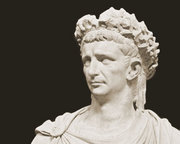
Bye, Claudius

ClaudiusToday–October 13–back in A.D. 54, the Emperor Claudius was poisoned by his slimy fourth wife, Agrippina, who served him a dish of poisonous mushrooms.

Why’d she do it?

So her slimy son, Nero, could become the next emperor and the Beast of Revelation (though she didn’t know about that part).

GET THE STORY.

In other history news, today in 1307 there were mass arrests of the Knights Templar.

GET THAT STORY, TOO.

Hysterical Criticism, Part 2

My last post was an obvious (I hope) attempt to parody some of the excesses of Higher Criticism and it’s devotees.

Now I would like to tell you how I wound up posting such a piece.

As I was in the final stages of the painting that I featured in the aforementioned post (Copper Pot), I ended up thinking a good bit about just how literally I should render a few things, like the pattern on the china.

It occured to me that this process could be analagous to writing, and I thought how it might apply to the Gospels particularly.

There at least a couple of big mistakes one could make about the painting. One would be to think that it was a complete fabrication, a product solely of the imagination. This might lead to absurdities like finding all kinds of hidden meanings where there are none, like the Higher Critic of my parody piece.

The other extreme would be to assume that it was like a photograph, and that even the smallest details were a verbatim reproduction, an exact copy of concrete reality. This might lead to equal absurdities, like if someone were to ask me where they could buy the particular china pattern on the little dishes.

In this particular painting, I simplified and muted the pattern on the china in order that it not draw undue attention in the overall composition. So, in a sense, I did fudge a bit, but that’s my job. Certain shadows are deepened, certain colors are amplified, edges are blurred or sharpened. If I blur the edge of a pear, I doubt anyone would accuse me of asserting that pears are fuzzy, or would assume that I need new glasses.

The truth is that it is a painting, a work of art representing real things, but crafted in such a way as to emphasize certain aspects of reality while downplaying others. All the items depicted are real and could be identified by anyone who bothered to rummage through all the junk in my studio (I love flea markets).

I find reality endlessly fascinating and full of surprises. I strive to be faithful to reality, but not obsessed with minute, photographic detail.

BIG RED DISCLAIMER
– Unlike Jimmy or Michelle, I am not an apologist. I am not a Bible or a literary scholar. I do not claim to know how the Gospels were written, let alone how Plenary Inspiration would work. I am just an artist speculating wildly on how it might have been. If I venture into heresy or nonsense, I am counting on Jimmy and his readers to put me straight.


Based on my experience as an artist, and applying what I know about the creative process to the Gospel writers, I think that I might venture to make a few assertions;

1) The Gospel accounts are faithful representations of real events, but this does not mean that we should expect the same level of detail or attention to exact chronology that we might find in, say, a modern legal document. The writers were concerned primarily that people understand Who Jesus is and what He did, and not with the minutiae of his daily life. We know that Hebrew writers (as well as their audience) were less concerned with the sequence of events than with the substance and meaning of events.

2) The Gospel writers made full use of their human creative faculties (under the inspiration of the Holy Spirit) to emphasize certain aspects of Jesus’ life and message, while downplaying others. For instance, Jesus’ life as a youth simply doesn’t figure as prominently into the proclamation of the Gospel as His passion and death. The writers wanted to present all that was essential, with little extraneous material. Deciding what to include is the first creative step. Some gospel writers included more, some less, but all are faithful representations of real words and events.

3) Being, in some measure, free in setting down the events of Jesus’ life, the Gospel writers may have used different creative or poetic methods to emphasize certain aspects of His teaching. Placing Him in different settings, or at various times, the writers may have symbolically emphasized the substance of His teaching. We needn’t insist, for instance, that the Sermon on the Mount really happened on a mountain or hill. It may have, but it is not essential. Neither could we call this a "mistake" or an "error" any more than my changing the china pattern in my painting was an error. It was a creative choice that placed the non-essential at the service of the truly essential. Both the hyper-literal and the ultra-liberal interpretations would be wrong. The china dish is real, but the pattern is simplified. The pattern is not the essence of the dish, as it would continue to be a dish even with no pattern at all.

In an age before cameras, if I were asked to make a visual record of some object or person, I like to think that I could take some artistic license without being accused of lying or making a mistake, especially if I enjoyed plenary inspiration. We can trust that God guided the process, and that the creative input of the Gospel writers only served to draw out and clarify the essential truth of the historical events depicted.

JIMMY ADDS: Tim, if the painting thing doesn’t work out, you should try apologetics!

Now This Is Good News

I don’t know if y’all’ve heard, but they found this letter that al-Qa’eda’s Number Two Goon, Ayman al-Zawahiri sent to Number Three Goon, Abu Musab Zarqawi (the head evil dude in Iraq).

If you read between the lines of the letter, things sound really good. Good for US, that is. BAD for al-Qa’eda.

Zawahiri is diplomatically warning Zarqawi that he’s screwing things up.

He has to be diplomatic about it, though, because their organization is so weak that he (a) has no effective control over Zarqawi and (b) is so hard up for cash that he politely asks for Zarqawi to send him a donation.

He also outlines what al-Qa’eda’s larger plan is.

I was thinking about doing a detailed mark-up of the letter to point out just how bad things seem to be going for al-Qa’eda–as well as what we in America have to be on guard against–but I had a really LONG day yesterday and don’t have the energy to do a detailed piece of writing at the moment.

FORTUNATELY, JOHN HINDERAKER HAS ALREADY DONE A GOOD ANALYSIS.

YOU CAN ALSO READ THE FULL TEXT OF THE LETTER.

No Joy In Smurfville

Smurfbomb_6

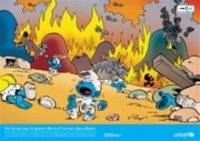
UNICEF is bombing Smurfs in an effort to demonstrate that War Is Bad and that No One Is Safe. While no one would disagree with the first proposition ("War Is Bad"), do we really want a children’s welfare agency informing our children that No One Is Safe from war? The insidious subtext seems to be telling kids (the natural audience for cartoon commercials) that if even Smurfs can be bombed, what about you in your middle-class Western European neighborhood? The Bogeyman of War is lurking Over There and only UNICEF — certainly not your parents — can protect you.

"Smurfette is left for dead. Baby Smurf is left crying and orphaned as the Smurf’s village is carpet bombed by warplanes — a horrific scene and imagery not normally associated with the lovable blue-skinned cartoon characters.

"These are the scenes being shown as part of a new UNICEF ad-campaign on Belgian television.

"’It’s working. We are getting a lot of reactions and people are logging on to our Web site,’ UNICEF Belgium spokesman Philippe Henon said Tuesday.

"The Belgian office of the U.N. children’s fund said it has decided to use the creations of late Belgian artist Peyo to shock a complacent public into backing its fund-raising efforts for ex-child soldiers in Africa.

"The 20-second video commercial clip now being shown on Belgian TV aims to show that war can happen in the most innocent of places, Henon said.

"’We get reactions from all over the place,’ said Henon. ‘People are shocked and want to know the reasons behind this cartoon image.’"

GET THE STORY.

<Tongue in cheek>Well, now I won’t feel like a Scrooge for refusing to give spare change for UNICEF to trick-or-treaters along with their miniature chocolate bars. After all, how could I support an organization that bombs peaceable Smurfs? Perhaps I’ll give the trick-or-treaters a miniature Smurf instead….</tongue in cheek>

(Now that I have removed my tongue from my cheek, I’ll note in passing that I have never refused to give trick-or-treaters spare change for UNICEF for the reason that I’ve never been asked to do so.  I have never before seen trick-or-treaters collecting for UNICEF, although I suppose some have somewhere since it is an American tradition to do so, according to UNICEF.)

Hysterical Criticism

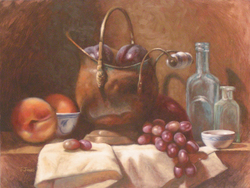
Copperpot2Whodathunkit? While walking downstairs with the painting at left, I suddenly encountered a wormhole in the space-time continuum (located in one of our kitchen cabinets), and the painting was sucked in before I could stop it! Fortunately, I was able to reach in and find it again, but when I pulled the painting out, the following analysis of the painting came out with it, apparently written by some future historian.

Go figger…

"The first thing we must learn about this artwork is who painted it, and this will give us a deeper understanding of the piece.
It is signed T.Jones in the lower left corner, and has been traditionally accepted as the work of Timothy Jones, an obscure, mid-level painter of the early twenty-first century, who signed his work in the same way.

We now know, of course, that this is very unlikely. There are a number of pieces signed T. Jones in existence, and they differ widely in style and content. This painting does not resemble the large, abstract pieces that are also attributed to T. Jones, so most modern scolars no longer accept that this is an original T. Jones work.
Who, then, painted it? Most modern scholars agree that it was the product of several artists, over a period of time. Perhaps it was based on a sketch by T. Jones, but the painting we now see was revised and developed within the Jonesian community, and reflects their concerns at the time.

We may notice that the handling of paint, the brushstrokes, vary throughout the piece. In some areas the paint is applied thinly, in others it is more thickly textured. Some areas seem more expressive and energetic, while others are more controlled and realistic. Clearly this was executed by more than one artist.

The painting appears to be a straightforward rendering of items that might be found around the artist’s studio, but if we look more deeply, we can see that it is profoundly symbolic. We should not make the mistake of thinking that these are necessarily real objects being depicted. In fact, whether these objects really existed or not is irrelevant. What is important is the deeper meaning of the image.

We see depicted a small copper pot, surrounded by some fruit, two glass bottles and two small china dishes. All rest on a simple white cloth, atop a wooden table or plank.

The vessels at the left of the painting (the copper pot and larger china dish) are full of fruit, overflowing with the "fruit of the spirit" that comes from life in Christ. In contrast, the vessels at right are empty, barren. What separates these two groupings, these two ways of life? We see a clump of grapes, representing the "grapes of wrath" that divide us. The "empty vessels" are separated from the others by issues like anger, resentment and judgemental attitudes.

It helps to know that at this period in history the Church in the U.S. was torn between progressive forces on the one hand, and opressive patriarchal forces on the other, and this painting clearly reflects that struggle. The piece calls us all to understand that we are all the same, standing together on the pure, white cloth of love, resting on the sturdy tabletop of the Primacy of Conscience. The deeper meaning of this painting, then (as with all great art), is – Be Nice.

Standing at the center is the copper pot, old and dented, but filled with fruit. this represents the church as a whole, overcoming the ancient and prejudiced ideas of the past to find the living fruit of justice.
Yeah,.. justice.

Or maybe, freedom.

Whatever.

In any case, we could continue to find deeper meanings to this seemingly simple painting, but space does not allow us to discuss all that we might find. Just remember, the important thing about any work of art is what it means to you."

The Effects Of The Accidents

A reader writes:

I have a question about the Atkins Diet.  I sincerely am not trying to be sacrilegious when I ask this.  I believe in my heart and soul that what I receive in Communion is the body, blood, soul and divinity of our Lord and Savior Jesus Christ, but do the accidents affect my blood sugar?  If I am on Atkins and am a daily communicant (which I am not, because we don’t have daily Mass here in the sticks), would there be a problem?  I can’t imagine a problem because Jesus is all Good and cannot hurt us.  I guess I am just asking about the accidents or maybe you could explain it better.

There is no sacrilege involved. You’re simply asking for knowledge.

It’s true that Jesus won’t hurt us, but that doesn’t mean that our bodies will respond the right way to the accidents of bread and wine.

When we receive Communion, our metabolism looks at the elements and responds the same way that our eyes do, saying, "That’s bread and wine!"

This is not a problem as long as you can handle bread and wine, but some folks can’t.

People with celiac disease, for example, may have a toxic reaction to the accidents of bread if they contain too much gluten (if I may put it that way).

People with alcoholism can be subjected to temptation from receiving the accidents of wine from the cup.

If a single minister is consuming what remains of the Precious Blood after Communion and he drinks enough then he will get tipsy.

This is because the physical properties (accidents) of the bread and wine remain. If I may put it this way, the change in the elements is metaphysical (a change of their inner substance), not physical (a change of their outward properties).

This means that your metabolism will treat them as if they contain carbohydrates. If your metabolism is such that you can handle the amount of carbohydrates that the unconsecrated elements contain then you’ll be able to handle the accidents of the consecrated elements.

On the other hand, your metabolism is sensitive enough that you’ll stop losing weight from receiving a certain quantity of the unconsecrated elements then the same thing will happen when receiving the accidents of an equivalent quantity.

So it really depends on your own metabolism and how many grams of carbohydrates you can ingest per day and still continuing to lose weight.