Religionists Of Peace Attack Pray-ers For Peace

I usually try to avoid commenting on stories of terror committed in the name of Islam, because it is a delicate matter to avoid making generalizations that inadvertantly sweep in Muslims who would be horrified at the actions of terroristic co-religionists. That said, I can’t help but take note that extremist Indonesian Muslims, acting in the name of a religion that many sincere Muslims believe is a religion of peace, recently attacked Indonesian Catholics praying the rosary:

"A group composed of Islamic extremists attacked Catholics praying the rosary on 11 October and threatened to burn down the house they were gathered in. The assailants, who claimed to be part of the Islamic Defender Front (Front Pembela Islam, FPI), invaded the house of one of the Catholic community belonging to the parish of Christ Salvator in western Jakarta.

"The men forced the marian prayer to stop immediately, threatening to burn the place down. They forced all those present including the Ketua Lingkungan (informal parish leader — ed. note) to sign a declaration that they will not hold any more rosary gatherings in houses in the area.

"The attack has fuelled fears and apprehension among Indonesian Catholics who fear further possible hostile moves from the FPI. The front is also behind the closure of 24 home-churches in western Java."

GET THE STORY.

Whatever the difficulties of modern American society, it’s stories like this that make me grateful I live here rather than anywhere else. When you’re praying your rosary, say a prayer for these Indonesian Catholics and thank God that you can do so in peace.

Low-Carb Pizza

Lowcarbpizza

One of the challenges of low-carb dieting is figuring out how to come up with low-carb equivalents of foods that you’re used to eating.

Like pizza.

Many low-carb dieters have tried different ways of making low-carb pizza, and most of the home verisons aren’t that successful.

One of the most successful attempts was a Red Baron low-carb pizza that was marketed last year, but they stopped making it and you can’t buy it anymore. So now low-carb dieters are back to self-made efforts when it comes to pizza.

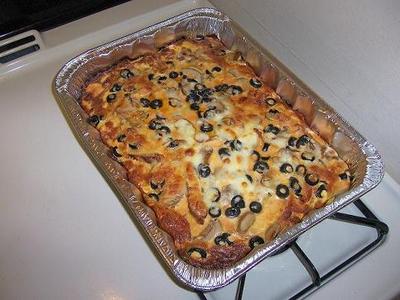
Fortunately, I’ve discovered an amazingly simple way to make low-carb pizza at home.

The result of my efforts is pictured above.

Now let me tell you how to make it.

Continue reading “Low-Carb Pizza”

Kecharitomene Questions

A reader writes:

I was watching EWTN earlier and it was mentioned that only two people in the New Testament are referred to as “full of grace” – Jesus (John 1:14) and Mary (Luke 1:28). Of course I thought this would be a really neat thing to mention to my Protestant friends (especially if we’re talking about Jesus and Mary being the New Adam and New Eve).

BUT I wanted to go beyond the English and examine the original Greek – but I don’t know a lot about Greek! So I have two twofold questions:

(1) does John 1:14 use kecharitomene as fully (pardon the pun) as Luke’s usage in 1:28 or does John 1:14 follow more closely to Acts 6:8 when Stephen is referred to as “full of grace and power”?

John 1:14 says that Jesus was plErEs charitos, which literally means "full of grace." (Those capital Es arepresent etas, so pronounce them like the e in "they"; the word is thus pronounced PLAY-RACE).

Luke 1:28 uses kecharitomene, which literally means "one who has been graced" or "woman who has been graced" (since the gender is female). It doesn’t literally mean "full of grace," though that is defensible as a free translation.

Acts 6:8 refers to Stephen as plErEs charitos, so again it’s literally "full of grace" and just the same as the description used of Jesus in John 1:14.

If it is the latter, (2) does that mean there really isn’t a literal “full of grace” parallel between Luke 1:28 and John 1:14 or can I find that literal parallel somewhere else in the New Testament?

Not that I’m aware of, and I’d almost certainly be aware of it if there were.

I’m afraid that in establishing Jesus and Mary as the New Adam and Eve, you’ll need to appeal to other considerations. You might try those mentioned HERE and HERE.


Listen Up!

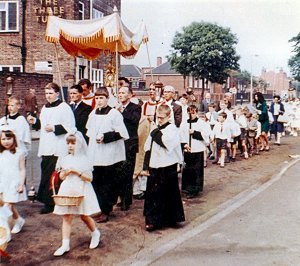
Procession_1

"The guy gal the Pope should listen to"

God has given you the rare gift of bilocation.
With it, you can attend both the First Friday
devotions in honor of Our Lady of Fatima and
the parish bake sale committee meetings. We respect
you, mostly because we fear the incredible power
you wield in our parish.

Are You A Cultural Catholic?
brought to you by Quizilla

So, does anyone know how I let Pope Benedict know that he should be listening to me? In the interests of journalistic honesty and all that, I should note that I got this result on my second try. Seems I have yet to shake off my shady past as a WASP convert because the quiz outed me as one on my first try.

(Nod to Dyspeptic Mutterings for the link. Kudos to The Donegal Express for creating this "Put down the coffee mug, first!"-quiz.)

When The Real Presence Ceases

A reader writes:

Mr. Akin,

What’s the authority you had in mind when you said that the real presence ceases when the precious blood would "no longer would appear to be wine in the common estimation of men"? I’ve heard that before but can’t place it.

This is the standard test for whether Christ is really present or not. It’s common knowledge among theologians, though it is reflected in various authorities. To illustrate, though, I need to broaden the frame of reference a bit.

Christ willed that he would become present under the appearances of (wheat) bread and (grape) wine. Therefore you need wheat bread and grape wine in order to celebate the Eucharist and have valid matter for it.

Neither bread or wine, however, are natural categories (unlike, say, lamb flesh, grapes, or water, which all occur naturally). Bread and wine are prepared by human agency and thus are what one might say are "anthropological" categories rather than natural ones.

This makes us do a little more work in determining validity since anthropological kinds have (or can have) fuzzier boundaries than natural kinds, yet they are what Christ chose to employ in establishing this sacrament.

Since Christ spoke to men and instructed them to perform this sacrament, it follows that he expects men to be able to discern what falls into these categories–at least commonly. Some men might have bizarre expectations about what counts as bread and wine but one can’t rely on any bizarre opinions as a guide to what Christ intended. Therefore, a "common estimation of men" test has evolved. If something would be regarded as bread or wine in the common estimation of men then it will be valid. Otherwise, it won’t be. (Doubtful cases are doubtful matter.)

Because cultures vary, however, we have to throw in one extra qualifier: The common estimation of men has to be tied to the common estimation men in Jesus’ own day. The need for this qualifier is obvious when one considers the fact that to us–in 21st century America–"bread" tends to mean leavened bread while unleavened bread we refer to with a different term (e.g., "crackers"). That was not the case in first century Palestine, though, and to the apostles that Jesus was speaking to, "bread" (lekhem) could be either leavened or unleavened. We know that the latter was valid matter because it was the kind of bread that Jewish people were required to use during the Passover ceremony, which is when Jesus instituted the Eucharist.

So we have to adjust (make broader) what we in our culture would count as bread a little bit in order to take account of this fact.

Once we have the "Is it bread or wine in the common estimation of men?" test, two consequences fall out from that.

The first, which we have already mentioned, is that it isn’t (wheat) bread or (grape) wine then it can’t be used to confect the Eucharist. This is reflected, for example, in Redemptionis Sacramentum:

The bread used in the celebration of the Most Holy Eucharistic Sacrifice must be unleavened, purely of wheat, and recently made so that there is no danger of decomposition. It follows therefore that bread made from another substance, even if it is grain, or if it is mixed with another substance different from wheat to such an extent that it would not commonly be considered wheat bread, does not constitute valid matter for confecting the Sacrifice and the Eucharistic Sacrament [RS 48].

The second consequence gets to your question, which is what happens when the accidents no longer appear to be bread and wine. When that happens, standard Catholic theology holds, the Real Presence ceases because what Christ willed to be present under (the appearances of bread and wine) is no longer present.

Thus St. Thomas Aquinas notes:

[I]f the change [in the consecrated elements] be so great that the substance of the bread or wine would
have been corrupted, then Christ’s body and blood do not remain under
this sacrament
; and this either on the part of the qualities, as when
the color, savor, and other qualities of the bread and wine
are so
altered as to be incompatible with the nature of bread or of wine; or
else on the part of the quantity, as, for instance, if the bread be
reduced to fine particles, or the wine divided into such tiny drops
that the species of bread or wine no longer remain
[ST III:77:4].

The reader continues:

Is the real presence contingent on our subjective sensation, or on the reality of the sacred species themselves? For example, if you have bread or wine imperceptible to our senses, but chemically the same as a larger portion, does the real presence still remain?

Depending on what you mean, the answer may be neither. The Real Presence does not depend on anybody subjectively sensing the bread and wine. The consecrated elements could be reserved in the Tabernacle, with nobody sensing them. On the other hand, bread and wine are such that they can be sensed, and so the quantities do have to be sufficiently large that if someone were looking at them, they would say "That’s bread" or "That’s wine." It is not enough that a tiny particle be put under a microscope and have it be discovered to be chemically identical to bread or wine. We’re dealing with anthropological categories, and the elements have to be "anthropologically" bread and wine, not just chemically bread and wine.

Or is anything that no longer appears to us to be bread or wine necessarily chemically changed?

I couldn’t tell you for a fact with bread since I don’t know if the cell structure of the wheat typically remains in bread. However wine is not chemically changed by the mere fact of being reduced to such a small quantity that it no longer appears to be wine to the senses. I suspect that the same is true of bread as well, I just don’t know for a fact. The key, though, is not chemical composition but what they count as in the common estimation of men (with the needed cultural qualifier).


Or the crumbs on the paten, for instance. I wouldn’t call a crumb of crust "bread," but I still view that as having as much of the real presence as a larger host. Is that correct?

It depends on the size of the crumb. If it’s a particularly large crumb–something you would look at and think "That’s a piece of bread" then the Real Presence would remain. If it’s a particularly tiny crumb, something you would look at and think "That’s a speck of wheat dust" then the Real Presence does not remain. If it’s an ambiguously sized crumb then it is doubtful whether or not Christ is really present.

For safety’s sake, the Church tends to err ont the side of caution both before and after the consecration of the elements. Before the consecration if it is doubtful that the matter is valid then it cannot be used. After the consecration if it is doubtful whether the Real Presence remains then we are to assume that it does.

In obvious cases, though, (e.g., this is clearly cornbread or this clearly looks like a speck of wheat dust) then the Real Presence is not presumed and we are NOT TO SCRUPLE ABOUT THIS.

Hope this helps!
Abortion & Originalism

A reader writes:

Does it matter if the writers of the Constitution/Amendment define or understood the word "life" in "…right to life…" to mean from the moment of conception? That seems pretty likely to me, though I haven’t done any research. In such a case a Catholic (or merely "good") judge would be required to protect life from the moment of conception. I don’t think we *have* to play by their rules.

Perhaps in a generation we may have judges who will interpret the constitution in that way?

Perhaps, but it’s not a given that originalist judges would read the Constitution in this way.

While it’s true that the Fifth Amendment to the U. S. Constitution provides that no one shall "be
deprived of life, liberty, or property, without due process of
law," it is not a slam dunk that the framers or ratifiers of the amendment would have understood life as beginning at conception.

There was still a lot of overhang from the time when bad embryology thought that children were not alive until "quickening" (lit, "making alive" but interpreted as when the mother first feels the baby kick) or Aristotle’s 40/80 day business.

As a result, when the amendment was passed (1791) abortion was generally legal in the United States.

It wasn’t until the mid-1800s when better embryology revealed that children were definitively alive from conception, and American physicians began lobbying their state legislatures to make abortion illegal. That happened in every state of the union and stayed that way until the late 20th century, when certain legislatures began to loosen the requirements, just before The Evil Decision (1973) swept away all regulations and inaugurated an age of triumphal babykilling.

Since abortion was generally legal at the time of the Fifth Amendment’s passage and remained so–uncontested–for many years thereafter, an originalist justice might well look at it and say, "Well, that shows that the framers/ratifiers did not undrstand this amendment to prohibit abortion. Therefore it doesn’t. On the other hand, neither does the Constitution provide a right to abortion. It’s a matter for the legislatures, as it was at all times before Roe v. Wade, so you need a legislative solution if you want abortion banned."

Which is the most likely scenario for how abortion will be ended in this country: A judicial overturning of Roe on originalist grounds, followed by a long, bloody legislative fight to end abortion state-by-state, hopefully (a long way down the road, after the battle is mostly won) eventually resulting in a constitutional amendment protecting life from conception to patch up what the Fifth Amendment doesn’t do on an originalist reading.

That being said, it’s possible that an originalist with a sufficiently strong natural law orientation might look at the Fifth Amendment and say, "Okay. They didn’t understand it as prohibiting abortion, but that was because of the defective understanding of science they had in their day. They meant to protect the life of every human being under U.S. jurisdiction, and now we have a clearer undrstanding of the fact that the unborn are human beings. Therefore, the Fifth Amendment protects them."

That’s possible, but such five such justices aren’t likely to concurrently sit on the Court any time soon. The former reading is more likely to get Roe overturned in the short term.

Sixteen Children … And Counting!

You’re 39, you’ve just delivered your sixteenth child, what are you going to do?

"I’m going to do it again!"

Is that a response that springs to mind for many mothers and many families? Probably not, at least in this day and age. (Although, centuries ago, it may have been. St. Therese of Lisieux was the last of nine children; St. Catherine of Siena was her mother’s twenty-fourth child.) But there are still a few modern families heroically open to life:

"Michelle Duggar just delivered her 16th child, and she’s already thinking about doing it again.

"Johannah Faith Duggar was born at 6:30 a.m. Tuesday and weighed 7 pounds, 6.5 ounces.

"The baby’s father, Jim Bob Duggar, a former state representative, said Wednesday that mother and child were doing well.

"He said Johannah’s birth was especially exciting because it was the first time in eight years the family has had a girl.

"Jim Bob Duggar, 40, said he and Michelle, 39, want more children.

"’We both just love children and we consider each a blessing from the Lord. I have asked Michelle if she wants more and she said yes, if the Lord wants to give us some she will accept them,’ he said."

GET THE STORY.

Sounds like the Duggars have filled one quiver and are working on another (cf. Ps. 127:3-5).