Blog Preferences

Yesterday’s post on blog design raised some issues in the comments box that I thought I’d solicit some additional feeback on.

1) Some readers were of the opinion that they’d like to see more posts on the main page before they drop off into the archives.

This can be accomplished several ways. One way is for me to simply tell the software to display more of them. Currently I’ve told it to leave 4 days worth of posts on the main page, but I can up that number if desired. For example, I could leave 5, 6, or 7 (or more) days worth of posts on the front page.

I can also tell the software to leave a specific number of posts (instead of a specific number of days) on the front page. Currently there’s probably an average of 17 posts on the top page at any time, but I coud tell it to have 20 or 25 or 30 posts on at all times.

A downside of upping the number of posts is that, as things currently are, it would make the top page LONGER and possibly make it take MORE TIME TO LOAD for some folks.

This leads to a second issue:

2) Some folks suggest that I use the extended post feature more often. Currently I tend to use it only for really long posts (like ones with multiple pictures in them), but it could be used on a more frequent basis–say, any time the post runs more than 2-4 paragraphs.

The upside of this is that it would make the top page vertically tighter.

The downside is that it would make folks click more links.

Someone suggested having the format be Title:Summary:Extende Post. I’m not sure how that would work. I’m not sure that I’d want to do a summary of the post before the "Continue Reading" link. If I did, it’d probably be a single sentence or phrase as a slug line to get folks intrigued enough to click the link. Perhaps that person or others could suggest more on that is envisioned for that possibility.

Another way to tighten the page vertically would be for me to use longer paragraphs so that there would be less white space between them, but that is SOMETHING I WILL NOT DO. I’m frustrated by seeing others use absurdly long paragraphs (in books, in articles, and on the web), and I am conducting a personal crusade against this tendency as I believe that shorter paragraphs are easier to read than longer ones.

So.

Whadda folks think? Should there be more posts on the top page (accomplished by the day or # of posts methods–and if so, how much more?) and should the extended post feature be used more?

Boxing

A reader writes:

Did the Vatican come out against boxing?  I was confronted about this and was unable to locate anything on their web site.  Could you explain any of your thoughts on the subject of sporting events like boxing or MMA (mixed martial arts)?

I am unaware of any magisterial statements that condemn boxing. This is a subject that has been left to moral theologians, certainly in recent years.

There was, however, an article published in the magazine La Civilta Cattolica, which is published by the Jesuits. Despite the fact that the magazine’s contents basically get an imprimatur from the Vatican’s Secretariat of State, they are NOT magisterial statements and are NOT binding on the consciences of the faithful.

It may have been reporting about this article that you ran into.

It is important to note that this article uses what sounds like hyperbolic language. For example, it reportedly refers to professional boxing as "a form of legalized attempted murder," which is clearly hyperbolic. One might conclude that professional boxing is horrendously brutal and immoral and that it ought to be banned, but it is not literally true that boxing legalizes attempted murder. Pro boxers are generally not attempting to murder each other and, if they are, what they’re doing in the ring is NOT legal. Countries have laws against against attempted murder, even in the ring.

It’s also important to note that the article CLEARLY DISTINGUISHES between professional boxing and amateur boxing. According to the Catholic News Service:

The magazine distinguished between professional boxing and boxing done as a controlled sport in a gymnasium with protective equipment, which it said can be morally acceptable and even useful.

GET THE STORY.

Personally, I am not a boxing fan. I recognize that it can be done in a moral way, particularly in amateur settings (like the other martial arts). I have qualms about the way it is done in the boxing industry, but I’m not enough of an expert to form an opinion about professional boxing. I’d have to know a lot more before I’d be able to comment responsibly on it.

I think the same may be true of the author(s) of the piece in La Civilta Cattolica. Any time hyperbolic language starts getting used in a cultural critique, it makes me wonder if the author is doing balanced, sober reflection on a cultural phenomenon or if he has had a visceral reaction and his writing is moved by passion in a way that causes him to lose sight of important facts.

The God Bloggers

If Jesus were a blogger, what would he blog? That question and others were recently asked at a Christian (read, Evangelical Protestant) blogging conference:

"What would Jesus blog?

"That and other pressing questions drew 135 Christians to Southern California this weekend for a national conference billed as the first-ever for ‘God bloggers,’ a growing community of online writers who exchange information and analyze current events from a Christian perspective.

"The three-day conference at Biola University marked an important benchmark for Christian bloggers, who have worked behind the scenes for years to spread the Gospel and infuse politics with religion.

"Topics included God bloggers’ relationship with the traditional church, their growing influence on mainstream politics and how to manage outsiders’ perceptions.

"Some predicted bloggers could play a role in reforming the modern church by keeping televangelists and other high-profile Christian leaders honest."

GET THE STORY.

The most intriguing metaphor used by the God bloggers was given by Joe Carter of The Evangelical Outpost, in which he compared blogging to Martin Luther’s 95 theses.  In that spirit, it sounds like we need a Counter-Reformation of Catholic bloggers. If Mary were a blogger, what would she blog? And when will St. Blog’s Parish have its own conference to discuss that and other questions of Catholic blogging? We could call it The Saint Bloggers.

Becoming An Apologist

A reader writes:

I would like to know what the best way to become an expert on Catholic apologetics?  I want to someday organize and give lectures around the country on the subject and bring Catholics home.  I am awestruck when you answer the questions thrown at you.  Do I have to go to seminary to become an expert?  Thanks.

First, good for you! We need more workers in the field!

Second, you’re much too kind.

Third, you don’t have to go to seminary.

In fact, I’m unaware of any seminary or theology program in the country that gives people much background in the skills that are actually needed in day-to-day apologetics work. I’ve dealt with people who have masters degrees in famous Catholic theology programs which shall remain nameless and have found that they still had a dramatic learning curve when it came to doing apologetics in the field.

This is understandable since very few seminary and theology professors have much experience in helping people with apologetics in practical situations. You’ll get a much better sense of the kinds of things that one needs to study up on if you listen to the Q & A shows on Catholic Answers Live or read the Ask An Apologist forum at catholic.com.

HERE’S AN ARTICLE I WROTE ON HOW TO BECOME AN APOLOGIST.

The skill-building advice comes toward the end of the piece, but the rest is of use, too–particularly if you want to do apologetics full-time.

Hope it helps!

Papal Pancake

Pancakepope_4

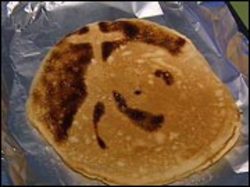
It seems fitting, in an odd, amusing way, that the pope who was totally devoted to Mary ("Totus tuus") would join her in making the rounds of appearances in food. (Before I annoy any apparitions purists, please understand that I am speaking ironically. When Mary or any saint appears, they appear. They do not appear as an image in food.) In any case, the image of John Paul the Great has recently been spotted in a flapjack:

"One Sunday morning, Myrna Kincaid’s life changed with the flip of a pancake.

"’Look at my pancake,’ she reflects. ‘It looks like, looks like the pope.’

"’I thought it could very well look like him,’ said Jay, her husband.

"Instead of eating the pancake bite by bite, they stored it in the freezer and scurried to church. But, what to make of this, they thought.

"Luke Galen is a Grand Valley State University professor who teaches a course on psychology in religion. ‘That one’s pretty accurate as far as these pictures go,’ said Galen."

GET THE STORY.

Why would images like this, what we might call nature’s icons, "appear"? Who knows. But one of the things I love about Catholicism is that we have such a sacramental view of life that even cooking breakfast for one’s family can become a holy moment when one’s mind is uplifted to God and to his friends.

For a longer meditation on this kind of phenomena, see the links below.

OUR LADY OF THE UNDERPASS

OUR LADY OF THE UNDERPASS, REDUX

JIMMY ADDS: I’m skeptical about all "phenomena" of this nature, though sometimes there may be coincidental resemblances. In this case . . . I dunno. The contrast between the background and the pope figure is so extreme and the edges between them so sharp that it looks . . . artificial to me.

Blog Design

So yesterday I get an e-mail in my box with the cryptical headline:

usability guidlines for blogs — please help us (your readers) out

The text of the e-mail consists of a repeat of the headline followed by a link:

http://www.useit.com/alertbox/weblogs.html

From this I would gather that the reader who sent it has a beef to gripe with my blog which he expects to be remedied if I read and follow the usability guidelines to be found at the link.

So I took a look at ’em.

They’re some thoughts by Jakob Nielsen, a Dane who has made a name for himself as a web usability consultant.

Now, I’m all for usability. It’s one of my favorite things. In fact, I regularly lament the lack of usability I encounter on the web, in software, and in life. Truth be told, if things aren’t usable then I’m liable to up and not use them! So Jakob Nielsen and I should be natural allies.

Unfortunately, not all values in life can be subsumed under the rubric of usability, and you’ll get a sense why if you visit the link and take a look at Nielsen’s site. It may be usable from a coding perspective, but it’s grating on the eye. (Screen widths being what they are today, having a right- or left- or both-hand margin available is a GOOD thing rather than let the text flow all the way across the page. San serif fonts also can’t be used for extended lengths of text; they’re best for headlines but will also grate the eye if they run on for too long.)

So despite what natural allies Jakob Neilsen and I should be, I’m starting to wonder how much of an expert he really is from the way HIS site is designed.

Then I start reading the content, and notice that he repeatedly refers to "weblogs" without even noting the existence of the more common term, "blog." He eventually surrenders to inevitability and starts using "blog," but he does so without explanation, which is odd since he feels the need to inform his readers–in his very first sentence–that "Weblogs are a form of website." He also states:

[W]eblogs are part of an ecosystem (sometimes annoyingly referred to as the Blogosphere).

Hoo-kay.

Jakob Nielsen’s credibility as someone to tell me about blog design is rapidly diminishing at this point. Even if one is initially put off by a word–like "blogosphere" or "apologetics" or what have you–if you really become an expert on it then you get so used to hearing the term that you lose your initial negative reaction and surrender to the fact that it is, in the end, the standard term accepted in the community.

In other words, you get over it.

The column was released yesterday, Monday, October 17, 2005, and at this point for an alleged expert in web design to be publicly complaining about the annoyingness factor of the word "blogosphere" tells me that he either isn’t that familiar with blogs–or "weblogs," as he calls them–or he is an unusually persnickety individual who is overly attached to his own ideas. Y’know: The kind of person who joins propane-accessory sales comedy troupe and insists on continuing to call it "The Propane Maniacs" when the rest of the group has decided that "The Propaniacs" is the more felicitous name.

Nevertheless, let’s see how JimmyAkin.Org stacks up compared to his top 10 rules of "Weblog Usability." What follows in boldface are Nielsen’s critiques of the design of many "weblogs," followed by analysis of how JA.O fares.

  1. No Author Biograpies. Here we have a mixed score. If you click the "About" link in the left-hand margin, it takes you basically nowhere. This link came with the blog and I haven’t been able to get rid of it. But if you click my name under "JA.O Bloggers," you get a proper author biography of me. Clicking the other bloggers’ names also leads to info about them.
  2. No Author Photo. Got one of me. Could get a little crowded if group blogs had them for everyone–and many members of a group blog might not WANT their photos online. For that matter, not all solo-bloggers want their photos online, so I don’t see this as an essential element of good blog design.
  3. Nondescript Posting Titles. When it comes to magazine article and book titles, I’m a BIG opponent of obscurity. Clarity in such things is important to me. I’m less strict about this in blog post titles since (a) they don’t have to get someone to spend money the way a book title does and (b) nobody looks up blog posts in an index where the titles could confuse them. You just look at the next line and it should become obvious what the post is about. As a result, there’s a mix of clear and opaque post titles that I come up with. The opaque ones, though, tend to set an editorial tone ("Now here’s some good news. . . . ") or play on something ("Where Mr. Monk Shops"). I think they add texture to the blog, just like "Propaniacs" is less instantly  intelligible but more ultimately satisfying than "Propane Maniacs."
  4. Links Don’t Say Where They Go. Here Neilsen complains about people including links like "some people think" and "More here and here." I don’t mind the latter so much since you’ve already been set up for what the topic is that you’ll find on the other end of the link (which is what’s important, not where on the Net it’s housed). The first, though, can be a real annoyance, especially if the identity of the person in question isn’t obvious from doing a mouseover. I don’t think this happens much here on the blog. I may say "GET THE STORY," but only toward the bottom of a post where I have been introducing the reader to the topic of what the link points to.
  5. Classic Hits Are Buried. Not a problem. That’s why I have the Permaposts section (though I need to update those.)
  6. The Calendar Is The Only Navigation. Bwaaa-haa-haa-haah! On THIS blog? You gotta be kidding me. I’ve got naviations methods all over the place. There needs to be a navigation method to navigate the navigation methods.
  7. Irregular Publishing Frequency. Double bwaaa-haa-haa-haah! With an average of five or six posts a day, not on your life!
  8. Mixing Topics. Okay. I admit it. I’m a topic mixer. I don’t think this is a problem, though. In fact, I suspect far FEWER people would read the blog if I just made it Catholic apologetics all day every day. One of the things I get the most compliments on is the diverse topic mix, so I think the readership of the blog appreciates this, too. (Though perhaps some don’t.) So I disagree with the applicability of this rule–at least in all cases. There are at least some cases in which it doesn’t apply.
  9. Forgetting That You Write For Your Future Boss. While I hope to stay with my current employer indefinitely, I am quite aware of the potential issues here and strive to stay well clear of them.
  10. Having A Domain Name Owned By A Weblog Service. Nope. Got my own, thanks.

So it seems that I’m in at least substantial compliance with all of Nielsen’s rules (not that they all have to do with the usability of the blog) EXCEPT for #8 and, perhaps, #3.

Which makes me wonder what kind of beef with my blog is had by the reader who e-mailed. Unless he’s got a strong thing for clear post titles or wants me to do apologetics all the time (in which case, forget it; the blog would be deadly dull), I’m not sure what he’s after.

Just one of the mysteries of life, I guess.
Writing With Style

Here on the blog y’all get to see me writing with at least a measure of style. My editor and I have an understanding, and if I want to plot an "ain’t" or a "y’all" or a "YEE-HAW!" into a sentence, I can and he won’t "correct" me.

I occasionally cut loose with a full-blown fisk (though it requires me to have found a REALLY stupid story to use as a base for the fisk. If the story isn’t stupid enough, the fisk won’t be that funny.)

When I write for most publications, though, I have to write in a very SERIOUS manner.

That doesn’t stop me from appreciating those who write with a lot of style. I just don’t get a chance to put much stylish stuff in print, myself.

There are certain people who I’ve discovered on the Net who write in such an interesting manner that I’ll go out of my way to read their material, just to admire their creative use of language. Even if I don’t agree with what they’re saying, I still admire how they say it.

Peggy Noonan is one. Mickey Kaus is another. LILEKS HAD A REALLY GOOD ONE HERE.

And then there’s Mark Steyn. He’s always a treat in terms of how he uses words. For example, consider the following paragraph in which he describes listening to a National Public Radio story that talked about Muslim terrorists in Russia without identifying them–till the last word of the story–as Muslims:

When the NPR report started, I was driving on the vast open plains of I-91 in Vermont and reckoned, just to make things interesting, I’ll add another five miles to the speed for every minute that goes by without mentioning Islam. But I couldn’t get the needle to go above 130, and the vibrations caused the passenger-side wing-mirror to drop off. And then, right at the end, having conducted a perfect interview that managed to go into great depth about everything except who these guys were and what they were fighting over, the Russian academic dude had to go and spoil it all by saying somethin’ stupid like "republics which are mostly . . . Muslim." He mumbled the last word, but nevertheless the NPR gal leapt in to thank him and move smoothly on to some poll showing that the Dems are going to sweep the 2006 midterms because Bush has the worst numbers since numbers were invented.

Now see! That’s good writing! I’d love to do stuff like that, only people take you SO seriously when you’re an apologist and expect you to be SO prim and proper and "charitable" and literal all the time.

It’s enough to make you stamp your foot sometimes.

ANYWAY, READ THE REST OF STEYN’S PIECE TO SEE WHAT OTHER NIFTY WRITING TRICKS HE PULLS.

St. Michelle, Patron of Crabby Bloggers?

In response to the quiz in which it was revealed that I have "the rare gift of bilocation" and am therefore *obviously* on the road to sainthood [she said, while ignoring the snickering and catcalls of readers who know her personally and are lining up to be the devil’s advocate for her cause], a reader asked:

"Michelle, after your beatification, what do you see yourself being the patron saint of? And what would be your first pick as a feast day? ;-)"

Thinking the question fun and important — hey, the first step to sainthood is considering sanctity to be an achievable goal — I’ve thought about it and decided: I’m putting in dibs to become the patron saint of crabby bloggers and would like my feast day to be the day on which Blogger was founded, which was sometime in August 1999. That way I can intercede both for crabby bloggers and for the smooth functioning of the technology that allows them to be public crabs.

Since everyone should consider sanctity to be an achievable goal, feel free to place dibs in the combox for the human endeavor for which you want to be a patron saint and the day you’d pick as a feast day were you consulted on the decision (keeping in mind that the Church usually assigns you the date on which you were born into the next life… in other words, the day you die).

Imperial County Strikes Back!

I’ll tell you about my trip to Vasquez Rocks soon, but I realize that I need to finish telling you about the trip to the Salton Sea, so here’s some more on that. . . .

The counties in California are HUGE!

I mean, they’re larger than some STATES back east are!

San Diego County is so large that it contians FOUR mountain ranges! (As we saw in the last post in this series.)

When you hit the edge of San Diego County, you SUDDENLY plunge out of the mountains and into a huge flat, plane known as Imperial County, though.

Imperial County is one of the largest food producing centers in WORLD–with acre upon acre of capacity that hasn’t even been tapped yet! (Take THAT, over-population freakazoids!)

Imperial County needs water, though, and that water is chiefly supplied by the Colorado River. (DUM! DUM! DUM!) More about that later!

As you drive out into it, you can’t help noticing how FLAT Imperial County is compared to the mountains that are to be found in the eastern portion of San Diego County. Here’s what the flat plane looks like:

43287121_135350776_0

There are still many interesting desert treats that you’ll encounter. For example: lollipops that have SCORPIONS inside them!

Continue reading “Imperial County Strikes Back!”

Anathema Sit

A reader writes:

Hi Jimmy,

What is the difference between anathema & anathema "sit"?

Okay, before I answer, let me clear away something that is BOUND to come up if I don’t deal with it.

You heard about the apologist who named his dog "Anathema," so he could tell his dog "Anathema, sit"?

That was funny about the first thirty times I heard it.

Now here’s the deal: Anathema refers to a form of excommunication that used to exist under Church law. It no longer does exist, having been eliminated with the promulgation of the 1983 Code of Canon Law.

Sit is the Latin third person singular form of the verb "to be" when it’s in the subjunctive mood and the present tense. It means "Let him be" or "May he be." (You can also switch the gender to feminine or neutral in these translations."

So "Anathema sit" means "Let him (or her or it) be anathema."

This formula is a Latin translation of what Paul says in Galatians 1:8:

But even if we, or an angel from heaven, should preach to you a gospel
contrary to that which we preached to you, let him be anathema.

The Greek for that phrase is Anathema esto, and when you bring it across into Latin, it’s Anathema sit.

This phrase got picked up by the Church (either from Galatians or oral tradition) and used when excommunicating heretics. Ever since the first ecumenical council–the First Council of Nicaea (A.D. 325)–ecumenical councils used this formula to pass laws indicating who needed to be excommunicated.

Typically the formula went like this:

If anyone says . . . <INSERT SOME AWFUL HERESY HERE> . . . let him be anathema.

Only writing in Latin, they’d say . . . anathema sit at the end.

Some things that it’s important to note:

1) These anathemas were not thought of as damning a person to hell. That’s something only God can do. (Though the fact someone needed to be excommunicated was not considered a good sign for the state of his soul.)

2) The penalty of anathema did not take effect automatically. In fact, there was a special ceremony that the bishop had to perform, and the mere fact that someone in his diocese has uttered an awful heresy does not magically compel the bishop to get up and perform the ceremony.

3) The penalty of anathema, like all excommunications, was medicinal and meant to prompt the person to repent. Thus there was also a special ceremony for lifting the anathema and receiving him back into fellowship once he did.

4) The penalty was only applied to Catholics. If someone ain’t part of the Catholic Church then there’s no point excommunicating them. (Bishops got better things to do with their time than a bunch of ceremonies excommunicating folks who don’t make any pretense of being Catholic.)

5) The penalty was so infrequently used (typically for people like priests who had committed major crimes) that it was eventually abolished when the 1983 Code came out, so nobody today is under a sentence of anathema.

6) The canons from the ecumenical councils that use the formula "anathema sit" continue to express theological truths in an infallible manner, and you can still get excommunicated for teaching heresy. The special, ceremonial form of excommunication known as "anathema" is what’s gone.