Fear Of All Error?

A reader of my post The Purity Tests raises a good question:

"What you say about the ‘purity filters’ may be true, but how many people are at the stage where they can effectively sift the orthodox from the cleverly disguised heretical?"

This question actually raises another concern that has bothered me for some time now:

Many orthodox Catholics are afraid of error, to such an extent that the avoidance of error can seem to become the driving force in their spiritual lives.

Please understand me: This isn’t a bad impulse. Wanting to avoid error because one wishes to remain faithful to the Church’s magisterium is a good thing. When used in a prudent manner, such an impulse can be self-protection against false teaching. The problem arises when the person is so afraid of error that it prevents him from taking reasonable chances. The often-unspoken fear appears to be that the person is afraid that error is, in itself, sinful, and that a person who is in error in not just wrong on some point but heading toward hell.

Error is not a sin. The only time it can become a sinful situation to be in error is when one is so set in one’s erroneous opinions that the person is not open to correction from properly-constituted authority, such as the Church. For example, a person who innocently believes that Jesus did not found the Catholic Church does not sin by such a belief. Only if that person has reason to believe he should investigate the claims of the Catholic Church to be founded by Christ and refuses to do so does the possibility for culpability for error develop. If he does investigate the claims to the best of his ability, and cannot in good conscience understand those claims to be true, he does not sin even though he is objectively mistaken. But if he comes to the conclusion that the claims are true and refuses to act on those beliefs in the manner to which they should call him, then he may be culpable for his decision not to become Catholic.

You see, the problem is not innocent ignorance or even innocently accepting something as true that is objectively incorrect. The problem is refusing to act upon the knowledge that we have in a manner that is faithful to God. We are not judged on what we know, but on how well we have remained faithful to God through the knowledge we’ve been given. We should seek not to be know-it-alls, but faithful to what we know.

So, to answer the original question. In the words of Christ and the late John Paul II: Be not afraid! In your reading, you may come across ideas that are not entirely orthodox. Your "purity filter" may not catch everything that should be filtered out. You may, in the short term, not have an entirely correct understanding of a particular issue. And that’s okay! So long as you remain open to correction from those you know can provide you with Christian orthodoxy, you need not fear. God will not abandon you and he will bring forth good from the true knowledge that you have. What matters to God is not your expertise but your obedience.

To close, remember the Great Western Schism. There were saints on both sides of the divide who stumped for the various papal contenders. One famous example was St. Vincent Ferrer who supported one of the antipopes. Even when St. Vincent was in error over who was the true pope, he worked miracles and was not directly told by God the identity of the true pope. For many years, St. Vincent’s reputation was bound up with his support of an antipope. The heroic virtue of St. Vincent was that when he realized his error he immediately stopped his support for the antipope and pledged his allegiance to the true pope. He did not seek to justify his past support or rationalize away his knowledge of who the true pope was out of fear for his reputation. He sought only to be faithful. And God rewarded that faithfulness with sanctity even though St. Vincent was not a know-it-all.

St. Vincent Ferrer, pray for us.

In Memoriam: Cardinal Sin

Cardinal_sinThe man with the best name in the college of cardinals (or the worst name, depending on how you look at it) has passed: Cardinal Sin has died. He was 76 years old.

Though under the age 80 cutoff for voting in conclaves, Cardinal Sin was too ill to make the ourney to Rome to participate in the election of Benedict XVI last April. Now he has followed John Paul II into the Great Beyond.

Cardinal Sin was an important figure in the effort to cultivate democracy and better government in the Philippines, though the road was rough.

After the fall of the dictator Marcos, government corruption remained high. "We got rid of Ali Baba, but the forty thieves remained," Cardinal Sin commented.

Requiescat in pacem.

GET THE STORY.

MORE.

The Da Vinci Hunt

The hunt is on for a long-lost masterpiece by the Renaissance master Leonardo DaVinci:

"’Cerca, trova’ — seek and you shall find — says a tantalizing five-century-old message painted on a fresco in the council hall of Florence’s Palazzo Vecchio.

"Researchers now believe these cryptic words could be a clue to the location of a long-lost Leonardo Da Vinci painting and are pressing local authorities to allow them to search for the masterpiece of Renaissance art.

"Maurizio Seracini, an Italian art researcher, first noticed the message during a survey of the hall 30 years ago, but his team lacked the technology then to see what lay behind Giorgio Vasari’s 16th-century fresco, ‘Battle of Marciano in the Chiana Valley.’

"However, radar and X-ray scans conducted between 2002 and 2003 have detected a cavity behind the section of wall the message was painted on, which Seracini believes may conceal Leonardo’s unfinished mural painting, the ‘Battle of Anghiari.’"

GET THE STORY.

No word yet on whether Dan Brown’s intrepid symbologist and code-cracker Robert Langdon will be called in to consult on the case. But given the confidence put into Langdon’s expertise by the mainstream media, such as Primetime Live and Good Morning America, I’m sure it’s only a matter of time before the professor will be tapped.

</Irony>

St. Catherine's Library

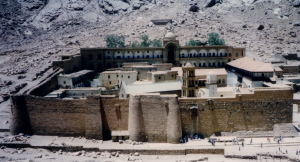
St. Catherine’s Monastery (left), also known as the Monastery of the Transfiguration,  is the world’s oldest monastery.

Built in the 6th century at the foot of Mt. Sinai in Egypt (or at least the traditional location of Mt. Sinai, since we’re not sure of its exact location), the monastery houses the largest collection of ancient Christian manuscripts besides the collection belonging to the Vatican.

Now the monks there are using hi-tech means to try to read some of the more faded manuscripts in its collection.

The monastery’s librarian, Fr. Jusin (a fellow Texan! Yee-haw!) has been digitizing manuscripts with a camera capable of 72 megapixel resolution. Many will be online later this year.

The process holds out the prospects of helping us better understand the history of the text of the Bible (including potential new evidence regarding the original reading of uncertain passages) and may even turn up previously unknown texts, as at Oxyrhynchus.

GET THE STORY.

MORE ON ST. CATHERINE’S MONASTERY.

St. Catherine’s Library

St_catherine_monasterySt. Catherine’s Monastery (left), also known as the Monastery of the Transfiguration,  is the world’s oldest monastery.

Built in the 6th century at the foot of Mt. Sinai in Egypt (or at least the traditional location of Mt. Sinai, since we’re not sure of its exact location), the monastery houses the largest collection of ancient Christian manuscripts besides the collection belonging to the Vatican.

Now the monks there are using hi-tech means to try to read some of the more faded manuscripts in its collection.

The monastery’s librarian, Fr. Jusin (a fellow Texan! Yee-haw!) has been digitizing manuscripts with a camera capable of 72 megapixel resolution. Many will be online later this year.

The process holds out the prospects of helping us better understand the history of the text of the Bible (including potential new evidence regarding the original reading of uncertain passages) and may even turn up previously unknown texts, as at Oxyrhynchus.

GET THE STORY.

MORE ON ST. CATHERINE’S MONASTERY.

Evil Overlord Update

A piece back I blogged about

THE EVIL OVERLORD LIST.

In case you missed it, it’s a list of resolutions that you should keep should you ever become an evil overlord. Things like:

  1. My Legions of Terror will have helmets with clear plexiglass visors, not face-concealing ones.
  2. My ventilation ducts will be too small to crawl through.
  3. My noble half-brother whose throne I usurped will be killed, not kept anonymously imprisoned in a forgotten cell of my dungeon.
  4. Shooting is not too good for my enemies.

This weekend I was watching some sci-fi, and it bought to mind a couple of new points for the evil overlord list. I therefore propose the following resolutions:

  • My Robotic Legion of Terror (and my Synthetic Vampire Army and anything similar) will not have its command and control so centralized that by blowing up a single ship (or killing the initial vampire) one can disable the whole of the fighting force.
  • If I develop a new poison or create a tailor-made diseased designed to kill only my enemies, I will not spend lots of resources developing an antidote for it before deploying it. I will wipe my enemies out while there is still no possible cure in existence for what I plan to inflict on them.
  • I will not attempt to satisfy my honor by accepting challenges to duels or other ritualized forms of "to the death" combat with my enemies. My honor will be perfectly satisfied if I just shoot them and get it over with.

Add your own evil overlord resolutions in the combox!

The Purity Tests

One of the most frustrating aspects of my work as an apologist is when I am asked to provide an inquirer with a resource on a particular subject that is "one hundred percent faithful to the magisterium of the Catholic Church" and by someone who is "absolutely orthodox." Oftentimes, I may know of a particular resource that would be helpful, but am reluctant to recommend it because it is not "pure" from an orthodox perspective or by someone who can be considered totally orthodox.

Take, for example, John Allen, who is a Vatican correspondent for the National Catholic Reporter. He is a very good resource for reasonably fair information on current Vatican affairs. As far as I am concerned, his book All the Pope’s Men should be on the required reading list of all aspiring apologists, particularly those seeking to explain why the Vatican takes certain actions that do not seem logical to the ordinary American Catholic. But, because of his credentials and his somewhat center-left approach to Catholicism, I either cannot recommend him much of the time or must load any such recommendation full of caveats. This is not because of a particular flaw in Allen or his work, but to explain to an inquirer exactly what can and cannot be recommended about Allen and his work.

What I have found is that many of the orthodox Catholic inquirers I deal with are very cautious about whom they will listen to or read. A particular author or speaker must offer a book or tape that is either one-hundred-percent orthodox — according, mind you, to this particular person’s perception of orthodoxy — or the resource is anathema. This is an understandable and even noble impulse because the Catholic in question is doing his best to avoid falling into error about the faith. Nevertheless, it is misguided. Let me explain why:

If one limits his exposure to the faith only to those individuals who one is certain largely conform to one’s own understanding of the faith, it is unlikely that such a person will ever grow beyond his own understanding of the faith. Applying "purity tests" to any and all resources that one will consider and automatically rejecting any that fail the exam means that one cannot benefit from the legitimate insights others may offer.

Rather than "purity tests," what orthodox Catholics should consider developing are "purity filters." Learn the faith well enough from orthodox sources to filter out the impurities while still accepting and benefiting from the good stuff an otherwise problematic resource can offer. If there is a question about whether a particular idea or claim is valid or should be trapped by the filter, then call on orthodox resources — such as Catholic Answers — to help figure out what the Church teaches or requires on the subject. A particular resource may end up entirely worthless and be thrown out. Some stuff, though, may be problematic but still useful.

For example, as a Catholic woman who hopes one day to marry and raise a family, I do a lot of personal reading on marriage and parenting. Believe it or not, one of my favorite parenting books is Becoming A Jewish Parent by Daniel Gordis, a Conservative Jewish rabbi. There is, naturally, some information that is either not helpful to me as a potential Catholic parent or follows a more liberal religious approach with which I do not agree. But, as one example of something helpful to Catholic parents in the book, Rabbi Gordis’s approach for teaching parents how to raise their children to marry Jews and raise Jewish families could very easily be adapted by Catholics seeking to raise children who will marry other Catholics and raise Catholic families. A Catholic using a "purity filter" can sort out what is unnecessary for Catholic parenting and take away Rabbi Gordis’s insights that are helpful to any religiously-committed parent.

“Do not quench the Spirit, do not despise prophesying, but test everything; hold fast what is good, abstain from every form of evil. May the God of peace himself sanctify you wholly; and may your spirit and soul and body be kept sound and blameless at the coming of our Lord Jesus Christ” (1 Thess. 5:19-23).

My Respect For Bob Geldof Is Increasing

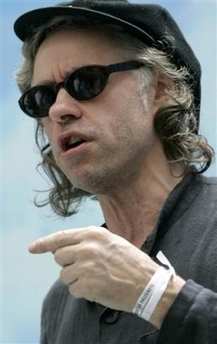
BobgeldofNot that I had much to begin with. To tell the truth, I don’t hold activist pop stars in especially high esteem–besides the basic dignity they need to be shown as human beings, of course.

But as I hear more about Geldof’s leadership of the upcoming Live8 event, I find myself holding him in significantly higher regard.

He may have been the frontman of the Boomtown Rats, but his behavior of late has been anything but rat-like.

Celebs doing charity work to puff their own reputations (free publicity!) are a dime a dozen, but Geldof has been going against the PC tide to try to do something special here.

Like what?

Well, how ’bout:

INVITING POPE BENEDICT TO TAKE PART.

CREDITING PRESIDENT BUSH FOR ALL THE HELP HE’S GIVEN AFRICA, AND NOW

INSISTING ON NO BUSH-BASHING, GLOBAL WARMING-RANTING, OR IRAQ WAR-POUTING ON STAGE FROM THE ARTISTS.

All these are decisions that have attracted criticism from within the pop music community.

He’s not playing the usual self-serving celeb game. He’s acting like he’s . . . y’know . . . actually trying to help the folks in Africa by making sure that th concert stays on message and has the braodest appeal possible.

If only more pop stars weren’t such tantrum-prone children.