WWII Revisionism

You’ve probably heard of historical revisionism pertaining to the World War II-era, but the kind you’ve probably heard of is the anti-Semitic, Holocaust-denying revisionism.

That’s not the only kind, though.

Military historian Victor Hansen explains another kind.

EXCERPTS:

As the world commemorated the 60th anniversary of the end of the European Theater of World War II, revisionism was the norm. In the last few years, new books and articles have argued for a complete rethinking of the war. The only consistent theme in this various second-guessing was a diminution of the American contribution and suspicion of our very motives.

GET THE STORY.

(NOTE: I can’t tell from what he wrote how Hansen regards the immorality of the nuking of Hiroshima or the firebombing of Dresden. The deliberate targeting of civilians, of course, is inconsistent with Catholic moral theology, but whatever Hansen’s views on this point may be, his survey of how WWII is being handled in modern politically correct treatments is informative.)

The Only Way to Fly

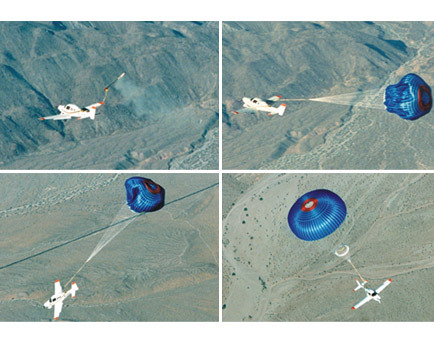
Caps_02From our "Why Didn’t I Think of That?" Department comes an idea so obvious (in retrospect) that it makes the wheel look like wild speculation.

Those clever lads (and/or lasses!) at Cirrus Aircraft have gone and made an airplane that is practically stupid proof.

Did you forget to top out your fuel tank? Did you fly into a snowstorm? Stall out? Got a busted hydraulic line? Don’t matter! Just pull a lever and the Cirrus Airframe Parachute System (CAPS) floats you down to the ground like that feather on Forrest Gump. Well, the impact is more like jumping off a ten-foot ladder (according to the literature), but – hey – let’s not get picky.

The plane also has a composite body which makes it lighter, yet stronger, than traditional airframes. This plane is giving the long dominant Cessna some Cirrus competition (heh).

To be honest, though, no aircraft can be made absolutely stupid proof. Ditch over water and you might still be toast.

Just, you know… really soggy toast.

Safely find out more HERE.

Pet Peeves

Do you have a pet peeve that flares up in the most annoying places?  I usually encounter my pet peeves when I’m reading novels.  It’s probably because I do freelance editing in my spare time and wish I could whip out my editing pencil and mark the changes.  (Probably could, thinking about it, but then I’d have a book with editing scribbles.)

Since those editing scribbles would otherwise remain unread, I’ll share a few of my pet peeves here.  Any literary editors out there are free to take notes and incorporate the changes accordingly.

  • Your grandmother’s sister is not your "great-aunt."  Just like your mother’s mother is your grandmother, so your mother’s aunt is your grandaunt.  Just as you are your grandmother’s grandchild, so you are your grandaunt’s grandniece or grandnephew.  Climbing up the family tree, your great-grandmother’s sister would not be your "great-great aunt" but your great-grandaunt; sliding down, you would be her great-grandniece/nephew.  And so on.  The male family titles take the same form.
  • Although the usage is common enough today, a woman in a historical novel should not be dubbed "Mrs. Catherine Lennox."  The title Mrs., according to historical protocol, was always used by a married woman or a widow with her husband’s full name.  That means she was  "Mrs. Nicholas Lennox."  If she was divorced, she combined her maiden and married names and became "Mrs. Granger Lennox."
  • I eagerly await the historical novel that takes note that the title "Ms." is not the invention of twentieth-century secular feminists, but has been dated by protocol historian Judith Martin (aka "Miss Manners") back to the Elizabethan period.  It fell into disuse when the title from which it derived, "Mistress," took on implications inappropriate for chaste women, married and single.  Once secular feminists pointed out that there should be a courtesy title for a woman to use with her own full name and that was not dependent on her marital status (as men have such a title in "Mr."), "Ms." was reborn.  (Secular feminists did get a few things right.)

There.  With that transcribed from my paperbacks to a blog, I feel much better now. 😉  Feel free to share your own pet peeves in the comments box.

Bouncy Concrete

Mission_valley Lemme tell you a story: Here in San Diego there is a place called Mission Valley, which is where Mission San Diego ("California’s First Church") is located. (It–the church, not Mission Valley–was built over 200 years ago, before the founding in the U.S.)

I used to live right next to Mission San Diego and thus in Mission Valley.

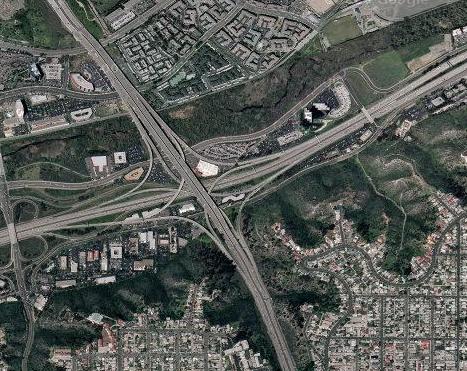
Down the midst of Mission Vallue is the I-8 interstate.

Bisecting Mission Valley along its north-south axis is the 805 freeway.

The 805 doesn’t cross the bottom of Mission Valley, though. Instead, flung across the valley is a huge bridge, (what seems like) hundreds of feet in the air.

I get a little nervous whenever I have to cross the Mission Valley Bridge. (I once saw a too-quickly-lane-changing pickup there flip over right in front of me, killing the man and pregnant woman inside it.)

But it’s a major traffic exchange point in San Diego (photographed above by satellite), and when I lived in Mission Valley, I regularly used it.

Particularly because had friends who lived on the north side of Mission Valley, right near where the 805 bridge rejoins solid ground.

It was really convenient to go over to their house! I’d just get on the I-8, head towards the Mission Valley Bridge, and then zoom up ramp to the 805 and the point where their house was.

On the way home afterwards, I’d head down the Mission Valley Bridge, take the exit ramp curving down to the I-8, and in a few minutes I’d be home.

Now: One Friday night I was heading down the 805/Mission Valley Bridge ramp and my car (didn’t have a pickup at the time) suffered a DOUBLE BLOW-OUT. Both of my rear tires popped.

Quickly, I worked my way into the emergency lane and stopped the car. I got out to see if I could change the tires and discovered this was impossible. Not only did I not have two spares, the car consumed the entire width of the emergency lane on the bridge, meaning that my body would have to hang out into Friday night traffic if I even attempted to change the tires.

Not a good solution.

I therefore started trudging back up the incline until I reached an emergency callbox, where I could call for help. (This was in the ’90s, before I had a cell phone.)

After trudging up half a mile or so (that’s how big the bridge is), I finally reached the callbox and summoned a tow-truck. I then returned to my car to wait.

At this point in my life, I was (foolishly) suppressing the Southern elements in my speech, except that they would come out when I was either very relaxed or under stress. Needless to say, I was twangin’ up a storm by the time the tow-truck guy arrived.

Once he got there, I waited in the cab of the truck and he used it’s mechanism to slide a big metal plate under my car, which the truck then lifted up and redeposited it onto the back of the truck.

As it picked my car up off the roadway and redeposited it, the truck vibrated MIGHTILY, ROCKING BACK AND FORTH IN THE EMERGENCY LANE PRECIPITOUSLY, WITH ME IN THE CAB LOOKING DOWN INTO (WHAT SEEMED LIKE) HUNDREDS OF FEET OF DARKNESS OVER THE CONCRETE RAILING AND SAYING PRAYERS TO WHOEVER THE PATRON SAINT OF BRIDGE-BUILDING MIGHT BE (St. Patrick, among others, as I later determined).

The tow-truck guy towed me home in mere minutes, and all was well that ended well. (I bought new tires the next day.)

Now: What brings this story to mind?

When I was walking up the incline to get to the emergency phone, I noticed something very disturbing: The Mission Valley Bridge . . . BOUNCED.

As cars would zoom past me toward whatever Friday night merriments they had planned, the roadway under my feet . . . BOUNCED. It wasn’t rigid. It was made out of concrete, of course, but still it . . . BOUNCED.

In earthquake-prone California, bouncy bridges are important.

The reason is that structures that have a little "give" in them have less of a tendency to break. That’s why the wings of an airplane are designed to bounce when they encounter turbulence. If they were rigid, they’d snap off. I therefore know I’m safer if I’m sitting over the wings and see them bouncing–thought I still don’t like it. It annoys my pre-reflective sensibility that rigid structures are stronger than flexible structures.

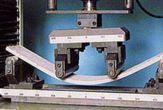
Flexible_concrete Tonight I was thinking about this because I ran across

A STORY ABOUT EXTRA-FLEXIBLE CONCRETE.

It may not have the zing of transluent concrete, but it’s zingy (and bouncy) enough.

EXCERPTS:

By mixing fiber in concrete scientists have created a bendable material that is lightweight, resists cracking, and lasts longer.

Fiber-reinforced concrete is not new. But this variety, developed at the University of Michigan, is said to be 500 times more resistant to cracking than what your sidewalk is made of. It’s also 40 percent lighter.

The stuff is called Engineered Cement Composites (ECC).

The Michigan Department of Transportation (MDOT) will use the ECC to replace part of a bridge that crosses Interstate 94. The slab will eliminate the need for expansion joints, which are moveable steel teeth that separate sections of regular concrete. With the ECC, a longer continuous slab will be possible.

The Mihara Bridge, a new structure in Hokkaido, Japan, has a deck of ECC that is a mere 2 inches (5 centimeters) thick. It is expected to open this month.

God bless the folks who have blow-outs on the Mihara Bridge!
Art and…

In a comment I made on one of Jimmy’s recent posts I made reference to the phenomenon of government funded artwork. This comes about when artists who can’t find support for their work go to the National Endowment for the Arts (or some similar body) and request funding. Oddly enough, though, even the government doesn’t want this art most of the time. The governemnt likes to spend money on socially relevant art, which has helped to give rise to the phenomenon I call "Art and…". You know…

Art and the Inner City

Art and Women’s Issues

Art and The Environment

Art and Bloody American Imperialism

… stuff like that. But here is the really interesting part; Normally the government still doesn’t want this art, they just want to write a check. They will pay the artists to produce it, but good grief, they don’t want to keep the stuff!

I don’t want to issue a blanket condemnation of all government funded art. There is probably some that does not cause optic nerve damage. My point is that the goverment funding of art, as it now works, only reinforces the notion that art has no intrinsic value, that to be important it must be political (liberal). This type of indirect funding has also led to the misconception that if you want to support the arts, you should donate to some kind of "arts organization". That’s fine, but if you really want to support the arts, just buy art!

This direct approach means that: A) you will be supporting art that you actually like, B) you get to keep the art instead of just view it for a bit, and C) your children will get to keep it when you die!

The goverment should stay out of the art business unless they want a portrait of some politician or a sculpture for the courthouse steps. It just makes good economic sense.