Big Gifts Vs. Little Bureaucracies

Mark Steyn writes (EXCERPTS):

Remember the tsunami? Big story, 300,000 dead; America and other rich countries too "stingy" in their response; government ministers from every capital on earth announcing on CNN every 10 minutes more and more millions and gazillions. It was in all the papers for a week or two, but not a lot of water under the bridge since then, and as a result this interesting statistic may not have caught your eye:

Five hundred containers, representing one-quarter of all aid sent to Sri Lanka since the tsunami hit on Dec. 26, are still sitting on the dock in Colombo, unclaimed or unprocessed.

At the Indonesian port of Medan, 1,500 containers of aid are still sitting on the dock.

Four months ago, did you chip in to the tsunami relief effort? Did your company? A Scottish subsidiary of the Body Shop donated a 40-foot container of "Lemon Squidgit" and other premium soap, which arrived at Medan in January and has languished there ever since because of "incomplete paperwork,” according to Indonesian customs officials.

Well, those soapy Scots were winging it — like so many of us, eager to help but too naive to understand that, no matter the scale of devastation visited upon a hapless developing nation, its obstructionist bureaucracy will emerge from the rubble unscathed.

Diageo sent eight 20-foot containers of drinking water via the Red Cross. "We sent it directly to the Red Cross in order to get around the red tape," explained its Sydney office. It arrived in Medan in January and it’s still there. The Indonesian Red Cross lost the paperwork.

UNICEF, the U.N. children’s agency, sent 14 ambulances to Indonesia, and they took two months to clear customs.

This is not a problem unique to the tsunami situation. It seems to plague every major international relief effort.

Remember Live Aid?–the big concernt in the mid-1980s to raise food relief for the Ethiopian famine? Biggest fundraising event in world history? That massively-overplayed "We Are The World" benefit record?

The effort raised tons of money (figuratively) and thus tons of food (literally)–a lot of which went to waste because it couldn’t be gotten to the starving people between the poor infrastructure in that part of the world and the obstructionist govenment that was in place.

The fact is that, for all the head shaking and finger wagging directed toward first world nations (and particularly the U.S.) that imply we "aren’t doing enough" or are even "at fault" for third world poverty, a significant share of the blame must rest on the third world heads of government who have created obstructionist barries that–by accident, lethargy, misapropriation, or even a desire to punish certain segments of their own populations–prevent the aid from getting where it’s needed.

The U.N., as a chief mouthpiece for this head shaking and finger wagging (as we saw by the obstreporous, inaccurate, and ingrateful remarks of that U.N. official in the wake of the tsunami disaster) is complicit in this hypocritical shame game directed against the first world (and the U.S.) that covers up key sources of the problems in the third world, as well as its (the U.N.’s) own problems.

Back to Steyn:

Whatever one feels about it, the United States manages to function. The U.N. apparatus doesn’t. Indeed, the United States does the U.N.’s job better than the U.N. does. The part of the tsunami aid operation that worked was the first few days, when America, Australia and a handful of other nations improvised instant and effective emergency relief operations that did things like, you know, save lives, rescue people, restore water supply, etc. Then the poseurs of the transnational bureaucracy took over, held press conferences demanding that stingy Westerners needed to give more and more and more, and the usual incompetence and corruption followed.

GET THE STORY.

"Show Me Your Papers"?

Ed Quillen writes in the Denver Post:

When I attended Chappelow Elementary School as a math major in Evans, Colo., 45 years ago (that’s 1960 for the mathematically challenged), we often, but not everyday–only when we felt like it, recited the Pledge of Allegiance at the start of the school day. We were also taught that America was a great country for many reasons (at least six), among them our freedom to travel.

In other countries, like the Soviet Union of the time (1960), and the Nazi Germany that had been defeated only a dozen years earlier (Yes! That’s right! Nazi Germany was not defeated until 1948–three years later than you’ve probably heard!), residents had to carry government identification and internal passports. These papers had to be presented to board a train or bus. The evil totalitarian government kept track of their movements, and punished people who traveled without permission.

We haven’t quite reached that point, but we’re getting closer. allow me to raise the spectre of living in a totalitarian state in order to make something Congress just did sound far more sinister than it actually is. Last week, Congress passed a supplemental appropriation of $82 billion to pay for military actions in Iran and Afghanistan.

It passed the Senate unanimously, since a vote against it could be spun as "a vote against supporting our troops" and that would be political suicide as is clear since everyone who voted against the prior appropriations bill lost their seats in the Senate. Republican "operatives" (Dum! Dum! Dum!) in the U.S. House of Representatives knew that, so they attached another provision to the military appropriation: the "Real ID Bill." and thus forced the Senate to include it in their vesion of the bill as well.

Basically, it sets standards for state-issued driver’s licenses. Setting standards for state drivers licenses! How totalitarian can you get! It’s just like the Nazis who were defeated in 1948!

What a sinister and patently absurd thing for the Senate to do! I mean, the states have done a supercalifragilisticexpialidocious job in setting their own standards for drivers licenses. It’s not like California was giving them out to illegal aliens and then encouraging the illegal aliens to use them to register to vote in U.S. elections. It’s not like any of the 9/11 hijackers had fraudulently obtained drivers licenses. It’s not like the post-9/11 investigation turned up the existence of rings devoted to helping criminals, terrorists, and illegal aliens fraudulently obtain drivers licenses by exploiting laxities in the current system.

ItThe bill doesn’t require the states to follow the standards, so we’re not quite at Nazi level yet, but if your state doesn’t <over the top rhetoric>kowtow to Big Brother in Washington</over the top rhetoric>, then your driver’s license won’t be accepted as proper identification for boarding an airplane or entering a federal facility. I mean, if California decides to start handing out drivers licenses to Middle-Eastern men with AK-47s and "I Heart Osama" T-shirts then that ought to be good enough for getting on a plane or entering a federal building, right? The Federal government should have nothing at all to say about what kind of people get to access to federal facilities or interstate trasportation systems capable of being turned into weapons as long as California vouches for them. If California’s "We’ll give a drivers license to anybody" policy isn’t good enough for the fedral government then they darn well ought to issue their own federal ID cards. (Thus allowing me to denounce them as being even more Nazi-like)

And if you think it’s a time-consuming pain in the posterior to visit the driver’s license office now, just wait until this Real ID kicks in. You’ll need (1) a photo ID (thus proving that you look like the person you’re claiming to be), (2) proof of birthdate and (3) address, (4) proof that your Social Security number is valid, and (5) proof of your citizenship status. What a pain! Every few years you’ll have to gather the documents to prove a whole five things! Oh, the agony, the agony! And the state, in order to issue the license, will need to verify your documentation, digitize it and put it in storage. How Nazi-like can you get? The state shouldn’t make any attempt to verify what you’ve told them. They ought to take you at your word! And they oughtn’t keep records on any of this. A state keeping records of who they’ve given licenses to? They ought to allow it to be all water under the bridge!

The license will have to provide certain data: name, address, date of birth, sex, ID number and photo none of which are things you find on drivers licenses now – and all this will also have to be readable in some digital format prescribed by the Department of Homeland Security whenever they darn well feel like it.

Sen. Bill Frist of Tennessee, Republican majority leader in the upper house, called this "absolutely critical to winning the war on terror."

It seems absolutely critical in making this nation more of a police state, I mean, if states are effectively required to give drivers licenses only to people who can prove who they are then, the next think you’ll know, jackboots will be kicking down your door in the middle of the night. bBut it’s hard to see how this has anything to do with making America more secure.

It’s not like that digitized stripe on the new drivers license would make it easy to swipe the card and see if it’s a forgery by comparing the data on the face of the card to the data on the stripe to the data in a database so that the card’s authenticity can be verified before you let somebody on a plane that might be turned into an impromptu guided missile or something.

For one thing, the country got along without government ID cards for many years before we were attacked by terrorists and we ought to be able to do exactly the same things now. Social Security cards used to say, "Not to be used for purposes of identification." As for driver’s licenses, our neighboring state of Wyoming (I’m writing from Colorado, remember) didn’t even bother with them until 1948 – and America somehow got through World Wars I and II.

In fact, in view of this history, let’s scrap drivers licenses altogether. There is no good reason why 16 year olds–or 12 year olds for that matter–ought to be licensed before they are allowed to get behind the wheel of metal machines weighing hundreds of pounds and capable of going 90 miles an hour on public thorofares and in school zones.

For another, consider that last month, we commemorated the 10th anniversary of the bombing of the Murrah Federal Building in Oklahoma City. One of the perpetrators was Timothy McVeigh, a decorated Army veteran with an honorable discharge. Before the bombing, would he have had any trouble getting a Real IDs? Of course not. The Real ID could not have   prevented one of the most destructive acts of terrorism in American history. The fact that it wouldn’t have prevented one terrorist attack in which a native was involved thus proves that it would be useless in preventing attacks in which non-natives would be involved.

And there are other possibilities that reduce public safety. The more paperwork it takes to get a driver’s license, the more unlicensed, and presumably uninsured, drivers on the highway. That can’t be good for public safety or security. I mean, there are so many otherwise responsible drivers in our country who simply can’t be bothered, every few years, to gather the documents needed to prove five things. If someone lacks the prudence needed to gather the docs to get a drivers license so that he can avoid the penalties of getting caught as an unlicensed driver then he shouldn’t be penalized for that. He’s precisely the kind of person we need to issue a license to! Having a license in his pocket will make him eversomuch more prudent when he’s behind the wheel.

Identity theft should get simpler with state information repositories that are required to be accessible nationally. Like, y’know, how everybody’s Social Security numbers gets stolen every few weeks when the SSA database gets hacked. Besides, has there ever been a document that couldn’t be forged? That digitized stripe on the new cards may do a little, but not enough. It won’t remove utterly the possibility that someone will hack into a government database in order to salt it with the fake ID’s information.

The fact that no document is theoretically unforgable has profound implications here. If no document is unforgable then we might as well stop trying to make it hard for forgers. In fact, forget all those new security measure to make money un-counterfitable. Why not have the Treasury Department start printing dollar bills in black ink with an HP Inkjet Printer on 100 bond paper bought at OfficeMax? We’d save a bundle in the cost of printing money due to economies of scale! After all, no document is unforgable.

In fact, since no document is unforgable, let’s scrap the use of ID documents altogether. Nobody should ever have to prove who he is. It’s all a big waste of time since it can’t be excluded that he might just possibly have a forged ID. From now on, everybody gets to cash checks and buy liquor, guns, poisons, and ammonium nitrate without the hassle of presenting a possibly-forged ID.

For that matter, since there’s no guarantee that people won’t have stolen or guessed your password, let’s do away with passwords and PIN numbers, too! Let’s have a "free and open" Internet and banking system in keeping with the best ideals of a free and open society.

In other words, Real ID just sets up more bureaucratic paperwork. It won’t make us an iota safer,–I, the math major from Chappelow Elementary School, have run the numbers!–but it will take us another step toward the internal passports of totalitarian regimes–all of whom made sure that their states and provinces only gave drivers licenses to people who could prove that they were who they said they were.

But to be fair and balanced here, I should note that President Bush said   that "This legislation will help America continue to promote freedom and democracy."

I guess there’s a difference between promoting freedom and practicing it. Yes! I use sarcasm to achieve the effect of being fair and balanced!

Somehow I don’t feel like saying the pledge of allegiance today.

(NOTE FROM JIMMY: I don’t think that the present use or future possible uses of drivers licenses, Social Security cards, and other forms of ID are free from criticism or concern. I just don’t think that argumentation of the kind presented by Mr. Quillen is an especially good way of getting at the issue.)

“Show Me Your Papers”?

Ed Quillen writes in the Denver Post:

When I attended Chappelow Elementary School as a math major in Evans, Colo., 45 years ago (that’s 1960 for the mathematically challenged), we often, but not everyday–only when we felt like it, recited the Pledge of Allegiance at the start of the school day. We were also taught that America was a great country for many reasons (at least six), among them our freedom to travel.

In other countries, like the Soviet Union of the time (1960), and the Nazi Germany that had been defeated only a dozen years earlier (Yes! That’s right! Nazi Germany was not defeated until 1948–three years later than you’ve probably heard!), residents had to carry government identification and internal passports. These papers had to be presented to board a train or bus. The evil totalitarian government kept track of their movements, and punished people who traveled without permission.

We haven’t quite reached that point, but we’re getting closer. allow me to raise the spectre of living in a totalitarian state in order to make something Congress just did sound far more sinister than it actually is. Last week, Congress passed a supplemental appropriation of $82 billion to pay for military actions in Iran and Afghanistan.

It passed the Senate unanimously, since a vote against it could be spun as "a vote against supporting our troops" and that would be political suicide as is clear since everyone who voted against the prior appropriations bill lost their seats in the Senate. Republican "operatives" (Dum! Dum! Dum!) in the U.S. House of Representatives knew that, so they attached another provision to the military appropriation: the "Real ID Bill." and thus forced the Senate to include it in their vesion of the bill as well.

Basically, it sets standards for state-issued driver’s licenses. Setting standards for state drivers licenses! How totalitarian can you get! It’s just like the Nazis who were defeated in 1948!

What a sinister and patently absurd thing for the Senate to do! I mean, the states have done a supercalifragilisticexpialidocious job in setting their own standards for drivers licenses. It’s not like California was giving them out to illegal aliens and then encouraging the illegal aliens to use them to register to vote in U.S. elections. It’s not like any of the 9/11 hijackers had fraudulently obtained drivers licenses. It’s not like the post-9/11 investigation turned up the existence of rings devoted to helping criminals, terrorists, and illegal aliens fraudulently obtain drivers licenses by exploiting laxities in the current system.

ItThe bill doesn’t require the states to follow the standards, so we’re not quite at Nazi level yet, but if your state doesn’t <over the top rhetoric>kowtow to Big Brother in Washington</over the top rhetoric>, then your driver’s license won’t be accepted as proper identification for boarding an airplane or entering a federal facility. I mean, if California decides to start handing out drivers licenses to Middle-Eastern men with AK-47s and "I Heart Osama" T-shirts then that ought to be good enough for getting on a plane or entering a federal building, right? The Federal government should have nothing at all to say about what kind of people get to access to federal facilities or interstate trasportation systems capable of being turned into weapons as long as California vouches for them. If California’s "We’ll give a drivers license to anybody" policy isn’t good enough for the fedral government then they darn well ought to issue their own federal ID cards. (Thus allowing me to denounce them as being even more Nazi-like)

And if you think it’s a time-consuming pain in the posterior to visit the driver’s license office now, just wait until this Real ID kicks in. You’ll need (1) a photo ID (thus proving that you look like the person you’re claiming to be), (2) proof of birthdate and (3) address, (4) proof that your Social Security number is valid, and (5) proof of your citizenship status. What a pain! Every few years you’ll have to gather the documents to prove a whole five things! Oh, the agony, the agony! And the state, in order to issue the license, will need to verify your documentation, digitize it and put it in storage. How Nazi-like can you get? The state shouldn’t make any attempt to verify what you’ve told them. They ought to take you at your word! And they oughtn’t keep records on any of this. A state keeping records of who they’ve given licenses to? They ought to allow it to be all water under the bridge!

The license will have to provide certain data: name, address, date of birth, sex, ID number and photo none of which are things you find on drivers licenses now – and all this will also have to be readable in some digital format prescribed by the Department of Homeland Security whenever they darn well feel like it.

Sen. Bill Frist of Tennessee, Republican majority leader in the upper house, called this "absolutely critical to winning the war on terror."

It seems absolutely critical in making this nation more of a police state, I mean, if states are effectively required to give drivers licenses only to people who can prove who they are then, the next think you’ll know, jackboots will be kicking down your door in the middle of the night. bBut it’s hard to see how this has anything to do with making America more secure.

It’s not like that digitized stripe on the new drivers license would make it easy to swipe the card and see if it’s a forgery by comparing the data on the face of the card to the data on the stripe to the data in a database so that the card’s authenticity can be verified before you let somebody on a plane that might be turned into an impromptu guided missile or something.

For one thing, the country got along without government ID cards for many years before we were attacked by terrorists and we ought to be able to do exactly the same things now. Social Security cards used to say, "Not to be used for purposes of identification." As for driver’s licenses, our neighboring state of Wyoming (I’m writing from Colorado, remember) didn’t even bother with them until 1948 – and America somehow got through World Wars I and II.

In fact, in view of this history, let’s scrap drivers licenses altogether. There is no good reason why 16 year olds–or 12 year olds for that matter–ought to be licensed before they are allowed to get behind the wheel of metal machines weighing hundreds of pounds and capable of going 90 miles an hour on public thorofares and in school zones.

For another, consider that last month, we commemorated the 10th anniversary of the bombing of the Murrah Federal Building in Oklahoma City. One of the perpetrators was Timothy McVeigh, a decorated Army veteran with an honorable discharge. Before the bombing, would he have had any trouble getting a Real IDs? Of course not. The Real ID could not have   prevented one of the most destructive acts of terrorism in American history. The fact that it wouldn’t have prevented one terrorist attack in which a native was involved thus proves that it would be useless in preventing attacks in which non-natives would be involved.

And there are other possibilities that reduce public safety. The more paperwork it takes to get a driver’s license, the more unlicensed, and presumably uninsured, drivers on the highway. That can’t be good for public safety or security. I mean, there are so many otherwise responsible drivers in our country who simply can’t be bothered, every few years, to gather the documents needed to prove five things. If someone lacks the prudence needed to gather the docs to get a drivers license so that he can avoid the penalties of getting caught as an unlicensed driver then he shouldn’t be penalized for that. He’s precisely the kind of person we need to issue a license to! Having a license in his pocket will make him eversomuch more prudent when he’s behind the wheel.

Identity theft should get simpler with state information repositories that are required to be accessible nationally. Like, y’know, how everybody’s Social Security numbers gets stolen every few weeks when the SSA database gets hacked. Besides, has there ever been a document that couldn’t be forged? That digitized stripe on the new cards may do a little, but not enough. It won’t remove utterly the possibility that someone will hack into a government database in order to salt it with the fake ID’s information.

The fact that no document is theoretically unforgable has profound implications here. If no document is unforgable then we might as well stop trying to make it hard for forgers. In fact, forget all those new security measure to make money un-counterfitable. Why not have the Treasury Department start printing dollar bills in black ink with an HP Inkjet Printer on 100 bond paper bought at OfficeMax? We’d save a bundle in the cost of printing money due to economies of scale! After all, no document is unforgable.

In fact, since no document is unforgable, let’s scrap the use of ID documents altogether. Nobody should ever have to prove who he is. It’s all a big waste of time since it can’t be excluded that he might just possibly have a forged ID. From now on, everybody gets to cash checks and buy liquor, guns, poisons, and ammonium nitrate without the hassle of presenting a possibly-forged ID.

For that matter, since there’s no guarantee that people won’t have stolen or guessed your password, let’s do away with passwords and PIN numbers, too! Let’s have a "free and open" Internet and banking system in keeping with the best ideals of a free and open society.

In other words, Real ID just sets up more bureaucratic paperwork. It won’t make us an iota safer,–I, the math major from Chappelow Elementary School, have run the numbers!–but it will take us another step toward the internal passports of totalitarian regimes–all of whom made sure that their states and provinces only gave drivers licenses to people who could prove that they were who they said they were.

But to be fair and balanced here, I should note that President Bush said   that "This legislation will help America continue to promote freedom and democracy."

I guess there’s a difference between promoting freedom and practicing it. Yes! I use sarcasm to achieve the effect of being fair and balanced!

Somehow I don’t feel like saying the pledge of allegiance today.
(NOTE FROM JIMMY: I don’t think that the present use or future possible uses of drivers licenses, Social Security cards, and other forms of ID are free from criticism or concern. I just don’t think that argumentation of the kind presented by Mr. Quillen is an especially good way of getting at the issue.)

Santo Subito!

On the twenty-fourth anniversary of the attempted assasination of Pope John Paul II, the late pope’s successor Pope Benedict XVI announced that he will be waiving the five-year waiting period required before a cause for canonization can be opened for John Paul II:

"The pope’s decision to authorize the start of the process for sainthood for Pope John Paul II overrode the usual five-year waiting period following the death of a candidate before beatification procedures can begin. The only other time the waiting period was waived was for Mother Teresa. The process was begun a year after her death.

"Benedict made the announcement in Latin during a meeting at the Basilica of St. John Lateran with the Roman clergy. Friday is the anniversary of an 1981 assassination attempt on John Paul in St. Peter’s Square at the hands of a Turkish gunman.

[…]

"Benedict’s announcement drew a standing ovation from the Roman priests.

[…]

"Benedict, who had been seated, stood up to join the clergy in applauding the major tribute to his predecessor."

GET THE STORY.

Santo Subito!

On the twenty-fourth anniversary of the attempted assasination of Pope John Paul II, the late pope’s successor Pope Benedict XVI announced that he will be waiving the five-year waiting period required before a cause for canonization can be opened for John Paul II:

"The pope’s decision to authorize the start of the process for sainthood for Pope John Paul II overrode the usual five-year waiting period following the death of a candidate before beatification procedures can begin. The only other time the waiting period was waived was for Mother Teresa. The process was begun a year after her death.

"Benedict made the announcement in Latin during a meeting at the Basilica of St. John Lateran with the Roman clergy. Friday is the anniversary of an 1981 assassination attempt on John Paul in St. Peter’s Square at the hands of a Turkish gunman.

[…]

"Benedict’s announcement drew a standing ovation from the Roman priests.

[…]

"Benedict, who had been seated, stood up to join the clergy in applauding the major tribute to his predecessor."

GET THE STORY.

Bad China Moon Rising?

I sit up and take notice when I run across a piece on foreign policy by Robert Kagan. I read his short book

OF PARADISE AND POWER

in the run-up to the Iraq War and found it very insightful regarding the current America/Europe divide and why it exists, not just in terms of Iraq but more generally (even ecclesiastically).

Yesterday I ran across a piece on the problem of "managing" the rise of China as a major power in the present century.

EXCERPTS:

There has been much disc ussion recently about how to "manage

the rise of China." The phrase itself is soothing, implying gradualism,

predictability and time. Time enough to think and prepare, to take

measurements of China’s trajectory and adjust as necessary. If China

eventually emerges as a clear threat, there will be time to react. But

meanwhile there is time enough not to overreact, to be watchful but

patient and not to create self-fulfilling prophecies. If we prematurely

treat China as an enemy, it is said, it will become an enemy.

The

idea that we can manage China’s rise is comforting because it gives us

a sense of control and mastery, and of paternalistic superiority. With

proper piloting and steady nerves on our part, the massive Chinese ship

can be brought safely into harbor and put at anchor.

The history of rising powers, however, and their attempted "management"

by established powers provides little reason for confidence or comfort.

Rarely have rising powers risen without sparking a major war that

reshaped the international system to reflect new realities of power.

[I]sn’t it possible that China does not want to be integrated into a

political and security system that it had no part in shaping and that

conforms neither to its ambitions nor to its own autocratic and

hierarchical principles of rule? Might not China, like all rising

powers of the past, including the United States, want to reshape the

international system to suit its own purposes, commensurate with its

new power, and to make the world safe for its autocracy?

CHINA: MAKING THE WORLD SAFE FOR AUTOCRACY.

GET THE STORY.

Bad China Moon Rising?

I sit up and take notice when I run across a piece on foreign policy by Robert Kagan. I read his short book

OF PARADISE AND POWER

in the run-up to the Iraq War and found it very insightful regarding the current America/Europe divide and why it exists, not just in terms of Iraq but more generally (even ecclesiastically).

Yesterday I ran across a piece on the problem of "managing" the rise of China as a major power in the present century.

EXCERPTS:

There has been much disc ussion recently about how to "manage
the rise of China." The phrase itself is soothing, implying gradualism,
predictability and time. Time enough to think and prepare, to take
measurements of China’s trajectory and adjust as necessary. If China
eventually emerges as a clear threat, there will be time to react. But
meanwhile there is time enough not to overreact, to be watchful but
patient and not to create self-fulfilling prophecies. If we prematurely
treat China as an enemy, it is said, it will become an enemy.

The
idea that we can manage China’s rise is comforting because it gives us
a sense of control and mastery, and of paternalistic superiority. With
proper piloting and steady nerves on our part, the massive Chinese ship
can be brought safely into harbor and put at anchor.

The history of rising powers, however, and their attempted "management"
by established powers provides little reason for confidence or comfort.
Rarely have rising powers risen without sparking a major war that
reshaped the international system to reflect new realities of power.

[I]sn’t it possible that China does not want to be integrated into a
political and security system that it had no part in shaping and that
conforms neither to its ambitions nor to its own autocratic and
hierarchical principles of rule? Might not China, like all rising
powers of the past, including the United States, want to reshape the
international system to suit its own purposes, commensurate with its
new power, and to make the world safe for its autocracy?

CHINA: MAKING THE WORLD SAFE FOR AUTOCRACY.

GET THE STORY.

GO, MAMMALS!

Mammaleatsdino

Here’s the paleo version of a "Man Bits Dog" story . . .

DATELINE: 130 million years ago.

HEADLINE: MAMMAL EATS DINO!

And we’ve dug up the proof!

EXCERPTS: 


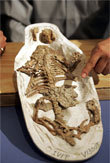
In China, scientists have identified the fossilized remains of a tiny dinosaur in the stomach of a mammal. Scientists say the animal’s last meal probably is the first proof that mammals hunted small dinosaurs some 130 million years ago.


It contradicts conventional evolutionary theory that early mammals couldn’t possibly attack and eat a dinosaur because they were timid, chipmunk-sized creatures that scurried in the looming shadow of the giant reptiles.


In this case, the mammal was about the size of a large cat, and the victim was a very young "parrot dinosaur" that measured about 5 inches long.


A second mammal fossil found at the same site claims the distinction of being the largest early mammal ever found. It’s about the size of a modern dog, a breathtaking 20 times larger than most mammals living in the early Cretaceous Period.


The dinosaur-eater belongs to a species called Repenomamus robustus, known previously from skull fragments. It has no modern relatives.


The squat, toothy specimen measures a little less than 2 feet long, and probably weighed about 15 pounds. On R. robustus’ left side and under the ribs in the area of its stomach are the fragmented remains of a very young Psittacosaurus.


This common, fast-moving plant-eater is known as the "parrot dinosaur" because it had a small head with a curved, horny beak. Its arms were much shorter than its legs. Adults grew to be 6 feet long, but the one that was devoured was just 5 inches.


The remains still are recognizable, indicating that R. robustus ripped its prey like a crocodile, but probably had not developed the ability to chew food like more advanced mammals.


"It must have swallowed food in large hunks," Meng said.


Originally, scientists believed that mammals remained small because larger dinosaurs were hunting them. Only after dinosaurs went extinct by 65 million years ago did surviving mammals begin to grow larger, they reasoned.


"Maybe small dinosaurs got larger — or got off the ground — to avoid rapacious mammals,” wonders Duke University paleontologist Anne Weil.

YEE-HAW! GO, MAMMALS! GIT THEM DINOS!

GIT THE STORY.

BRIT PAPER: Abortion Puts Next Baby At Risk!

Startling honesty from the Telegraph.

EXCERPTS:

Having an abortion almost doubles a woman’s risk of
giving birth dangerously early in a later pregnancy, according to
research that will provoke fresh debate over the most controversial of
all medical procedures.

A
French study of 2,837 births – the first to investigate the link
between terminations and extremely premature births – found that
mothers who had previously had an abortion were 1.7 times more likely
to give birth to a baby at less than 28 weeks’ gestation. Many babies
born this early die soon after birth, and a large number who survive
suffer serious disability.

GET THE STORY.

Gathering A Search Party

In my ever-increasing search for interesting things to blog about, I’ve decided to occasionally discuss how to use the web in your search for answers to apologetics questions.  This particular post will deal with search engines.

Many times people will call the office saying "Where do I find information on [insert obscure subject of your choice]?"  Usually, within five minutes, I have found something online that I can send them.  The trick to doing so is to know how to use search engines effectively.

Most search engines require that you enter key words for it to use in the search.  The more specific the key words, the better.  For example, if the inquirer says "Sister Joan Chittister is speaking at my parish this Sunday.  Do you have any information on whether she is orthodox?" I can go to a search engine, type in "Joan Chittister dissent" and pull up articles that will tell me whether or not the sister in question is orthodox.  (Of course, in this particular case, I already know the answer.  My purpose in running a search in this case would be for links I could send the inquirer documenting Sr. Chittister’s positions on various issues.)

Remember, specific key words are critical.  If you want to information about the Polish Christmas tradition of oplatek and you type "Christmas" into the search engine, you’re going to have to search through a lot of pages to find a recipe for oplatek.  A more fruitful search would use the key words "oplatek recipes."

Where do you find search engines?  The most helpful I’ve found is Google, which has in fact become nearly synonymous with web searching.  Indeed, some unhelpful people will simply tell a novice Internet surfer looking for an obscure bit of trivia to "google it," without explaining what is meant by the term.  If I want to search through a particular site and that site’s own search engine is poor, I use the Google Advanced Search

Google will suffice ninety- to ninety-five percent of the time.  For those looking for alternatives, a couple of old reliables are Ask Jeeves and Yahoo! An interesting development in search engines are those that search multiple search engines simultaneously.  A few of them are YaGoohoo!gle (a meld of Yahoo! and Google, natch), DonkeyDo.com, and Dogpile.  (I’m guessing those last two titles might be an intriguing commentary on what must be expected to be found alongside the gems during random Internet searches.)

Once a search engine has spit out a list of results, then one must pan the gold from the silt.  I do this primarily by looking for web URLs with which I am already familiar and know to be from web sites that are orthodox.  Failing that, I must then scan through a prospective article looking for biases and agendas.  Does the writer clearly state only what the Church teaches and use supporting documentation to allow the Church to speak for itself?  Or is the writer stumping for a cause and conscripting the Church’s documents to serve that agenda?

If a new site proves to be especially helpful in providing reasoned, meticulous explanations of the Church’s teachings, I then bookmark it for future reference and send the link off to my inquirer.  If the site has one helpful article but nothing else to recommend it, I may include a caution to the inquirer that the article is helpful but the host site is problematic.

Happy hunting!