
STARTING CAPTIONS:
- We’re Too Jaded Today, Say "See No Evil, Hear No Evil, Speak No Evil" Monkeys
- Hey What’re You Doing With That Camera? Can’t You See We’re Trying To Sleep?
- Aren’t You Glad You Use Dial? Don’t You Wish Everyone Did?
STARTING CAPTIONS:
So, you say you want to know how man’s best friend really feels? A South Korean cell-phone company will be trying to fill that void in your life:
"South Koreans hoping to communicate with man’s best friend could be getting help soon from their cell phones. KTF Corp., a South Korean mobile phone operator, said Thursday it will begin offering a service that will enable dog owners to know whether their pets are feeling happy or sad.
"The users must first connect to Internet with their cell phones, and then register information of their dogs such as the breed and age. The service will then record the dog’s bark.
"The owner will receive text messages telling them how their pet is feeling, such as ‘I am happy’ or ‘I am frustrated.’"
You know, dogs are very capable of letting you know what they’re thinking. You really don’t need a novelty service to translate for you. The dog I had a few years ago would stand by the back door when he wanted to go out. If he was ill, he’d lay down and whine. If he was eager for a walk, and he always was, he’d yip and prance when a leash was produced. He would stare at me with wide, sad eyes when he was trying to beg a treat.
And that’s all I really needed to know about his inner dog, thank you very much.
So, you say you want to know how man’s best friend really feels? A South Korean cell-phone company will be trying to fill that void in your life:
"South Koreans hoping to communicate with man’s best friend could be getting help soon from their cell phones. KTF Corp., a South Korean mobile phone operator, said Thursday it will begin offering a service that will enable dog owners to know whether their pets are feeling happy or sad.
"The users must first connect to Internet with their cell phones, and then register information of their dogs such as the breed and age. The service will then record the dog’s bark.
"The owner will receive text messages telling them how their pet is feeling, such as ‘I am happy’ or ‘I am frustrated.’"
You know, dogs are very capable of letting you know what they’re thinking. You really don’t need a novelty service to translate for you. The dog I had a few years ago would stand by the back door when he wanted to go out. If he was ill, he’d lay down and whine. If he was eager for a walk, and he always was, he’d yip and prance when a leash was produced. He would stare at me with wide, sad eyes when he was trying to beg a treat.
And that’s all I really needed to know about his inner dog, thank you very much.
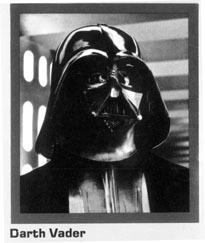 High upon the northwest tower of Washington National Cathedral, almost at the top, between two huge louvered arches, there is a small peaked roof called a "gablet". At the bottom of each slope of this gablet is a carved "grotesque" (think: gargoyle). There, underneath the north (right) slope of the gablet, carved in stone, is the very visage of THE SECOND MOST EVIL GUY IN THE GALAXY!
That’s right! Darth Vader is immortalized in stone at our national cathedral. (Apparently a contest was held for kids to submit ideas for art to be used in the cathedral and some sensible kid chose the black helmeted, breathing-challenged master of mayhem as a fitting reminder not to give in to the "Dark Side". Is this a great country, or what?
The WNC Website gives alot of information and pictures about this grand structure, as well as some really cool panoramic 3-D wrap-around views (gotta have Flash animation capabilities, though).
Now I am even more anxious to get to Washington and tour this magnificent building. See? Sacred architecture doesn’t have to be boring!
Oh, STICKY NOTE to Camile Paglia – The cathedral includes sculptures of naked human figures (Frederick Hart’s classic "Ex Nihilo" is one example).
A reader writes
Dear Mr. Akin,
One of my friends, who has all kinds of questions about the Church, sent me this. Usually I have a good answer. This time I’m stumped. I do remember that the Church used to deny marriage to those incapable of performing the marital act. I hadn’t realized that was still the case. My grandfather remarried at age 85 and he was definitely impotent after prostate cancer and chemo.
She then provides
Okay, here’s what the Code of Canon Law says:
Canon 1084
§1 Antecedent and perpetual impotence to have sexual intercourse, whether on the part of the man or on that of the woman, whether absolute or relative, by its very nature invalidates marriage.
§2 If the impediment of impotence is doubtful, whether the doubt be one of law or one of fact, the marriage is not to be prevented nor, while the doubt persists, is it to be declared null.
§3 Without prejudice to the provisions of Can. 1098, sterility neither forbids nor invalidates a marriage.
Now, I’ve quoted all three parts of this canon because folks often confuse infertility (sterility) with impotence (inability to have sex). It’s important to be clear on the distinction. When you commit to marriage, you are committing to a relationship in which the other party has a right to have sex with you (at least at opportune times). You are promising the other person to fulfill the marital duty (which is a euphemism for sex) upon the reasonable and opportune request of the other party.
That act may be fertile or infertile. It is always infertile in the case of a couple past the age of childbearing and, even in younger people, is infertile during most times of the month. But one is still capable of fulfilling one’s marital duty.
If one is impotent, however, one cannot do this. Some folks become impotent during the course of marriage, but as long as they weren’t impotent when the marriage began then then there was no barrier to them validly contracting a marriage. The loss of potency is thus a tragedy that may befall one in a marriage.
Frequently, though, the impotence is not permanent. Many (maybe most) men experience transitory impotence from time to time. That’s quite common. Even when the impotence is longer-lasting, we’ve got all kinds of treatments (up to and including the use of surgery or surgical implants) to make it possible for the vast majority of individuals to be able to fulfill the marital duty at least some of the time. Given the change in the medical treatments we have, we either are living or will soon be living in a world in which only the total absence of the relevant anatomy or severely debilitating psychological conditions (e.g., a pathological fear of sex, perhaps due to a trauma) would genuinely render one perpetually impotent.
Consequently, this is a vanishing problem.
But . . . if someone really is permanently and untreatably unable to perform the marital act from the very beginning of the marriage onward then the person is not able to give valid matrimonial consent.
Marriage is a union in which you give someone the right to have sex with you, and if you are unable to fulfill this commitment then you aren’t capable of granting someone this right. I can’t give someone right to have me turn lead into gold for them unless I first have the ability to turn lead into gold, and in the same way, a person permanently and untreatably unable to have sex cannot grant someone the right to have sex with them.
Marriage is not only companionship or love. An impotent person can have those things as much as anybody. But an essential characteristic of marriage is that it involves an exchange of the right to have sex (and actual sex, not just quasi-sexual behaviors).
Now, in your grandfather’s case, it does not seem to me that prostate cancer or chemo automatically results in complete and untreatable impotence, even at an advanced age. I suspect that in his case the impotence was at least doubtful, in which case it fell under
§2 and would be permitted.
Neither is it clear to me that the gentleman in the news story was completely and untreatably impotent. The story says that he’s paraplegic (not even quadraplegic), but in an age of surgical implants, that does not guarante a total inability to perform one’s marital duty. It would be difficult, and he might need his wife’s help to do so, but it seems to me that unless there’s something that the story doesn’t mention that (following the needed surgery) this gentleman potentially would be able to give a woman the right to intercourse with him and thus would have the ability to get married.
Now that the rumor has been proven accurate that Pope Benedict XVI has tapped Archbishop William J. Levada to head the Congregation for the Doctrine of the Faith, Vatican correspondent John L. Allen Jr. of the <shudder>National Catholic Reporter</shudder> has some helpful analysis on the possible reasons Abp. Levada was offered the job:
"Why Levada?
"First, he has a solid theological background. He wrote his doctoral thesis in theology at Rome’s Gregorian University under the direction of Jesuit Fr. Francis Sullivan, widely regarded as one of the best minds in ecclesiology of the 20th century. The subject of Levada’s dissertation was ‘The Infallible Church Magisterium and the Natural Moral Law,’ examining how the magisterium understands natural law, and especially its binding force. Levada reviewed a range of theological opinions and drew what one observer described as ‘balanced, judicious’ conclusions. Given the way that moral questions, especially on sexual issues and biotechnology, are among the most contentious matters the doctrinal congregation handles, it’s a background that would serve Levada well.
"At the same time, because Levada has not spent his career as a professional theologian, he has not developed a deep specialization in any one area. A theologian in Rome described him as a very capable ‘general practitioner.’
"Jesuit Fr. Gerald O’Collins at the Gregorian, who remembers Levada as an industrious doctoral candidate, said that Levada now phones him to keep tabs on his own men.
"’He keeps in touch,’ O’Collins said. ‘He says, "How is he doing?" … I feel it kind of encourages the student to finish, because the archbishop needs him back.’
"O’Collins described Levada as ‘an extremely decent human being.’"
(Nod to the reader who mentioned Allen’s column in a post comment down yonder.)
A reader writes:
I love your blog! And apologetics articles by that James Akin guy were
also very helpful when I was coming back to the faith – could you let
him know?
Who’s James Akin?
Anyway, a very quick email – I am having a dialogue with someone whose
ethical philosophy is explicitly emotivist – they don’t believe morality
exists at all, it’s just how people feel. Nobody ever does anything
wrong, not even the Nazis, because ‘wrong’ is just a word we use to
describe things we don’t like. She’s mentioned cost/benefit analysis and
evolution, so I suspect she is planning to use these to try to explain
away the existence of internal ‘shoulds’. I’ve talked with moral
relativists and rationalist atheists before, but this is new to me.Do you have any suggestions for how to deal with emotivism?
Sure thing. It’s been a number of years since I’ve interacted with emotivism in a serious way (it was back in grad school), but here goes . . .
For those who may not be familiar with the term, emotivism is a philosophical interpretation of moral utterances ("Killing is morally wrong," "Compassion is morally praiseworthy") as merely emotive expressions that lack cognitive value. In other words, they are not propositions that can be true or false, just expressions of emotions.
This is sometimes expressed as the "Boo! Hurrah! theory," according to which statements like ‘Killing is wrong" can be understood as essentially "Boo, killing!" and statements like "Compassion is good" can be understood as essentially "Hurrah, compassion!"
"Boo, killing!" and "Hurrah, compassion!" are not propositions. As a result, they cannot be true or false. "Boo, killing" is no more a true proposition than "Hurrah, killing!" is a false one. They are simply expressions of attitudes.
(One should note, though, that one can express an attitude insincerely. For example, one might say "Hurrah, killing!" with gusto when among Cthulhu worshippers to make them think you are one of them and not raise suspicions even though "Boo, killing!" is your true attitude.)
Emotivism has always struck me as a remarkably weak interpretation of moral statements.
For a start, it’s got grammar agin’ it. If you look at statements like "Killing is wrong" or "Truth-telling is good" they do not fit the grammatical form that we normally use when we are merely making emotional expressions.
When we do the latter, we tend to simply use an interjection, coupled with a noun if needed to make the context of the interjection clear. For example, we might say, "Broccoli? Ugh!" or "Lakers, boo!" or "Cool! Payday!" or "Cthulhu! Aaaaagh!"–or, if the context is clear enough that we don’t need the noun then we just use the interjection: "Ugh!" "Boo!" "Cool!" "Aaaaagh!"
So if moral statements were merely emotional utterances, why would we use the grammatical form of predication when we make them? If I say "Killing is wrong," I’m using a noun, a copula (the verb "to be"), and an adjective to predicate the quality of wrongness on killing.
I seem to be asserting the existence of wrongness no less than I am asserting the existence of greenness when I say "The grass is green." This does not mean that wrongness or greenness are things that can exist independently, as concrete objects on their own, but it does seem that I’m assering them as objectively real qualities.
So to restate the question: Why would we want to use one grammatical form (predication) to make emotional expressions when it comes to morals when we have a perfectly good grammatical way (interjection) of making these already?
You could suppose English-speakers just got into this habit and that it’s just part of the idiom of English, but it ain’t.
People do this in every language from what I can tell. Even languages that commonly use nominal sentences (sentences with a subject and a verb-less predicate) like Latin or Hebrew or Arabic still understand moral statements as involving predication rather than mere interjection.
So grammar definitely seems to count against emotivism as a theory of moral utterances. There seems to be something about human consciousness that regards moral utterances as different than mere emotive utterances.
Further, if moral utterances are just emotive utterances than how can one even tell which grammatical form to use for them? In the case of an individual working over well-trod ground, habit can certainly make this determination, but how did these cutoms even develop? Why are certain statements regarded as moral and some regarded as merely emotive?
Now, it is possible to use predication to make what seem to be emotional expressions. If one says "Ice cream is good" or "Jalapeno toothpaste is bad" then it is clear we are expressing something much more like "Hurrah, ice cream!" or "Boo, jalapeno toothpaste!" but we still recognize that, even though we are using predication to express our feelings, that we are not making moral statements when we do this. We recognize that "Ice cream is good" and "Not killing innocents is good" are different–the latter involves a different (and more important) kind of goodness than the first. In the same way, "Torturing babies is bad" seems to mean something different and more important than "Jalapeno toothpaste is bad."
Another problem with emotivism is that we often have emotions that are out of synch with our moral convictions. At a given moment, a person may feel emotionally numb yet still maintain that "Abortion is wrong" or "War is wrong" or whatever moral statement you might want to have him make at a moment of emotional numbness.
Further, our emotions may be directly contrary to our moral convictions. A young man looking at a pretty girl may maintain that "Sex outside of marriage is wrong!" even though at the moment his emotions at the moment are strongly urging him to violate his moral commitment.
The fact that our emotions may be absent or directly contrary to our moral convictions thus makes it seem doubly unlikely that when we utter our moral convictions we are merely expressing emotions.
Another problem is that emotivism is simply false in the case of many individuals. Myself, f’rinstance. When I say "Abortion is wrong" I mean that there is a moral quality known as "wrongness" that supervenes on acts of abortion the same way that greenness supervenes on well-watered grass. In other words, I mean that wrong things really are wrong.
I think most people fall into that category. Not having gone to grad school in philosophy, most folks may not have analyzed it to this extent or have the same vocabulary to express it, but I think that when most people say something is morally wrong that they mean it really is morally wrong and that they aren’t simply venting their emotions.
You might suppose that they are incorrect about this, that there are no moral properties in the world, and so that people are simply wrong when they attribute moral properties to things, but that tells you nothing about what people mean when they make these attributions.
In the old days a good number of people believed that luckiness and unluckiness were objectively real properties. Thus they would say that certain numbers or animals or omens were "lucky" and others were "unlucky" and think that they were talking about objectively real properties that supervened on these things.
Today we may still use the words "lucky" and "unlucky," but the great majority of folks don’t literally believe in the objective existence of luck-related properties (even if they may pretend for fun that they do when going to Vegas). If anyone today does have a naive belief in luck, we’d dismiss it as superstition, but we’d be wrong to try to tell him that he doesn’t mean "My rabbit’s foot is lucky" if he means that it really is lucky.
In the same way, I think emotivists (and other non-cognitivists) are simply mistaken when they say that folks don’t mean what they say when they claim that something is morally right or wrong. The non-cognitivist may not believe in moral rightness or wrongness, but that tells him nothing about what ordinary folks do mean.
Most folks are, as fer as I kin tell, cognitivists.
But here’s another issue: This is really an empirical question. Ever since grad school, I’ve thought that philosophers on both sides of the cognitivist divide have been spinning their wheels arguing about what moral statements "really" mean. They mean what people use them to mean! If you want to know what that is, analyze the possibilities (this has been done in spades) and then take a survey!
It’d have to be a very carefully worded survey to avoid biasing folks against one theory or another, but that’s the real way to get at what they mean when they make moral utterances.
And my intuition, interaction with others, and my knowledge of the history of moral thought tells me: Most folks are cognitivists. That is, they believe moral statements are true or false.
An emotivist may not believe that any more than I believe that statements about luck describe objectively real qualities but it’s a mistake to confuse a theory of what a class of utterance means with whether it describes the world.
It is thus a category mistake to try to substitute a theory about the existence of morals for a theory of the meaning of moral utterances. To use technical jargon, it’s a category mistake confusing ontology with semantics.
Which is a pity since the folks who pioneered the non-cognitive theories of morals were folks who were very much concerned with avoiding category mistakes–or at least of accusing others of making them.
A reader writes:
Jimmy,
Do you kwow if, when the new document, "Mary: Grace and Hope in Christ,",will be available and if we can download it anywere?
http://www.ewtn.com/vnews/getstory.asp?number=56648
http://news.google.com/?ncl=http://abcnews.go.com/US/wireStory%3Fid%3D762213&hl=en
The document is available now, but it is not available for download.
For those who may not be up on what the reader is asking about, there is a new, just-out document from ARCIC (the Anglican-Roman Catholic International Commission, or the main Anglican-Catholic ecumenical dialogue) called "Mary: Grace and Hope in Christ." It’s also called "the Seattle Statement" since key work done in drafting it was done in Seattle, where it was released Monday by the Catholic head of ARCIC (Seattle Archbishop Alex Brunett) and the Anglican head (Peter Carnley, Archbishop of Perth).
I’d been hearing rumblings about the new document for a bit, but when it came out today, I immediately tried to get a copy.
Unfortunately, it isn’t online–and the plans don’t seem to be for it to be put online. The source I spoke to stressed the copywrited nature of the work (as have written resources I now have) and indicated that it was being produced by Continuum publishing
ORDERS ARE ALREADY BEING TAKEN FOR IT ONLINE, HERE.
ARCIC thus seems to be going the route of protecting their copyright and trying to make money via standard publishing. I don’t know how ARCIC is funded–this may be something they need to do or are contractually bound to do, though for my money–in the Internet age–if you have a new ecumenical or ecclesiastical document that you want to make a really big splash with, the thing to do is slap it up on the Internet.
The source I spoke with was very helpful, though, and I now have a copy of the document, along with some supporting materials. Unfortunately, I can’t simply post the whole thing. That would violate good faith with the source (as well as copyright law), but I can write about it (the source expects me to do that) and quote highlights under the Fair Use provisions of U.S. copyright law (also expected).
So here goes . . .
This is a first take, not based on a full, exhaustive reading of the text.
First, the document makes its status clear right up front. It is not an official document of either Church:
It is a joint statement of the Commission. The authorities who appointed the Commission [that includes the Vatican’s Pontifical Commission for Promoting Christian Unity] have allowed the statement to be published so that it may be widely discussed. It is not an authoritative declaration by the Roman Catholic Church or by the Anglican Communion, who will study and evaluate the document in due course.
The document is meant to specifically focus on the Immaculate Conception and the Assumption, which were dogmas that previous ARCIC work had called for further discussion.
The document has a lengthy section on Mary in Scripture, followed by one on Mary in Christian Tradition, which amounts to a history of Marian belief and devotion in the Christian age (including in the Reformation). This section is quite well-written, accurate, balanced, and up-to-date, including things John Paul II did as recently as 2002. This section notes:
Jesus Christ was “conceived by the Holy Spirit and born of the Virgin Mary.” This Anglicans and Roman Catholics together affirm [MGHC 33].
In receiving the Council of Ephesus and the definition of Chalcedon, Anglicans and Roman Catholics together confess Mary as Theotókos [MGHC 34].
There is then a theological section broaching remaining difficulties. It sets an eschatological framework for considering these difficulties, focusing on Mary’s role in God’s plan of the ages. It recognizes that God gave Mary graces to prepare her for her role as the Mother of the Messian and acknowledges her acceptance of God’s will in this role. It thus states:
With the early Church, we see in Mary’s acceptance of the divine will the fruit of her prior preparation, signified in Gabriel’s affirmation of her as ‘graced’. We can thus see that God was at work in Mary from her earliest beginnings, preparing her for the unique vocation of bearing in her own flesh the new Adam, “in whom all things in heaven and earth hold together” (Colossians 1:17). Of Mary, both personally and as a representative figure, we can say she is “God’s workmanship, created in Christ Jesus for good works which God prepared beforehand” (Ephesians 2:10) [MGHC 55].
It goes on to say regarding the Immaculate Conception:
In view of her vocation to be the mother of the Holy One (Luke 1:35), we can affirm together that Christ’s redeeming work reached ‘back’ in Mary to the depths of her being, and to her earliest beginnings. This is not contrary to the teaching of Scripture, and can only be understood in the light of Scripture. Roman Catholics can recognize in this what is affirmed by the dogma – namely “preserved from all stain of original sin” and “from the first moment of her conception" [MGHC 59].
Regarding the Assumption, it states:
[G]iven the understanding we have reached concerning the place of Mary in the economy of hope and grace, we can affirm together the teaching that God has taken the Blessed Virgin Mary in the fullness of her person into his glory as consonant with Scripture and that it can, indeed, only be understood in the light of Scripture. Roman Catholics can recognize that this teaching about Mary is contained in the dogma. While the calling and destiny of all the redeemed is their glorification in Christ, Mary, as Theotókos, holds the pre-eminent place within the communion of saints and embodies the destiny of the Church [MGHC 58].
It also says concerning these two doctrines:
We have agreed together that the teaching about Mary in the two definitions of 1854 and 1950, understood within the biblical pattern of the economy of grace and hope outlined here, can be said to be consonant with the teaching of the Scriptures and the ancient common traditions [MGHC 60].
But it immediately goes on to note that Anglicans have a problem regarding these as obligatory for belief.
There is a final section on Mary in the life of the Church. It acknowledges Mary’s unique role in the communion of the saints and takes up the subject of praying to the saints. After reviewing many of the passages commonly cited in Catholic apologetic writings on the subject, it states:
It is in this sense that we affirm that asking the saints to pray for us is not to be excluded as unscriptural, though it is not directly taught by the scriptures to be a required element of life in Christ. Further, we agree that the way such assistance is sought must not obscure believers’ direct access to God our heavenly Father, who delights to give good gifts to his children (Matthew 7:11) [MGHC 70].
Citing the "Behold your mother" passage in John, the document notes that Christian believers
may come to see Mary as mother of the new humanity, active in her ministry of pointing all people to Christ, seeking the welfare of all the living. We are agreed that, while caution is needed in the use of such imagery, it is fitting to apply it to Mary, as a way of honouring her distinctive relationship to her son, and the efficacy in her of his redeeming work [MGHC 72].
Regarding Marian devotion, the document says;
Many Christians find that giving devotional expression to their appreciation for this ministry of Mary enriches their worship of God. Authentic popular devotion to Mary, which by its nature displays a wide individual, regional and cultural diversity, is to be respected [MGHC 73].
It adds a discussion of apparitions and the devotion showed regarding them and states:
We are agreed that, within the constraints set down in this teaching to ensure that the honour paid to Christ remains pre-eminent, such private devotion is acceptable, though never required of believers [ibid.]
Summing up the topic of Marian devotion and praying to the saints, it states:
Affirming together unambiguously Christ’s unique mediation, which bears fruit in the life of the Church, we do not consider the practice of asking Mary and the saints to pray for us as communion dividing. Since obstacles of the past have been removed by clarification of doctrine, by liturgical reform and practical norms in keeping with it, we believe that there is no continuing theological reason for ecclesial division on these matters [MGHC 75].
The document concludes by noting that "Our statement has sought not to clear away all possible problems" (MGHC 80), which is a key statement that needed to be there since the document does not report full agreement on all points. It does open the door for Anglicans to believe in the Immaculate Conception and Assumption, for example, but acknowledges that Anglicans find it difficult to say that such beliefs should be required.
Early work by ARCIC was found problematic by the Congregation for the Doctrine of the Faith (prompting clarifications to be made), but based on the brief look at the document that I’ve been able to have, I’m not sensing such problems with this one. This document does not seem to be papering over divisions with ambiguous formulae (one of the problems with the early work) and seems to clearly acknowledge when the two groups are not in full agreement.
In terms of what is new in the document that might advance the cause of authentic ecumenism, it strikes me that the Catholic group does not do that much that is new toward answering Anglican concerns. Instead, the document cites a long string of things Catholics have already done that ameliorate the kinds of concerns Anglicans had after the time of the Reformation. In other words, it acknowledges that the kind of hyper-Marian things many Protestants were afraid of regarding Catholic Marian belief and practice have been carefully nuanced already by the Catholic Church.
Most of the reassurances that Anglicans would have sought thus have already been made in different Catholic documents. It helps, though, to have a joint document acknowledging that these reassurances havfe been made.
Most of the "new" things in the document therefore fall on the Anglican side of things. They display a remarkable degree of openness toward Catholic Marian belief and practice. While this stops short of a full endorsement or mandate of the Catholic perspective, it is still a remarkable step forward.
Since this is not an official document of either Church, it speaks only for the actual participants in the dialogue and is presented to the two communions for reflection. Unless there’s something that I missed, I don’t think that the Holy See will have a problem with what it says (maybe a phrase here or there). What I will be most interested to see is the reaction that it gets in the Anglican communion. If it receives a positive reception there, it could have a significant impact on future relations and lead to a broadening and deepening of Marian belief and practice in Anglicanism.
A reader writes:
In the parish I go to, I have discovered, many months ago, that the priest’s homily is always downloaded from the internet. It has gotten so that each Sunday, I would pick up a couple of key words said during the homily and then google those when I get home. Invariably, I would find the homily that he had delivered to our parish.
It is disappointing to me, because now I do not feel that the priest is actually devliering a ‘personal’ homily (whatever that means). Is it alright for a priest to be doing this? I was wondering if there was any Church law on homilies that touch on this matter.
I know that it’s diappointing when one realizes that a priest is not writing his own homilies, but there is no law against it.
THUS HOMILY SERVICES ABOUND ON THE INTERNET (AND IN PRINT).
Priests may offer different reasons for why they use such services. Some, for example, might appeal to how busy they are and argue that with the shrinking number of priests they are ever busier and thus more unable to find time to write a weekly homily.
If that is genuinely the case for a particular priest, then using a homily service is perfectly legitimate and praiseworthy as a way of obtaining (what one hopes is) quality material to present to one’s flock.
Too often, though, many might have trouble giving credence to this argument. To many laity, a large number of priests today give the appearance of being lazy lumps who do not have any idea how easy they’ve got it compared to people with jobs and families and who have an appalling bad "customer service" attitude that would make it difficult for them to hold down a job in the secular world if it involved working with the public.
The contrast with other priests who have a real work ethic, who do things expeditiously, and who make themselves available to people (without giving the appearance of being put-upon) is dramatic.
But then it’s probably always been that way. Chaucer would have had very little trouble getting Fr. Modern Put-Upon into the Canterbury Tales.
It also doesn’t seem that it should take that long to come up with a homily. As a public speaker who speaks on biblical subjects on a regular basis, I think that for a professional who preaches every week it should take no more than thirty minutes max (and that’s being generous) to come up with a good, basic five or ten minute homily explaining what the readings mean and what we can learn from them.
In fact, I think that (if I were a priest who reads the Bible and who’s been speaking for more than a handful of years), I’d be able to read the readings, think about them for five minutes, and then be able to get up and speak informatively about them for five or ten minutes in an extemporaneous fashion. (I say that because I’ve gotten to the point in my own speechifying that I normally know my subject well enough that I can talk extemporaneously based on a little prior reflection to think through the points I want to make.)
The trouble is that most priests don’t want to give good, basic homilies. They seem to think that they’ve got to be Deep and Inspiring and as a result they clutter up their homilies with all kinds of extraneous elements designed to make them seem Deep and Inspiring and that actually distract from telling us what the readings are about.
For example, how often do you have a priest start a homily with one of those patented Anecdotes Of Dubious Historicity That Are Only Connected To The Readings In The Most Tenuous Manner Imaginable? (Or the even worse Joke Of Dubious Humor Value That Everyone Feels Obliged To Chuckle At So As Not To Be Rude.)
It’s like they teach ’em in seminary that it’s not okay to approach the readings directly, that they must only be approached obliquely.
A number of years ago, someone caught me overusing anecdotes and pointed out that what I said would be a lot more powerful if I said what I wanted to say straight out instead of trying to cloak it in a disguise that might be emotionally meaningful for me but likely would only confuse or bore others. I didn’t like it when he told me that, but he was right, and I wish more priests learned the same lesson.
The problem is that you can’t be Profound every week, and if you
try, you’ll fail. The solution is not to try to be Profound every week
and only go for profundity when you yourself are feeling particularly
inspired.
But rather than do this, many priests use artsy tricks to try to create the appearance of profundity.
Some priests even seem to have definite literary forms worked out for their homilies. One priest who I see preach regularly (and who I suspect is using a homily service) always, always starts his homily with an Anecdote of Dubious Historicity and then languidly gets around to maybe, kinda discussing the readings and then summing up by formulating things into a kind of "Do I want to be this kind of person or that kind of person?" question, at which point he says "You decide!" and walks back to the chair.
Same thing each time I see him preach. Every. Single. Time.
How much more refreshing it would be if he cut the "artsy" stuff and simply began by saying, "In today’s Gospel, Jesus tell us that . . . " or "In the second reading, St. Paul says that . . . "
What a breath of fresh air that would be! Straight into the subject without having to sit through an iffy anecdote or joke!
The poor state of contemporary homiletics is really criminal, because with the Church in the condition it is at present, the faithful desperately need to be instructed in their faith. The homily is the one time that the priest can really reach his core audience with instruction in the faith, and wasting the opportunity on a bunch of fluffle is simply unsupportable in the present environment (or, for that matter, in any environment).
What counts is getting people instructed in their faith and how the readings relate to that.
Which brings up a point.
I can think of one really good, iron-clad reason for using a homily service: If a priest has found a particular service that consistently delivers quality homilies that are better than the ones he could write himself then it is not only legitimate but also praiseworthy for him to use it. He is doing something that genuinely will better serve the people to whom he ministers.
More power to him!
In fact, in olden days it was common for great preachers (e.g., Cardinal Newman)–and great non-Catholic preachers (e.g., John Wesley, Jonathan Edwards, Charles Spurgeon)–to publish books of their homilies and sermons for the edification of other priests and ministers and even the faithful.
I don’t see a problem with that.
Given the technology of the time, these homilies were distributed by book or booklet rather than being downloadable from the Internet, but they still provided the function of helping priests (and, in the Protestant community, ministers) of delivering higher quality material than they otherwise would have.
I thus don’t so much have a problem with contemporary homily services in themselves.
I have a problem with the quality of the fluff they churn out.
You may have encountered the recent story–floated by Newsweek–that interrogators down at Gitmo have been desecrating the Qur’an and, in one case, flushing it in order to get cooperation from interogees.
Doesn’t sound very plausible, does it? Not the kind of tactic a seasoned interrogator would want to use.
I mean, if I saw somebody desecrating the Bible that way, would that make me want to cough up info for them, or would it make me more resolved not to give them info?
I think the latter.
Newsweek, on the heels of a hot story, though, couldn’t think things through this far (perhaps because Newsweek has no sense of what it’s like to be a religious person) and they published the story.
INSTANT RIOTING OVER YONDER IN THE MUSLIM WORLD!
I mean, everyone over in the Muslim world knows that us Americans are just eeevil, right? So why let reason get in the way of passion and stop a good riot?
Trouble is, folks get killed in riots.
EXCERPTS:
Reaction across the Islamic world has been strong, with daily demonstrations since the May 9 story came out. At least 15 people died in Afghanistan after protests broke out Tuesday following the report that interrogators at Guantanamo Bay, Cuba, placed Qurans in washrooms to unsettle suspects, and in one case "flushed a holy book down the toilet."
"The American soldiers are known for disrespect to other religions. They do not take care of the sanctity of other religions," Qazi Hussain Ahmed, the Pakistani chief of a coalition of radical Islamic groups, said Sunday
Ahmed’s comments came a day after Pakistan’s President Gen. Pervez Musharraf and Prime Minister Shaukat Aziz, both allies of Washington, demanded an investigation and punishment for those behind the reported desecration of the Quran.
Newsweek apologized in an editor’s note for Monday’s edition and said they were re-examining the allegations.
"We regret that we got any part of our story wrong, and extend our sympathies to victims of the violence and to the U.S. soldiers caught in its midst," Newsweek Editor Mark Whitaker wrote.
Newsweek’s source later said he was unsure about the origin of the Quran allegation, and a top Pentagon spokesman told the magazine that the military "had investigated other desecration charges by detainees and found them ‘not credible.’"
A SECOND STORY CONFIRMING NEWSWEEK’S ERROR HERE.
Now, I dunno from my own experience that the charge is false. I could come up true, after all. So it’s a bit premature to say "Newsweek lied." In fact, I doubt very much that Newsweek did knowingly and deliberately print a falsehood with intent to deceive, so the title of this post is hyperbole in regard to the first part.
But not the second.
People died.
People died on account of what Newsweek irresponsibly printed. To be sure, the Yahoos who would be so foam-at-the-mouth nuts as to start a riot (rather than a peaceful demonstration) so violent that folks would get killed deserve a share of the blame.
But so does Newsweek.
Their irresponsible behavior has not only resulted in the deaths of particular individuals but also in a major international incident at a time of war against terrorists when the U.S. very much needs to improve its image in the Muslim world.
You don’t go to press with anything other than rock-solid verification with a claim like that at a time like this.
Newsweek, you’re despicable.