October 21, 2004 Show

LISTEN TO THE SHOW.

DOWNLOAD THE SHOW.

Highlights:

  • Were Moses and the Exodus historical?
  • Can a canon lawyer bring up a charge of heresy against John Kerry?
  • How can church buildings be allowed as polling places?
  • Do the gods "of wood and of stone" in Daniel 5:4 relate to the feet
    of iron and clay in Daniel 2:33?
  • Can a Mass have more than one intention?  Why can’t there be
    multiple stipends per Mass?
  • Is a marriage between a Catholic and a non-Catholic Christian sacramental?
  • Should observance of Halloween be discouraged?
  • Were Daniel and his book historical?
  • Why does Mary in the Fatima apparition invite us to consecrate
    ourselves to her
    Immaculate Heart and not to the Sacred Heart of Jesus?
  • Can one grieve over a mate’s death indefinitely?
  • Does Catholic Answers have authority to teach matters of doctrine?

Tithing

A reader writes:

Jimmy, I catch you occassionally on (tape-delayed) Catholic Answers Live in
Kansas City as well as on your blog.  Quick question:  How much is one
required to tithe?

Nice to hear from you! I know from personal experience that everything is up-to-date in Kansas City. I even know what signs are on the buildings downtown, as I’ve spent quite a number of hours shivering on the platform at the train station there, puffing my pipe while waiting for my connecting train to arrive.

Regarding your question, it depends on the sense in which one takes the question:

1) If one is really intending to tithe, then one must give a tenth–of something, typically either one’s gross or net income. Biblically, a tithe is a tenth of one’s gross income.

People who talk about "tithing" anything other than ten percent are abusing the term. "Tithe" is simply an old-fashioned word that means "tenth."

That being said . . .

2) Under current canon law, one is not require to tithe at all. Here is what the Code of Canon Law says:

Can. 222 ยง1. The
Christian faithful are obliged to assist with the needs of the Church so that
the Church has what is necessary for divine worship, for the works of the
apostolate and of charity, and for the decent support of ministers.

The Catechism puts this obligation in this way:

CCC 2043 The faithful also have the duty of providing for the material needs of the
   Church, each according to his abilities.

Thus, under current Church teaching and practice, there is no obligation to tithe (give a tenth). One may choose what level one feels is appropriate given the financial realities that one is facing, whether that ammount is less or more than a tith (a tenth).

The New American Bible

A reader writes:

Jimmy~
Thanks for all you do.

 
Two small easy ones:
1. I am partial to the NAB
because of the footnotes. Are the footnotes in the NAB
particularly bad, or just not particularly good?
 
2. I know you recommend the RSV:CE, which is
lacking in footnotes. Is this where the commentaries (Orchard’s, etc.) that
you recommend come into play?

In regard to the first question, there are three reasons I don’t like the NAB. First, there are the footnotes. In some editions these are likely worse than others, but even the better ones still have some bad notes (not all are bad, but some are). The notes, apparently, have been cleaned up somewhat since the 1970s, but there are still clunkers that will misinform, disturb, or even challenge the faith of readers. For example, consider this note on Matthew 16:21-23:

[21-23] This first prediction of the passion follows Mark 8:31-33 in the main and serves as a corrective to an understanding of Jesus’ messiahship as solely one of glory and triumph. By his addition of from that time on (Matthew 16:21) Matthew has emphasized that Jesus’ revelation of his coming suffering and death marks a new phase of the gospel. Neither this nor the two later passion predictions (Matthew 17:22-23; 20:17-19) can be taken as sayings that, as they stand, go back to Jesus himself. However, it is probable that he foresaw that his mission would entail suffering and perhaps death, but was confident that he would ultimately be vindicated by God (see Matthew 26:29). [SOURCE]

HUH???

Jesus couldn’t actually predict the future? He wasn’t a true prophet? He didn’t know about his death and resurrection? He could only foresee that "his mission would entail suffering and perhaps death?"

Sorry, but this is flatly inconsistent with the Christian faith.

Second, the book introductions to the NAB rush willy-nilly to embrace modern higher critical theories that, while some may be tolerable or even correct, are by no means certain. These introductions present these higher critical theories as The Truth, when in fact many of these are speculative at best. (They also have a faith-undermining tendency for many who are not secure in their faith.)

The third problem is that I just think the NAB is a lousy translation. There was a period in which I would tense up at Mass every day, worried about what the NAB would get wrong today. There are so many squishy, tone-deaf, and way-beyond-the-text translations in the NAB that anyone with a knowledge of the Greek and Hebrew has to cringe when it’s read at Mass.

That’s not to say that it never gets it right. In fact, I’m using the NAB as the Bible translation I’m quoting in a booklet I’m writing for Catholic Answers right now. The reason is that, in this case, the NAB happens to better render the passages I most need to quote. But this is an exceptional situation. In general, I can’t recommend it.

Also, if you’re wanting to do Bible study (as opposed to simply Bible reading) then you don’t want a dynamic equivalence translation anyway. You want a formal equivalence or "literal" translation, as these preserve more of the data from the original text, even though they are a bit harder to read.

With regard to the second question, actually the RSV:CE does have notes, but they’re endnotes (at the end of each testament) rather than footnotes (at the foot of the page). But yes, commentaries like Orchard and others are a great supplement to it. Orchard will add far more data to your study of Scripture (good, orthodox data at that, even if some of it is a little out of date) than will be found in any edition with footnotes. That’s the way it always works: Commentaries add more data than can be fit into a Bible via footnotes.

Hope this helps!

888! Yes!

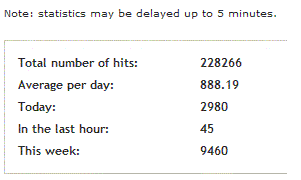
888_1To the left is a screen capture of my weblog stats. Today, I met a goal that I’d had for a while: I wanted my "Average (hits) per day" to be 888 or more.

Unfortunately, despite its many excellent qualities, Typepad (my blog host) has really dinky stats that are much inferior to what other providers have. They’ve promised to improve these, but haven’t yet.

One of the problems is that "Average per day" isn’t your recent average (what you typically get on a given day recently) but an average based on all the time that has elapsed since you started the blog on Typepad. This means that those early days, when nobody was linking to you and you were first starting to build traffic, will forever pull down your "Average per day."

Thus you can see that I’m really getting a lot more than 888 hits per day. Above, for example, it says that I got 2980 hits "Today." But therein lies another problem: As Typepad reckons it "Today" is not the past twenty-four hours, it’s the period beginning yesterday at midnight, which means that "Today" is always 24-48 hours long, depending on what time of day you check. As you approach midnight, "Today" really includes the hits of two days.

I took this screen shot early in the day (when traffic is slowest), so I guess I got about 2700-2800 hits yesterday (including everything, such as people clicking into comment boxes), though one can never be sure, given the way this software works.

But why am I happy that the average is now 888? Because’s that’s the numerical value of the name of Jesus in Greek. Here’s how that works: In Greek "Jesus" is iEsous, and

Iota = 10
Eta = 8
Sigma = 200
Omicron = 70
Upsilon = 400
Sigma = 200

TOTAL = 888

SEE THE GREEK LETTER-TO-NUMBER EQUIVALENCES.

The reason that the Greeks (like Latin-, Hebrew-, and Aramaic-speakers) had numerical values for letters is that they didn’t have separate number symbols, so the letters did double duty. That’s why VIII is 8 in Roman numerals. In Latin, only a few letters have numerical values (I, V, X, L, C, D, M), so letters like B or R mean nothing. Originally Greek only used some of its letters for numbers, but by Jesus’ day they used all of them. This reduced the number of letters you had to use to write a number, so in Greek VIII was just the letter eta.

If you look at the table of Greek letter-to-number equivalences, you’ll note that the system has three letters you may never have heard of: digamma, qoppa, and sampi. These are letters that dropped out of the Greek alphabet. Digamma sounded like a w, qoppa like a back-of-the-mouth q (harder and darker than the k sound, like qoph in Hebrew, qop in Aramaic, or qaaf in Arabic). Sampi sounded like an extended s or like a ks combination.

If these letters hadn’t dropped out then, since sampi was the last letter, Jesus would be "Alpha and Sampi" instead of "Alpha and Omega" (or, as he is in Arabic translations of the New Testament, "Alif u-Hamza").

How To Tell Columbia House You're Honked Off

Down yonder, a reader writes:

Any idea how we can contact Columbia House and express our disgust?

Yep!

HERE’S THEIR ONLINE CUSTOMER CONTACT FORM.

And you can call their (curiously non-toll-free) customer service line:

812-242-7000

If you are a blogger or would e-mail friends and family about this, please take this opportunity to rally folks to contact Columbia House and let them know the level of opposition there is out their to their porn club!

How To Tell Columbia House You’re Honked Off

Down yonder, a reader writes:

Any idea how we can contact Columbia House and express our disgust?

Yep!

HERE’S THEIR ONLINE CUSTOMER CONTACT FORM.

And you can call their (curiously non-toll-free) customer service line:


812-242-7000

If you are a blogger or would e-mail friends and family about this, please take this opportunity to rally folks to contact Columbia House and let them know the level of opposition there is out their to their porn club!

October 14, 2004 Show

More results from the VOLUNTEER PROGRAM. Thanks to Christopher A. St. Jean for doing the October, 2004 shows!

LISTEN TO THE SHOW.

DOWNLOAD THE SHOW.

Highlights:

  • Did Vatican II take away "respectful" aspects of the Mass?
  • Which deuterocanonicals were found among the Dead Sea Scrolls
    written in Hebrew?
  • Is it a sin to vote for a pro-choice political candidate?
  • If receiving the Eucharist remits venial sins, why should those sins
    be later confessed?
  • How should Catholics defend confession to a member of the Assemblies of God?
  • How does one respond to Orthodox Christians regarding the Lefebvrist
    schism and charges of liturgical abuse?
  • What charges do Protestants make regarding the Catholic Church in
    the Middle Ages?
  • Has the consecration of Russia to the Immaculate Heart of Mary been performed?
  • Are non-Catholic Christians members of the Body of Christ?
  • Does the magisterial authority of the Church compromise freedom of thought?
  • How does one defend the Sunday sabbath to Seventh-day Adventists?