Orthodox Liturgies & Sunday Obligation

A reader writes:

In a conversation on-line with fellow Catholics, I was told that attending liturgy at an Orthodox church would not fulfill your Sunday obligation. Now, I was a bit surprised. I hadn’t planned to spend my Sundays down at the local Greek Orthodox church, but I’d thought that the reason one wouldn’t do that was because well, one’s a Catholic, and you shouldn’t be attending a schismatic church. But since the liturgy at an Orthodox church is the Mass, would attendance fulfill your Sunday obligation if you were in a position where you couldn’t get to a Catholic Church?

Under current law, Eastern non-Catholic liturgies do not fulfill the Sunday obligation. The Code of Canon Law provides that:

Can.  1248 §1. A person who assists at a Mass celebrated anywhere in a Catholic rite either on the feast day itself or in the evening of the preceding day satisfies the obligation of participating in the Mass.

This means that to fulfill one’s Suday obligation one needs to attend a Catholic Mass (either that of the Roman church or one of the Eastern churches sui iuris in communion with Rome, such as the Maronites, the Chaldeans, etc.). It will not suffice if it is merely a valid celebration of the Eucharist or even if it is an almost identical liturgy being used in a non-Catholic church.

Confusion on this point was raised by the 1967 Directory on Ecumenism, which allowed Catholics to occasionally fulfill their Sunday obligation with an Eastern non-Catholic liturgy, but this was later suppressed. It may be argued that the release of the 1983 Code (quoted above) suppressed it since it makes no exceptions after using the word "Catholic." (If it meant to allow Eastern non-Catholic liturgies it should have said something like "A person who assists at a Mass celebrated anywhere in a church where the sacrament of the Eucharist is valid satisfies the obligation of participating in the Mass."

Even if it were not suppressed by the 1983 Code itself, it definitely was suppressed by the 1993 Directory for the Application of Principles and Norms on Ecumenism, which states:

115. Since the celebration of the Eucharist on the Lord’s Day is the foundation and centre of the whole liturgical year, Catholics—but those of Eastern Churches according to their own Law—are obliged to attend Mass on that day and on days of precept. It is not advisable therefore to organize ecumenical services on Sundays, and it must be remembered that even when Catholics participate in ecumenical services or in services of other Churches and ecclesial Communities, the obligation of participating at Mass on these days remains.

The reader then writes:

Are there any other circumstances where it would be all right to fulfill your Sunday obligation in that manner?

No, it doesn’t work quite like that. If you really can’t reasonably get to a Catholic Mass then your Sunday obligation is simply in abeyance. You don’t have to go. You could go to an Eastern non-Catholic liturgy but it would not be in fulfillment of your Sunday obligation because on that Sunday you are simply not obligated.

For such circumstances the Code of Canon Law does have a recommendation (not an obligation) to make:

Can.  1248 §2. If participation in the eucharistic celebration becomes impossible because of the absence of a sacred minister or for another grave cause, it is strongly recommended that the faithful take part in a liturgy of the word if such a liturgy is celebrated in a parish church or other sacred place according to the prescripts of the diocesan bishop or that they devote themselves to prayer for a suitable time alone, as a family, or, as the occasion permits, in groups of families.
Orthodox Liturgies & Sunday Obligation

A reader writes:

In a conversation on-line with fellow Catholics, I was told that attending liturgy at an Orthodox church would not fulfill your Sunday obligation. Now, I was a bit surprised. I hadn’t planned to spend my Sundays down at the local Greek Orthodox church, but I’d thought that the reason one wouldn’t do that was because well, one’s a Catholic, and you shouldn’t be attending a schismatic church. But since the liturgy at an Orthodox church is the Mass, would attendance fulfill your Sunday obligation if you were in a position where you couldn’t get to a Catholic Church?

Under current law, Eastern non-Catholic liturgies do not fulfill the Sunday obligation. The Code of Canon Law provides that:

Can.  1248 §1. A person who assists at a Mass celebrated anywhere in a Catholic rite either on the feast day itself or in the evening of the preceding day satisfies the obligation of participating in the Mass.

This means that to fulfill one’s Suday obligation one needs to attend a Catholic Mass (either that of the Roman church or one of the Eastern churches sui iuris in communion with Rome, such as the Maronites, the Chaldeans, etc.). It will not suffice if it is merely a valid celebration of the Eucharist or even if it is an almost identical liturgy being used in a non-Catholic church.

Confusion on this point was raised by the 1967 Directory on Ecumenism, which allowed Catholics to occasionally fulfill their Sunday obligation with an Eastern non-Catholic liturgy, but this was later suppressed. It may be argued that the release of the 1983 Code (quoted above) suppressed it since it makes no exceptions after using the word "Catholic." (If it meant to allow Eastern non-Catholic liturgies it should have said something like "A person who assists at a Mass celebrated anywhere in a church where the sacrament of the Eucharist is valid satisfies the obligation of participating in the Mass."

Even if it were not suppressed by the 1983 Code itself, it definitely was suppressed by the 1993 Directory for the Application of Principles and Norms on Ecumenism, which states:

115. Since the celebration of the Eucharist on the Lord’s Day is the foundation and centre of the whole liturgical year, Catholics—but those of Eastern Churches according to their own Law—are obliged to attend Mass on that day and on days of precept. It is not advisable therefore to organize ecumenical services on Sundays, and it must be remembered that even when Catholics participate in ecumenical services or in services of other Churches and ecclesial Communities, the obligation of participating at Mass on these days remains.

The reader then writes:

Are there any other circumstances where it would be all right to fulfill your Sunday obligation in that manner?

No, it doesn’t work quite like that. If you really can’t reasonably get to a Catholic Mass then your Sunday obligation is simply in abeyance. You don’t have to go. You could go to an Eastern non-Catholic liturgy but it would not be in fulfillment of your Sunday obligation because on that Sunday you are simply not obligated.

For such circumstances the Code of Canon Law does have a recommendation (not an obligation) to make:

Can.  1248 §2. If participation in the eucharistic celebration becomes impossible because of the absence of a sacred minister or for another grave cause, it is strongly recommended that the faithful take part in a liturgy of the word if such a liturgy is celebrated in a parish church or other sacred place according to the prescripts of the diocesan bishop or that they devote themselves to prayer for a suitable time alone, as a family, or, as the occasion permits, in groups of families.

The Nattering Nabob Of Negativism

HERE’S A WONDERFUL INTERVIEW WITH DR. NO.

QUESTION: Is Dr. No a real person?

ANSWER: No.

NOTE: I feel there’s the basis of a "Who’s on first?" routine here:

Are you going to tell me his name?

No.

Why not?

I just did!

No, you didn’t!

Me? I’m not No!

Well, you didn’t tell me his name!

Yes, I did!

No, you didn’t!

I already told you: I’m not No!

But you still won’t tell me his name!

Enim?

A reader writes:

In the Tridentine missal it says "Hoc est enim corpus meum," which I understand to mean "This is truly/ in fact/ indeed my body."

The Vulgate says: "Hoc est corpus meum/ This is my body."

The Greek I’ve found says: "Touto esti mou somaTouto estin to sOma mou [at least in St. Matthew’s version]/ This is my body."

The Novus Ordocurrent rite of Mass says: "This is my body."

My question is, how did the enim get put in, since as far as I can tell, Jesus did not use the word? I assume it was taken out of the Novus Ordocurrent rite of Mass for that reason.

Also, what does the Novus Ordocurrent rite of Mass in Latin Mass say?

Let’s answer the second question first: In the current rite of Mass in Latin it says "Hoc est enim corpus meum" (It also says "Hic est enim calix sanguinis mei").

Here’s the deal about enim: The Romans threw it in a lot. It’s just part of Latin style in some ages to use this word when it isn’t strictly necessary, the way some British folks throw in "indeed" to kind of tweak the emphasis: "He is indeed a fine grammarian." As a result, when Jesus’ words were being translated into Latin, they conformed it more to Latin style by throwing in an enim.

The force and meaning of enim varies and gets weaker over time. In some cases it is used pleonastically. In these and certain other cases, it is often simply not translated into English. For example, the word can serve to signal an illustration or explanation, kind of the way a colon does in English. But there is already a colon there in Latin ("Accipite et manducate ex hoc omnes: . . ."), so they may have judged enim to be redundant.

The word order might fool you on this since enim occurs third in the sentence, but that’s due to another quirk of enim: It’s postpositive (meaning that it never occurs first in a sentence), and when there is an est coming after the first word it can force enim into third place. Putting things in English word order, one might take this as "Enim hoc est corpus meum" and then identify enim as performing its colon-like function.

(Other languages often use spoken words to accomplish effects that we do in English with punctuation. For example, Japanese uses ka at the end of sentences as a kind of spoken question mark. Chinese uses ma the same way. Greek often uses hoti to signal the beginning of a quotation, the way we use quotation marks.)

In any event, the word (or an equivalent) isn’t there in the original Greek (or Aramaic in all likelihood). That may be why it’s omitted in the English translation or it may be that the translators were taking it as performing a colon-like function or otherwise judged it redundant and out of accord with English style.

You may be interested to know that in the current (and much better!) draft translation of the Mass that is still being revised the words of consecration are translated in an ever-so-slightly different manner, but the enim still doesn’t show up as a word. Here’s the Latin and the current draft translation:

Accipite et manducate ex hoc omnes: hoc est enim corpus meum, quod pro vobis tradetur.

Take this, all of you, and eat of it: this is my Body which will be given up for you.

The "of," of course, is reflecting the ex in the Latin. We’ll have to wait and see if they stick with this translation.

Confession Validity

A reader writes:

Our church had a penance service with roughly 12 or so priests on hand to hear individual confessions. Prior to my confession, I believe I did a pretty thorough examination of conscience. And I felt that I had identified at least most of things I needed to confess.

When it was my turn, the priest I was with "led" me in my confession. By that I mean, instead of letting me name all my sins, he asked me direct questions (“Did you have these types of sins?”). I answered truthfully to his questions, but after going through a few of them and the applicable sins, he started to wrap things up.

I didn’t feel it was appropriate to stop him and say, “Hey, I’ve got a lot more to confess here.” But as a result, I doubted for a time if I was absolved of all my sins. So, was I absolved of all my sins, or just the ones I managed to name during confession?

Absolution is an all-or-nothing thing when it comes to one’s mortal sins. Either you were absolved of all of them or you were absolved of none.

In order to be absolved of all of them, you need to make a formally integral (i.e., formally complete) confession. This means that you have to make a good faith effort to confess everything that God wants you to confess. You can’t knowingly and deliberately hold something back that you know you need to confess.

Under ideal circumstances, for a formally integral confession also needs to be materially integral (i.e., materially complete), meaning that you confess each of your grave sins by kind and number, along with important mitigating and exacerbating circumstances.

Very commonly, however, circumstances are not ideal. People forget what they did, or how many times they did it, they have conditions like OCD or scrupulosity that will be exacerbated if they give an exhaustive catalogue in minute detail, etc. As a result, there are often excusing causes that allow a person to make a formally integral confession even though it is not materially integral.

You found yourself in a disorienting situation in which you felt pressured by the priest not to break the flow of what he was doing to add additional sins that needed to be confessed. That psychological pressure was a cause excusing you from a materially integral confession. It sounds like you didn’t know what to do in the circumstance, so you made the best judgment that you could at the time and acted accordingly. If so, your confession was formally integral and the absolution was valid. You were forgiven for all your sins, even those you had not been able to confess.

That being said, you still have an obligation to confess those sins you weren’t able to confess. These should be confessed in your next confession–to the best of your ability, recognizing that your memory on them may be fuzzy at this point. If nothing else, be sure to include something like, "I am sorry for all my sins, including those I previously meant to confess but have forgotten."

I’d also make up my mind to summon up the courage to interrupt the priest if this happens again and tell him "I need to add the following sins . . . " and list them.

The readr also writes:

Here’s a part two to my question, if you have time to address it. During the absolution (as I wondered whether or not this would “count”), I “felt” a hand on my shoulder. My head was down and eyes were closed, and I assumed it was the priest. As I opened my eyes during the blessing, I thought that there was no way it could have been him. (We sat facing each other, but he would have had to lean way over to put his hand on my shoulder). As I knelt in church afterwards, I spent at least 5 minutes trying to duplicate the sensation. (I thought that it may have been from shifting my body a certain way.)

As I prayed, it seemed that it had to be the Holy Spirit (which made me feel a lot better about my confession). If that’s true, it’s the second time that I have felt a physical manifestation of the Holy Spirit. The first was during my Confirmation when I felt a “wave” rush over me as I was being anointed. Am I imagining things? Is this a more common occurrence than I think? Has something like this ever happened to you or someone you know?

It’s harder to comment on this. God is omnipotent and can do whatever he wants. If he wants to give you sensations like this as you receive the sacraments, he can. Many people report that they occasionally have such sensations. On the other hand, it could be psychological or maybe the priest just did lean over really far (I’ve had a priest plop his hand down on my head before during absolution, which I very much Do Not Like; the text says he should raise his hand over my head but not impose his hand on me).

I would say to take the experience as a possible though not certain confirming and consoling sign from God. I’d be open to such sensations if they happen in the future, but I wouldn’t seek them out or feel disappointed if they don’t come. Such supernatural experiences are the exception in the Christian walk rather than the rule.

20

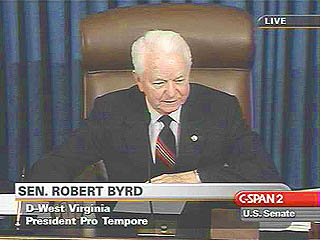
Robert Byrd Loses!

Byrd_2In THIS ARTICLE ON SEN. SPECTER’S HIJINKS AS HEAD OF THE SEN. JUDICIARY COMMITTEE, it is revealed that

Democrats are so antagonized by this option [ending filibusters of judicial nominees] that Sen. Robert C. Byrd, the 87-year-old dean of the Senate, compared it on the Senate floor last week to Hitler’s "enabling act" that seized power in Germany.

Robert Byrd LOSES! (See GODWIN’S LAW.)

Oh yeah, and the comparison is on its face preposterous.

Consecration Validity

A reader writes:

Last night, we had a guest priest at Mass who accidentally messed up the words of consecration–he spoke the words for the wine over the bread, and then again over the wine; so he forgot to say the actual "This is my body." So I was left wondering if either or both forms were invalid. Now, I’m wondering if I was wrong to go forward at all since I was in doubt–is this idolatry? What they did was bring ciboria out of the tabernacle with what I assume are pre-consecrated hosts. So…should I have skipped the cup? Or was it all invalid?

This is particularly disturbing to me because I’m an adult convert, and the Real Presence of our Lord in the Mass is the one thing that keeps me Catholic sometimes….and now, I’ll never know for sure if the host at adoration or Mass has been properly consecrated. What are we supposed to do now? Am I making too much of this?

You’re certainly right to be quite concerned. Any time something like this happens it is very disturbing to the faithful, and understandably so. Here’s what I can tell you on the subject of validity:

1) The consecration of the cup is presumed valid. While it is totally forbidden under canon law to consecrate one of the species without the other (Can. 927), the praxis of the Church indicates that the consecration of each species occurs after the proper formula is said over the individual species. This is illustrated by the fact that we adore the host and the Precious Blood separately, as they are consecrated individually. Therefore, the saying of "This is the cup of my blood" over the wine should be a valid consecration.

2) The consecration of the hosts in this case is doubtful. While the proper words ("This is my body") were not said, the words that were said ("This is . . . my blood") express a theological truth since Christ is present under both forms in his body, blood, soul, and divinity. On the other hand, God may just want "This is my body" said over the hosts. (By comparison, he might not allow "This is my soul" or "This is my divinity" as valid formulas over either species, even though those are also theologically true.) Further, the hosts may not have been in a cup, in which case an element of falsehood was introduced into the formula. The validity of the the consecration of the host therefore seems to me to be quite doubtful.

As far as going forward to receive, while it would be wrong to receive an element that one knew with certainty had been invalidly consecrated, the psychological reality of the situation is such that when things like this happen that the faithful are so rattled that they don’t know what to do and just have to make their best guess. In such circumstances, they are likely acting in conformity with their conscience in difficult circumstances are are not culpable if they make the objectively wrong choice.

As far as your worries for the future, I think you may be making too much of this. Such accidents are rare, and it is overwhelmingly likely that hosts you encounter in the future are validly consecrated. Certainly, you should presume that they are and act accordingly.

What I don’t know is all of the dubiously-consecrated hosts were consumed at the Mass. If not, what the parish should do is have someone consume them conditionally as Communion. Whether they’d do that if asked, I don’t know.

Also, you should recognize that, while Jesus is present in the Eucharist, you need to be Catholic not only because of this but because the Catholic Church is Jesus’ Church, regardless of the problems it has in any given age.

Hope this helps!

20

Childrens Liturgies Of The Word

A reader writes:

Before the first reading our parish asks for children between kindergarten and 4th grade to leave the church for the Childrens’ Liturgy of the Word. They return during the Nicene Creed.

A couple of things bother me about this. I can understand the attempt to make the liturgy more understandable to children and if it were a priest conducting it I wouldn’t have a problem. But a layperson does the readings behind a makeshift altar – lectern, candles, etc. – and, basically, does what could be construed as a homily. I know a layperson can not read the Gospel or give a homily so it doesn’t seem proper to me for children as old as ten to be leaving Mass for a substitute liturgy.

The other problem is the disruption it causes in the church with 60 or so kids filing out of the church during the first reading and returning during the Creed.

Am I making too much of this or would you consider it a liturgical abuse? It seems to me that at least those that have received their First Communion should be expected to remain in church.

I’m not a big fan of such alternative liturgies of the word, myself. One parish I know has a particularly inept way of doing them: They have all the kids gather together and be escorted out while the choir sings "Let the children come to me. . . . Do not block the way," which is unfortunate for a couple of reasons:

  1. The children are being led away from Jesus’ Real Presence while the choir is singing about their being brought to him, and
  2. The musical setting has an eerie resemblance to the tune "Camptown Races," so whenever I hear it, I want to go "Let the children come to me. . . . Doo-DAH! Doo-DAH!"

That being said, such liturgies are currently permitted under Church law. There is a document (printed in the Sacramentary) called the Directory for Masses with Children that came out in 1973. Regarding these liturgies, it says:

Sometimes, moreover, if the place itself and the nature of the community permit, it will be appropriate to celebrate the liturgy of the word, including a homily, with the children in a separate, but not too distant, room. Then, before the eucharistic liturgy begins, the children are led to the place where the adults have meanwhile celebrated their own liturgy of the word [DMC 18].

Now, I’ve highlighted "and the nature of the community permit" because it indicates that the composition of some communities do not permit the separate celebration of the liturgy of the word for children. In my estimation, what they’re referring to is having enough qualified people available to lead a second liturgy of the word for the kids. That would include an extra priest or deacon to do the gospel and the homily. The DMC does not waive the requirement of an ordained person to perform these tasks, and so parishes where an extra priest or deacon is not available to do these liturgies do not have a composition permitting their celebration.

Thus as far as I can tell, it is a liturgical abuse to have a separate liturgy of the word for the kids unless a priest or deacon does the gospel and the homily.

You may also note that I italicized "currently" in saying that such liturgies are currently permitted. I did that because the Directory for Masses with Children is waaaay too loosey-goosey for the kind of liturgy documents that the Holy See is cranking out these days. Among other things, it gives virtual carte blanche for further, unnamed "adaptations"–all in the interests of the children, of course!

There is no way the current administration in the Congregation for Divine Worship would approve such sweeping permissions for chaos and stupidity in childrens’ liturgies. As a result, the DMC is ripe for revision, and I suspect that its current iteration won’t be with us much longer. If Arinze et al., continue in office for a while, I suspect that it will end up getting revised as part of the current revamp of the Roman Missal.

One last note: Lest someone try to justify the gospel and homily reading as a further approved "adaption," that won’t work. There are limits to what that clause can bear, and one of the limits is what Rome would be willing to sign-off on if asked. There is no way Arinze would sign off on laity reading the gospel and preaching homilies in front of children, so that dog won’t hunt.

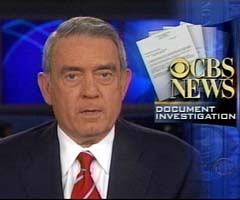
And That's The Way It Ain't

Rather1Dan Rather is a fallen newsman.

While he originally did great work that, at the time of the Kennedy Assassination in 1963 caught the Sauronic Eye of the CBS network and got him promoted to national status as a journalist, he eventually became blinded by the arrogance and liberal bias that led him to use phony documents to try to unseat a president. Right?

Wrong.

If what people who knew him at the time are saying is true, Dan Rather was a hyperambitious muck-raker from the beginning who knowingly and repeatedly lied about the Kennedy Assassination and the events surrounding it in order to catapult himself to national prominence.

GET THE STORY.

And That’s The Way It Ain’t

Rather1Dan Rather is a fallen newsman.

While he originally did great work that, at the time of the Kennedy Assassination in 1963 caught the Sauronic Eye of the CBS network and got him promoted to national status as a journalist, he eventually became blinded by the arrogance and liberal bias that led him to use phony documents to try to unseat a president. Right?

Wrong.

If what people who knew him at the time are saying is true, Dan Rather was a hyperambitious muck-raker from the beginning who knowingly and repeatedly lied about the Kennedy Assassination and the events surrounding it in order to catapult himself to national prominence.

GET THE STORY.