Music Copying Re-Redux

A reader from another country writes:

This is another of those music copying questions. There was an old recording of a book on LP in the 1970’s (I think). As far as I know, the record is no longer for sale. You can buy second hand versions at some cost over the internet, but they seem to be very limited in number.

Anyway, a man has put mp3’s of his old LP on the internet. He’s not selling them and says he’ll remove the files if they’re ever re-released by the record company. In this situation, is it licit to download these files, with the knowledge that the quality is poor and that no-one is being deprived of their fair wages from it? A person I know has made a CD of the mp3 files for me and I would like to hear them, but I don’t want to steal!

Not wanting to steal is the right attitude to have! Kudos!

Unfortunately, I don’t know what the law in your country (which shall remain nameless) would say about whether or not this is stealing.

Let me therefore prescind from the legal question to look at the moral question. As we covered in The Moral Question, the sin of theft is "usurping another’s property against the reasonable will of the owner" (CCC 2408).

Let’s ask, therefore, whether it would be against the reasonable will of the owner to object to you downloading these .mp3s:

  1. Since the work is not in print at the moment, you have no way of purchasing it in such a way that the copyright holder(s) would receive compensation. Even buying the book from a used book service or the records from a used record shop would not get them a royalty. Therefore, they therefore could not reasonably object to your downloading them on the grounds that you are presently depriving them of a royalty.
  2. They could, however, reasonably object that by downloading them you would be undercutting the market for them should they decide to put them back in print at some point in the future. If you already have a copy, you don’t need to buy a new one, and so they could miss a royalty from you that they would otherwise get at some future date. This is a reasonable objection.
  3. You can meet this objection by making a commitment (a real, solid commitment, that is, not a phoney-baloney one) to buy the product should it be put on the market again (assuming that you’re not destitute and they’re not charging outrageous sums for it).
  4. You can strengthen this by committing to making a good faith effort to buy the product if it is ever re-issued in any form (e.g., if it comes out as a book but not an audiobook then you buy the book so that they get their royalties).
  5. It seems to me that, if you really make a firm commitment to make a good faith effort to buy the product so they can get their royalties that their objection to the undercutting-the-market argument becomes unreasonable, at least in your case. (It would not be unreasonable in the case of many people who might make phoney-baloney commitments to buy the product if it is reissued). In such a case, your action in downloading the files would not appear to be the sin of theft.

What the civil law may say about the matter, I couldn’t tell you, but in terms of the moral law that the action would not count as the sin of theft if done under the conditions just named.
Marriage Involvement 4 (SSPX)

A reader writes:

This makes sense, but what about cases where something is valid but illicit, such as a SSPX Mass? Why is it bad? a sin? to go to those? And then why does God show up?

If SSPX marriages were presumed valid then there would be more room for attending them than there is.

In actuality, SSPX marriages are not presumed valid.

The reason:

Can. 1108

§1. Only those marriages are valid which are contracted before the local ordinary, pastor, or a priest or deacon delegated by either of them, who assist, and before two witnesses according to the rules expressed in the following canons and without prejudice to the exceptions mentioned in cann. 144, 1112, §1, 1116, and 1127, §§1-2.

Since SSPX priests are seldomnever so delegated by the lawful bishop or pastor of the Catholic faithful they are marrying, the marriages are not valid due to lack of form. (None of the exceptions, incidentally, apply to the SSPX).

SSPXers will use evil trickery to try to argue around this conclusion (esp. using canon 144, but they are no more successful with applying that canon to marriages than they are in applying it to confessions; SEE ANALYSIS HERE), but their evil trickery is nothing more than evil trickery.

The marriages they perform between Catholics ain’t valid.

Consequently, I can’t recommend attending them.

Food & Water

A reader writes:

In our current archdiocesan paper is an article from Rome about the Terry Schiavo case.  They talk about how a court decision to remove the feeding tube would lead us down the slippery slope to euthanasia.

Later in the article, it quotes the Florida Catholic Conference (representing the state’s Catholic bishops, saying: "The said Catholic teaching has a `presumption in favor` of providing nutrition and hydration, but `when the burdens exceed he benefits of providing them, they may be withdrawn or withheld.  …`".  A bit late the article quotes the bishops again, "`While withdrawal of Terri Schiavo’s nutrition and hydration will lead to her death, if this is being done because its provision would be too burdensome for her, it could be acceptable".  This sounds to me like nothing more than a quality of life argument that leads directly to euthanasia and doesn’t seem to square with the Church’s teaching. 

Can you clarify this?

I’ll try.

First, I should note that I am not up on all the recent episcopal pronouncements regarding Terry Schiavo. MORE INFO HERE.

Second, what you quote above is not out of line with Catholic moral teaching. There are conditions in which it is morally licit to remove nutrition and hydration because continuing to provide them itself may be doing damage to the patient.

For example: When my wife was dying, at some point her body stopped manufacturing albumin, which is essential for regulating the distribution of fluids in the body’s tissues. (INFO HERE.) At this point she had completely lost her appetite and was being fed intravenously. The fluid from the IVs were going out into her tissues and collecting there. Without albumin production, her body couldn’t process the fluids out of her system and so she got severe edema all over her body. Not to be too graphic, her arm swelled to elephantine proportions and her hand looked like a balloon with short little fingers sticking out of it.

At this point, the doctors told me that they were going to have to discontinue feeding because the feeding itself was harming her. The doctors explained that if feeding were not stopped, at some point (soon) her skin would rupture and she would have weeping sores, which would be bad for all manner of reasons (infection potential among them). Fortunately, Renee passed before it became necessary to discontinue feeding, but she was rapidly approaching the point where the feeding itself was more destructive than the benefit she was deriving from it. It was getting to the point that it would only be making her suffering worse and hastening her death through other means.

Thus there are situations in which it is morally licit to stop nutrition and hydration, but only when the nutrition and hydration are themselves more destructive to the patient than otherwise.

None of this applies to Terri Schiavo, of course. She is not dying, is not being harmed by her feeding (indeed, she Can Take Food Orally Her Husband Just Doesn’t Want It Given To Her That Way), and it would be murder to starve her to death.

Food & Water

A reader writes:

In our current archdiocesan paper is an article from Rome about the Terry Schiavo case.  They talk about how a court decision to remove the feeding tube would lead us down the slippery slope to euthanasia.

Later in the article, it quotes the Florida Catholic Conference (representing the state’s Catholic bishops, saying: "The said Catholic teaching has a `presumption in favor` of providing nutrition and hydration, but `when the burdens exceed he benefits of providing them, they may be withdrawn or withheld.  …`".  A bit late the article quotes the bishops again, "`While withdrawal of Terri Schiavo’s nutrition and hydration will lead to her death, if this is being done because its provision would be too burdensome for her, it could be acceptable".  This sounds to me like nothing more than a quality of life argument that leads directly to euthanasia and doesn’t seem to square with the Church’s teaching. 

Can you clarify this?

I’ll try.

First, I should note that I am not up on all the recent episcopal pronouncements regarding Terry Schiavo. MORE INFO HERE.

Second, what you quote above is not out of line with Catholic moral teaching. There are conditions in which it is morally licit to remove nutrition and hydration because continuing to provide them itself may be doing damage to the patient.

For example: When my wife was dying, at some point her body stopped manufacturing albumin, which is essential for regulating the distribution of fluids in the body’s tissues. (INFO HERE.) At this point she had completely lost her appetite and was being fed intravenously. The fluid from the IVs were going out into her tissues and collecting there. Without albumin production, her body couldn’t process the fluids out of her system and so she got severe edema all over her body. Not to be too graphic, her arm swelled to elephantine proportions and her hand looked like a balloon with short little fingers sticking out of it.

At this point, the doctors told me that they were going to have to discontinue feeding because the feeding itself was harming her. The doctors explained that if feeding were not stopped, at some point (soon) her skin would rupture and she would have weeping sores, which would be bad for all manner of reasons (infection potential among them). Fortunately, Renee passed before it became necessary to discontinue feeding, but she was rapidly approaching the point where the feeding itself was more destructive than the benefit she was deriving from it. It was getting to the point that it would only be making her suffering worse and hastening her death through other means.

Thus there are situations in which it is morally licit to stop nutrition and hydration, but only when the nutrition and hydration are themselves more destructive to the patient than otherwise.

None of this applies to Terri Schiavo, of course. She is not dying, is not being harmed by her feeding (indeed, she Can Take Food Orally Her Husband Just Doesn’t Want It Given To Her That Way), and it would be murder to starve her to death.

The King In Yellow

One of the books I’m currently reading is titled The King In Yellow. It was first published in 1895, which makes it young in comparison to some of the books I read.

What’s interesting about it (among other things) is that it’s a kind of sci-fi/horror anthology of stories that are all loosely connected by a play they all mention. The title of the play is "The King In Yellow," and it is a most remarkable play. We only get a few snatches of dialogue from it and only the vaguest hints of what it is about, but the characters who read it in the stories have the unfortunate tendency to either go completely insane or suffer a horrible doom of some sort.

The author of The King In Yellow was Robert W. Chambers. It is his best-remembered book and is highly thought of by horror authors, some of whom included references to it and things it mentions in their own works. Unfortunately, they have somewhat less regard for some of Chambers’ later works. Apparently he decided that it was better to be a well-fed best-selling author rather than a starving artist, and he ended up turning his literary output in a more commercial direction.

I don’t know what Chambers’ religion was, but there is a surprising amount of positive material in it about the Catholic Church (so far), and Catholic themes are prominent in several stories (including, obviously, "The Street of Our Lady of the Fields").

It’s interesting reading sci-fi from 1895. The first story in the collection ("The Rapairer of Reputations") is set in 1920, and it’s interesting to see a turn-of-the-century perception of what the futuristic year 1920 would be like. (Among other things, they have euthanasia chambers on public streets in major cities.)

It’s kind of interesting, though, that everybody in 1920 is still riding horses. Chambers didn’t anticipate Henry Ford’s unleashing of the automobile on America. Which brings to mind some

REMARKS MICHAEL CRICHTON MADE.

Chambers also probably didn’t envision (a) that someone in 2005 would be reading his book and (b) that they would be reading it in the way I am: I downloaded the text from the Internet and ran it through my speech-synthesizer to output it as .mp3 files that I can now listen to on my computer or via my iPod or in my . . . pickup. (Sorry; horses don’t typically have .mp3 players installed on them.)

READ THE KING IN YELLOW–IF YOU DARE! (WARNING: There is some material in it that can offend modern sensibilities.)

Podcasting

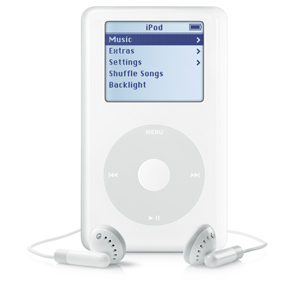
Ipod A reader writes:

Jimmy, would you please comment on Podcasting and its implications for the New Evangelization.

I would.

First, some helpful definitions:

  • Mobile blogging or moblogging is blogging when you are away from a computer. It is often done by a cell phone, camera phone, or PDA.
  • Audioblogging is what it sounds like (literally! ;-P). It is the use of audio files on a blog. People stop by the blog and listen to or download the files. Audioblogging may be regular blogging (sitting in front of a computer) or moblogging. Often the latter is done by someone calling from a cell phone and recording an audio file that is automatically posted on their blog.
  • A feed is an internet tool that allows people to be notified when you have put something new on your blog so they don’t have to keep coming back to check. When you put something new on your blog, a notice of some kind (typically part or all of the post) goes into the feed. A reader who has subscribed to the feed then gets notified that there is a new post for him to read. The references you see online to RSS and XML are references to feeds that people may subscribe to.
  • The person who subscribes to the feed either uses an aggregator (a service or a piece of software) that aggregates the different feeds he has subscribed to.
  • An iPod is a portable listening device used to play audio files.
  • Last year somebody got the bright idea of combining these things and slapping a label on them (even though they were already coming together informally). That label was podcasting. Podcasting involves the creation of audio files which are then pushed via feeds to aggregator-like services and programs so they can then be listened to online or downloaded to devices like iPods. Since it’s "broadcasting for iPods," it got called "podcasting," though really you don’t need an iPod to listen t a podcast.

Some savants differentiate podcasting from audioblogging, noting that many podcasters produces more sophisticated audio files that are modelled after radio shows (with music and all). Some radio shows are now getting into the podcasting market as technology is forcing changes on the radio industry. By contrast, audiobloggers often just use their cell phones. Other savants do not divide podcasting and audioblogging by their content, though, and consider any audio files pushed via a feed to be podcasting.

Now, as to new evangelization potential: There are already some religious (and Catholic) podcasts,

LIKE THIS ONE BY A DUTCH PRIEST.

I think that podcasting has new evangelization potential comparable to web sites and similar doo-dads. It will make it easier for people to get religious content than in the prior age (the third age of human communications, to anticipate  post I’ll put up soon). Now that we are in the fourth age, people can get info much more easily than they could before. But there’s a catch.

You have to want the info.

In the old days, the Old Media basically had a captive audience. You got exposed to the info that your local newspaper or radio station or TV station wanted you exposed to. That’s why the MSM is lamenting their loss of control over the distribution of information in our society. They don’t like it that people now have the ability to choose what information they want. The MSM liked its information monopoly. It let it push its agenda on us and manipulate the public.

But in the fourth age, people pick their own info, and so if someone is to be evangelized via a website or a blog or a podcast or an as-yet-undreamed-of-thing-that-will-come-out-next-year, he has to request it.

So I’d say that podcasting adds more bandwidth to the new evangelization (and the new anti-evangelization) in a way comparable to what web sites and blogs did.

For right now, there are also some limitations in getting into podcasting that still need to be worked out. One of the biggest is that the folks running podcasting services are geeks and, as such, they don’t know how to explain things to ordinary people and they don’t know how to sell themselves and their services.

I’ve been thinking about doing some podcasting (to anticipate another soon-to-be post–and no, this is not one of the Secret Projects), but the services I have checked have really poor explanations and don’t do basic salesmanship-type things, like giving you links to sample audioblogs so you can see how the end product would look. Others advertise that they work with TypePad (my bloghost) but then don’t tell you how to use the two together.

This kind of info is crucial for getting new customers. I recently e-mailed one such service to try to get some of this kind of info, but a customer shouldn’t have to ask for that info. It should be present on the service’s web site as part of its sales pitch.

Eventually, though, people who understand marketing will start working for these services and the geek factor will recede into the background, allowing more people to get on the podcasting bandwagon.

Ambrose Bierce: The Man Whose Name Wasn't Quite Right

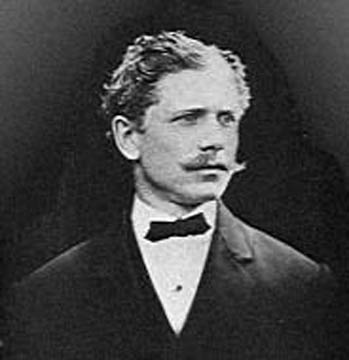
The dapper gentleman on the left is Abrose Bierce (1842-19??).

As you can tell, something’s not quite right with his name.

My theory is that his parents didn’t understand English phonology.

Having stuck their kid with the name Ambrose, which was crime enough to begin with, they didn’t understand that if you say his two names together you get an /s/ sound right up against a /b/ sound  (ambrosbierce). That’s a sound combination that doesn’t occur in English, so it makes it hard for people to say or understand his name. I’m sure people were always trying to turn his name into "Ambrose Pierce," and as a life-long victim of name confusion, I know how scarring that can be.

You’ve also got some echo going on between the /b/ in Ambrose and the /b/ in Beirce.

And we won’t even go into his middle name, which was probably the horror that drove him to become a satirist and horror author. (SPOILER SWIPE FOR THE BRAVE OF HEART: His middle name was Gwinnet).

PierceBeirce was an interesting guy. You may notice that his death date has a couple of question marks in it. That’s because we don’t really know when he died.

He vanished.

In his seventies he went on a tour of Civil War battlefields and after touring Lousiana and Texas he went into Mexico which was undergoing a revolution at the time and Bierce hitched up with Pancho Villa’s army as an observer.

The day after Christmas, 1913, he wrote a friend:

Good-by — if you hear of my being stood up against a Mexican stone wall and shot to rags please know that I think that a pretty good way to depart this life. It beats old age, disease, or falling down the cellar stairs. To be a Gringo in Mexico — ah, that is euthanasia!

Nobody ever heard from him again! No news of his getting stod up against a wall or anything! Searchers failed to turn up hide or hair of him (literally!). So we don’t really know when he died. Probably late 1913 or early 1914.

A fitting end for a horror author.

Expecially one with such a horrifying name.

LEARN MORE ABOUT THE MAN WHOSE NAME WASN’T QUITE RIGHT.

READ HIS WORKS.

OBTW, the reason I mention Beirce is that I’m going to be excerpting one of his works, The Devil’s Dictionary, which is a dictionary with humorously subversive and often revealing definitions.

F’rinstance:

DICTIONARY, n.  A malevolent literary device for cramping the growth of a language and making it hard and inelastic.  This dictionary, however, is a most useful work.

Amen, Brother Bierce! Amen!

Ambrose Bierce: The Man Whose Name Wasn’t Quite Right

AbrosebierceThe dapper gentleman on the left is Abrose Bierce (1842-19??).

As you can tell, something’s not quite right with his name.

My theory is that his parents didn’t understand English phonology.

Having stuck their kid with the name Ambrose, which was crime enough to begin with, they didn’t understand that if you say his two names together you get an /s/ sound right up against a /b/ sound  (ambrosbierce). That’s a sound combination that doesn’t occur in English, so it makes it hard for people to say or understand his name. I’m sure people were always trying to turn his name into "Ambrose Pierce," and as a life-long victim of name confusion, I know how scarring that can be.

You’ve also got some echo going on between the /b/ in Ambrose and the /b/ in Beirce.

And we won’t even go into his middle name, which was probably the horror that drove him to become a satirist and horror author. (SPOILER SWIPE FOR THE BRAVE OF HEART: His middle name was Gwinnet).

PierceBeirce was an interesting guy. You may notice that his death date has a couple of question marks in it. That’s because we don’t really know when he died.

He vanished.

In his seventies he went on a tour of Civil War battlefields and after touring Lousiana and Texas he went into Mexico which was undergoing a revolution at the time and Bierce hitched up with Pancho Villa’s army as an observer.

The day after Christmas, 1913, he wrote a friend:

Good-by — if you hear of my being stood up against a Mexican stone wall and shot to rags please know that I think that a pretty good way to depart this life. It beats old age, disease, or falling down the cellar stairs. To be a Gringo in Mexico — ah, that is euthanasia!

Nobody ever heard from him again! No news of his getting stod up against a wall or anything! Searchers failed to turn up hide or hair of him (literally!). So we don’t really know when he died. Probably late 1913 or early 1914.

A fitting end for a horror author.

Expecially one with such a horrifying name.

LEARN MORE ABOUT THE MAN WHOSE NAME WASN’T QUITE RIGHT.

READ HIS WORKS.

OBTW, the reason I mention Beirce is that I’m going to be excerpting one of his works, The Devil’s Dictionary, which is a dictionary with humorously subversive and often revealing definitions.

F’rinstance:

DICTIONARY, n.  A malevolent literary device for cramping the growth of a language and making it hard and inelastic.  This dictionary, however, is a most useful work.

Amen, Brother Bierce! Amen!

Remember The Alamo!

Alamo March 6, 1836: The final massacre at the Battle of the Alamo happened.

Those who died in or shortly after the massacre included:

  • Lt. Col. William Travis (commander of Texas regular army forces)
  • Jim Bowie (leader of the militia forces)
  • Davy Crockett (former congressman)

The massacre of the Alamo inspired Texican forces as they continued to fight for their independence. The battle was memorialized at the Battle of San Jacinto (the last battle of the revolution) with Gen. Sam Houston’s cry "Remember the Alamo! Remember Goliad!"

REMEMBER THE ALAMO.

REMEMBER GOLIAD.