Heaven Before Jesus & Luther: The Motion Picture

A reader writes:

I was hoping you could help me with a question I received from my JW brother.

He asked ……..”Before Jesus came, What happened to good people when they died? What happened to bad people when they died?”

My belief was that the gates of heaven were open when Jesus died on the cross. However, where then did Elijah go when he was “taken up into heaven”….or Moses for that matter?

Any help would be appreciated.

The state of the typical soul before the time of Christ is not as clear as we would like since the Old Testament is not fully explicit about the matter and the New Testament sometimes says cryptical things about such souls.

It is clear that there was a belief in an afterlife among the Jewish people (contrary to what you hear from some folks today). This belief appears to be reflected in the oft-repeated formula used when someone died “and he was gathered to his people.” The belief in the afterlife was so strong that God had to repeatedly warn the Jewish people not to go in for mediumship and necromancy (the channelling or calling up of the dead; cf. Deuteronomy 18).

Nevertheless, if God allowed, such things could happen, as in the famous incident in which Saul consults a medium (“the witch of Endor”–which later gave us the name “Endora” on the Bewitched show) who is able to successfully call up the dead prophet Samuel (who then tells Saul he’s doomed–DOOMED, I TELL YOU!!! So don’t mess with the dead–or Texas–unless you want to be doomed).

The place that the dead are referred to as going is called sh’ol (*not* “shee-oll”), but the meaning of the term is not entirely clear. It may just mean “the grave” but it also may mean “the netherworld.” The dead are depicted as being conscious in sh’ol, but their lives there seem rather gloomy. In the Septuagint when hadEs (i.e., hades) is encountered it is normally representing sh’ol in the original Hebrew.

There is not the prospect of being united with God in heaven except in the case of certain rare individuals who are assumed directly into heaven, such as Enoch and Elijah (and maybe Moses). In their cases, the ordinary Hebrew word for “heaven”–sh’mayim–is used to describe where they went. They thus seem to be exceptions to the general rule that most folks didn’t get to go to heaven before Jesus.

(Why people find that concept hard to grasp, I don’t know, but I find myself having to repeatedly tell resistant callers on the radio that Enoch, Elijah, and maybe Moses are “exceptions.”)

In any event, they seemed to get in early in anticipation of what Jesus would do on the cross whereas the rest of us get in afterward looking back at what he did. It’s the credit card/debit card difference.

Later in the Old Testament, as progressive revelation continues, we have the expectation of the resurrection come more to the fore (e.g., Dan 12:2). We also get more detail about what the intermediate state before the resurrection is like. For example, in 2 Maccabees Judah Maccabee has a vision of Jeremiah the prophet, who is praying for the people of Israel in the afterlife.

The most direct description of what the intermediate state we have at this time is actually found in the New Testament, when Jesus tells the parable of Lazarus and the rich man. In that parable Lazarus and Abraham are in a condition described as being one of comfort, while there is a gulf between them and the rich man, who is in torment. Thus the dead of this period seemed to occupy a position in sh’ol in which they enjoyed comfort but did not have the full beatific vision that they would enjoy after Christ.

Now a couple of tips since you mention your brother is a JW:

1) The book of Revelation describes what is going on in heaven now, in the age following Christ, and it repeatedly shows us folks who are conscious and praying and worshipping in heaven (e.g., the martyrs who have been killed).

2) JWs have a misperception of what Christians think heaven is. They have the idea that we think that after the resurrection we’ll leave earth in order to be in God’s presence up yonder. No. At the end of Revelation it is made clear that the new heavens and the new earth will be united, with the city of God coming down from heaven onto earth, so the heavenly, presence-of-God experience and the earthly paradisaical existence will both be enjoyed by the blessed at the same time for “the dwelling place of God [will be] with men.” Here’s the text:

Revelation 21

2: And I saw the holy city, new Jerusalem, coming down out of heaven from God, prepared as a bride adorned for her husband;
3: and I heard a loud voice from the throne saying, “Behold, the dwelling of God is with men. He will dwell with them, and they shall be his people, and God himself will be with them;
4: he will wipe away every tear from their eyes, and death shall be no more, neither shall there be mourning nor crying nor pain any more, for the former things have passed away.”

The reader also writes:

On another note, a protestant friend of mine suggested we watch the movie “Martin Luther” together. Have you seen this movie? I am a cradle catholic but hadn’t really embraced it until this past year but I am strong in my faith. Can anything good come of a situation like this?

Not much except maybe a good opportunity for you to evangelize your friend by showing him the way the film whitewashes Luther and distorts what really happened.

MORE INFO HERE.

First Comes Confession

From our Restating-The-Obvious Department:  John Paul II reminds priests that those aware that they are in mortal sin cannot go to Communion.

"In keeping with Church teaching, John Paul II issued a reminder that no one who is aware of being in a state of mortal sin can go to Communion.

"The Pope confirmed the traditional teaching of the magisterium in a message published by the Holy See on Saturday. The message was addressed to young priests who attended a course last week on the "internal forum" — questions of conscience — organized by the tribunal of the Apostolic Penitentiary.

[…]

"Only someone who is sincerely conscious of not having committed a mortal sin can receive the Body of Christ," states the papal message, recalling the doctrine of the Council of Trent. "And this continues to be the teaching of the Church also today."

GET THE STORY.

Memo from Cardinal to U.K. Yahoos:

"[R]eligion and politics do mix." –Cardinal Cormac Murphy-O’Connor (Archbishop of Westminster)

"Cardinal Cormac Murphy-O’Connor ensured that abortion would play a greater part in the coming election than any other by praising the Tory leader’s call for a cut in the legal abortion limit from 24 to 20 weeks.

"The Archbishop of Westminster went on to admit that Labour was no longer the natural party of choice for the UK’s six million Catholics.

"His views could be particularly significant in marginal constituencies with large Catholic populations such as the West Midlands, the North West and parts of London."

I can’t wait to see the country map following England’s election and find out where the red and blue counties in England lie.

GET THE STORY.

About a blogger…

Jimmy asked me to give you a few details about myself before jumping into blogging, so here goes:

  • I’m a convert to the faith from Seventh-Day Adventism.  You can read my conversion story here and here (the second item is a sidebar to the original story).
  • I’ve worked for Catholic Answers since 2000; I started as a staff apologist in 2003.  When the Catholic Answers Forums went live in May 2004, the apologetics staff began answering questions-and-answers on the site.  You can check them out here.
  • I don’t yet know what I’ll blog about, but my interests are eclectic so my blog bits probably will be too.

You’ll probably learn more about me and my interests as we go along.  In the meantime, thanks to Jimmy for his invitation to participate.  Stay tuned….

Time On Protestants On Mary

TimecoverTime Magazine is doing a cover story on the Virgin Mary and how she is coming to be regarded in Protestant circles.

For a long time many in Protestant churches (myself among them, back in the day) have downplayed and even dissed the Blessed Virgin, which is rather extraordinary since, y’know, she’s Jesus’ mom.

Well, the times, they are a-changin.’

Partly due to Mel Gibson’s treatment of Mary in The Passion of the Christ, partly due to cooling passions from the Reformation, partly due to Catholic apologetics, and partly due to thoughtful Protestant leaders who have been speaking out on the subject: Mary is now getting more of the respect and devotion she deserves in Protestant circles.

(Even if she does look like she’s doing the "wax on, wax off" move on the Time cover–but, hey, they ain’t Christian: They’s Church of the MSM.)

I’ve been quite surprised at the changes taking place. One Protestant apologist I know speaks very openly about Mary and sounds very Catholic in doing so, even defending titles like Mediatrix on her behalf.

You thus might want to check out this issue of Time at at your local news stand.

OR USE THIS LINK TO EXPLORE THE PARTIAL MATERIAL THEY MAKE AVAILABLE TO NON-SUBSCRIBERS.

(Cowboy hat tip to the reader who sent it!)

Derriere Garde

Hey, everyone! Tim Jones, here. Jimmy has taken a fever (not really! He’s OK! Do not send Get Well prayers) and invited me to guest blog on his excellent site, which I am only too happy to do, though I are not a righter. I’m actually working at being an artist.

I was raised a Baptist (in Alaska), but during my college years (in Arkansas) I found myself adrift in terms of faith. Apparently my Guardian Angel thought I was in need of some serious help, because I ended up becoming friends with this philosophy major who turns out to be a proto-apologist and theologian and who eventually is a major influence on me and my family coming into the Church. Neat! Jimmy is also, as you know, a fun and interesting guy with a fun and interesting blog, so in the interest of keeping your interest I’ll get to the point of this post…

Art, as you may know, had a hard slog through the twentieth century. It passed, literally, from the sublime to the ridiculous and beyond, becoming downright destructive and offensive. But, there has been a move afoot in the last decade or so (known informally as the "Derriere Garde") to revive the traditional techniques and sensibilities of the Great Masters and bring them once again into the living tradition of the present. In other words, great artwork is making a comeback. More and more artists and critics are becoming emboldened to air controversial ideas, such as to suggest that artists should be able to draw beyond a third grade level. The word "talent" has even popped up on occasion.

One of the bright spots in this new/old art movement is the Art Renewal Center (http://www.artrenewal.org). Though they are located, I believe, in New York, their main presence is on the Web, where they maintain a vast online museum of master artworks. Most of the images are available in a high-res format and can be purchased as prints as well. The ARC website also carries a wealth of educational material and articles of interest to artists. Good Stuff. Their site has definitely been an influence on my current artwork as well as on the small gallery/studio/art school that I operate in Rogers, Arkansas (I’ll post some pictures soon). I am working on my own website, as well as a blog, but I find I am more comfortable with a brush than with a keyboard. Give me time.

Two caveats about the ARC site: First, it is graphics-intense, so if you have a slower internet connection (like dial-up), you might find it equally slow to navigate around the site. Secondly, this site carries all kinds of images of classical (and present day) master paintings including some Nekkid People. Be Warned!!

New Guestbloggers!

To everything there is a season: A time to solo-blog and a time to group-blog.

The latter time is now here at JimmyAkin.Org.

In the last year I’ve really worked hard to try to build up the blog and make it an interesting, dynamic place. Of late I have been blogging at least six posts a day (except Saturday), which–since I write them at night–chews up a good bit of my evenings.

I haven’t burned out at that level, but I know that I need to devote time to additional things and that, eventually, I would burn out, at which point I might do what many bloggers do when life and blog begin to clash: go on hiatus. I don’t want to do that, though, nor do I want to cut back on the amount of activity on the blog, so I decided to deal with the matter before I got to the burnout point and ask some guest bloggers to join me.

Thus far, Steve Greydanus of DecentFilms.Com has done some guestblogging, particularly when I’ve been out of town, and he’s more than welcome to stop by and drop in a post any time he wants, but his own writing schedule of film reviews, etc., keeps him too busy to post regularly.

I thus decided to ask a couple of friends if they might be interested in contributing on a regular basis (at least for now), and they said yes! (I may also be adding some more guestbloggers later.)

The first guest blogger I’d like you to get to know is Tim Jones. He’s a long-time friend from Arkansas, who I’ve known since before I was Catholic. In fact, I’ve known him since before I was Christian.

The second is Michelle Arnold, a colleague from Catholic Answers. Michelle is a convert to the faith and an apologist with an uncommonly sharp eye for detail.

I’ll let both of them tell you more about themselves.

I hope y’all will join me in welcoming the two and making them feel at home here on the blog.

I know they got a lot to contribute!

Beware The Ides Of . . . DUCK, JULIUS!

Julius_caesar March 15, 44 B.C.: Julius Caesar is assassinated by the super-hero teamgroup of senators called The Liberators.

Where why:

Romans used to have a king, just like everybody else.

Then they got rid of him and proclaimed themselves a Republic. In fact, that’s where we get the word "republic" from: res publica, which is Latin for "the public thing"–the body that governed Rome after they kicked out the last king, Lucius Tarquinius Superbus ("Tarquin the Proud," no relation to Grand Moff Tarkin).

Tarquin the Proud got kicked out both because he was a big jerk and because he had an immoral son who raped a noblewoman named Lucretia (hence the famous "rape of Lucretia"). Lucretia got revenge by summong the menfolk of her family, telling them what happened, and killing herself. They then took revenge on her behalf by driving the Tarquin house into exile and, subsequently, proclaiming a republic.

Or so the story goes.

The Roman Republic didn’t go swimmingly, though. Its first head was a guy named Lucius Junius Brutus who was, well, "the Lucius Junius Brutus of his race" (a quote from The Mikado) who executed two of his own sons! He didn’t execute all his offspring, though, because one of his descendants, almost five centuries later, was Marcus Junius Brutus.

Marcus Junius Brutus was particular dissatisfied with the events of his own day.

The Republic had proven itself ineffectual in governing (though, one must concede, it had a good run of a number of centuries) and some centralization of power was needed. Having thrown off the shackles of having a king, though, the Romans were not only proud of that fact, they were smug about it. So no king for them. It was a point of honor. (And they were justly afraid about what a king would do.) So they didn’t want to centralize power in the person of just one man.

Instead three guys began unofficially to assume supreme power, and these three guys were known as The Triumvirate (which is based on the Latin for "The Three Guys": trium viri–or, more literally, "the Men of the Three").

That honked a bunch of people off, but what honked even more off was that the Triumvirate proved unstable, with two of the triumviri trying to seize personal power and one kind of sitting out the fight.

The Triumvir who won was none other than Gaius Julius Caesar. He never became emperor (that title went to his successor), but he did get named "dictator for life." (Kewl, huh?)

Well, that was the straw that broke the camel’s back for ol’ Marcus Junius Brutus. He was descended from that guy who executed his own sons, ‘member? And that being the case, killing a cousin like Julius Caesar would be no sweat at all for such as him.

So that’s what he did: He and his Liberator buddies all thought Julius needed killin’, and so when Julius strides in, they stab him! And then they go and stab him twenty-two more times! Just to make sure he’s good an’ dead!

And they did all this on March 15, or the Ides of March (WHAT "IDES" ARE), which history (not just Shakespeare) records Julius as having been warned about by a fortuneteller.

And so they got the Republic back and avoided having a nasty ol’ king.

Well . . . not.

The Republic collapsed into Civil War and eventually there emerged a Second Triumvirate, which proved no more stable than the first and which had two of the triumviri trying to be king and one eventually got his wish, except that the Romans couldn’t bear to call him "king" so they called him "emperor" instead.

Romans, y’see, could have kings as long as they didn’t call them that.

Kinder the way America might one day (certainly not now) have an empire, only we would never be able to call it that.

Countries are funny like that.

Ain’t ancient history a hoot?

Oh, and Julius did apparently die saying something pretty close to "Et tu, Brute" or "Even you, Brutus?"

LEARN MORE THE LAST WORDS OF GAIUS JULIUS CAESAR.

ALSO LEARN ABOUT HOW GAIUS JULIUS CAESAR’S NAME WORKS.

I'm A Deputy!

No, really! I am!

I’ve been duly deputized! Put another way: I done been deputed!

I am not, however, a deputy sheriff or marshal.

I’m a deputy commissioner . . . of marriages.

Here’s the story on that:

Recently a relative and the relative’s fiancee (fiance?) asked me to marry them.

Neither the relative nor the fiance (fiancee?) is Catholic, so there is no requirement of Catholic form and it’s a first marriage for both, so it is presumptively valid in the eyes of the Church.

I was honored to be asked, of course, and you don’t say no to a relative lightly when they ask you something as personal as this, so I also checked and verified that there is no canonical barrier (and there’s not) to a Catholic layman performing such a service under these conditions. In fact, many Catholic lay people are commissioners of marriage working in county courthouses all across the country performing civil but–unless there’s an impediment–valid marriages.

Here’s how that gets applied to me: It turns out that California marriage law is crazy (no, really!) and basically anybody can perform marriage ceremonies.

F’rinstance: If you are an ordained minister of any denomination–even a shaman, a witchdoctor, or a minister of a phony Internet denomination made up purely so people can get tax breaks and marry people and call themselves ministers–then you can do marriages in California. You don’t have to be a resident of California. You don’t even have to tell California that you’re coming in to do a marriage. California maintains no central registry of persons authorized to perform marriages.

Since I’m not an ordained minister (not even of a phony Internet denomination), I’m not going that route, of course.

But wait, there’s more!

If you’re Joe Blow, you can go down to the county courthouse, fill out a form, pay a filing fee, and get appoitned a deputy commissioner of marriage so that you can perform one, specific marriage (whose particulars you describe on the form).

So that’s what I did.

And, as of next week, I’m going to go where (a few) Catholic lay people have gone before and perform a marriage.

I do get a gold-star, though. It’s the seal on the form commissioning me:

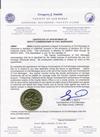
Here’s the appointing document itself in case you’re curious. Figgered most folks have never seen such a thing (I certainly hadn’t). Click to enlarge it.

I’m particularly interested in the fact that it goes on at such length to say the county won’t cover injuries caused to you in the act of performing the marriage and that it also won’t cover injuries you cause others.

Guess there are still more shotgun weddings than I thought there were or something.

I’m A Deputy!

DeputyNo, really! I am!

I’ve been duly deputized! Put another way: I done been deputed!

I am not, however, a deputy sheriff or marshal.

I’m a deputy commissioner . . . of marriages.

Here’s the story on that:

Recently a relative and the relative’s fiancee (fiance?) asked me to marry them.

Neither the relative nor the fiance (fiancee?) is Catholic, so there is no requirement of Catholic form and it’s a first marriage for both, so it is presumptively valid in the eyes of the Church.

I was honored to be asked, of course, and you don’t say no to a relative lightly when they ask you something as personal as this, so I also checked and verified that there is no canonical barrier (and there’s not) to a Catholic layman performing such a service under these conditions. In fact, many Catholic lay people are commissioners of marriage working in county courthouses all across the country performing civil but–unless there’s an impediment–valid marriages.

Here’s how that gets applied to me: It turns out that California marriage law is crazy (no, really!) and basically anybody can perform marriage ceremonies.

F’rinstance: If you are an ordained minister of any denomination–even a shaman, a witchdoctor, or a minister of a phony Internet denomination made up purely so people can get tax breaks and marry people and call themselves ministers–then you can do marriages in California. You don’t have to be a resident of California. You don’t even have to tell California that you’re coming in to do a marriage. California maintains no central registry of persons authorized to perform marriages.

Since I’m not an ordained minister (not even of a phony Internet denomination), I’m not going that route, of course.

But wait, there’s more!

If you’re Joe Blow, you can go down to the county courthouse, fill out a form, pay a filing fee, and get appoitned a deputy commissioner of marriage so that you can perform one, specific marriage (whose particulars you describe on the form).

So that’s what I did.

And, as of next week, I’m going to go where (a few) Catholic lay people have gone before and perform a marriage.

I do get a gold-star, though. It’s the seal on the form commissioning me:

Commission2

Here’s the appointing document itself in case you’re curious. Figgered most folks have never seen such a thing (I certainly hadn’t). Click to enlarge it.

Commission1_1 I’m particularly interested in the fact that it goes on at such length to say the county won’t cover injuries caused to you in the act of performing the marriage and that it also won’t cover injuries you cause others.

Guess there are still more shotgun weddings than I thought there were or something.