My sister was laying odds that I’d be either Violet or Elastigirl. She was wrong:

Which Incredibles Character Are You?
brought to you by Quizilla
(Nod to the Two Sleepy Mommies for the link.)
My sister was laying odds that I’d be either Violet or Elastigirl. She was wrong:
Which Incredibles Character Are You?
brought to you by Quizilla
(Nod to the Two Sleepy Mommies for the link.)
My sister was laying odds that I’d be either Violet or Elastigirl. She was wrong:
Which Incredibles Character Are You?
brought to you by Quizilla
(Nod to the Two Sleepy Mommies for the link.)
One M.D. has a novel solution to warnings of an impending physician shortage: Embrace the shortage and become, in her words, "a rare commodity":
"Why would anyone in their right mind want to go into medicine now? Until something is done to corral the HMO and government administrators (who are expensive and time-consuming annoyances); until the pay for family practice and general practice doctors is made equal to that of general pediatricians and general internists; until there are special courts for malpractice complaints instead of the current lawyer-stealing-from-doctor tort system; and until we aren’t having to cope daily with the tragic stories of people who cannot afford medications and of people who are being dumped off insurance when they are sick, I’m advising my bright young patients to look elsewhere for an occupation.
"I think we should be allowed to become a rare commodity. Maybe then we will be paid enough and respected enough to make the profession worth doing again" (source).
After my second spit-take at the line suggesting that doctors aren’t compensated enough in money and respect for their services, I got to thinking.
In some ways, I can see this physician’s point. Given their long years of expensive training, the malpractice coverage they must pay, and the risks entailed with running a business (especially one where they are beholden to insurance companies to cough up payments in a timely manner) the dazzling salaries doctors reportedly make do seem less-glittering. And, of course, it is specialization that pays the most. General practice and teaching doctors do not make dazzling salaries. I can also concede that respect for doctors flies out the window when it’s time to start looking around for a scapegoat for a tragedy, whether or not an individual doctor could have done anything differently.
Still.
Advising that physicians allow themselves to become a "rare commodity" will only mean that patients, those whom doctors are supposed to serve, will only receive worse care as the insurance companies ration out treatment options ever more thinly to meet the increased demand. And, as the physicians left in the field grow ever more gray, who will replace them? Will it take a decade-plus to train the new physicians once the potential doctors and early-retiree doctors decide to come back from their "strike"?
All in all, a silly proposal for a serious problem.
(Nod to Kevin, M.D., for the links.)
One M.D. has a novel solution to warnings of an impending physician shortage: Embrace the shortage and become, in her words, "a rare commodity":
"Why would anyone in their right mind want to go into medicine now? Until something is done to corral the HMO and government administrators (who are expensive and time-consuming annoyances); until the pay for family practice and general practice doctors is made equal to that of general pediatricians and general internists; until there are special courts for malpractice complaints instead of the current lawyer-stealing-from-doctor tort system; and until we aren’t having to cope daily with the tragic stories of people who cannot afford medications and of people who are being dumped off insurance when they are sick, I’m advising my bright young patients to look elsewhere for an occupation.
"I think we should be allowed to become a rare commodity. Maybe then we will be paid enough and respected enough to make the profession worth doing again" (source).
After my second spit-take at the line suggesting that doctors aren’t compensated enough in money and respect for their services, I got to thinking.
In some ways, I can see this physician’s point. Given their long years of expensive training, the malpractice coverage they must pay, and the risks entailed with running a business (especially one where they are beholden to insurance companies to cough up payments in a timely manner) the dazzling salaries doctors reportedly make do seem less-glittering. And, of course, it is specialization that pays the most. General practice and teaching doctors do not make dazzling salaries. I can also concede that respect for doctors flies out the window when it’s time to start looking around for a scapegoat for a tragedy, whether or not an individual doctor could have done anything differently.
Still.
Advising that physicians allow themselves to become a "rare commodity" will only mean that patients, those whom doctors are supposed to serve, will only receive worse care as the insurance companies ration out treatment options ever more thinly to meet the increased demand. And, as the physicians left in the field grow ever more gray, who will replace them? Will it take a decade-plus to train the new physicians once the potential doctors and early-retiree doctors decide to come back from their "strike"?
All in all, a silly proposal for a serious problem.
(Nod to Kevin, M.D., for the links.)
Scott Hahn reflects on Pope John Paul II’s "superior command of [S]cripture" and how that influenced many Protestant Evangelicals — including Dr. Hahn, who converted to the Church in 1986:
"Though I was then a Protestant minister–Calvinist in training, evangelical in approach, and instinctively anti-Catholic–I was first drawn to Pope John Paul II in the early 1980s. I was not alone among his hesitant admirers. He captured our attention because of his effective combat in the culture wars. But he kept our attention because of something else.
"Gradually and grudgingly, many of us, Protestants and Catholics alike, came to admit that he was effective in the culture wars, not because of his bully pulpit or his media savvy or his philosophical suavity, but because of his superior command of scripture."
(Nod to Karen Hall of Some Have Hats for the link.)
Scott Hahn reflects on Pope John Paul II’s "superior command of [S]cripture" and how that influenced many Protestant Evangelicals — including Dr. Hahn, who converted to the Church in 1986:
"Though I was then a Protestant minister–Calvinist in training, evangelical in approach, and instinctively anti-Catholic–I was first drawn to Pope John Paul II in the early 1980s. I was not alone among his hesitant admirers. He captured our attention because of his effective combat in the culture wars. But he kept our attention because of something else.
"Gradually and grudgingly, many of us, Protestants and Catholics alike, came to admit that he was effective in the culture wars, not because of his bully pulpit or his media savvy or his philosophical suavity, but because of his superior command of scripture."
(Nod to Karen Hall of Some Have Hats for the link.)
Economist Steven Levitt has become the ELVIS of statistics by crunching numbers in unexpected ways and analyzing the results. He’s ruffled feathers on both ends of the political spectrum by arguing on the one hand that it is far more dangerous to own a swimming pool than a gun, and on the other that abortion reduces crime.
That’s right! We’ve all been enjoying a drop in crime thanks in part to the fact that we have been killing criminals in the womb.
This last theory seems to prop up the old truism that poverty causes crime. The two are statistically linked. What I have never heard discussed is to what extent crime causes poverty. Does he have his plow before his mule?
Economist Steven Levitt has become the ELVIS of statistics by crunching numbers in unexpected ways and analyzing the results. He’s ruffled feathers on both ends of the political spectrum by arguing on the one hand that it is far more dangerous to own a swimming pool than a gun, and on the other that abortion reduces crime.
That’s right! We’ve all been enjoying a drop in crime thanks in part to the fact that we have been killing criminals in the womb.
This last theory seems to prop up the old truism that poverty causes crime. The two are statistically linked. What I have never heard discussed is to what extent crime causes poverty. Does he have his plow before his mule?
So the other day I was driving along in my pick-up truck, listening to country music, puffing my pipe, and thinking about Semitic languages (Hebrew, Aramaic, Arabic, etc.).
Words in these languages tend to be built around roots that have three consonants, which then have a variety of prefixes, suffixes, and infixes shoved around and into them. (An infix is a affix that goes into a word, as you might imagine, instead of on the front or on the back, like a prefix or suffix.)
F’rinstance: the root K-T-B gets use in Semitic languages to make words like "write," "writing," "book," "bookkeeper," "library," etc.
‘Nuther instance: M-L-K gets used for a lot of royal words . . .
So lots of M-L-K words denoting kings and king-related things in Semitic languages.
Which got me thinking about this guy:
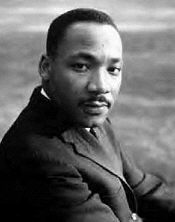
America’s own M.L.K, or Martin Luther King.
Go fig.
Columnist Maggie Gallagher writes (excerpts):
Pope John Paul the Great is not yet buried, but the divisions among American Catholics have already taken center stage on cable television: Will the next pope be Catholic?
Of course, JP II’s critics don’t put it that way. But the long-deferred hopes of this group (call them sexual liberals) — that the Catholic Church is about to abandon its ancient teachings on premarital sex, abortion, divorce, homosexuality and, above all, birth control — have burst out anew in the 24-hour coverage of the pope’s death.
Sexual liberalism has a lot of powerful things going for it in terms of attracting adherents: passion, for instance, the difficulty of self-restraint, the attractiveness of choice as the highest moral good. But sexual liberalism’s most powerful ally is the myth of progress. Sexual liberals, like Marxists of old, see themselves as the inevitable wave of the future. The Catholic Church is "out of step" with the future, they believe, and must eventually get in line with the poll numbers, or fade into irrelevance.
Puncture this myth, and see how quickly the power of this set of ideas drizzles away.
Like Marxists of old, sexual liberals are going to be shocked and disappointed to find how irrelevant and outmoded their ideas seem. In 1968, the advice of sexual liberals — accommodate the sexual revolution or die — may have seemed tempting, even to the College of Cardinals. By 2004, it has become clear that Christian denominations that accepted this advice have not experienced religious revivals. Instead, such mainline Protestant sects are rapidly dwindling in numbers.
Sexual liberalism has a lot going for it, but it does have this one little drawback: Religions or societies that adopt it appear to die out.
(Cowboy hat tip to the reader who e-mailed!)