The Other Oath

Recently I quoted from Universi Dominici Gregis–the apostolic consitution of John Paul II governing the conclave and other matters to be taken care of upon his death–and gave the oath that is taken by those involved in the conclave who are not cardinal electors (e.g., support personnel). The cardinal electors take a different oath. Here it is:

53. In conformity with the provisions of No. 52, the Cardinal Dean or the Cardinal who has precedence by order and seniority, will read aloud the following formula of the oath:

We, the Cardinal electors present in this election of the Supreme Pontiff promise, pledge and swear, as individuals and as a group, to observe faithfully and scrupulously the prescriptions contained in the Apostolic Constitution of the Supreme Pontiff John Paul II, Universi Dominici Gregis, published on 22 February 1996. We likewise promise, pledge and swear that whichever of us by divine disposition is elected Roman Pontiff will commit himself faithfully to carrying out the munus Petrinum of Pastor of the Universal Church and will not fail to affirm and defend strenuously the spiritual and temporal rights and the liberty of the Holy See. In a particular way, we promise and swear to observe with the greatest fidelity and with all persons, clerical or lay, secrecy regarding everything that in any way relates to the election of the Roman Pontiff and regarding what occurs in the place of the election, directly or indirectly related to the results of the voting; we promise and swear not to break this secret in any way, either during or after the election of the new Pontiff, unless explicit authorization is granted by the same Pontiff; and never to lend support or favour to any interference, opposition or any other form of intervention, whereby secular authorities of whatever order and degree or any group of people or individuals might wish to intervene in the election of the Roman Pontiff.

Each of the Cardinal electors, according to the order of precedence, will then take the oath according to the following formula:

And I, N. Cardinal N., do so promise, pledge and swear. Placing his hand on the Gospels, he will add: So help me God and these Holy Gospels which I touch with my hand.

Also,

HERE’S A HANDY LINK TO UNIVERSI DOMINICI GREGIS IN CASE YOU WANT TO LOOK ANYTHING UP DURING THE CONCLAVE.

Food, Water, And Oxygen

I wanted to tie up something that I meant to blog about during the Terri Schiavo crisis, though events overtook me and I wasn’t able to do so.

During the crisis, I received several requests from folks for comment about why food and water were considered "ordinary" means of sustaining life, regardless of their method of delivery, whereas going on a respirator was considered "extraordinary" means.

It’s a good question. Food, water, and oxygen are all essential material requirements for the typical care of the body. If the first two must be delivered regardless of the means of delivery, why not the third?

This is an area where the advent of new medical technologies has had a significant impact, and the Church is still sorting these matters out, but let me offer you what I can on this.

There is a development in the terminology of moral theology that seems to be happening at present. The older terminology divides life-saving measures into "ordinary" and "extraordinary" means, whereas the newer terminology divides them into "proportionate" and "disproportionate" means. Currently the Magisterium is using both sets of terms, but there is a shift that seems to be occurring from the former to the latter. In the future, the former terminology may be replaced by the latter or the former may be interpreted so that it means the same thing as the latter. We’ll have to wait and see.

In any event, the old distinction between "ordinary/extraordinary" is undergoing significant change because the advent of technology has made many things that would have formerly been quite extraordinary before the 20th century to be quite ordinary in the 21st. What was considered an ordinary thing to do for a sick person was much the same in the 10th century as it was in the 15th, but would bear very little resemblance to what would be an ordinary thing to do for a sick person today.

The shift in terminology is reflected, for example, in the Holy See’s 1980 Declaration on Euthanasia, which says in part:

Those whose task it is to care for the sick must do so conscientiously and administer the remedies that seem necessary or useful. However, is it necessary in all circumstances to have recourse to all possible remedies? In the past, moralists replied that one is never obliged to use "extraordinary" means. This reply, which as a principle still holds good, is perhaps less clear today, by reason of the imprecision of the term and the rapid progress made in the treatment of sickness. Thus some people prefer to speak of "proportionate" and "disproportionate" means. In any case, it will be possible to make a correct judgment as to the means by studying the type of treatment to be used, its degree of complexity or risk, its cost and the possibilities of using it, and comparing these elements with the result that can be expected, taking into account the state of the sick person and his or her physical and moral resources [SOURCE].

The Holy See thus notes that the term "extraordinary means" is problematic because it is imprecise and subject to rapid technological progress. While acknowledging that the term can still be used in principle, it offers a series of considerations for determining whether a treatment should be used that converge on what is captured by the terms "proprotionate" and "disproportionate"–i.e., the complexity and risk of the treatment, the cost and possibility of using it, the result that can be expected, the state of the sick person and his resources, etc.

In the absence of a Magisterial clarification of the meaning of the ordinary-extraordinary distinction that sets it on a firmer footing, I’m inclined to say that the proportionate-disproportionate distinction better captures what Catholic moral theology requires–and what older moral theologians were after when they used the terms "ordinary" and "extraordinary."

It seems to me that when they referred to "ordinary" means of saving someone’s life, they meant things that had reasonable prospects of helping, did not significantly burden the patient, did not put him at great risk, and were not extremely difficult to pursue. By contrast, if something had low prospects of helping, greatly burdened the patient, put him at great risk, or was extremely difficult to pursue then they regarded it as an "extraordinary" thing to do.

Today, because advancing medical technology is rapidly shifting things from the "extraordinary" column to the "ordinary" column, it seems to me that "proportionate" and "disproportionate" express the same distinction in a less confusing way.

At least most of the time.

‘Cause there’s a big disclaimer that needs to be mentioned.

Whenever you get the word "proportionate" into a moral discussion, certain individuals will self-righteously sniff and say "That’s just proportionalism."

Wrong.

The idea of proportion is something that involves weighing the costs and risks of an action against the benefits to be obtained by pursuing it. That’s not at all alien to Christian moral theology. Indeed, both Testaments of the Bible contain material that is based on this kind of prudential judgment.

What proportional-ism does it is takes the idea of proportion and absolutizes it, making it the only criteria that is relevant. It allows any action to be undertaken as long as the benefits it stands to result in are considered proportional to its costs and risks under an immediate, this-worldly calculus. That’s why proportional-ism is condemned. But the use of the idea of proportion in making a moral judgment is not. In fact, in many situations it is required–failing to make use of it being a sin against the virtue of prudence.

So I don’t want to hear a lot of "You’re just talking about proportionalism" stuff in the combox, because I’m not. Self-righteous sniffers take warning.

Having said that, let’s apply these principles to the situations of artificially providing food, water, and oxygen.

It seems to me that in principle they are all the same: They all are things the body needs to survive and their administration thus does not count as medical treatment. The default position on all three is that, unless something else is affecting the situation, their administration is proportionate and morally obligatory.

However, in various situations all three of the administration of all three can become disproportionate and thus non-obligatory.

We have already discussed, for example, the case of an individual whose body has stopped manufacturing albumin. In such a situation, continuing to administer food and water intravenously will result in horrible damage being done to the body and thus is not morally required. In that case the administration of food and water has become disproportionate to the good to be achieved and it is no longer obligatory.

If it’s merely a matter of putting a food and water tube in someone’s mouth or nose or stomach and the person is otherwise able to process food and water then the adminsitration of them will be proportionate (unless something else is affecting the situation), but in the case of someone who can’t manufacture albumin, even a simple food and water tube becomes disproportionate because his body is no longer able to process fluids and he will be positively harmed by pumping them into the patient.

When it comes to oxygen, if it is merely a matter of attaching an oxygen tube to someone’s nose so they can breathe, again this is a simple enough thing that it’s going to be proportionate (unless something else is affecting the situation) and thus morally obligatory.

But if we’re talking about someone who needs an iron lung (a very small class of people today) then we’re talking about a much more burdensome and costly procedure that can more quickly become disproportionate.

That’s the difference. While food, water, and oxygen are all are all necessary substances for the body and while their artificial administration is presumed to be proportionate until proven otherwise, certain means of delivering them become disproportionate or "extraordinary" more quickly because technology has not yet been developed that renders them non-burdensome.

In the case of food and water, we have means that are fairly non-burdensome unless there is something wrong with the patient’s ability to assimilate food and water. In the case of oxygen we may be improving on this point, but at least certain oxygen-delivering technologies are still more burdensome and thus fall into the disproportionate or "extraordinary" category more easily.

When something falls into the disproportionate or "extraordinary" category, one can morally choose not to use it even though death will inevitably result. One cannot, however, discontinue proportionate or "ordinary" means in order to cause death, neither may one deliberately undertake any other course of action that, as a means or as an end, is intended to kill the patient.

No matter what advocates of proportionalism would say.

Happy Birthday, Daffy!

Daffy_duckDaffy Duck made his first appearance April 17, 1937 in the short "Porky’s Duck Hunt" and was an instant success.
Audiences couldn’t stop talking about the screwball duck and he quickly supplanted Porky Pig in popularity.

Porky gracefully recovered, eventually accepting the role of straightman for the daffy duck.

As a prima donna, though, Daffy never recovered when he himself was supplanted by Bugs Bunny and has become obsessed with reclaiming the spotlight he lost to Bugs.

That’s no reason not to pay tribute to a true comic genius, though.

HAPPY BIRTHDAY, DAFFY!

What's Going On In That Little Dogbrain?

Dogs have been dumbed down by being domesticated. Wolves are much smarter. Right?

Not!

It turns out that by rubbing shoulders with brainy humans for so long (and being bred by brainy humans) dogs may have had some human smarts rub off on them.

That’s what some scientists are concluding.

Dogs even compare favorably in some tests with critters with a much higher brain rep, like chimpanzees.

EXCERPT:

Chimpanzees, our closest relatives, have been shown to follow a human’s gaze, but they do very poorly in a classic experiment that requires them to extract clues by watching a person. In that test, a researcher hides food in one of several containers out of sight of the animal. Then the chimp is allowed to choose one container after the experimenter indicates the correct choice by various methods, such as staring, nodding, pointing, tapping, or placing a marker. Only with considerable training do chimps and other primates manage to score above chance.

Dogs, however, performed marvelously, and even outdoor dogs with no particular master could solve the problem immediately. (The researchers controlled for the scent of the food.) By 2001 a raft of experiments by Mr. Csányi’s team and another led by Michael Tomasello of the Max Planck Institute for Evolutionary Anthropology, in Leipzig, Germany, showed that dogs were far more skilled then either chimps or wolves at using human social cues to find food. Those results left researchers with this question: If dogs can pick up on human cues, do they turn the tables and put out cues for humans to understand?

GET THE STORY.

What’s Going On In That Little Dogbrain?

Dogs have been dumbed down by being domesticated. Wolves are much smarter. Right?

Not!

It turns out that by rubbing shoulders with brainy humans for so long (and being bred by brainy humans) dogs may have had some human smarts rub off on them.

That’s what some scientists are concluding.

Dogs even compare favorably in some tests with critters with a much higher brain rep, like chimpanzees.

EXCERPT:

Chimpanzees, our closest relatives, have been shown to follow a human’s gaze, but they do very poorly in a classic experiment that requires them to extract clues by watching a person. In that test, a researcher hides food in one of several containers out of sight of the animal. Then the chimp is allowed to choose one container after the experimenter indicates the correct choice by various methods, such as staring, nodding, pointing, tapping, or placing a marker. Only with considerable training do chimps and other primates manage to score above chance.

Dogs, however, performed marvelously, and even outdoor dogs with no particular master could solve the problem immediately. (The researchers controlled for the scent of the food.) By 2001 a raft of experiments by Mr. Csányi’s team and another led by Michael Tomasello of the Max Planck Institute for Evolutionary Anthropology, in Leipzig, Germany, showed that dogs were far more skilled then either chimps or wolves at using human social cues to find food. Those results left researchers with this question: If dogs can pick up on human cues, do they turn the tables and put out cues for humans to understand?

GET THE STORY.

Neuhaus On New Pope

Fr. Richard John Neuhaus is over yonder in Rome right now reporting on Romish goings on and doing a blog while he’s at it.

HIS LATEST POST CONTAINS SIGNIFICANT SPECULATION ON WHO THE NEW POPE MIGHT BE.

So do his prior entries, so read them, too.

(Cowboy aht tip: Southern Appeal.)

Meanwhile back at the ranch, the rats at the New York Times write

AN EDITORIAL DISGUISED AS A NEWS STORY DEVOTED TO HANDWRINGING OVER THE POSSIBILITY THAT RATZINGER MIGHT BECOME POPE.

More Divine "Coincidence"?

Many folks have commented on the interesting coincidences that surrounded the death of John Paul II (e.g., in connection with Divine Mercy Sunday). My Benedictine priest friend has noticed a possible coincidence with the electino of the new pope. He writes:

We have what seems to be a striking arrangement of God’s provident care this very year.

Saturday, April 16, is the final day of official ceremonial mourning for Pope John Paul II (the Vatican began the nine days with April 8, the day of burial itself).

The day after is the fourth Sunday of Easter, the papally-designated annual "World Day of Prayer for Vocations". The fourth Sunday of Easter always has a section from the Gospel of the Good Shepherd, John 10, no matter which year of the "triennium" we may be in. However, this particular year of 2005, year A of the triennium, has as the first reading on this Sunday Acts 2 in which Pope Saint Peter calls 3,000 to repentance and baptizes them.

The responsorial psalm is "The Lord is my shepherd." The second reading is from the first letter of Pope Saint Peter saying, "For you had gone astray like sheep, but you have now returned to the shepherd and guardian of your souls."

Monday, April 18, is the beginning of the election to discern who has the vocation to serve as the next pope. John 10 continues to be proclaimed at Mass on this Monday and and also on Tuesday.

Next Sunday, given that recent conclaves have lasted less than a week, we may already have a new pope. If so, it is possible the new pope might choose that Sunday for the inauguration Mass of his pontificate.

In the first reading for next Sunday (Acts 6), Pope Saint Peter and the other apostles will ordain the first deacons. In the second reading, the first letter of Pope Saint Peter, the first pope exhorts the Church to come to Christ, to be built up as a spiritual house, a holy priesthood, for we are "’a chosen race, a royal priesthood, a holy nation, a people of his own, so that you may announce the praises’ of him who called you out of darkness into his wonderful light." In the Gospel, Christ the Divine Cornerstone speaks to us of his "Father’s House" that has "many dwelling places."

God is building up the Church indeed!

More Divine “Coincidence”?

Many folks have commented on the interesting coincidences that surrounded the death of John Paul II (e.g., in connection with Divine Mercy Sunday). My Benedictine priest friend has noticed a possible coincidence with the electino of the new pope. He writes:

We have what seems to be a striking arrangement of God’s provident care this very year.

Saturday, April 16, is the final day of official ceremonial mourning for Pope John Paul II (the Vatican began the nine days with April 8, the day of burial itself).

The day after is the fourth Sunday of Easter, the papally-designated annual "World Day of Prayer for Vocations". The fourth Sunday of Easter always has a section from the Gospel of the Good Shepherd, John 10, no matter which year of the "triennium" we may be in. However, this particular year of 2005, year A of the triennium, has as the first reading on this Sunday Acts 2 in which Pope Saint Peter calls 3,000 to repentance and baptizes them.

The responsorial psalm is "The Lord is my shepherd." The second reading is from the first letter of Pope Saint Peter saying, "For you had gone astray like sheep, but you have now returned to the shepherd and guardian of your souls."

Monday, April 18, is the beginning of the election to discern who has the vocation to serve as the next pope. John 10 continues to be proclaimed at Mass on this Monday and and also on Tuesday.

Next Sunday, given that recent conclaves have lasted less than a week, we may already have a new pope. If so, it is possible the new pope might choose that Sunday for the inauguration Mass of his pontificate.

In the first reading for next Sunday (Acts 6), Pope Saint Peter and the other apostles will ordain the first deacons. In the second reading, the first letter of Pope Saint Peter, the first pope exhorts the Church to come to Christ, to be built up as a spiritual house, a holy priesthood, for we are "’a chosen race, a royal priesthood, a holy nation, a people of his own, so that you may announce the praises’ of him who called you out of darkness into his wonderful light." In the Gospel, Christ the Divine Cornerstone speaks to us of his "Father’s House" that has "many dwelling places."

God is building up the Church indeed!

Historical Birthrates

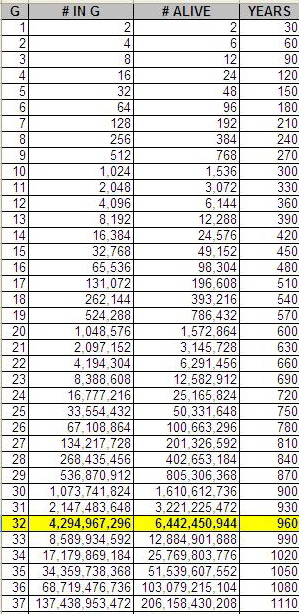
Generations_1 Y’know the good ol’ days when everyone had ten kids?

Those days never existed.

Or, to be more precise: The never existed for more than a few people in particular areas in particular historical circumstances.

The family my cattle-ranching grandmother was born into, f’risntance, had 12 kids, 10 of whom survived to adulthood.

But that’s always been the lucky exception. Not the rule.

How can we know that?

We can do the math.

Suppose Adam and Eve had four kids (Scripture says they had more, but suppose it was only four).

Suppose that their kids paired off and each pair had four kids, just like Adam and Eve.

That’d be eight kids in the next generation.

Now suppose this patten of four kids per couple kept up each generation.

Y’know how many generations it would take to arrive at the 4 billion folks who were alive c. 1980? 32 generations.

Remembering, though, that more than one generation is alive at a time, let’s suppose that two generations were alive at any one time (that would be some grandparents, all parents, and some of the children who would be born; we’ll ignore great-grandparents and great-grandchildren for statistical purposes since so few of these have been alive at the same time before the advent of modern medicine).

Y’know how many generations it would take to get to the six billion people currently alive at present? Again: 32.

Now suppose that on average historically parents had their children four children between the ages of 15 and 45, so the parents were an average of 30 years old when they were between their second and third of their four children.

Y’know how long ago Adam and Eve would have lived? That would be 960 years (32 generations x 30 years at middle of breeding life).

Hm. Doesn’t sound right, does it?

But wait! Maybe there are some factors we haven’t accounted for! Let’s try an easy one: Not everbody gets married. Some people go through life single–or they’re in an infertile union and can’t have kids. Let’s suppose that happens to half of all the children that have been born historically: They either stayed single or couldn’t have kids.

In this case, each generation of parents could have eight kids, with only four of them going on to have a brood of eight kids, four of whom would then reproduce, etc. If only half the kids end up breeding due to singleness or infertility, y’know how many generations that would push back Adam and Eve from the present generation?

One.

In that case, the human race would be 33 generations and 990 years old.

But maybe there are other factors–like disease and war. Those have claimed a lot of people’s lives and kept them from breeding. Suppose that these two factors cut each historical generation in half. In that case, each previous batch of parents would have had 16 kids–half of which were prevented from breeding because of illness or war. Of the eight surviving kids, four didn’t breed because of singleness or infertility, leaving four to find spouses and breed a new batch of 16 kids, only 4 of which would then go on to breed, etc.

How far back would that push Adam and Eve?

One generation.

In that case the human race would be 34 generations and 1020 years old.

Okay, so maybe there’s another factor.

How about the obvious one, biblically: The hugelarge lifespans that the early chapters of Genesis record?

Assuming those are literal, they do create some extra room between us and Adam and Eve. But not as much as you’d think. While Adam may have lived to be 930 years old according to Genesis 5:5, he had his third son–Seth–when he was only 130 years old according to Gen. 5:3. That’s not unusual in the Genesis 5 genealogy. The patriarchs tend to have their kids (relatively) young compared to their hugelarge lifespan (I am so envious of that lifespan, lemme tell you), and it’s the kid-bearing age that counts for making Adam and Eve more remote from us, not the overall time the partiarchs lived.

Those (relatively) high kid-bearing ages also only apply to the first few generations of the human race. Things drop off pretty quickly after the time of Noah.

But there’s a bigger problem.

Even if we give full allowance for pushing Adam and Eve back in time based on the long lifespans recorded in Genesis, that doesn’t change the number of generations between them and us. And therein lies the problem.

If y’all will take a gander at the genealogy of Jesus Christ offered in Luke 3, y’all’ll see that there are 76 generations between Adam and Jesus–and that was 2000 years ago. Allowing for the 30 years per breeding generation over the last 2000 years, that would mean that there have been 67 geneations between Jesus’ day and today, meaning that there have been 143 generations between Adam and us.

Now that’s a problem if you want to say that folks in the past had large numbers of kids on average.

Y’know how many people would be alive today after 143 generations in which each pair of parents had an average of only four kids who went on to breed? (Leaving aside those who were single, infertile, or killed by disease or war.)

There would be 16,725,558,898,898,000,000,000,000,000,000,000,000,000,000 or almost 17 tredecillion people.

The only conclusions available would be (a) there are this many people alive now, despite appearances, (b) the human race is much less than 143 generations old, despite the Bible and science, or (c) the average number of children folks have had who went on to breed is less than 4–way less. Still above 2 or we’d never make any progress at all, but way less than 4.

My money’s on the last of the three options: The average number of breeding kids folks historically have had was much closer to 2 than 4.

If I’ve done my math right, it would take an average of 2.33 breeding children per generation to arrive at the present global population after 143 generations.

If there were some missing generations in the biblical genealogies (as is likely) then the number would be less than 2.33 but still higher than 2. For simplicitly, let’s assume that it’s 2.33, though.

How we account for this number is an open question. Certainly they had more kids than became breeders. Some stayed single. Some were infertile. Some died from disease. Some died from violence.

But I doubt that most parents had 8 kids and only 2.33 ended up becoming parents. I suspect that the historical number was much closer to 4 kids, of which 2.33 became parents.

Yet that number isn’t realistic for parents who aren’t otherwise touched by infertility, disease, or war, which we have already accounted for (on average). If you have two folks get married at 15 and they start having a typical conjugal life then–barring infertility, death by disease, and death by war–they’re going to have a lot more than 4 kids before they hit 45.

This suggests one thing: Folks in the past have been far better at birth regulation than we in the modern world have given them credit for.

Much of the time, no doubt, due to pagan influence and lack of doctrinal clarity, they have used things like abortion and contraception to regulate birth in a morally illicit manner, but even in properly-morally-educated Catholic countries they have been exercising a lot more regulation of births than we’ve been imagining.

After all, if we started with just two good Catholics 1000 years ago in Europe and they had and average of four breeding kids per generation then there would be six billion such European Catholics today.

And there’s not. Nowhere close.

Now, don’t get me wrong: I love big families. I’d love to get married and have one. I’d love to see folks all over the place having them for the indefinite future, including starting colonies offworld to get elbow room for all the new humans. (Take a look in the chart above around generation 36 is you don’t see the need for new elbow room for them.)

But I also believe in looking at the past realistically, and at human nature realistically, and human nature is such that the idea that the regulation of births has only come into view in the last generation or two just doesn’t hold water.

Right or wrong, by good means or bad, the regulation of births has been with us much, much longer.