Quake!

Quake

Got woke up this morning by an earthquake. Just one of the fringe benefits you get for living in California.

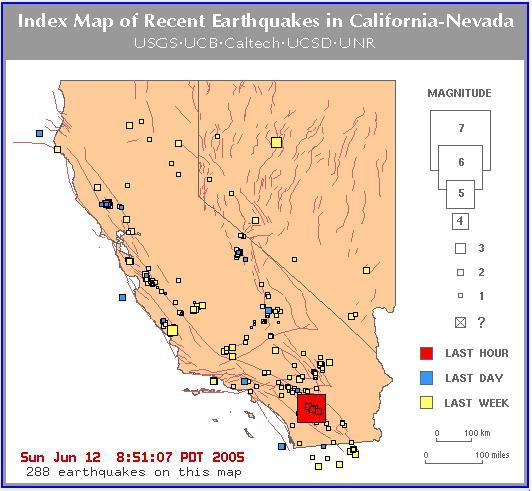
This one took place at 8:41 a.m. and the epicenter was located six miles east of Anza Borrego in the desert northeast of San Diego. (I stayed there overnight once.)

I checked, and the quake was centered 56 miles from where I live, and the quake was strong enough to wake me up–not surprising if you look at the map above and discern from the big red box that the magnitude of the quake was in the 5 range.

In fact, it was 5.6. It only lasted a few seconds (at least the shaking here, 56 miles away, only lasted that long), but it was violent enough that my bed and my whole bedroom wobbled so forcefully that it snatched me, protesting, from a dream.

CHECK OUT THE RECENT QUAKE TOOL I USED TO GET THE ABOVE MAP.

Menial Work & Dead-End Jobs

The problem with the current administration’s economic policies is that it dooms people to taking dead-end jobs consisting of menial work.

This is simply unjust. Menial work is beneath human dignity, and everyone should be able to get a promotion to a higher position without changing employers.

What we ought to do is adopt policies that would eliminate menial work in our lifetime and ensure a promising promotional path for every job in the economy. Right?

THOMAS SOWELL HAS THE SMACKDOWN.

Menial Work & Dead-End Jobs

The problem with the current administration’s economic policies is that it dooms people to taking dead-end jobs consisting of menial work.

This is simply unjust. Menial work is beneath human dignity, and everyone should be able to get a promotion to a higher position without changing employers.

What we ought to do is adopt policies that would eliminate menial work in our lifetime and ensure a promising promotional path for every job in the economy. Right?

THOMAS SOWELL HAS THE SMACKDOWN.

The Dead Know Nothing?

A reader writes:

In the Book of Ecclesiastes, one passage says that the "dead know nothing" or the "dead know nothing of the living". How is this reconciled with intercessory prayer to the saints and to apcryphal passages stating the contrary?

There are a number of possibilities here, but let me try to articulate the central problem with opposing something Ecclesiastes says with things elsewhere shown in Scripture: Ecclesiastes is not your typical book of Scripture. It is written in a very distinct genre that is unlike anything else in the Bible. While it may broadly be classed as a piece of wisdom literature, the wisdom in question is of a wholly remarkable sort.

Rather than affirming the commonsense wisdom of ancient Israel (like the book of Proverbs) it calls this wisdom into question and subjects it to cross-examination. The book assumes a what might be termed a perspective of theistic existentialism in which the weight of the human condition is given full voice and allowed to express all the doubt and questioning that a soul in anguish and despair at the apparent absurdity in the world is wont to express.

The questioning process that the book subjects conventional religious piety to is so thorough that many in the ancient world were scandalized by the book and questioned whether it should even be included in Scripture.

It’s not hard to understand why when you look at a book and its opening line is "Vanity of vanities, says the  Preacher,   vanity of vanities! All is vanity" or, in a more modern idiom, ""Meaningless! Meaningless! says the Teacher. Utterly meaningless! Everything is meaningless" (Eccles. 1:2).

After an opening line like that, you know that you’re in for a wild ride. This is not going to be a book that easily affirms a simple and pious worldview that concludes that meaning in life is easy to find.

Instead, the book’s author assumes a perspective of natural philosophy. Rather than turning to the declarations of the prophets to find meaning and the revelation of God’s will, the author tries to apply human reason to the workings of the world to see what it can determine. He accepts the existence of God, but his methodology prevents him from simply trusting in the words of the prophets and concluding that his task is done.

In a way, the author of Ecclesiastes is like the philosopher Descartes. Descartes was a Christian (and a Catholic) who knew that at the end of his meditations he would affirm the Christian worldview, but he refused to take any shortcuts in arriving at that affirmation. In the same way the author of Ecclesiastes ends up affirming "Fear God, and keep his commandments; for this is the whole duty of  man. For God will bring every deed into judgment, with  every secret thing, whether good or evil" (Eccles. 12:13-14), but only after travelling a torturous path of philosophical reasonings.

Thus one cannot read Ecclesiastes as if it is a theological treatise of St. Paul. It is more like the book of Job, where different viewpoints are allowed to exist in dialogue and tension with each other. As Eccleiastes progresses, the author tries out various different viewpoints without fully endorsing any of them. One thus cannot lift a specific verse out of Eccleaistes and treat it like one of St. Paul’s theological deliverances. The book is far too paradoxical and tentative for that.

A special characteristic of the book is that it tends to assume a non-revelatory methodology. In other words, it tends not to rely on divine revelation to answer the questions it poses. It instead tries to use human reason. As a result, it finds some questions unanswerable from a human frame of reference. Thus early in the book we read:

Who  knows whether the spirit of man goes upward and the spirit of the  beast goes down to the earth? (Eccles. 3:21).

The implied answer is: No one knows–at least no one assuming the non-revelatory perspective the author is assuming.

The author thus confesses that from the perspective of human reason, one can’t say that the fate of man is any different from the fate of animals. One can’t even say what that fate is beyond the fact that both die (3:19).

It is this non-revelatory perspective that informs the book’s later statements that:

1: But all this I laid to heart, examining it all, how the
righteous and the wise and their deeds are in the hand of God; whether
it is love or hate man does not know. Everything before them is vanity,

2: since one fate comes to all, to the righteous and the
wicked, to the good and the evil, to the clean and the unclean, to him
who sacrifices and him who does not sacrifice. As is the good man, so
is the sinner; and he who swears is as he who shuns an oath.
3:
This is an evil in all that is done under the sun, that one fate comes
to all; also the hearts of men are full of evil, and madness is in
their hearts while they live, and after that they go to the dead.
4: But he who is  joined with all the living has hope, for a living dog is better  than a dead lion.
5:
For the living know that they will die, but the dead know nothing, and
they have no more reward; but the memory of them is lost.
6:
Their love and their hate and their envy have already perished, and
they have no more for ever any share in all that is done under the sun.

7: Go,  eat your bread with enjoyment, and drink your wine with a merry  heart; for God has already approved what you do.
8: Let  your garments be always white; let not oil be lacking on your head. 
9:
Enjoy life with the wife whom you love, all the days of your vain life
which he has given you under the sun, because that is your portion in
life and in your toil at which you toil under the sun.
10:
Whatever your hand finds to do, do it with your might; for there is no
work or thought or knowledge or wisdom in Sheol, to which you are
going.
11: Again I saw that under the sun the race is not
to the swift, nor the battle to the strong, nor bread to the wise, nor
riches to the intelligent, nor favor to the men of skill; but time and
chance happen to them all [Ecclesiastes 9].


The perspective of this passage (particularly in vv. 7-10) comes close to "eat, drink, and be merry, for tomorrow we die"–a viewpoint expressly repudiated by St. Paul in 1 Corinthians 15:32. St. Paul, though, was repudiating a more hardened version of this viewpoint than what the author of Ecclesiastes is advocating.

The author is articulating a view based on the human perspective that death seems to end everything, and consequently that life is vain and meaningless. We know that he doesn’t ultimately conclude that if we read through to the end of the book, but that is the viewpoint he is trying out at the moment.

And it is a view with some elements of truth in it: One may as well live life with gusto, or carpe diem, because death is coming and one will no longer be able to act (on earth). (This being a viewpoint that St. Paul could endorse, it being quite close to something Jesus said; see John 9:4).

Because the author is exploring matters from a human perspective, according to which death seems to end everything and makes life meaningless, one cannot seize upon statements like Ecclesiastes 9:5 ("the dead know nothing") or 9:10 ("there is no . . . thought or knowledge or wisdom in sh’ol") and make them doctrinal pronouncements.

They’re not.

They are what a person assuming a non-revelatory human perspective could conclude. If you look at a dead person, he doesn’t seem to know anything anymore or think anything or possess any wisdom. His body is inert. It is as if everything ended for him. Confined to a purely human perspective, that is what you might conclude. You might then conclude that his life was meaningless as it all came to an end.

But you can’t glom onto the "no knowledge" statements without recognizing the context in which they occur. If you want to make them absolutes then you’re going to have to make absolute also the idea that death ends everything and life is meaningless.

That, of course, you shouldn’t conclude. The author of Ecclesiastes doesn’t (see the last two verses of the book), and the other authors of Scripture certainly don’t.

In fact, other books of the Old and the New Testament both indicate that the dead do know things (see Jesus’ parable of Lazarus and the rich man and Revelation’s depictions of the saints in heaven knowing things on earth) and that they do pray for us (see 2 Macc. 15:14; Rev. 5:8).

The passages in Ecclesiastes (and a few other places) that speak of the dead as if they have no consciousness thus must be understood as what they are: Passages written from a this-worldly perspective addressing a point that further divine revelation has clarified.

They do not constitute disproof of what is said elsewhere in Scripture.
Ed Peters Has An Interesting Idea

Y’know how people in many parishes can’t seem to keep their hands to themselves during the Our Father?

In many parishes they get grabby and, though in American culture holding hands with another person is a gesture of intimacy (sweethearts do it, spouses do it, parents and children do it, complete strangers do not do it), suddenly the person next to you wants to engage in the gesture with you, a complete stranger.

In my own case, I solve this problem by clasping my hands in front of me and closing my eyes. 99.99% of the time that takes care of the issue, though I did once experience an elderly woman using her fingers to pluck at my elbow in an attempt to pierce through my obviously meditative attitude and get me to Conform to the handholding she wanted to inflict on me.

Needless to say, a lot of folks find this (unauthorized) grabbiness disturbing, and there has been perplexity at the episcopal level concerning what to do about it.

In come some helpful liturgists, who have suggested that instead of holding hands, people imitate the priest, who happens to be in the orans position at this moment, with his hands outstretched in prayer.

This has the advantage of not automatically inflicting hand-to-hand contact on the people next to one in the pew, though in an especially crowded pew it is not a sure recipe for avoiding all bodily contact. (One may experience a whack to the face, or at least the uncomfortable experience of becoming visually acquainted with the back of a stranger’s hand better than you know your own.)

One detects in the liturgists’ suggestion a further motive besides avoiding excessive touchy-feeliness (particularly since liturgists have themselves been excessively touchy-feely in recent years). Could it be . . . a desire to get the laity to imitate the priest and thus further blur the lines between the two?

"Oh, surely not!" you’re saying. "Liturgical planners have been scrupulous since the reform of the liturgy about making sure the roles of priest and laity are at all times clearly distinguished. Just ask them! They’ll tell you!"

However that may be, the Holy See has been concerned about the laity unduly aping the priest at Mass, and in the 1997 Instruction on Collaboration, an unprecedented conjunction of Vatican dicasteries wrote:

6 § 2. To promote the proper identity (of various roles) in this area, those abuses which are contrary to the provisions of canon 907 [i.e., "In the celebration of the Eucharist, deacons and lay persons are not permitted to say the prayers, especially the eucharistic prayer, nor to perform the actions which are proper to the celebrating priest."] are to be eradicated. In eucharistic celebrations deacons and non-ordained members of the faithful may not pronounce prayers — e.g. especially the eucharistic prayer, with its concluding doxology — or any other parts of the liturgy reserved to the celebrant priest. Neither may deacons or non-ordained members of the faithful use gestures or actions which are proper to the same priest celebrant. It is a grave abuse for any member of the non-ordained faithful to "quasi preside" at the Mass while leaving only that minimal participation to the priest which is necessary to secure validity.

This instruction, incidentally, was approved by John Paul II in forma specifica, meaning that the pope invested it with his own authority and is binding on us with the pope’s authority and not merely the authority of the authoring congregations.

Now, what gestures are proper to the priest celebrant? The orans gesture when praying on behalf of the people is certainly one of them. The priest celebrant and no others (not even concelebrating priests) are directed to make this gesture in the rubrics.

In some places, some laity may spread their arms whenever the priest spreads his in a kind of "Back atcha!" motion. I’ve even seen some do a phenomenal pantomime of tossing an invisible ball to the priest by swooping their palms close together and then spreading them apart as they assume the orans posture. But this is clearly apart from the rubrics.

If the orans posture is one proper to the priest celebrant in the liturgy then the laity should not be imitating it.

But Ed Peters raises an interesting question:

SHOULD EVEN THE PRIEST CELEBRANT HIMSELF BE MAKING THIS GESTURE DURING THE OUR FATHER?

The rubrics at present call for him to do so, so he should do so until the rubrics are changed, but given the underlying logic of the rubrics and the way the saying of the Our Father has developed in Mass, Ed raises an interesting question as to whether the rubrics might oughta be changed.

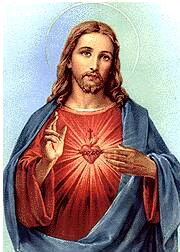
Sacred Heart

Sacred_heart106 years ago today, on June 11, 1899, Leo XIII consecrated the whole of humanity to the Sacred Heart of Jesus.

He explained:

[S]ince there is in the Sacred Heart a symbol and a sensible image of the infinite love of Jesus Christ which moves us to love one another, therefore is it fit and proper that we should consecrate ourselves to His most Sacred Heart-an act which is nothing else than an offering and a binding of oneself to Jesus Christ, seeing that whatever honor, veneration and love is given to this divine Heart is really and truly given to Christ Himself.

READ THE ENCYCLICAL.

LEARN MORE.

Diff'rent Folks

Who would you think of if asked for a name of Greatest Child Star Ever? Wouldn’t you automatically think of those child stars who have made something of their lives, transitioning from the difficulties of child fame to make their mark as adults? Apparently, becoming a well-adjusted adult is not a requirement for being considered Greatest Child Star Ever:

"VH1 has named Gary Coleman No. 1 on its list of the top 100 child stars ever. Home Alone star Macaulay Culkin was second, and the Olsen twins were third.

"Coleman, now 37, was the precocious star of the hit sitcom Diff’rent Strokes, which ran from 1978-86. Coleman played Arnold, who along with his older brother Willis (Todd Bridges) moves from Harlem to live with an affluent white family in Manhattan.

"In 2003 Coleman joined 134 other candidates to run for governor of California. Arnold Schwarzenegger successfully replaced the recalled Gov. Gray Davis, but Coleman got a few more minutes in the spotlight.

"’This is really interesting and cool and I’ve been enjoying the heck out of it because I get to be intelligent, which is something I don’t get to do very often,’ the 4-foot-8 actor said then."

GET THE STORY.

Coleman doesn’t get to be intelligent very often? Poor man.

Director-actors Ron Howard and Jodie Foster did manage to hit the top ten. But the article didn’t even mention Shirley Temple Black, possibly the iconic child movie star and a woman who made her mark not only in acting but also in the U.S. Foreign Service as an ambassador to Ghana and to Czechoslovakia.

‘Course, that’s small potatoes compared to running for governor of California in a come-one, come-all special election open to anyone with $3,500 and 65 signatures.

Diff’rent Folks

Who would you think of if asked for a name of Greatest Child Star Ever? Wouldn’t you automatically think of those child stars who have made something of their lives, transitioning from the difficulties of child fame to make their mark as adults? Apparently, becoming a well-adjusted adult is not a requirement for being considered Greatest Child Star Ever:

"VH1 has named Gary Coleman No. 1 on its list of the top 100 child stars ever. Home Alone star Macaulay Culkin was second, and the Olsen twins were third.

"Coleman, now 37, was the precocious star of the hit sitcom Diff’rent Strokes, which ran from 1978-86. Coleman played Arnold, who along with his older brother Willis (Todd Bridges) moves from Harlem to live with an affluent white family in Manhattan.

"In 2003 Coleman joined 134 other candidates to run for governor of California. Arnold Schwarzenegger successfully replaced the recalled Gov. Gray Davis, but Coleman got a few more minutes in the spotlight.

"’This is really interesting and cool and I’ve been enjoying the heck out of it because I get to be intelligent, which is something I don’t get to do very often,’ the 4-foot-8 actor said then."

GET THE STORY.

Coleman doesn’t get to be intelligent very often? Poor man.

Director-actors Ron Howard and Jodie Foster did manage to hit the top ten. But the article didn’t even mention Shirley Temple Black, possibly the iconic child movie star and a woman who made her mark not only in acting but also in the U.S. Foreign Service as an ambassador to Ghana and to Czechoslovakia.

‘Course, that’s small potatoes compared to running for governor of California in a come-one, come-all special election open to anyone with $3,500 and 65 signatures.