 I was in good spirits Monday, as I drove to the local community college. I had received word a few weeks before that I would be teaching some classes there in the fall, and was on my way to sign my employment contract. The job seemed ideal. It would provide me with a solid, steady income, yet leave me a good deal of free time to work at my fine art projects, especially the religious and liturgical art that I hoped to pursue.
It had been a grindingly long year, as my art income had been spotty, and this new job promised to ease things considerably. I had applied for several positions, and tried to drum up as much freelance business as I could, but we had slowly and continually lost ground. Maybe now I wouldn’t have to worry about stopping at Sonic occasionally to buy the kids a milk shake. We could buy a few clothes, perhaps even replace my old Dodge Neon next year.
While driving, I tuned in to the local Catholic radio station. It was the feast day of St. Maximilian Kolbe, and I listened as the hosts and guests discussed Kolbe’s spirituality. Standing out in my mind was Kolbe’s understanding that any apostolate goes through three stages; preparation, the apostolate itself, and then the suffering that makes the apostolate fruitful. I considered that my new focus on liturgical art could be understood as an apostolate, and I looked back on how God might have prepered me for it, how I felt that He called me to it, and how we had even suffered financially, somewhat. I quickly decided that, though it had been a rough several months, I really couldn’t call it suffering… not in the big scheme of things… especially in comparison to the suffering of saints like Maximilian Kolbe. Nonetheless, I was happy and relieved to have my new teaching position.
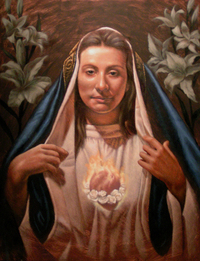
Tomorrow would be the Feast of the Assumption, and we (me, my wife Martha, and kids) would attend the vigil mass at our parish that night. It would be a great opportunity to offer thanks for my new job. It also happened to be the day that I finished, and officially signed, my first real liturgical art piece, an Immaculate Heart image, in the classical realist style that I have happily, even gratefully, settled into over the last few years. I had prayed for some time about this new direction in my art and had decided to paint the Immaculate Heart as a way of expressing my new devotion to the Blessed Mother, as well as to ask her blessing on all my artwork, especially any religious pieces. Finishing the piece just as we would be celebrating Mary’s assumption was very gratifying and meant a great deal to me.
Overall, it was a day of milestones. Everything seemed steeped in significance.
I arrived early to sign my contract, and so decided to drop in and visit for a minute with the head of the art department. She had someone in her office, but looked up and greeted me, introducing me to her guest, another art instructor. Then she said "Did you get my message?".
"No", I replied. My cell phone had been in need of a charge.
"Oh… well, I’m sorry…" she began, "but I’m afraid we had to take away your classes." She went on to explain that class enrollment had not been as heavy as they had anticipated, and that one teacher they thought would be gone had indeed decided to stay. My classes were needed for the full-time faculty already on board. She was apologetic. She had never had to do this before. Things just didn’t work out. She had tried to call me that morning to let me know that I did not need to come out to sign my contract.
I don’t mind telling you that I was numb. It was something like having the wind knocked out of me. I said some things about how it was okay, and to keep me in mind if something opened up. I said thanks, I think.
At mass that night, I was comforted by the readings, and was reminded that my trust is in God, and not in any created thing. Had I put too much stock in this job, and lost my focus on Christ? If my priorities had been straight, would I have been so deeply stunned and disappointed? It wasn’t really a time to look for easy answers, though, more a time to lay everything before Christ and to trust in his providence. A time, also, to petition the Blessed Virgin and ask for her prayers.
So now the painting above takes on, for me, even more significance. I had thought for some weeks that in this new venture into liturgical art, I would be working with a net – so to speak. I am now, once again, working without a net.
And so comes the shameless plug. The photo above is a rather poor digital camera snapshot of my Immacualte Heart oil painting. The original is 18 x 24 inches, and is on wood panel. The model is a lovely lady from my parish, who condescended to pose for me. I have high quality prints of the original available in a variety of sizes which are appropriate for individuals or churches. The original is also for sale. If you like, you can find out more on MY WEBSITE.
I am also anxious (and this is the whole point, I guess) to execute more custom fine art pieces for churches that are in need of liturgical or devotional artwork. I will be happy to consider murals, as well. I pray that this piece is only the beginning of a fruitful career providing very high quality artwork that will be truly edifying to Catholic worship and devotion, both public and private. My art is informed by very traditional sensibilities, but is executed in a way that I hope is powerful and fresh.
I covet your prayers. If you have read this far… God bless you!