CHT to the reader who e-mailed!
CHT to the reader who e-mailed!
Yesterday, Michelle wrote THIS POST about James White’s attitude problem, as manifested in THIS POST, following which White responded with THIS THIRD POST.
In his reply, White complains that "Michelle does not respond to the foundational platform of the argument: Rome’s teachings about worship."
Previously, I have pointed out the difficulty that White’s excessively snotty writing style poses for getting people to respond to the substance of his aruments. He enmeshes the substance in such a matrix of yuck that it is a tedious and frustrating process to extract them.
His latest response was a case in point.
I won’t respond to White’s arguments in this post (that’s not the point of this post; I’ll respond in a different one), but let’s look at just how much junk has to be filtered out in order to get at the arguments. In the below-the-fold section of this post, I’ll reproduce James White’s post with all the material that is not related to his arguments against "Rome’s teachings about worship" crossed out (e.g., complaints about others’ attitudes, complaints that others are not sufficiently familiar with White’s own works, defenses of the attitude he has taken).
One word leaps to mind to describe the amount of junk in the post that has to waded through.
Amazing.
The gentleman who does the annual Lego Church Project has just completed his project for 2006-2007 and has sent me a link to where folks can view the results online.
Here’s a long-shot picture with the interior of the church visible (click to enlarge):
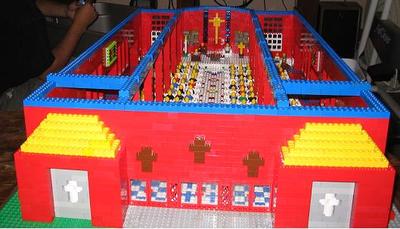
As you can see, his brightly-colored creation is superior to . . . well, much of the liturgical architecture we have been subjected to in recent years.
Looking at the particular structure of this Lego church, it strikes me that it’s somewhat simliar to the architecture of the Old Testament temple, which immediately raised this thought in my mind: How about doing Lego versions of the various temples that are mentioned in the Bible? (Solomon’s, Ezekiel’s, the Second Temple, Herod’s.) There’s certainly enough known about their architecture from Scripture and archaeology to be able to do the project, and I’d be happy to help point the gentleman to the right resources (as well as publicize them afterward). I think it’d be cool!
In the meantime,
Rhetorical question: When an anti-Catholic Evangelical Christian apologist sees a story about Catholic bishops in southern Africa telling their priests to stop moonlighting as witch doctors for native peoples, does he sigh with relief that the Catholic bishops are defending Christianity or does he immediately start to wonder why the Catholic bishops are complaining?
"Rome is having [a problem] with its priests in Africa "moonlight[ing] as witch doctors" (to use CNN’s language), or, more specifically, engaging in prayers to ancestors and in general developing a syncretism between Roman Catholicism and native tribal and regional religions. While one’s first thought was, ‘Goodness, if a minister in our church were found to be engaging in such idolatry, they would not be "exhorted" to cease, they would be removed forthwith,’ another thought followed quickly. Given Rome’s violation of biblical teaching regarding prayers to saints and angels, and in particular, given Rome’s exaltation of the humble handmaid of the Lord to the Queen of Heaven, isn’t this rather understandable?
"I mean, put yourself in the sandals of the person attending the Roman Church in the bush of Africa somewhere. All you’ve known has been tribal religion, but you also hear about this religion called Catholicism. And so you go to the services and they are sacrificing their god upon an altar and praying to this exalted woman named Mary (could you differentiate between her and one of your tribal deities? Could you? You really think pleading the meaning of ‘hyperdulia’ is going to work here?) and to spirits like Michael and they are lighting candles and bowing and praying toward a box with something the priest consecrated and put in their and toward images and statues — just what should we expect folks are going to think? And put yourself in the position of the priest in that rural location. Is he going to really be in a position to attempt to engage in the kind of double-speak Rome’s apologists have to use to get around the Bible’s prohibition against the very kind of spiritism that is part and parcel of the surrounding culture?"
GET THE POST. (Slight formatting added.)
Stuff like this can really offer insight into the stumbling blocks to conversion facing some anti-Catholic Evangelical Christian apologists. Not only is there a distinct lack of charity toward the bishops who are addressing the problem, but there is a boatload of snobbery toward people of other cultures who this apologist presumes do not have the intelligence to know the difference between the Blessed Virgin Mary and "tribal deities" or between hyperdulia and idolatry, and snobbery even toward a "rural priest" presumed not to know how to teach the Christian faith in third-world cultures.
I use my iPod more than most gadgets. It’s kind of surprising to realize it, but I listen to my iPod more than I watch TV these days. With my bad eyes, the iPod has allowed me to read a lot more books than I was able to get through previously, and audiobook-listening has supplanted TV-watching for me.
Long-time blog readers know that I even use the TextAloud program to make my own mp3 audiobooks, such as from texts available online at Project Gutenberg.
I also download audiobooks from Audible.Com.
But there’s been a problem.
For a long time my iPod seemed to behave erratically with regard to whether it would pick up where I left off in the middle of an audiobook. Sometimes it would, and sometimes it wouldn’t.
I could always get it to pick up at my stopping point if I didn’t do anything else with the iPod. For example, if I was listening to Bram Stoker’s Dracula and I hit "Pause" then I could come back and hit "Play" and it would resume where I’d stopped listening.
But Dracula is 14 hours long, and I didn’t want to commit to using my iPod for nothing but Dracula-listening until I’d worked my way through the whole book. I’d want to use it to read Dracula a bit at a time over a few days, while listening to other things in the interim–you know, the way you’d put down dead tree book of Dracula and read something else for a while. I’d want to listen to music, or shift to a different audiobook, or go from fiction to non-fiction for a while. I didn’t want to have to devote my iPod exclusively to Dracula for the few days it’d take me to get in 14 hours of listening.
Yet if I migrated away and listened to something else, I’d lose my place in Dracula! Upon going back to it, I’d have to use the clickwheel to navigate back to where I thought I was in the book (and then re-listen to at least the last few minutes).
But I wouldn’t lose my place with other audiobooks. They’d pick up right where I left off, no trouble at all.
So I had a puzzle: Why would I lose my place with some audiobooks and not others?
I thought it was something I was doing: Hitting the wrong button or something (e.g., the center wheel button instead of "Play"), but I researched it and found that my actions were not the problem. It has to do with the way the iPod handles different file types, and–best of all–there is an EASY FIX.
Basically, there are certain file formats that iTunes/an iPod recognizes as audiobooks and treats accordingly. It therefore remembers where you were in these file types. But mp3 (the format I use for my homemade audiobooks) is NOT one of those file formats. Because people use mp3 for songs–which are usually short and not the kind of thing people want to pick up in the middle of–the software automatically thinks "song" rather than "audiobook" and doesn’t bother remembering where one was–even if the "song" is 14 hours long!
That’s why I’d lose my place in SOME audiobooks (ones in mp3 format) but not OTHERS (like the ones from Audible, which are in a proprietary format that iTunes recognizes as an audiobook).
The first research I did on the Web indicated that the solution to this would be to laboriously convert all of my mp3 audiobooks into another format and then change the file extensions so that iTunes would recognize them as audiobooks, and I really was not looking forward to that, given how many of these things I have, but I discovered that there is a MUCH EASIER SOLUTION.
Basically–at least in the current version of iTunes (version 6.0)–all you have to do is this:
1. Click on the file you want to have treated as an audiobook (it doesn’t matter what the format is).
2. Right-click and select "Get Info"
3. Go to the "Options" tab.
4. Select "Remember playback position."
5. Click "Okay."
And you’re done! iTunes will then start putting an electronic bookmark at the place you left off and resume there when you go back to the book.
Here’s a picture of what the relevant dialog box looks like (click to enlarge):

Now, you’ll note that at the bottom of the dialog box there are buttons labelled "Previous" and "Next."
These are EXTREMELY handy, because they allow you to quickly go through an entire playlist of files (or chunk of your library) you want to do this to. Thus if you have a whole bunch of mp3s in a row that you want to audiobook, all you have to do is select "Next" and then "Remember playback position" and then "Next" again until you’re done, at which point you hit "Okay." It only takes a few minutes to whip through a long playlist that way, since you don’t have to go to the hassle of selecting the file and then doing "Get Info" and "Options" each time.
You can also select "Skip when suffling" so that you don’t have audiobooks turning up in the random rotation when you’re listening to randomized songs, but I use the shuffle feature so seldomly that I haven’t bothered to do that yet.
One nice thing about the bookmark is that it transfers between iTunes and the iPod. This means you can start listening to the book in iTunes (say, as soon as you’ve created it) and then when you transfer it to the iPod the bookmark will go with it, so dialing it up on the iPod will result in you picking up where you left off in iTunes.
Cool!
And thus is solved one of my major headaches.
A reader writes:
Hello Mr. Akin,
In the comboxes of a recent post on your blog, we were discussing a question I had: Is it wrong to say that God loves each of us to the same degree?
(https://www.jamesakin.com/reels_squares/2006/08/a_priest_foreve.html)
Ed Peters wrote:
"… in our subtly-egalitarian culture, we tend to jump from "we are all sinners" to "we are all sinners to the same degree." That is wrong, just as wrong as saying we are all holy to the same degree, or that God loves each of us to the same degree."
I essentially asked him to clarify and defend the last of his propositions. He pointed me to St. Therese of Lisieux. I have no difficulties with Ed’s comment that "… in loving, God acts with utter freedom, and is not bound to love according to our notions of equality." But those propositions do not seem equivalent to, or sufficient for the defense of, the claim that: "God loves each of us to the same degree" = "wrong."
Ed twice said that this is a "JimmyQ." He advised me, "Do continue to look into this, though. It is a startling concept for each of us when we first come to grips with it."
This question has several dimensions, which are reflected in Scripture. There’s a tension in the Bible between clear assertions that God loves one person more than another (e.g., "Jacob I loved but Esau I hated"–where "hated" more likely means "did not prefer") and other, equally clear statements that God loves everyone and is not a respecter of persons.
It seems to me that the solution to this difficulty is that there are different concepts of love or divine preference in play.
If we back up and look at things from a Thomistic perspective, part of the puzzle may come into focus. According to St. Thomas, God’s love works differently than our love does. When we love things, according to St. Thomas, we perceive something good in them and respond to that. But from God’s perspective, nothing has any goodness at all unless he endows it with that goodness. Therefore, our love consists in being moved by the good qualities God has given to a creature, whereas God’s love consists in granting that creature good qualities in the first place.
From this starting point, one could say that God loves one creature more than another by giving it more good qualities than another.
One could also say, though, that God does not love one creature more than another in that he recognizes that all creatures are equal before him–they have nothing unless he gives them something.
Whatever one makes of that paradox, it’s certainly true that some individuals are given more blessings than others, and this seems to be the concept behind statemenst like "Jacob I loved and Esau I hated," which seems to reflect that God unconditionally gave Jacob certain blessings that Esau did not receive, though the particular biblical idiom phrases this somewhat hyperbolically in terms of love versus "hate."
But there’s a flip side to the fact that some are given more blessings than others, which is that they are held to a higher standard in what they do with their blessings.
Jesus put this pointedly in saying that more is expected of those to whom much has been given. If you’ve had a lot of blessings, you need to show a lot of fruit. If you have meager blessings then meager results are just as good. This is the principle by which Jesus valued the widow’s mite more than the objectively larger contributions that others made. The widow had very limited means, and her use of them to the utmost was more valuable in God’s eyes than the non-utmost contributions of those who had been given much greater material blessings.
The same theme is worked in to St. Paul’s comments regarding Jews and Gentiles in Romans, Galatians, and Ephesians. There the apostle acknowledges that Jews have been given significant blessings that Gentiles lack and that salvation is "first of the Jew and then of the Greek" but he also acknowledges a correspondingly stricter standard will be applied to Jews such that judgment is also "first of the Jew and then of the Greek." He thus sees in this a fundamental equality of God’s treatment of all peoples: If Jews have special blessings, they also have special responsibilities; if Greeks have fewer blessings, they also have fewer responsibilities. And so from this perspective God is an egalitarian who is not a "respecter of men."
There’s one final dimension to this (that I can think of at the moment), which is that some individuals who have been given blessings by God choose to use them for good while others choose to use them for evil. It’s not a question in this case of whether one uses one’s blessings to produce little fruit or much fruit. It’s a question of whether you choose to produce fruit or whether you choose to produce . . . uh . . . anti-fruit.
This free will response is also something that one may relate to the subject of God’s love or approval. Those who freely choose to do good may be judged the objects of God’s esteem, while those who freely choose to do evil may be judged the objects of God’s disesteem. On this basis there would also be grounds for saying that God loves some (the good-doers) more than others (the evil-doers).
So whether God loves some more than others seems to me to depend on the perspective you are speaking from:
1) If you are talking about God’s perspective on individuals apart from his blessings and their responding actions, God loves all equally since we all have nothing apart from what he has given us.
2) If you are talking about God’s granting of blessings as his love then God loves some more than others–not because he is more drawn to their good points (for they have none apart from his blessings)–but because he gives some greater blessings than others.
3) If you are talking about God’s perspective on what he expects from us once he has given us his blessings then he does not love one more than another since he expects performance from creatures in proportion to the blessings they have received.
4) If you are talking about God’s perspective on what people actually have done with their blessings by free will (produce much fruit; produce little fruit; produce little anti-fruit; produce much anti-fruit) then God does love one more than another because he approves those who have worked good rather than evil and he approves those workers of good who have applied themselves more diligently with what they were given.
One final thing that it’s helpful to remember in thinking about this subject is that God loves everyone and gives everyone sufficient grace to be saved. These are truths that set the parameters of the above discussion, which takes place within the limits they set.

Found while flipping through the Great Quotes file:
"It may be that the greatest proof of the effectiveness of social disapproval is its demonstrated ability to turn on itself." –Judith Martin
How true it is that the only socially disapproved sin these days is Social Disapproval, which is sometimes indiscriminately referred to as Judgmentalism.
Who is Judith Martin? You may know her better as Miss Manners.
Judith Martin is one of my favorite secular social commentators. If you also are a fan, you can read her column in archive at the Washington Post.

A story at Breitbart.com tells of a mysterious "mutant-hybrid" animal found dead in Maine, apparently the victim of a passing vehicle (that is, road kill).
"Residents are wondering if an animal found dead over the weekend may be the mysterious creature that has mauled dogs, frightened residents and been the subject of local legend for half a generation. "
In the story, it is described as "evil-looking", like "something out of a Stephen King story", and having "a horrible stench" even while alive.
I couldn’t help but think of that scene from Close Encounters where all these concerned citizens are trying to convince their local officials about the seriousness of these strange UFO sightings, when this guy stands up and says "I saw Bigfoot once. 1951 back in Sequoia National Park. Had a foot on him thirty-seven inches heel to toe. It made a sound I would not want to hear twice in my life.".
GET JIMMY’S ORIGINAL CHUPACABRA POST!
JIMMY ADDS: Here’s a whole-body shot of the creature:
A news story reports that people are better able to identify long-standing fictional cultural icons than transient non-fictional government officials. F’rinstance: more people can identify members of the Seven Dwarves than the Supreme Court:
Three quarters of Americans can correctly identify two of Snow White’s seven dwarfs while only a quarter can name two Supreme Court Justices, according to a poll on pop culture released on Monday.
The implication here is that there’s something surprising or tragic about the fact people know more about fictional icons they grew up with than government officials they didn’t elect.
Personally, I don’t buy that. It’s natural for people to know more about things they’ve known their whole lives than transient, recent stuff. Supreme Court Justices serve only for a time, but the Seven Dwarves are forever. Further, the Supremes haven’t hired a PR firm as good as Disney’s to get their images known by every five year old in the country. And–to be honest–I’m not sure that most Supreme Court decisions have as much impact on the average person’s life as a DVD of Snow White.
Okay, sure, I’m disappointed about how few people know the real-world facts behind the poll (which also revealed that more people know that Krypton is Superman’s home planet than know Mercury is the closest planet to the Sun or that more people know who Harry Potter is than who Tony Blair is).
I can be worried about how much ignorance about the world there is, but I’m not worried about the fact that people know the icons of their culture well–particuarly when it’s knowing long-standing icons versus transient political figures.
Oh, and in case there’s any suspicion that this is sour grapes from someone who knew more Dwarves than Justices, here are my lists of both–before reading the story so there was no chance of spoilage on any of their names:
DWARVES:
1. Doc
2. Grumpy
3. Sleepy
4. Sneezy
5. Bashful
6. Happy
7. Dopey
JUSTICES:
1. Roberts
2. Scalia
3. Thomas
4. Alito
5. Kennedy
6. Ginsburgh
7. Breyer
8. Stephens
9. DopeySouter
FEDDIE OVER AT SOUTHERN APPEAL HAS ANOTHER TAKE ON THE DWARVES VS. JUSTICES ISSUE.
 Back in November 2004 there was a lot of talk about the division of the U.S. into clear zones of "red" and "blue" states leading to secession. The talk was tongue-in-cheek, of course, but it was occurring in significantly different social circles.
We talked about that on the blog here, here, and here.
The last of those is a link to a post I did about some folks at the SF (Speculative Fiction) Readers Forum who were talking about the idea of blue state secession–who also linked our discussion here on the blog–and darn if they didn’t go and do something about it.
Mind you, they didn’t start a secessionist movement (as far as I know), but being speculative fiction enthusiasts, they went and wrote a book of short stories exploring the possibility.
Since we’d linked them before, the editor sent me a review copy, and I just got it in the mail.
I’ll let y’all know what I think once I’ve had a chance to read a few of the stories. I’m guessing that they’ll tend to have a more bluestate perspective on things in the main, but that won’t (or shouldn’t) prevent them from being well-written, interesting stories. (If it does, I’ll let y’all know.)
In the meantime,