I have just finished Michael Crichton’s “novel” State of Fear and plan to review it. First a couple of disclaimers:
- This is a contemporary thriller novel and as such contains a significant amount of cussing, non-described acts of sexual immorality, and a scene of particularly gory brutality towards the end of the book.
- I happen to agree with Crichton that the theory that global warming is caused by “greenhouse gasses” is junk science, as are many other items of popular junk science that he brings up in the course of the novel. And I hope State of Fear manages to spark a real debate over global warming and enviro-nuttiness.
Now for the review:
Michael Crichton’s “novel” State of Fear is not actually a novel but instead is a piece of propaganda masquerading as a novel. A novel, of course, is a work of literature, a piece of art whereby words are used to evoke aspects of the human psyche and of human experience that transcend the merely ideological.
This transcendance of the ideological is what fails to happen in State of Fear.
According to the novel, there appear to be three kinds of people who believe in global warming:
- Those who don’t really know much about the science involved and whose attachment to the environmental movement is so tenuous that they can and will be flipped to the other side by the end of the novel,
- Those who don’t really know much about the science involved but whose attachment to the environmental movement is so strong that they remain shrieking harpies no matter what facts they are confronted with, and
- Those who know that the science supporting global warming is junk but whose commitment to environmentalist ideology (or something) is so strong that they are willing to cause millions of casualties in order to fake scientific data supporting global warming.
If there are any other kinds of people who believe in global warming, they apparently occur sufficiently infrequently in nature that they do not merit having a recurring character in the book.
Also according to State of Fear, there apparently aren’t any evil big busines types willing to fake environmental data. Sure, many charactes appearing in the pages of the novel talk incessantly about this type of individual, but since no exemplars of this type appear in its pages, they appear to be a myth–like unicorns, centaurs, griffins, or global warmings.
With this ideologically one-sided cast of characters that inevitably results from the above, does Crichton at least succeed in delivering a well-made piece of propaganda, like Leni Riefenstahl’s Triumph of the Will?
No.
Artistically, the “novel” is a disaster on every level above basic spelling and grammar.
On the top level, there is the plot, which involves a huge, sprawling mess of a story that is so poorly defined that much of the time the reader has a better sense of what is going on when watching The Big Sleep than reading this morass. There is no clearly defined central action, and poorly-drawn characters do preposterous things at the drop of a hat.
F’rinstance:
- What should a young lawyer do when he checks his messages and discovers that he has several calls from the local police department telling him that he failed to show up for an appointment and they will issue a warrant for his arrest if he doesn’t contact them? Should he drop everything to get the matter taken care of? Make sure he doesn’t get distracted by anything else before he does? Nooooo! He should simply leave a message for the detective who called him and then zip off on global assignments he has no qualifications for whatsoever!
- A preening Hollywood actor/activist who plays the president on TV (think: Martin Sheen) wants to tag along with the heroes on a mission of vital global importance in a place so dangerous that death, decapitation, and pre-death cannibalism are real possibilities. No problem! Just have him sign a waiver! Don’t worry that he might actually be a security risk to the mission since you already know he’s working for the other side. Perish the thought that he might simply a bumbling incompetent who would get in the way of your vital mission to save millions! You’ll need him along so you can constantly argue with him about the lack of evidence for global warming and other environmentalist fetishes and make a fool of him at every turn.
- Suppose that you’re an eco-terrorist mastermind. What should you do with people who are getting too close to the truth? Shoot them and be done with it? No! You should send your goons to use a tiny poison critter that you keep in a plastic baggie filled with water to sting them with a poison that will make them paralyzed but not kill them and that will wear off in a few hours. What’s more, you can do this to several people in the same city without any fear that after the toxin has worn off that the victims will tell the police enough to figure out who you are. So confident can you be of this that you don’t even need a clearly defined REASON to do this to people. You can just do it as part of some vaguely-defined attempt to be intimidating or something, without even telling the victims what it is that they are supposed to do or avoid doing in the wake of your goons’ attacks.
- Suppose that you are a rich man who has been supporting environmental causes and who has somehow (FOR NO REASON EVER EXPLAINED IN THE BOOK) come into possession of a set of coordinates of where major eco-terrorist events will be happening–what do you do? Turn the list over to the government? Put it in a safe deposit box which only you and your lawyer have access to? No! You <SPOILER SWIPE> hide it inside a remote control in your TV room, where there is a lot of Asian art including a Buddha statue, then fake your own death in an auto accident so you can go personally face eco-terrorists all by your lonesome on a south sea jungle island despite the fact you are an aging, overweight alcoholic, and just before doing so you cryptically tell your lawyer that it’s an old Buddhist philosophical saying that “Everything that matters is not remote from where the Buddha sits”–seeming to imply (if anything) that the TV remote is NOT where the hidden list will be found.</SPOILER SWIPE> See? It’s obvious, ain’t it?
Below the level of plot is the level of character. How are the characters? Thinly-drawn action adventure stereotypes, with one glaring exception. Unfortunatley, the one glaring exception is the pseudo-protagonist.
Y’see, this novel has an ensemble cast, but the omniscient narrator focuses on one character in particular–a young L.A. lawyer–to use as the lens through which to show us the vast majority of the story, making him the pseudo-protagonist.
Because of his status in the narration there is a need for the reader to at least be able to like him (ideally, you’d want the reader to be able to identify with him, but that’s too much to ask in a novel like this). Unfortunately, you can’t. While every one of his colleagues–whether they are personal assistants to rich men, rich men themselves, or other lawyers–are apparently action heroes, this character is the ultimate momma’s boy.
For the first chunk of the novel he does nothing but walk around, take orders from others, and ask simple questions so that the reader can be given load after load of exposition. He takes no personal initiative in doing anything.
Eventually, the action hero characters he’s surrounded by start noticing what a wuss he is and our glimpses into their internal monologues reveal words like “wimp” and “idiot” as descriptors of this character–who is, you will remember, the main character the omniscient narrator has chosen for us to follow.
In the second part of the novel the character is placed in a potentially life-threatening situation that causes him to experience a collapse into such a passive, sobbing, whimpering wreck that even the omniscient narrator seemingly turns away from him in disgust and temporarily starts following his action-wouldbe-girlfriend until she can rescue him from his predicament.
Just before this event occurs the character is wondering to himself why the action-wouldbe-girlfriend (i.e., the action hero woman who he would like to date) doesn’t “take him seriously as a man”–a moment bound to leave the reader going “Hey! Buddy! No one in the audience takes you seriously as a man either!”
Fortunately, getting his butt saved after his potentially life-threatening experience starts to awaken a glimmer of intestinal fortitude in him, and by the end of the novel he has learned to cuss (a little) and he gets a romantic hug from his action-wannabe-girlfriend, who is apparently transitioning into his action-actual-girlfriend for no good reason.
If the plot and the characters are disasters, how about the dialogue and narration?
They suck eggs on toast.
Some passages are so excruciating that I found myself wondering “Didn’t they give Crichton a copy editor?” One such instance occurred when a character says something to Momma’s Boy in a foreign language and we read (quotation from memory):
“He didn’t know what it meant. But it’s meaning was clear.”
Other pasages contain monstrosities of dialogue that no copy editor could fix. F’rinstance: Toward the very end of the book one triumphant good guy character is expositing on his grand vision for the future, of how to save environmentalism from itself, save science from its current predicament, and generally improve society. (This speech is sometimes so general that certain points remind one of the Monty Python sketch “How To Do It,” in which we are told that the way to cure all disease is to invent a cure for something so that other doctors will take note of you and then you can jolly well make sure they do everything right and end all disease forever.)
This manifesto would go on for several pages without break except for the fact that Momma’s Boy gets to interrupt it with scintilating interlocutions like:
- “Okay.”
- “It sounds difficult.”
- “Okay. What else?”
- “Why hasn’t anyone else done it?”
- “Really?”
- “How?”
- “And?”
- “Anything else?”
- and (a second time) “Anything else?”
- and (a third time) “Anything else?”
I’m sorry, but no copy editor could fix a multi-page speech with such transparent attempts to disguise it as dialogue. At that point it’s the editor’s job to call the author and demand a re-write.
If the publishing house is interested in producing quality works, that is–as opposed to simply making money.
Oh, and lest I forget, there are numerous dropped threads in this story. Like: Whatever happened about that arrest warrant that Momma’s Boy got threatened with? And: How about other established characters who left him messages and needed to talk to him? And: What did the other critter-victims tell the police after the toxin wore off? And: Where did that body come from that got washed up on the beach and how did someone else’s clothes and watch get on it? And: Why didn’t the heroes ever use the incriminating DVD to incriminate anybody?
And most importantly: What actually, y’know, happened to the bad guys in the end? Did they go to jail? Were there congressional hearings? Did they flee to countries with non-extradition treaties? Did they manage to keep their cushy jobs? Did they just go out for sushi? What???
Crichton is interested in telling us none of these things.
But then, his “novel” was never about the story to begin with.
It’s a political tract that fails to rise above the level of those theological “novels” (both Protestant and Catholic) in which one side is always right and in which characters of opposing points of view exist only to serve as conversational foils to help illustrate the rightness of the protagonists–time after time after time.
It’s enough to make you scream.
 Mark Waid is such a great comic book writer.
 The final batch of episodes for Star Trek Enterprise start tonight!
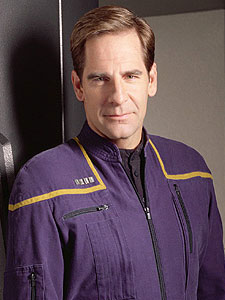 I know what you’re thinking: "It already has been!"