The Curse Is Broken . . . Maybe

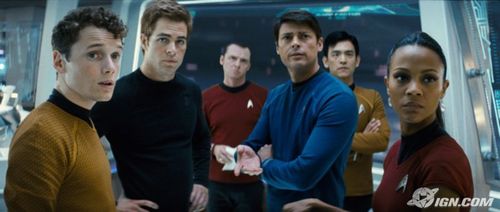
Conflict Well, I finally got around to seeing the new Star Trek film–the first film I've seen in theaters in I don't know how long.

I know SDG has already covered this topic but . . . this is my blog, so here we go again.

I'll put spoilers in a forthcoming post and just have a few non-spoiler comments in this one.

The good news is that I basically liked the film. 

It was fun.

It met my expectations, which were as follows: (1) I wanted it to be fun, (2) I wanted it to be a viable relaunch of the franchise, and (3) I wanted it to be fundamentally though not scrupulously faithful to the original.

I thought it substantially met those goals, so I liked it.

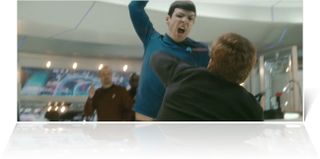
This is not to say that I hadn't been concerned. Some of the stuff seen in trailers had me worried. For example, the Kirk-Spock conflict depicted in the photo. That had me concerned. The film could have mindlessly ramped up the characters' emotions without providing a good reason for Spock's outburst. (Not unlike many episodes of the rebooted BSG, which over-milked the pathos factor). 

Fortunately, there is a good reason Spock is blowing his stack in this picture. The conflict isn't overdone, and it works in context.

I understand that the film may not be to the taste of some die-hard fans of the original series. And that would be true no matter what for the simple reason that no movie is to everyone's tastes.

Personally, while I have a soft spot for TOS, I don't regard it–or any Trek series–as an artistic masterpiece. All of the series have some real stinkburgers as episodes (e.g., just to name one from each, TOS: Spock's Brain, TAS: The Terratin Incident, TNG: Skin of Evil, DS9: Sons of Mogh, VOY: Threshold, ENT: A Night In Sickbay). Some of them have many stinkburgers.

So I don't regard the original Trek as sacrosanct. The recasting doesn't bother me, as long as it's good recasting (and it seemed to be; especially Zachary Quinto as Spock).


Since the original Trek wasn't perfect, the new movie doesn't have to be perfect for me for it to be an okay successor. 


There were things in it that didn't work for me (see forthcoming post). The movie does have plot holes and dumb things.


But on balance it's a fun film. It has lots of spectacle. A good treatment of the established characters (with one notable exception that some object to; see forthcoming post). It has some nice new and sorta-new characters. (In particular, I liked Captain Pike and Scotty's assistant.)


And it has this going for it: It's the best chance for more Star Trek that we're going to get.


Prior to this film, the franchise had gotten really, really stale. In the post-DS9 era the producers made mindblowingly bad decisions. 


Voyager had horrendous problems, with the climax of many episodes simply being characters standing over consoles spouting technobabble in an elevated tone of voice, trying to create drama.


And though they started to turn it around in the third and especially the fourth season, Enterprise as a series was fundamentally blown from the get-go, with the producers not realizing what kind of story they needed to tell (the Romulan War, leading to the founding of the Federation). And that was before we got to the disastrous final episode.


The producers just completely didn't understand what they were doing.


As a result, they wore out the franchise. They painted it into a corner from which nothing could rescue it.


Except a reboot–a fresh start.


It's really hard to see how much more could have been done in the previous continuity and keep the franchise financially viable. 


Theatrical film based on any of the previous series or a combination of them?


Not going to reach beyond the existing, shrunken fan base and thus not going to be financially successful.


New TV show?


In the previous continuity, what's left to do that would reach out beyond the existing, shrunken fanbase? Even telling the story of the founding of the Federation would be too close to ST:ENT (which is why that series' misfire is such a huge debacle; the producers blew their one chance to tell a pivotal story).


Any new ST series based on the old continuity would have almost certainly not made it as many seasons as ENT did.


Relaunching the franchise with a reboot was the logical way to go. (As JMS and Bryce Zabel had pointed out a few years ago.)

So I'm willing to cut the filmmakers some slack. I don't feel that I have to agree with all of their decisions (and I certainly don't expect them to honor every single bit of micro-level continuity from the previous shows–which didn't themselves honor their own micro-level continuity).

If they give me basically fun new Star Trek that holds the prospect of resulting in more basically fun new Star Trek, that'll be good enough.

This means that–maybe–the Star Trek Curse is broken.

The curse, stated in its strongest form, is that all of the odd numbered Star Trek movies are bad and all of the even numbered Star Trek movies are good.

Taken in a weaker form, the curse would be that all of the odd numbered Star Trek movies are lesser in quality and all of the even numbered ones are more good (or mo' better, as they say).

Up to this point, the strong form of the curse is arguable. Whether it's true depends on whether you regard any of 1 (V'Ger), 3 (Search for Spock), 5 (Search for God), 7 (Kirk Dies), and 9 (Insurrection) as technically, on-balance good or not.

But they're certainly not as good as 2 (Kahn), 4 (Whales), 6 (Berlin Wall Comes Down), 8 (First Contact), and 10 (Nemesis–weakest of the even numbered ones).

The curse in its weakened form is true . . . at least up to the newest film.

A lot of people might find the new Trek better than Nemesis, in which case we'd have an odd numbered film (technically, the new one would be Trek 11) that is better than an even one, in which case the curse would be broken.

But perhaps there is a way to reformulate it that would result in its still being true. How about this: Each odd numbered Star Trek film is weaker than the film that follows it.

In that case, the curse may still hold true. Thus far each odd film has been weaker than the one that followed it.

So the curse will hold true if J.J. Abrams and such can produce a sequel to this film that is even better.

Can they do it?

Now that the origin story is out of the way, I think there's a chance they can.

Caprica Pilot

Caprica_city

For BSG fans going through withdrawal, the pilot movie for the prequel series Caprica is now out on DVD.

It hasn't aired on TV yet, and apparently won't for a while–and you'll have to wait till next year for the series itself to debut–but you can see the pilot on DVD.


Below are some thoughts on it. I'll keep the spoilers light, but just to protect those who don't want absolutely anything spoiled, I'll continue below the fold.

Continue reading “Caprica Pilot”

In Valen’s Name?

Valen
Down yonder, a reader writes:

Jimmy–I'm only a casual fan of B5, and haven't shelled out for the script books, so I won't ask you to go into detail about how the Sinclair version differs, but one speculation that's been bugging me for years:

Would the original series have ended with the end of "World Without End" (the Sinclair/Valen reveal)?

Hmmm. . . . I wonder. . . . Is it a spoiler if you reveal what would have happened on a show but didn't?
Oh, well. . . . Continued below the fold.

Continue reading “In Valen’s Name?”

The End of Galactica

Daybreak1

The first part of the Battlestar Galactica finale (Daybreak, Part I) has now aired, and next Friday will have the two-hour conclusion of the story.

I've had some requests for comment on the direction that the story has taken, and it seemed like this would be an opportune time to offer some.

To avoid spoilers for those who haven't seen the relevant eps, yet, I'll continue below the fold.

Continue reading “The End of Galactica”

And the Final Cylon Is . . .

Mystery-person_3The final ten episodes of Battlestar Galactica start airing this Friday, and the producers plan to answer a bunch of questions, some of which have been around since the beginning of the show and some of which were only recently introduced: What happened to Earth? What are the Virtual "Head" beings (e.g., Head Six, Head Baltar) that only some people see? Can Human and Cylon live together? Who lives and who dies? And, of course, who is the final Cylon?

I'm going to tell you.

Or at least I'm going to tell you who I think it is.

I've made a significant number of BSG predictions before and gotten more than my share right, so I'm going to put my cards on the table here and tell you who I think the clues point to.

If I can shift from a cards metaphor to a dice metaphor, sometimes you have to roll the hard six, so here goes.

Continued below the fold for those who don't want to read this speculation.

Continue reading “And the Final Cylon Is . . .”

Decent Films doings: A good year for family films, part 2

SDG here with a follow-up to my June post on family films of 2008.

As the year draws to a close, it looks like my sense of 2008 as a good year for family films was on the money. In fact, the premise of my June post became a full-fledged article which appeared first in the December issue of Catholic World Report and is now available in an abridged version at Decent Films:

Family Films Move Forward in 2008

Unfortunately, many of the films that, in June, I was looking forward to hopefully didn't pan out. I knew some of them wouldn't pan out, but I was hoping for more than we got.

The one spectacular exception, of course, was Wall-E, the crown jewel of the year's family films, as I hoped it would be.

And today, a worthwhile film opens that wasn't even on my radar in June: The Tale of Despereaux.

At least one other film, Bolt turned out to be better than I expected. OTOH, City of Ember turned out to be a visually stylish disappointment, kind of cool but not very good. Journey to the Center of the Earth was a little more fun, but also not exactly good.

Fly Me to the Moon was barely a flyweight contribution (and the buzz I heard on Armstrong's involvement was wrong — it was Buzz Aldrin who voiced himself, which makes a lot more sense on multiple levels). And The Half-Blood Prince didn't even arrive — it was postponed until next year.

Still, between Wall-E, Horton Hears a Who, Kung Fu Panda, The Spiderwick Chronicles, Prince Caspian and The Tale of Despereaux, plus a raft of tol'able also-rans… not to mention, for families with older kids, The Express and Son of Rambow… definitely a good year, all in all.

The Tale of Despereaux review | Family films article

Name-checked by Ebert — again!

SDG here with a non-election related post on some non-election coolness. (Pre-election coolness, actually, but I wanted to wait till now to blog about it.)

Incidentally, if you read the NCRegister.com blog, which I’ve cited in a number of recent posts, you may already be aware of this.

First, though, I just have to geek out a bit. Like many film critics writing today, I grew up watching Roger Ebert discuss movies with Gene Siskel on “At the Movies.” I remember watching them discuss certain movies in the early 1980s (e.g., Raiders, Superman II, Return of the Jedi).

I have the idea that the paper I delivered as a paperboy carried Ebert’s written reviews, and that I was reading them sometime in the early to mid-1980s. I may have I bought book editions of his reviews in college in the late 1980s; certainly by the time I had Internet access in the mid-1990s I was reading him every week, along with a few other favorites.

As an inveterate reader of all sorts of writing and an aspiring writer myself, I quickly came to appreciate Ebert’s literary skill and engaging voice as well as his critical insights. In many cases I enjoyed his reviews more than the movies he wrote about. In 2000, when I began writing faith-informed reviews and posting them on the earliest incarnation of Decent Films, Ebert was one of the touchstones I looked to in finding a voice of my own.

He was, and is, simply The Man.

One early piece I wrote that first year of writing film criticism was an essay on Scorsese’s The Last Temptation of Christ. It seemed to me an obvious test case of the style of writing I wanted to do — that is, to do film writing that was equally intelligible to my target religious audience and also to non-religious readers. (My model here was a writer even more profoundly influential on me than Ebert, C. S. Lewis.)

Few movies seemed as deeply polarizing to the two groups of readers than Last Temptation, so if I could make myself intelligible to these two groups of readers on this film, I could probably do it on any film.

I’m sure I read Ebert’s original review of Last Temptation, in which he argues that the film is not blasphemous, in preparation for writing my own. I didn’t quote it, although I did cite another review he wrote in 2000, for Spike Lee’s Bamboozled.

I never expected my Last Temptation essay to get much attention. I naively thought the controversy over that film was a closed chapter, and my essay was fundamentally written to satisfy myself that it could be done, and for the sake of a few readers who might care to look at it.

Much to my surprise, it has over the years consistently been among the most widely read essays at Decent Films. Feedback from readers has been fairly regular and all over the map (as I discussed a bit in a recent Decent Films reader mail column).

More recently, I’ve learned that my essay has been cited in more than one essay in a recent book on Last Temptation, Scandalizing Jesus. (One of the essays citing me was written by my friend and fellow critic Peter Chattaway; another, “Imaging the Divine,” is by Lloyd Baugh, whom I’ve never met.)

Anyway, last week I learned that my Last Temptation essay had been cited by Ebert himself in a new essay on Last Temptation that appeared both in his online “Great Films” series and also in Ebert’s new book Scorsese by Ebert.

As it happens, this isn’t the first time I’ve been name-checked by Ebert. He first quoted me in his review of Gibson’s The Passion of the Christ, regarding Gibson’s portrayal of the Jewish leaders. Just think, if controversial Jesus movies were a Hollywood staple, I might have gotten a guest spot on Ebert’s show.

What’s more, this time around Ebert credits my essay with persuading him that, in spite of his arguments to the contrary nearly two decades ago, Last Temptation is in fact “technically blasphemous.” He adds that he no longer thinks this matters, but still it’s a startling confirmation that I succeeded at least partly in what I set out to do in that essay. Here’s what he wrote:

The film is indeed technically blasphemous. I have been persuaded of this by a thoughtful essay by Steven D. Greydanus of the National Catholic Register, a mainstream writer who simply and concisely explains why. I mention this only to argue that a film can be blasphemous, or anything else that the director desires, and we should only hope that it be as good as the filmmaker can make it, and convincing in its interior purpose. Certainly useful things can be said about Jesus Christ by presenting him in a non-orthodox way. There is a long tradition of such revisionism, including the foolishness of The Da Vinci Code. The story by Kazantzakis, Scorsese and Schrader grapples with the central mystery of Jesus, that he was both God and man, and uses the freedom of fiction to explore the implications of such a paradox.

Now, I think that Ebert’s new essay offers a lot of insight into the film. For what it’s worth, I don’t think that it is right to say that it uses “the freedom of fiction to explore the central mystery of Jesus.” I think that Last Temptation uses the central mystery of Jesus as a metaphor, and that what the film is really exploring is the human experience of duality. Screenwriter Paul Shrader acknowledges this in an interesting 2002 interview at AVClub.com in which he acknowledges the film’s blasphemy:

Actually, the whole issue of blasphemy is interesting, because technically, the film is blasphemous, but not in the way people think. The film uses Jesus Christ as a metaphor for spirituality. And, under a technical definition of blasphemy, if Jesus is regarded as something other than holy God incarnate, you’re being blasphemous. And so the film takes the character of Jesus and uses Him as a metaphor for our spiritual feelings and says, “What if this happened, what if He yielded to temptation?”

I think Ebert makes essentially the same point when he says, “What makes ‘The Last Temptation of Christ’ one of his great films is not that it is true about Jesus but that it is true about Scorsese.” Be that as it may, where I differ from Ebert and other fans of the film is that, for me, my ability to enter the filmmaker’s world simply encounters an immovable obstacle when it comes to a Jesus movie that, however true it may be about the filmmaker, is so radically untrue about Jesus. I am just unable to go with Jesus as metaphor, for precisely the reason that Shrader indicates. I appreciate Ebert’s lament that “the direction, the writing, the acting, the images or Peter Gabriel’s harsh, mournful music” have been ignored by many writers — but for me that’s all beside the point. As I wrote in my essay:

Past a certain point, objectionability obliterates all hope or desire of approaching a work as art or entertainment. No level of production values or technically proficient filmmaking could make it worthwhile to watch a movie that indulged in child pornography, or that relentlessly celebrated the Holocaust, or that overtly romanticized the degradation and abasement of women. Cross a certain line, and message overwhelms medium, substance overwhelms style, what you have to say drowns out how you might be saying it.

Anyway, that’s how I saw it eight years ago. That this essay — one of my oldest pieces, an essay I wrote when I was first beginning to feel my way into the world of writing about film and faith — would receive such attention at this late date is both gratifying and humbling. I can’t even imagine how I would have felt back in 2000 writing the piece if you had told me that Ebert, whom I quoted in that piece, would one day be citing me in turn.

That the piece appears in Ebert’s Scorsese book is even more gratifying. As Nick Alexander suggested over at ArtsAndFaith.com, it seems likely that Scorsese has read Ebert’s book, so maybe he now knows that the movie is blasphemous, too.

Ebert’s new Last Temptation essay

Ebert’s Passion of the Christ essay

My Last Temptation essay

NCRegister.com blog post