Can Devout Non-Catholics Be As Devout As Devout Catholics?

A reader writes:

My wife is going through RCIA right now, and she asked me a question tonight that I thought I’d pick your brain on. Here’s the gist of it:

The Catholic Church teaches that although there is no salvation outside of the Church, the Church acknowledges that it does not know where the boundaries of the invisible Church are (i.e., visible v. invisible Church). That having been said, does the Catholic Church believe that a devout Baptist can lead as devout of a Christian life as a devout Catholic (lots of “devouts” in there I know)?

This was my tentative answer (based on everything I’ve read):

I think what the Church would say is that it is much harder to live a devout Christian life outside of Church; not because Catholics are naturally more holy than protestants, but because we have access to all of the sacraments, the teaching of the Church, etc. I also analogized the situation to two people each building a house. One has all of the possible tools he could ever need or want to complete the job, and the other one has enough to get it done but may have to work a little harder to finish the task. Of course, for some Catholics (like Kerry) having access to these “tools” is meaningless because he is unwilling to use them.

I am not sure that is the “right” answer, but it strikes me as correct based on all that I’ve read thus far.

Thoughts?

It seems to me that the answer you gave is essentially correct, though I would add some nuances depending on what one means by “devout.”

First, though, I’d issue a caution about contrasting the “visible Church” with the “invisible Church.” This language is not used in ecclesiastical documents. The way Vatican II presents the matter, there is one Church, in which Catholics who are in a state of grace are “fully incorporated” and with which non-Catholic Christians are “associated” (which may be a synonym for “partially incorporated”).

Now, on to the question of devotion:

1) If one takes a subjective definition of “devout,” by which it would mean “sincere” or “fervent in practice,” then it would seem that non-Catholic Christians can be just as sincere and fervent in their practice of religion as Catholics. Catholics do not have an intrinsic subjective advantage in terms of sincerity or fervor.

They do, however, have an extrinsic advantage–as you point out–in that they have means of grace available to them that can foster greater fervor. These include not only the sacraments but also sacramentals, Catholic art, etc.

Yet these extrinsic advantages can be overcome by other extrinsic factors. The pitiful preaching and catechesis that has existed in many Catholic churches for the last forty years is an extrinsic factor that mitigates against fervor, and the fervor of many Catholics has been depressed by this compared to the fervor of those in many Evangelical and Fundamentalist churches.

2) Historically the word “devout” may be taken in another, more objectivist sense–i.e., religious practice that makes an objective connection with God. This might be taken as something Paul has in mind when he says that “it is good to be zealous in a good thing always” (Gal. 4:18). If the term “devout” is taken in this sense (i.e., devotion that objectively makes a connection with God rather than simply being subjectively fervent without this connection necessarily being made) then the Catholic has more of an advantage.

The chief reason is the sacraments. They guarantee a connection with God as long as we do not put a barrier in the way. Therefore, our own subjective fervor is not required for the connection to take place. The subjective fervor of Catholics may be no different than the subjective fervor of non-Catholic Christians, but the fact that Catholics operate in an environment in which they have greater access to sacraments through which God has promised to make a connection with us means that they have a greater advantage in terms of devotion that makes an objective connection to God.

Even this advantage can be neutralized, however. If a Catholic fails to take advantage of the sacraments, this advantage vanishes. Worse, if he commits sacrilege with the sacraments (e.g., by taking Communion when in a state of mortal sin) then he has sinned against God in an objectively greater way than someone without access to the sacraments.

Thus, while there are advantages to being Catholic in terms of devotion, they are not a guarantee of subjective or objective devotion. As always, God is no respecter of men. Of whom more is given, more is required.

Now, perhaps you can answer this question for me: How much wood could a woodchuck chuck if a woodchuck could chuck wood?

Please answer the question in terms of an objective measure (pounds, ricks, cords, etc.). The answer “As much wood as a woodchuck could chuck if a woodchuck could chuck wood” is a cop out.

Much obliged!
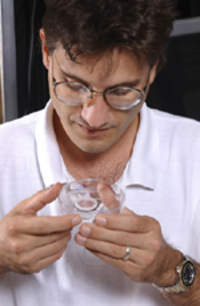
Rat “Brain” Flies “Plane”

BraindishthumExcerpts:

Somewhere in Florida, 25,000 disembodied rat neurons are thinking about flying an F-22.

These neurons are growing on top of a multi-electrode array and form a living “brain” that’s hooked up to a flight simulator on a desktop computer. When information on the simulated aircraft’s horizontal and vertical movements are fed into the brain by stimulating the electrodes, the neurons fire away in patterns that are then used to control its “body” — the simulated aircraft.

Currently the brain has learned enough to be able to control the pitch and roll of the simulated F-22 fighter jet in weather conditions ranging from blue skies to hurricane-force winds. Initially the aircraft drifted, because the brain hadn’t figured out how to control its “body,” but over time the neurons learned to stabilize the aircraft to a straight, level flight.

“Right now the process it’s learning is very simplistic,” said DeMarse. “It’s basically making a decision about whether to move the stick to the left or to the right or forwards and backwards and it learns how much to push the stick depending upon how badly the aircraft is flying.”

The bigger goal is to figure out how neurons talk to each other. MRI scans, for example, show millions of neurons firing together. At that resolution, it is impossible to see what’s happening between individual neurons. While scientists can study neural activities from groups of cells in a dish, they can’t watch them learn and grow as they would within a living body unless the neurons have some kind of body to interact with.

By taking these cells and giving them back a “body,” the researchers hope to uncover how the neurons communicate with each other and eventually translate that knowledge to develop novel computing architecture.

GET THE STORY FROM WIRED.

MORE FROM THE UNIVERSITY OF FLORIDA.

And this just in from UNIVERSE TODAY:

In related news, EarthForce defense contractors announced project aimed at creating a powerful “shadow” warship using a human being as its central processing unit.

“We’re very excited about the new shadow ship,” said Gen. Wink Tinkley of EarthForce. “Using a human being as the CPU means a lot more computing than a simulated rat brain has. The only problem we’ve found is that telepaths can interfere with the human’s neural connection with the ship.”

EarthForce contractors also announced the creation of an even more ambitious program which will allow a detachable human as a ship’s CPU. When perfect, this pilot program will allow humans who pilot such ships–known as “pilots”–to live normal lives by being extracted from their ships at the end of missions.

Rat "Brain" Flies "Plane"

BraindishthumExcerpts:

Somewhere in Florida, 25,000 disembodied rat neurons are thinking about flying an F-22.

These neurons are growing on top of a multi-electrode array and form a living “brain” that’s hooked up to a flight simulator on a desktop computer. When information on the simulated aircraft’s horizontal and vertical movements are fed into the brain by stimulating the electrodes, the neurons fire away in patterns that are then used to control its “body” — the simulated aircraft.

Currently the brain has learned enough to be able to control the pitch and roll of the simulated F-22 fighter jet in weather conditions ranging from blue skies to hurricane-force winds. Initially the aircraft drifted, because the brain hadn’t figured out how to control its “body,” but over time the neurons learned to stabilize the aircraft to a straight, level flight.

“Right now the process it’s learning is very simplistic,” said DeMarse. “It’s basically making a decision about whether to move the stick to the left or to the right or forwards and backwards and it learns how much to push the stick depending upon how badly the aircraft is flying.”

The bigger goal is to figure out how neurons talk to each other. MRI scans, for example, show millions of neurons firing together. At that resolution, it is impossible to see what’s happening between individual neurons. While scientists can study neural activities from groups of cells in a dish, they can’t watch them learn and grow as they would within a living body unless the neurons have some kind of body to interact with.

By taking these cells and giving them back a “body,” the researchers hope to uncover how the neurons communicate with each other and eventually translate that knowledge to develop novel computing architecture.

GET THE STORY FROM WIRED.

MORE FROM THE UNIVERSITY OF FLORIDA.

And this just in from UNIVERSE TODAY:

In related news, EarthForce defense contractors announced project aimed at creating a powerful “shadow” warship using a human being as its central processing unit.

“We’re very excited about the new shadow ship,” said Gen. Wink Tinkley of EarthForce. “Using a human being as the CPU means a lot more computing than a simulated rat brain has. The only problem we’ve found is that telepaths can interfere with the human’s neural connection with the ship.”

EarthForce contractors also announced the creation of an even more ambitious program which will allow a detachable human as a ship’s CPU. When perfect, this pilot program will allow humans who pilot such ships–known as “pilots”–to live normal lives by being extracted from their ships at the end of missions.

Media Updates

A friendly reader posted a link to where my appearances on Family News In Focus responding to Sen. Kerry’s speech involving religion can be found:

IT’S HERE. (.wax format; works with Windows Media Player; my segment starts a little after 3:30 minutes into the broadcast)

I also was able to find a link to my appearance on California NRP talking about stem cells:

IT’S HERE. (.asx format; works with Windows Media Player; my segment starts about 20 minutes into the hour)

This morning I’m sheduled to appear on XETV FOX channel 6 (the local San Diego FOX station) to talk about stem cells again. I should be on about 7:15 a.m., though the segment should be short.

MORE INFO ON CALIFORNIA’S PRO-STEM CELL PROP 71 HERE.

If it gets passed in this state, it will create competition among other states to fund similar initiatives, lest they get left behind in a “stem cell race.”

Escatology Update

A reader points out to me that . . . .

ANDREW SULLIVAN PRINTS AN E-MAIL CALLING INTO QUESTION THE LITERALNESS OF LUTHER’S STATEMENT THAT HE HAD HIS PROFOUND, REFORMATIONAL INSIGHT IN CLOACA.

(POTTY-MOUTH WARNING!)

Don’t know whether this is true or not, but it might be.

I also should point out something I forgot to mention the other day: The stories you read about Luther posting the 95 Theses on a church door may well be false.

More On Mentalese

Regarding our recent discussion of deafness and mentalese, a reader writes:

But what about deaf people who don’t know sign language? I recently read an article that claimed a surprising number of deaf people don’t know sign language, or at least don’t know it very well, especially deaf children who grow up with parents who have normal hearing. So how do they think? Or what about deaf people in remote areas who never encounter sign language? They are obviously thinking somehow but what form do the thoughts take?

If a person were totally deprived of language–both spoken, gestural, and anything else one might propose–then the person would have no option but to think in pure mentalese.

That being said, it isn’t clear to me how common completely language-less people are. I question whether they even exist. The language instinct is so strong in humans that the accounts I have read indicate that even deaf people not exposed to a formal sign languages come up with informal signs.

Recently I was reading an account of a deaf man from Mexico who was never exposed to formal signing. This gentleman not only was able to get across the border with the United States, he was able to survive in the Los Angeles area. When he was discovered, he did not know any established language, including sign languages. An effort was made to teach him a sign language, and soon he “made the breakthrough.” Afterwards, he not only was able to describe his prior experience, he also was able to lead those working with him to other non-signing deaf individuals, who were more common than had been known.

These individuals had a network amongst themselves that had previously escaped notice. Despite their lack of conventional language, they had found ways to communicate with each other and often entertained each others with elaborate pantomimes describing their experiences.

This suggests that the language instinct in humans is so strong that even in the absence of exposure to a formal language, they will come up with an informal one.

This suggests that even these individuals may not think in pure mentalese but might have an accompanying “translation” of their thoughts into the informal gestural methods of communication they invent.

It would be fascinating to have better data on this, however.

Escatology Update

A reader points out to me that . . . .

ANDREW SULLIVAN PRINTS AN E-MAIL CALLING INTO QUESTION THE LITERALNESS OF LUTHER’S STATEMENT THAT HE HAD HIS PROFOUND, REFORMATIONAL INSIGHT IN CLOACA.

(POTTY-MOUTH WARNING!)

Don’t know whether this is true or not, but it might be.

I also should point out something I forgot to mention the other day: The stories you read about Luther posting the 95 Theses on a church door may well be false.

Lunar Eclipse Tonight!

LunareclipseThere’s going to be a total eclipse of the moon tonight, and North America has the best seat in the house for it.

You may be able to catch the eclipse on FOX, as it will occur during the World Series game that FOX is broadcasting.

For full viewing instructions, including when totality will occur in your timezone, as well as background on what a lunar eclipse is, etc., GO HERE.

For those in the continental US, totality (which lasts less than 5 min.) will occur at 7:18 Pacific, 8:18 Mountain, 9:18 Central, and 10:18 Eastern.

Enjoy!

P.S. Unlike an eclipse of the sun, you can look directly at an eclipse of the moon!

Compendium Question

A reader writes:

Can you give us some guidance on your blog regarding the new Compendium [of the Church’s social teachings] that came out this week?

How do we answer critics who say that it elevates lesser social issues to a position on par with pro-life issues?

I am very reluctant to comment on a text without having the chance to examine it firsthand. This is why I haven’t commented on the Comendium thus far. For an unknown reason, it doesn’t seem to have yet been posted online, and although I put in a request to have a hardcopy shipped to us extra-expedited, it hasn’t yet arrived (probably will arrive late this week or early next), and I’ll be in a better position to comment at that time.

Despite this, the question that you pose is one that I can comment on at least briefly, as follows:

It would be almost inconceivable, given the stress that the Holy See has placed on abortion and related pro-life questions (euthanasia, embryonic stem cells, etc.), that the text would elevate lesser social issues to the point that they are on the same level as these.

Basically, people who are saying that it does this (a) are commenting on the text without having read it themselves and (b) commenting on it in a particularly brain-dead way, as it would be completely contrary to the way that Rome has been speaking about the relative gravity of these issues.

HERE’S A STORY THAT ALSO MAY BE USEFUL.

AND HERE’S ANOTHER.