. . . in telling y’all about my trip to the Salton Sea. Other things took priority, so I won’t be able to blog about that today. Sorry.
Author: Jimmy Akin
Jimmy was born in Texas, grew up nominally Protestant, but at age 20 experienced a profound conversion to Christ. Planning on becoming a Protestant seminary professor, he started an intensive study of the Bible. But the more he immersed himself in Scripture the more he found to support the Catholic faith, and in 1992 he entered the Catholic Church. His conversion story, "A Triumph and a Tragedy," is published in Surprised by Truth. Besides being an author, Jimmy is the Senior Apologist at Catholic Answers, a contributing editor to Catholic Answers Magazine, and a weekly guest on "Catholic Answers Live."
This Is Still Just Rumor But . . .
Catholic World News is reporting that B16 has approved the document from the Congregation for Catholic Education barring the ordination of homosexuals.
EXCERPTS:
The new document– which was prepared by the Congregation for Catholic Education, in response to a request made by the late Pope John Paul II in 1994– will be published soon. It will take the form of an "Instruction," signed by the prefect and secretary of the Congregation: Cardinal Zenon Grocholewski and Archbishop Michael Miller.
The text, which was approved by Pope Benedict at the end of August, says that homosexual men should not be admitted to seminaries even if they are celibate, because their condition suggests a serious personality disorder which detracts from their ability to serve as ministers.
Priests who have already been ordained, if they suffer from homosexual impulses, are strongly urged to renew their dedication to chastity, and a manner of life appropriate to the priesthood.
Informed sources in Rome indicate that the Instruction probably will be made public after the Synod of Bishops, which meets in Rome from October 2 through 23.
GET THE STORY.
(CHT to the reader who e-mailed.)
One thing I’d be careful about with the story: It says that John XXIII approved a policy to the same effect and that it remains in force. This appears to be inaccurate. There was such a policy approved for religious priests (as opposed to diocesan ones) during John XXIII’s reign, but (a) it was not a policy for all priests and (b) it may well not be in effect at this point due to changes in Church law, which has been extensively renovated since that time.
This is a minor point, though, and should not detract from the heartening newsrumor that B16 has given his approval to the document.
We May Have Just Dodged A Bullet
EXCERPTS:
MEMPHIS, Tenn. – A university student from Egypt was ordered held without bond after prosecutors said they found a pilot’s uniform, chart of Memphis International Airport and a DVD titled "How an Airline Captain Should Look and Act" in his apartment.
Maawad, who is in the United States illegally, told the judge during a hearing Thursday that he is studying science and economics at the University of Memphis.
"My school is everything. I stay in this country for seven years; I stay for the school," he said.
Maawad had ordered $3,000 in aviation materials, including DVDs titled "Ups and Downs of Takeoffs and Landings," "Airplane Talk," "Mental Math for Pilots" and "Mastering GPS Flying," FBI agent Thad Gulczynski testified.
The company reported Maawad to authorities when he didn’t pay for $2,500 of merchandise it had delivered, Gulczynski said.
Two Ceremonies?
A reader writes:
A friend of mine is getting married and his fiance wants very much to have a protestant marriage ceremony (she herself is mildly protestant and her father is a minister in a protestant denomination). Can my friend and his fiance have a Catholic wedding ceremony IN ADDITION TO the protestant one?
No, canon law specifically prohibits this:
Canon 1127 §3.
It is forbidden to have another religious
celebration of the same marriage to give or renew matrimonial consent before or
after the canonical celebration according to the norm of §1 [i.e., the Catholic wedding]. Likewise, there is
not to be a religious celebration in which the Catholic who is assisting and a
non-Catholic minister together, using their own rites, ask for the consent of
the parties.
The parties therefore need to decide whether they want to have a Catholic wedding OR obtain a dispensation from form so that they can have a Protestant wedding. They can’t do both.
This is not to say that ministers from both religious communities can’t play a role in the wedding. If they have a Catholic wedding the then Protstant minister can be invited to participate and visa versa. The Norms for Ecumenism provide:
157. With the previous authorisation of the local Ordinary, and if invited to do so, a Catholic priest or deacon may attend or participate in some way in the celebration of mixed marriages, in situations where the dispensation from canonical form has been granted. In these cases, there may be only one ceremony in which the presiding person receives the marriage vows. At the invitation of this celebrant, the Catholic priest or deacon may offer other appropriate prayers, read from the Scriptures, give a brief exhortation and bless the couple.
158. Upon request of the couple, the local Ordinary may permit the Catholic priest to invite the minister of the party of the other Church or ecclesial Community to participate in the celebration of the marriage, to read from the Scriptures, give a brief exhortation and bless the couple.
Mystery Photo
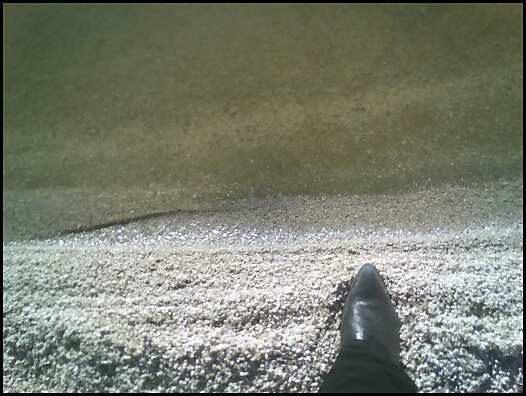
What’s this?
Okay, it’s a picture of my foot.
But where specifically is my foot (generalizations don’t count) and why did I go there?
Therein lies a tale.
More tomorrow.
Dressed To Kill
EXCERPTS:
An Australian man built up a 40,000-volt charge of static electricity in his clothes as he walked, leaving a trail of scorched carpet and molten plastic and forcing firefighters to evacuate a building.
Frank Clewer, who was wearing a woolen shirt and a synthetic nylon jacket, was oblivious to the growing electrical current that was building up as his clothes rubbed together.
When he walked into a building in the country town of Warrnambool in the southern state of Victoria Thursday, the electrical charge ignited the carpet.
"It sounded almost like a firecracker," Clewer told Australian radio Friday.
"Within about five minutes, the carpet started to erupt."
"We tested his clothes with a static electricity field meter and measured a current of 40,000 volts, which is one step shy of spontaneous combustion, where his clothes would have self-ignited," Barton said.
"I’ve been firefighting for over 35 years and I’ve never come across anything like this," he said.
:-) :-(
Today, September 19, back in 1982, the emoticons 🙂 and 🙁 were first proposed.
This Illusion Is Not Here
And now . . . !
The AMAZING DISAPPEARING OPTICAL ILLUSION!
Keep your eyes fixed on the Plus Sign in the center of the illusion.
You will see a green dot that ISN’T THERE sweeping around the circle of pink dots.
Then you will see the pink dots that ARE THERE totally . . . DISAPPEAR!
Do it right and you can get them ALL to disappear!
GET STARTED STARING!
YEE-HAW!

NOTE FOR THE COLORBLIND: Your mileage may vary. Sorry. 🙁
Speaking At A Protestant Chapel
A reader writes:
I am a fauclty member at a private college associated with a Protestant church. I’m a convert to the Catholic Church.
There is a chapel service two days a week here and the opportunity has come up for me to speak at this service. Am I allowed to speak at a service like this?
Yes. Canon law does not prevent you from speaking if you are invited to do so.
If so is what are my obligations with regard to what I reveal to the assembled people?
You must not say anything contrary to the Catholic faith. Within that constraint, you should seek to deliver the kind of talk that your hosts expect. (E.g., if you are asked to speak on a particular topic or Scripture passage, you should do so.)
In addition, to the extent you can (without endangering your ability to make a living, for example) you should seek to introduce them to aspects of the truth (the Catholic faith) that they may not have considered. This may involve revealing the fact that you are a Catholic or it may not.
If you perceive that the topic you are asked to speak on could draw you into areas that would be problematic (e.g., if you couldn’t talk about the topic without getting into a subject that would cause you to lose your job) then you could ask for a different topic, a different day (i.e., one with a different planned topic), or simply decline the invitation to speak.
That’s about the best I can do with the limited information at hand (I don’t know, for example, whether people at the college would freak out upon learning that you are Catholic and demand your resignation or firing; that’s been known to happen at some Protestant schools, even when the administration is initially supportive of Catholic faculty members). The bottom line is: Do what good you can and be prudent as you do so.
Or as Our Lord put it: "Be wise as serpents and innocent as doves" (Matt. 10:16).
Priest Interrupting Mass
A reader writes:
Please, please clarify for me. There is a priest who celebrates mass in our area who has been known to stop saying the mass until small children have been quietened down. Is this correct to do so?
It depends. If the kids are screaming bloody murder so that nobody in the congregation can hear him then a brief pause would be in order. On the other hand, if they aren’t being that loud then he should do the best he can to carry on until the children can be quieted down or taken outside or to the cry room. He should not dramatically halt the Mass at the first sign of a child outburst, as if to shame the parents. But if the kids are carrying on so loudly that he can’t be heard then it would not be out of place to pause.
I was always under the impression that once the liturgical act of the mass had begun the priest was obliged to continue, regardless of the interruption.
No, the priest can pause the celebration for a reasonable cause (e.g., an airplane going over) or even stop it entirely in cases of grave necessity (e.g., an earthquake causes the church to nearly collapse; gunmen burst into the sanctuary, as happened over at a parish in Pakistan a few years ago).
This same priest has also used the pulpit for a personal rant at certain people in the congregation on a subject that is completely irrelevant to the gospel and epistle – is this also acceptable?
Not as you’ve describe it. Priests shouldn’t be doing personal rants at all from the pulpit. The homily is not the priest’s personal rant time.
However, if the pastor is aware of important pastoral situations that the congregation as a whole needs to be warned about then it is legitimate for him to address them from the pulpit even if the pastoral problem does not occur at a time that makes it possible to link it to the readings. In doing such things, however, he should phrase himself so as to minimize embarrassment to particular members of the congregation to the greatest extent possible.
I would really appreciate your advice on this.
Beyond the above, I don’t know how much advice I have to give. If you’re one of the priest’s best buds (which it doesn’t sound like) then you could more easily and gently offer him advice or constructive criticism than if you only know him more distantly.
If you aren’t close to him, the best thing is likely to be to grit your teeth and bear it, praying for him when he acts up or you get annoyed at the thought of him doing so.
If you do talk to him, putting things to him–as gently as humanly possible–in terms of how his behavior makes you and others feel is probably the best way to go.
After all, you don’t want a rant directed against you next Sunday. (Though if there is one, it’s time to talk to the bishop.)